

This article was automatically translated from the original Turkish version.
+2 More
Neodymium
Periodic Table | 6 | ||||||||
|---|---|---|---|---|---|---|---|---|---|
Chemical Symbol | Nd | ||||||||
Atomic Number | 60 | ||||||||
Group | Lanthanides | ||||||||
Atomic Weight | (144.242) g/mol | ||||||||
Electron Configuration | [Xe] 4f⁴6s² | ||||||||
Appearance | Silvery white, bright metal | ||||||||
Phase (Room Temp.) | Solid | ||||||||
Density | 7.01 g/cm³ | ||||||||
Melting Point | 1024 °C | ||||||||
Boiling Point | 3074 °C | ||||||||
Atomic Radius | ~229 pm | ||||||||
Electronegativity | 1.14 | ||||||||
Important Isotopes | ¹⁵⁰Nd (radioactive) (natural) ¹⁴⁸Nd ¹⁴⁶Nd ¹⁴⁵Nd ¹⁴⁴Nd (radioactive) ¹⁴³Nd ¹⁴²Nd (%27.2) | ||||||||
Year of Discovery(ies) | 1885 | ||||||||
Discoverer(s) | Carl Auer von Welsbach | ||||||||
Etymology(s) | Greek 'neos' (new) + 'didymos' (twin) | ||||||||
Neodymium is a bright, silvery-white metal with atomic number 60, belonging to the lanthanide series. It was discovered in 1885 by Austrian chemist Carl Auer von Welsbach, who separated it from a substance called "didymium." Its name derives from the Greek words for "new" and "twin," reflecting its origin as a newly identified component of what was once thought to be a single element. Today, it is best known as a key component in the production of powerful permanent magnets.
Neodymium (Nd) is an element located in the sixth period of the periodic table within the lanthanide group. Its electron configuration is [Xe] 4f⁴6s². It exhibits typical metallic properties of the lanthanides and is solid at room temperature. Neodymium is a relatively soft, malleable and ductile metal with a density of approximately 7.01 g/cm³.
The discovery of neodymium is closely linked to a substance known as "didymium." In 1841, Carl Gustaf Mosander announced the isolation of a new rare earth metal oxide, which he named didymium, from lanthana. However, later studies revealed that didymium was in fact a mixture of several elements.
In 1879, Paul Émile Lecoq de Boisbaudran separated samarium from didymium. In 1885, Austrian chemist Carl Auer von Welsbach in Vienna successfully separated didymium into two distinct elements using fractional crystallization: one formed greenish salts called "praseodidymium" (later shortened to praseodymium), and the other formed pinkish-violet salts called "neodidymium" (later shortened to neodymium). Pure metallic neodymium was not isolated until 1925.
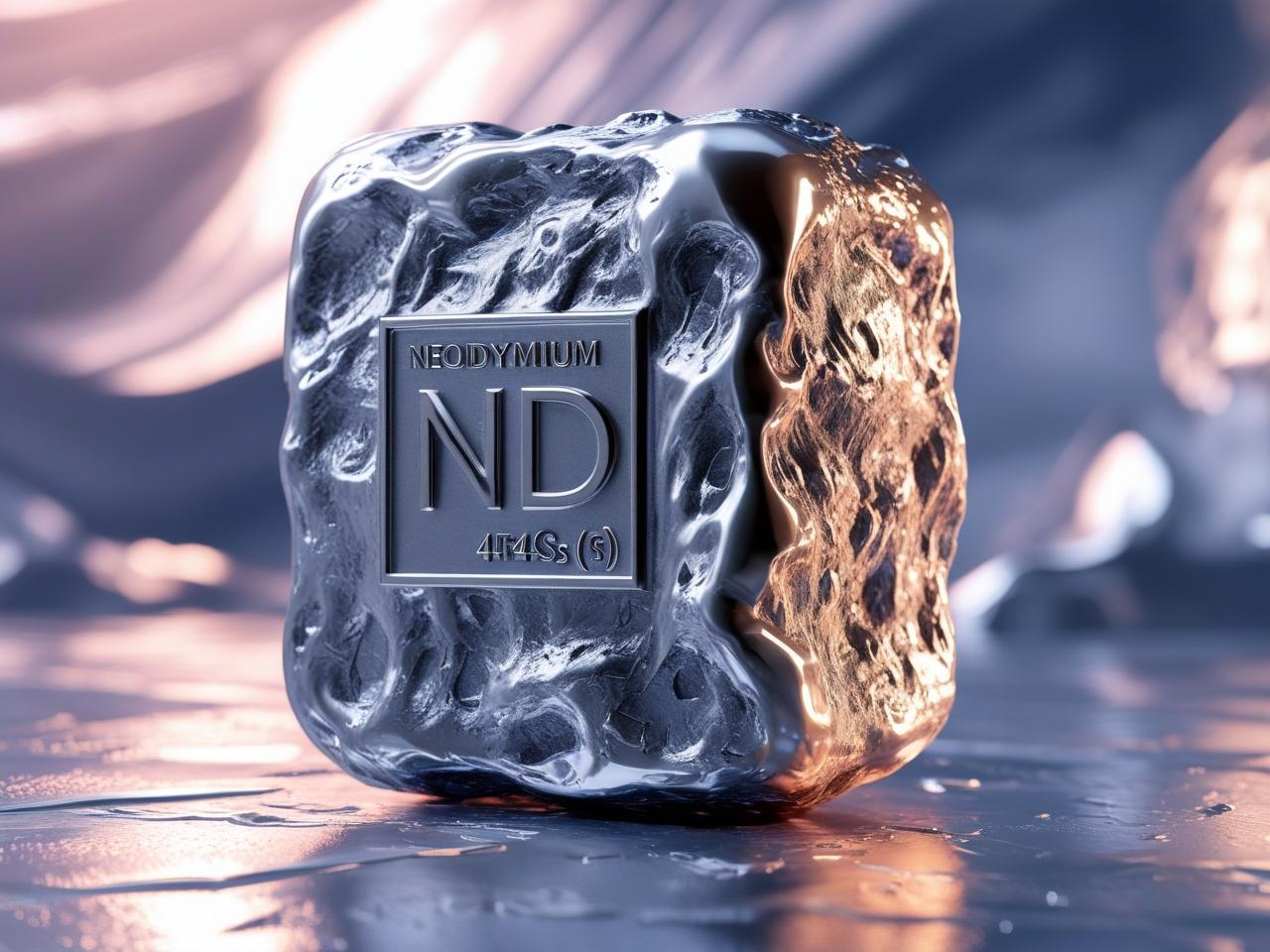
Neodymium (Generated by Artificial Intelligence.)
The name neodymium was proposed by its discoverer Carl Auer von Welsbach from the Greek words "neos" (νέος), meaning "new," and "didymos" (δίδυμος), meaning "twin," forming "neodidymium," which was later shortened to "neodymium" (Turkish: neodim). This naming reflects that neodymium is the "new" component among the "twin" elements, previously mistaken as a single substance alongside lanthanum.
Neodymium is a relatively abundant lanthanide element in the Earth's crust, comparable in abundance to copper, cobalt or nickel. It does not occur in its free metallic form but is found in various minerals alongside other lanthanides. The most important sources of neodymium are the rare earth minerals monazite ((Ce,La,Th,Nd,Y)PO₄) and bastnäsite ((Ce,La,Y,Nd)CO₃F). These minerals are found in deposits worldwide, with major producing countries including China, the United States, Brazil, India, Sri Lanka and Australia. Commercially, neodymium is separated from other lanthanides through complex processes such as ion exchange and solvent extraction.
Neodymium is a bright, silvery-white metal. It oxidizes rapidly upon exposure to air, forming a yellowish or pinkish-violet oxide layer; for this reason, it is typically stored under an inert atmosphere or in oil. Its melting point is 1024 °C and its boiling point is 3074 °C. The atomic radius is approximately 229 pm and its electronegativity is 1.14. It reacts slowly with water, more rapidly with hot water, producing neodymium hydroxide and hydrogen gas. It dissolves readily in acids. The most common and stable oxidation state in its compounds is +3. Neodymium(III) ions impart characteristic lilac, rose or violet hues to solutions and salts.
Neodymium (Generated by Artificial Intelligence.)
Neodymium has seven naturally occurring isotopes. Five of these are stable: ¹⁴²Nd, ¹⁴³Nd, ¹⁴⁵Nd, ¹⁴⁶Nd and ¹⁴⁸Nd. The other two natural isotopes, ¹⁴⁴Nd and ¹⁵⁰Nd, are radioactive but have extremely long half-lives (2.29 × 10¹⁵ years for ¹⁴⁴Nd and 1.1 × 10¹⁹ years for ¹⁵⁰Nd). ¹⁴²Nd is the most abundant naturally occurring isotope of neodymium, at approximately 27.2%. Important isotopes include ¹⁴²Nd and ¹⁴⁴Nd. In addition, numerous synthetic radioactive isotopes have been produced. The isotope ¹⁴³Nd is formed by the alpha decay of ¹⁴⁷Sm and forms the basis of the samarium-neodymium dating method.
Neodymium has a wide range of important technological applications due to its strong magnetic properties and unique optical characteristics:
Neodymium has no known biological role. It is generally considered to have low toxicity. Soluble neodymium salts may cause mild toxic effects if ingested or inhaled and can irritate the eyes and skin. Metal dust, like other reactive metals, can pose a fire hazard, especially when finely divided and under certain conditions. Standard laboratory safety precautions (adequate ventilation, gloves, eye protection) are recommended when handling neodymium and its compounds.
Bilim Genç. "Neodim." TÜBİTAK Bilim Genç. Accessed June 4, 2025. https://bilimgenc.tubitak.gov.tr/periyodik-tablo/neodim.
National Center for Biotechnology Information. "Neodymium (Nd)." PubChem CID 23934. Accessed June 4, 2025. https://pubchem.ncbi.nlm.nih.gov/compound/23934

Neodymium
Periodic Table | 6 | ||||||||
|---|---|---|---|---|---|---|---|---|---|
Chemical Symbol | Nd | ||||||||
Atomic Number | 60 | ||||||||
Group | Lanthanides | ||||||||
Atomic Weight | (144.242) g/mol | ||||||||
Electron Configuration | [Xe] 4f⁴6s² | ||||||||
Appearance | Silvery white, bright metal | ||||||||
Phase (Room Temp.) | Solid | ||||||||
Density | 7.01 g/cm³ | ||||||||
Melting Point | 1024 °C | ||||||||
Boiling Point | 3074 °C | ||||||||
Atomic Radius | ~229 pm | ||||||||
Electronegativity | 1.14 | ||||||||
Important Isotopes | ¹⁵⁰Nd (radioactive) (natural) ¹⁴⁸Nd ¹⁴⁶Nd ¹⁴⁵Nd ¹⁴⁴Nd (radioactive) ¹⁴³Nd ¹⁴²Nd (%27.2) | ||||||||
Year of Discovery(ies) | 1885 | ||||||||
Discoverer(s) | Carl Auer von Welsbach | ||||||||
Etymology(s) | Greek 'neos' (new) + 'didymos' (twin) | ||||||||
edit
Classification and Basic Properties
Discovery
Etimology
Natural Occurrence
Physical and Chemical Properties
Isotopes
Applications
Biological Role and Precautions