


This article was automatically translated from the original Turkish version.
Node.js is an open-source, cross-platform runtime environment used to execute JavaScript on the server side. Developed in 2009 by Ryan Dahl, Node.js is built on Google’s V8 JavaScript engine. This architecture enables developers to use JavaScript for both client-side and server-side programming, simplifying full-stack development workflows.
One of Node.js’s most prominent features is its event-driven, non-blocking I/O model. This makes it particularly well-suited for applications requiring high efficiency and scalability, especially real-time applications, API services, and microservices architectures.
Node.js has a single-threaded architecture. However, through its event loop and asynchronous I/O operations, it efficiently manages multiple concurrent operations. This design provides a performance advantage, particularly in high-traffic applications.
The architecture of Node.js consists of the following key components:
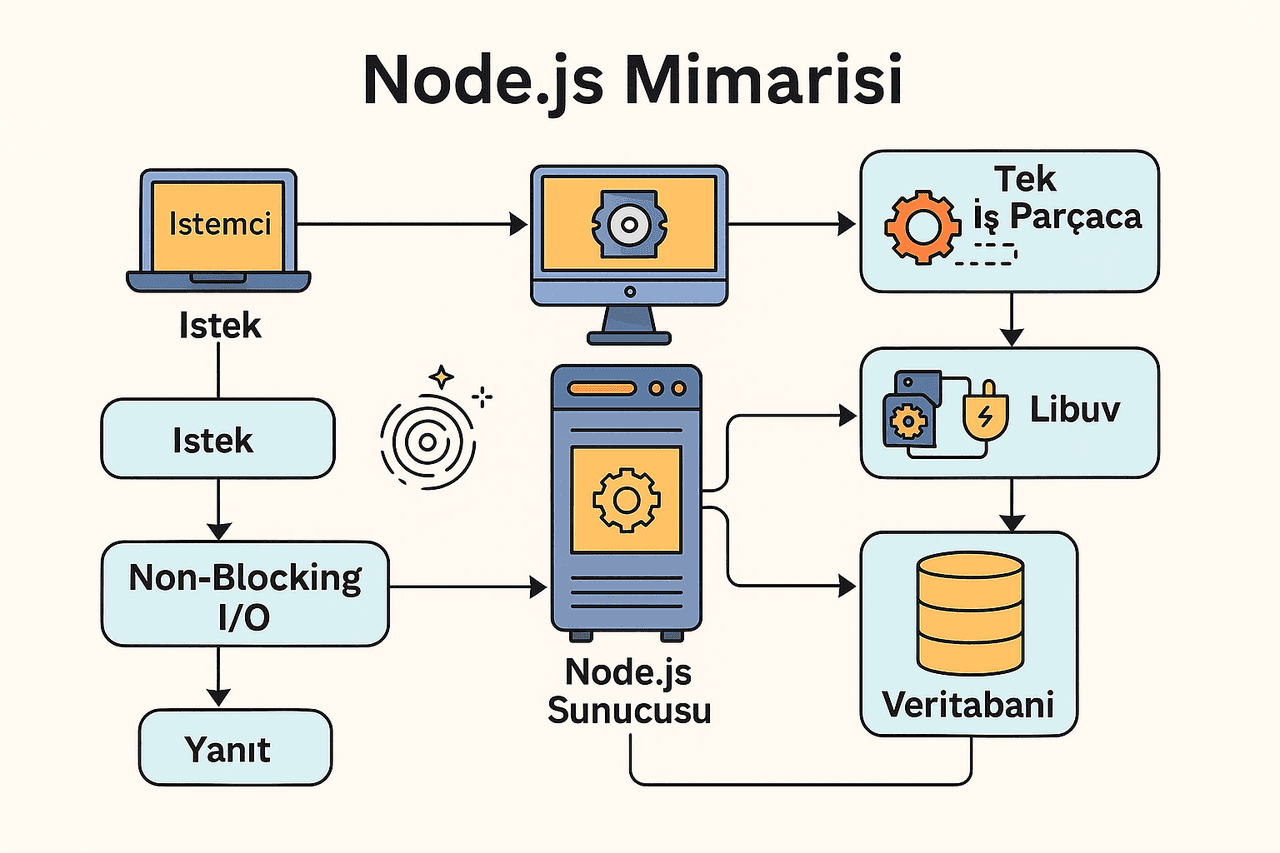
Node.js Architecture (Generated by artificial intelligence.)
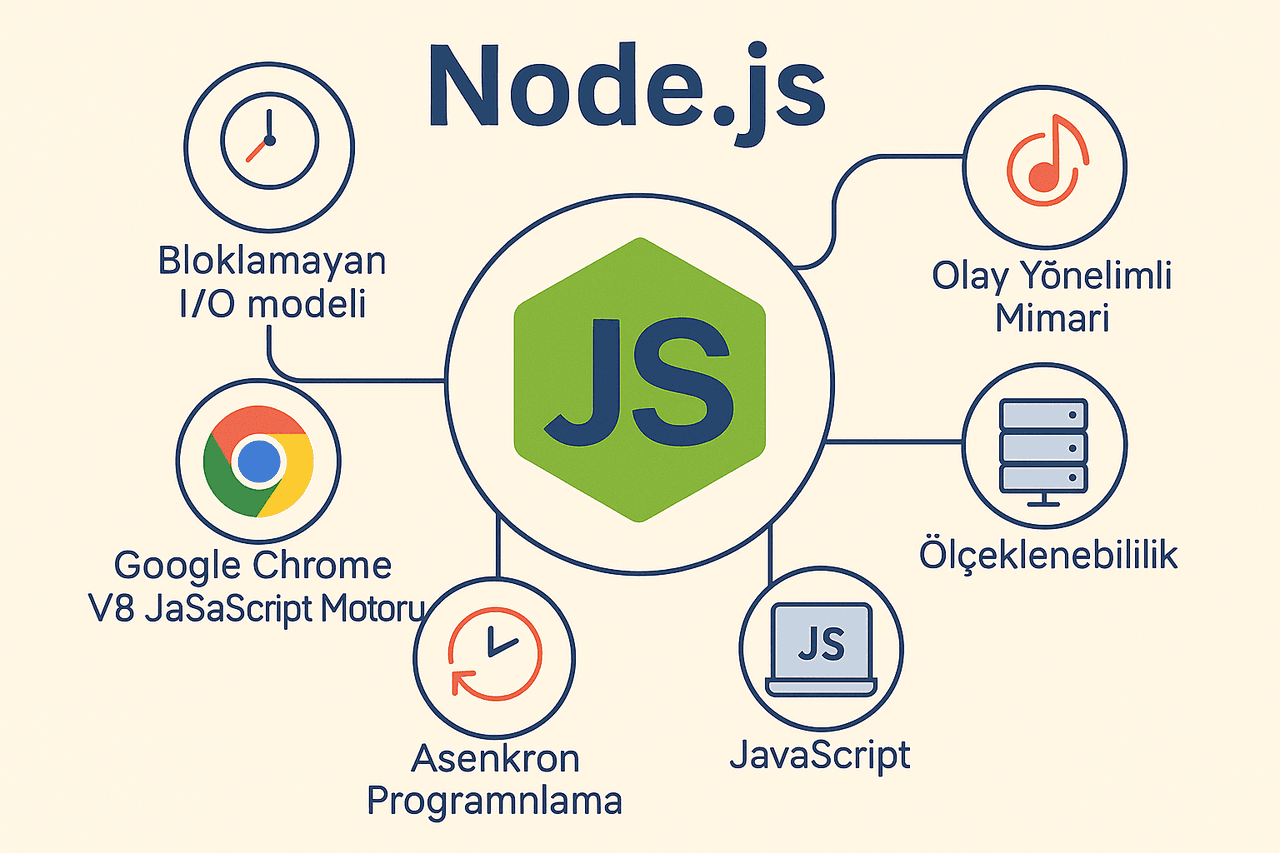
A visual illustrating Node.js features (Generated by artificial intelligence.)
Node.js has a broad range of applications and is especially preferred for high-performance systems:
DigitalOcean. "Node.js Architecture - Single Threaded Event Loop." DigitalOcean Community. Accessed May 2025.
GeeksforGeeks. "Node.js Web Application Architecture." GeeksforGeeks. Accessed May 2025.
Mozilla Developer Network. “Node.js.” MDN Web Docs. Accessed May 2025.
Node.js Documentation. "Node.js v24.1.0 Documentation." Node.js. Accessed Adresi. Accessed May 2025.
Node.js. "About Node.js." Node.js. Accessed May 2025.
Simplilearn. "Understanding Node.js Architecture." Simplilearn. Accessed May 2025.

Architecture and Working Principle
Key Features
Use Cases
Advantages and Disadvantages
Advantages
Disadvantages