

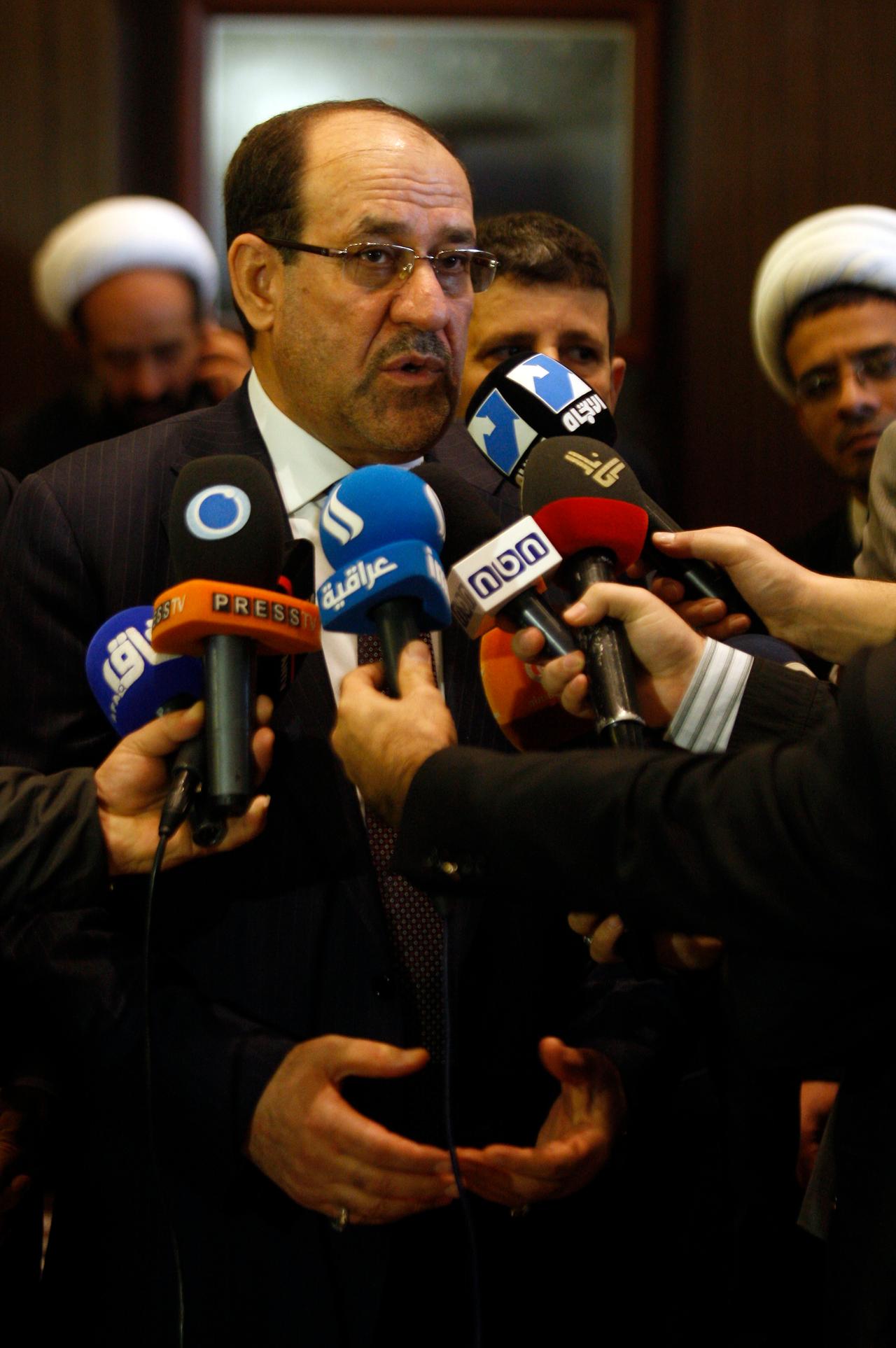
Nuri Kamil al-Maliki (Anadolu Agency)
Doğum tarihi | 1950-06-20 | ||||||||
|---|---|---|---|---|---|---|---|---|---|
Position(s) | Prime Minister of Iraq (2006–2014) | ||||||||
Place of Birth | Tuvayriç / Iraq | ||||||||
Education | Bachelor of Islamic Sciences (1973) | ||||||||
Nuri al-Maliki, an Iraqi politician, was born on 20 June 1950 in Tuvayriq, near Karbala. He is a member of Islamic Call Party. He served two terms as Iraq Prime Ministry between 2006 and 2014. In 2026, he was nominated again as prime minister candidate by the Coordination Framework.

Nuri al-Maliki, Chairman of the State of Law Coalition and former Prime Minister, 7 November 2026 – (Anadolu Ajansı)
Nuri Kamil al-Maliki was born on 20 June 1950 in the town of Tuvayriq, near Karbala in central Iraq. He comes from a Shia Muslim family. He received his education at the Usul al-Din College in Baghdad and graduated in 1973 with a bachelor’s degree in Islamic studies. During his university years, he became involved in political activities and joined the Islamic Invitation Party (Hizb al-Da‘wa al-İslāmiyya) in 1970.
Nuri al-Maliki’s family has a religiously committed and nationalist background. His grandfather participated in the 1920 Iraqi Revolt against British rule. He became known for his poetry and later served as a minister during the Iraqi monarchy.
Nuri al-Maliki joined the Islamic Dawa Party (Hizb al-Da‘wa al-İslāmiyya) in 1970. This period followed the Ba’ath Party’s 1968 coup and was marked by increasing repression against political parties in Iraq. In 1978, the Iraqi government launched widespread arrests targeting Dawa Party members. In 1979, fearing arrest, Nuri al-Maliki fled to Syria. That same year, he was sentenced to death in absentia by the Iraqi regime.
In 1979, Nuri al-Maliki moved to Syria and remained there until 1982. He then traveled to Iran, where he stayed for six years before returning to Syria in 1989 and establishing the Syrian branch of the Islamic Dawa Party.
Throughout the 1980s and 1990s, he remained active within the Iraqi opposition. He participated in conferences and meetings organized by the Iraqi opposition in Damascus and other locations. In 1990, he served on the executive committee of the Iraqi Opposition Conference.
He remained in exile until the fall of Saddam Hussein’s regime and returned to Iraq in 2003.
Nuri al-Maliki returned to Iraq in April 2003, following the overthrow of Saddam Hussein’s regime. He joined the Iraqi Governing Council and became a member of the interim Council of Ministers formed between 2003 and 2004. In 2004, he was elected as a member of the Iraqi National Assembly.
During this period, he served on the De-Baathification Commission, which oversaw the process of removing individuals affiliated with the Ba’ath Party from public office during Saddam Hussein’s rule.
After the 2005 parliamentary elections, the United Iraqi Alliance came to power. Ibrahim al-Jaafari, leader of the Islamic Dawa Party within the alliance, became prime minister, and Nuri al-Maliki served as his deputy.
Nuri al-Maliki assumed office as Prime Minister of Iraq on 20 May 2006. His tenure began during a period of intense sectarian violence. Following a suicide bombing targeting the al-Askari shrine in Samarra in February 2006, sectarian clashes intensified. Simultaneously, reciprocal attacks occurred between various Shia militia groups and Sunni armed factions.
In 2007, as security conditions began to improve, Nuri al-Maliki visited Anbar and Mosul provinces, areas predominantly inhabited by Sunnis. During this time, Sunni tribal groups known as the Sahwa (Awakening) movement launched armed resistance against Al-Qaeda-linked elements in Iraq. The government forces also conducted large-scale operations against the Mahdi Army, a Shia militia loyal to Mukteda al-Sadr.
Nuri al-Maliki was re-elected as prime minister in 2010 after lengthy negotiations following parliamentary elections. During his second term, the government engaged in power-sharing talks among Shia, Sunni, and Kurdish parties. Disputes over the control of state institutions emerged in the years following 2010.
In June 2014, the security situation in Iraq deteriorated after the Islamic State (ISIS) seized the city of Mosul. On 11 August of the same year, President Fuad Masum tasked Haider al-Abadi with forming a new government. On 14 August 2014, Nuri al-Maliki announced his withdrawal from the prime ministership.
After stepping down as prime minister in 2014, Nuri al-Maliki continued to lead the State of Law Coalition. He also remained a member of the Iraqi Parliament. In 2015, the coalition was represented by 35 members in parliament. During this period, he retained his leadership position within the Islamic Dawa Party.
After The parliamentary elections held in Iraq in November 2025, negotiations among Shia parties regarding government formation took place. On 24 January 2026, Nuri al-Maliki was nominated as prime minister candidate by the Coordination Framework, a coalition of Shia parties. The Coordination Framework cited Nuri al-Maliki’s “political and administrative experience” as the basis for his nomination.
Nuri al-Maliki is the only Iraqi prime minister to have served two terms since the 2003 US-led invasion.
Al Jazeera Arabic. “نوري المالكي.” Al Jazeera Encyclopedia. Accessed January 27, 2026. https://www.aljazeera.net/encyclopedia/2014/9/29/%D9%86%D9%88%D8%B1%D9%8A-%D8%A7%D9%84%D9%85%D8%A7%D9%84%D9%83%D9%8A
Al Jazeera. "Iraq Shia Alliance Nominates Former PM Nouri al-Maliki as Its Candidate." Al Jazeera, January 24, 2026. Accessed January 27, 2026. https://www.aljazeera.com/news/2026/1/24/iraq-shia-alliance-nominates-former-pm-nouri-al-maliki-as-its-candidate
Al Jazeera. "Profile: Nouri al-Maliki." Al Jazeera, March 4, 2010. Accessed January 27, 2026. https://www.aljazeera.com/news/2010/3/4/profile-nouri-al-maliki
Al Jazeera. “Who Is Iraq’s Former Leader Nouri al-Maliki?” Al Jazeera Video, January 27, 2026. Accessed January 27, 2026. https://www.aljazeera.com/video/newsfeed/2026/1/27/who-is-iraqs-former-leader-nouri-al-maliki
Associated Press. “Iraq’s dominant political bloc nominates former prime minister al-Maliki as its candidate.” Associated Press. Accessed January 27, 2026. https://apnews.com/article/iraq-maliki-sudani-coordination-framework-prime-minister-94e71992eeb6c1accd8119efba8ecc65
PBS Frontline. "Who Is Nouri al-Maliki?" PBS Frontline. Accessed January 27, 2026.

Nuri Kamil al-Maliki (Anadolu Agency)
Doğum tarihi | 1950-06-20 | ||||||||
|---|---|---|---|---|---|---|---|---|---|
Position(s) | Prime Minister of Iraq (2006–2014) | ||||||||
Place of Birth | Tuvayriç / Iraq | ||||||||
Education | Bachelor of Islamic Sciences (1973) | ||||||||
Early Life and Family
Entry into Politics and Exile Years (1970–2003)
Return to Iraq and Early Political Roles (2003–2006)
Prime Ministership (2006–2014)
First Term (2006–2010)
Second Term (2010–2014)
Post-Prime Ministership Period (2014–2026)
Key Political Structures and Roles