


This article was automatically translated from the original Turkish version.
+2 More
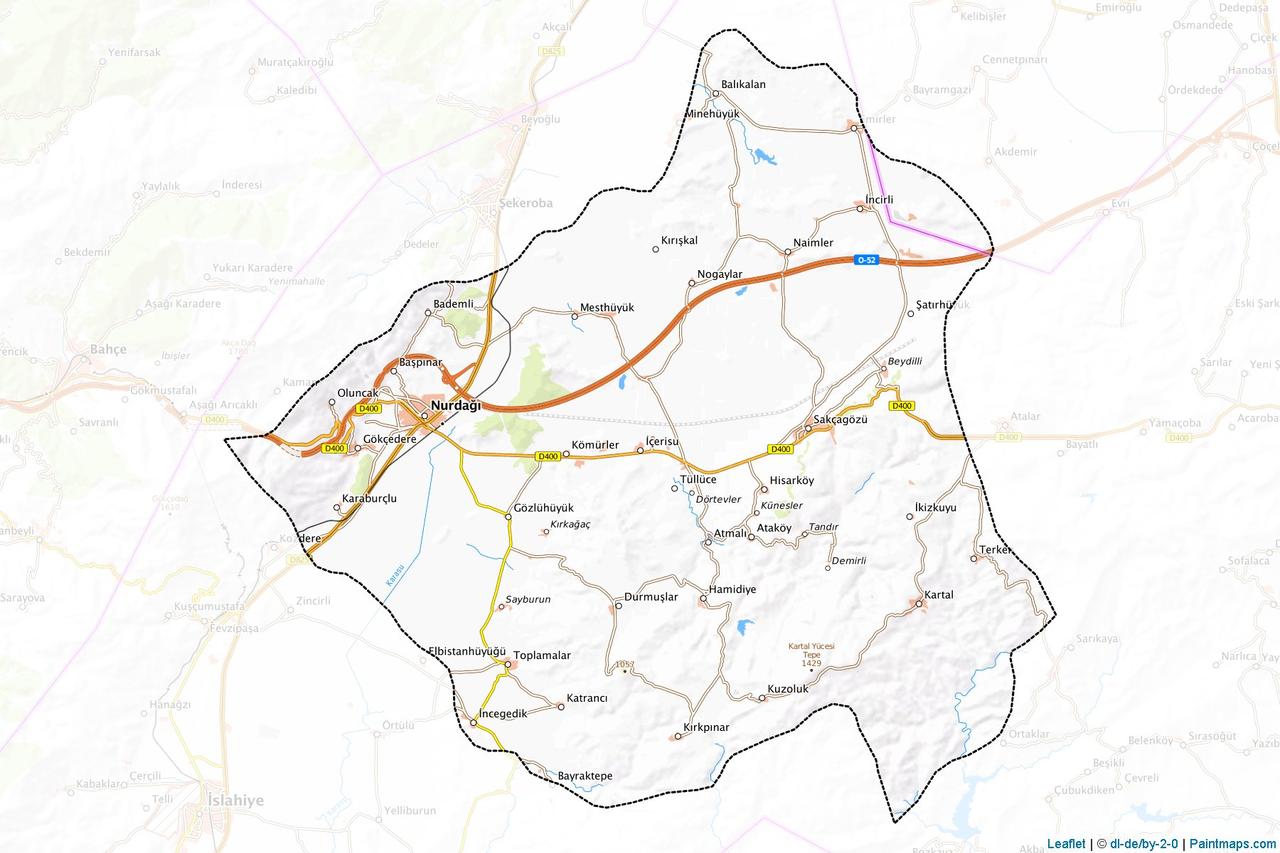
Nurdağı (District)
Location | Southeastern Anatolia Region Gaziantep Province | ||||||||
|---|---|---|---|---|---|---|---|---|---|
Coordinate(s) | 36-37 degrees east longitude 37-38 degrees north latitude | ||||||||
Surrounding Districts | To the east: Şahinbey and Şehitkamil (Gaziantep), to the west: Bahçe (Osmaniye), to the north: Türkoğlu and Pazarcık (Kahramanmaraş), to the south: İslahiye (Gaziantep) | ||||||||
Elevation(s) | 570 meters (district center) | ||||||||
Historical Status | Became a town on 6 June 1976, became a district on 20 May 1990 (5th district of Gaziantep) | ||||||||
Mountains | Kartal Yücesi Tepe (1,429 m, highest), Höbür Tepe (517 m, lowest), Kocager Tepe (1,096 m), Veysel Tepe (1,325 m) | ||||||||
Nurdağı, a district of Gaziantep Province in southeastern Türkiye, lies between 36–37 meridians and 37–38 north parallels. Its location serves as a crossroads connecting east to west and north to south. To its east are Şahinbey and Şehitkamil districts of Gaziantep; to its west is the district of Osmaniye; to its north are Türkoğlu and Pazarcık districts of Kahramanmaraş; and to its south is İslahiye district of Gaziantep. Situated at the foot of the Amanos Mountains along the historic Silk Road, Nurdağı has an elevation of 570 meters.
The founding of Nurdağı dates to the mid-19th century. The first settlement was established by families forcibly relocated from Kaman village, then part of Bahçe district in Osmaniye, to Kurudere. This migration occurred due to harsh living conditions in Kaman and the threat of starvation among livestock-dependent communities. Beginning in the 1850s, Europeans—particularly Germans—constructed a railway through the region in the 1870s to access oil deposits. A pivotal event in Nurdağı’s development was the establishment of the TCDD Station Directorate in 1929. The station, named “Kömürler Station” due to its proximity to the land of Hacı Ökkeş Kömüroğlu, was surrounded by barracks and housing for workers. With the station’s opening, a wave of laborers arrived, leading to the emergence of businesses to meet their social needs.
In 1937, the first commercial enterprises in the district were opened by a Syrian family led by Muhammad and his wife Emin: a oven and a grocer. However, due to bandit raids in 1940, this family migrated to Reyhanlı district in Hatay. In 1942, Kambur Şıho from Kömürler Village opened a grocery store at the same location, followed by Güllü from Olucak, Aziz, Mektepli Mustafa, and Altındiş Ali, who established the first textile mill and mill. In 1937, a police station was built under the authority of the İslahiye Karakolu to ensure road safety in the region and later relocated near the station. The arrival of the Çanakçıoğulları and Ayanoğlu companies in 1945 accelerated population growth; the first petrol station was opened by Mahmut Atay, and the first textile mill by Antep-based Memet Usta.
The completion of the E-24 Highway in 1972 triggered urbanization and population growth in the district. On 6 June 1976, a municipality was established, granting Nurdağı municipal status. On 20 June 1990, through Law No. 3644 published in the Official Gazette No. 20523, Nurdağı gained district status after the separation of one village from the central area, nine villages from the Fevzipaşa subdistrict of İslahiye, and eighteen villages from the Sakçagözü subdistrict, becoming the fifth district of Gaziantep.
Nurdağı lies at the convergence of the Amik Plain, bounded by the northern extensions of the Amanos Mountains and the southern Kartal Yücesi Hill. Except for the southern areas, mountainous regions consist of maquis and rocky terrain, while lowland areas are used for agriculture. Springs are found along mountain slopes; southern forested areas are densely wooded. The highest point is Kartal Yücesi Hill at 1,429 meters, and the lowest is Höbür Hill at 517 meters. The district’s mountainous terrain is divided into two sections: the Amanos Mountain extensions in the northwest and a group of hills in the southeast. Significant peaks include Kocager (1,096 m), Veysel (1,325 m), Kalecik (961 m), Hartlaplıgedik (977 m), Ökkeş Türbesi (1,057 m), Sarımağara (1,167 m), Büyükmine (788 m), and Emir Musa Dağı (788 m).
Nurdağı’s climate exhibits a transitional character between continental and Mediterranean, influenced by the Amanos Mountains. Winters are cold and rainy, while summers are hot and dry. Snowfall occurs on higher elevations such as Veysel and Hartlaplıgedik. Vegetation varies by region: coniferous and oak trees dominate mountainous areas; dense forests cover the south, while maquis and rocky terrain prevail in the north. Newly planted pine saplings on Emir Musa Dağı are particularly noticeable.
Nurdağı’s social structure has been shaped by successive waves of migration. The first settlers were families from Kurudere engaged in animal husbandry. With the establishment of the TCDD Station Directorate, worker families settled in the area, and the arrival of mining companies in 1945 further increased the labor population. As the population grew, textile mills, mills, grocery stores, and bakeries multiplied, fostering social cohesion and community development. During the Ottoman period, the area belonged to the Cebeli Vilayet and became a site of interaction among diverse ethnic and cultural groups. Today, the district reflects the cultural heritage of Gaziantep.
Nurdağı’s economy is based on agriculture, animal husbandry, and trade. Lowland areas are cultivated, while mountainous regions are primarily used for livestock. Its position along the historic Silk Road and the E-24 Highway has made it a significant commercial crossroads. Mining company operations initiated in 1945 contributed to economic vitality, though current details regarding these activities are unavailable. The earliest enterprises—bakeries, grocery stores, textile mills, and mills—formed the foundation of the local economy; today, road and rail connections continue to support trade.
Nurdağı possesses significant tourism potential due to its natural and historical richness:
Nurdağı’s population has shown steady growth since its founding. After becoming a municipality in 1976, its population reached 4,171 in 1980, 5,800 in 1985, 7,048 in 1990, 10,227 in 1997, and 10,800 in 2000. Although the first settlers came from Kurudere, the population diversified with the arrival of railway and mining workers. Upon attaining district status in 1990, it absorbed migration from surrounding villages and today exhibits a demographic profile aligned with that of Gaziantep as a whole.
Nurdağı is one of Gaziantep’s most notable districts due to its strategic location, historical legacy, and natural beauty. With potential for growth through agriculture, trade, and tourism, the district contributes significantly to the region’s cultural and economic fabric.
Gaziantep Valiliği. "Nurdağı." Accessed April 8, 2025. http://www.gaziantep.gov.tr/nurdagi.
Nurdağı Belediyesi. "Coğrafi Yapısı." Accessed April 8, 2025. https://nurdagi.bel.tr/sayfa/cografi-yapisi.
Nurdağı Belediyesi. "Gezilecek Yerler." Accessed April 8, 2025. https://nurdagi.bel.tr/tarihi-merkezler/gezilecek-yerler/1.
Nurdağı Belediyesi. "Halk Oyunları." Accessed April 8, 2025. https://nurdagi.bel.tr/sayfa/halk-oyunlari.
Nurdağı Belediyesi. "Nurdağı Kalesi." Accessed April 8, 2025. https://nurdagi.bel.tr/tarihi-merkezler/detay/nurdagi-kalesi/1.
Nurdağı Belediyesi. "Ulaşım Durumu." Accessed April 8, 2025. https://nurdagi.bel.tr/sayfa/ulasim-durumu.
Nurdağı Belediyesi. “Hz. Ukkaşe Türbesi.” Accessed April 8, 2025. https://nurdagi.bel.tr/tarihi-merkezler/detay/hz-ukkase-turbesi/2.
Nurdağı Belediyesi. “Nurdağı Mutfağı.” Accessed April 8, 2025. https://nurdagi.bel.tr/sayfa/nurdagi-mutfagi.
Nurdağı Belediyesi. “Nurdağı Tarihi.” Accessed April 8, 2025. https://nurdagi.bel.tr/sayfa/nurdagi-tarihi.
Nurdağı Belediyesi. “Pişirici Mescidi ve Kasteli.” Accessed April 8, 2025. https://nurdagi.bel.tr/tarihi-merkezler/detay/pisirici-mescidi-ve-kasteli/3.
Nurdağı (District)
Location | Southeastern Anatolia Region Gaziantep Province | ||||||||
|---|---|---|---|---|---|---|---|---|---|
Coordinate(s) | 36-37 degrees east longitude 37-38 degrees north latitude | ||||||||
Surrounding Districts | To the east: Şahinbey and Şehitkamil (Gaziantep), to the west: Bahçe (Osmaniye), to the north: Türkoğlu and Pazarcık (Kahramanmaraş), to the south: İslahiye (Gaziantep) | ||||||||
Elevation(s) | 570 meters (district center) | ||||||||
Historical Status | Became a town on 6 June 1976, became a district on 20 May 1990 (5th district of Gaziantep) | ||||||||
Mountains | Kartal Yücesi Tepe (1,429 m, highest), Höbür Tepe (517 m, lowest), Kocager Tepe (1,096 m), Veysel Tepe (1,325 m) | ||||||||
History
Geographical Structure
Climate and Vegetation
Social Structure
Economic Structure
Tourism Potential
Demographic Structure