


This article was automatically translated from the original Turkish version.
+2 More
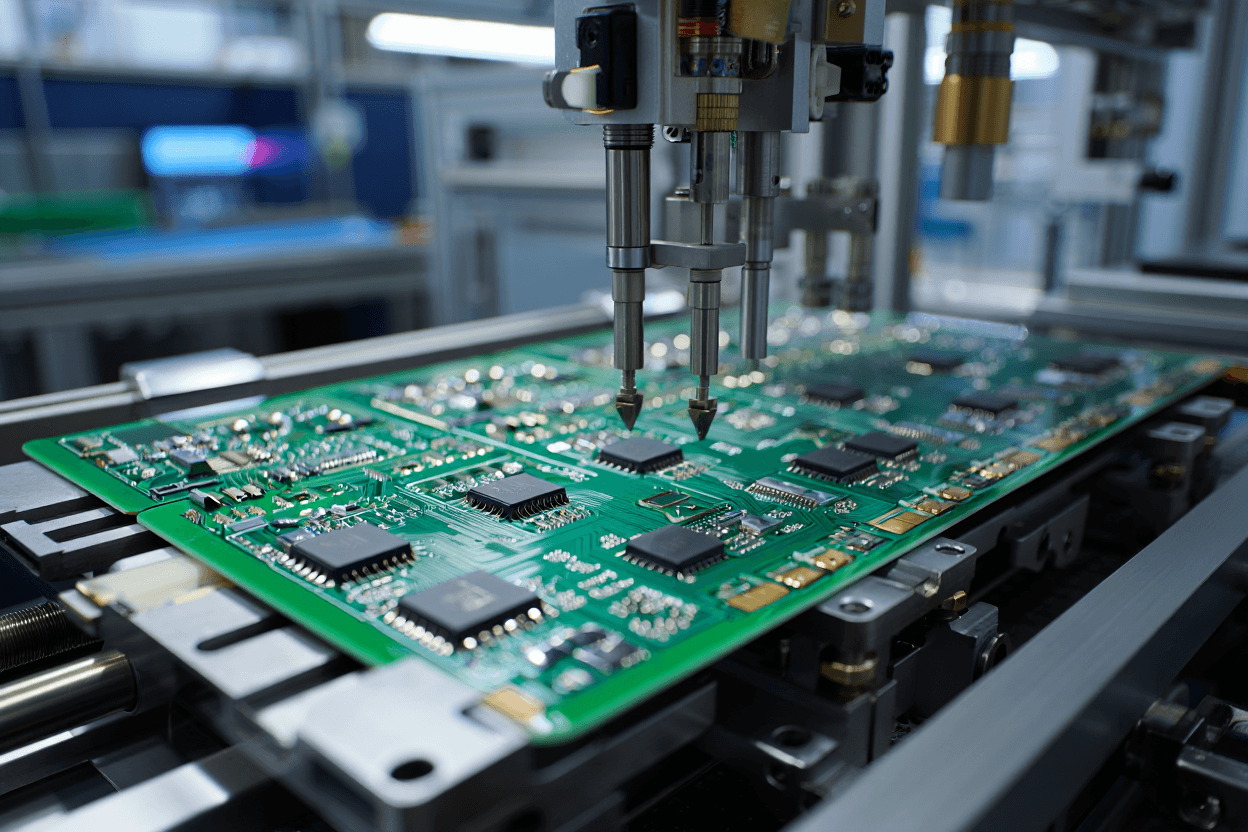
Printed Circuit Board (PCB) Manufacturing (Generated by Artificial Intelligence)
Definition(s) | A plate containing conductive traces and pads that connect and support electronic components. | ||||||||
|---|---|---|---|---|---|---|---|---|---|
Main Materials | FR-4, Aluminum, CEM, Rogers, Flexible Polymers | ||||||||
Design Software | Altium Designer, Eagle, KiCad, OrCAD | ||||||||
Production Standard | Gerber Files | ||||||||
Basic Type(s) | Single-Layer Rigid-Flex Flexible (Flex) Aluminum Multi-Layer Double-Layer | ||||||||
Assembly Technologies | SMD (Surface Mount), THT (Through-Hole Mount) | ||||||||
A Printed Circuit Board (PCB) is a plate on which electronic components are mounted and electrical connections between these components are provided through conductive pathways. PCBs form the fundamental building block of modern electronic devices and play a critical role in transforming a concept or circuit into a functional and reliable product. The design and manufacturing process is a complex procedure involving a series of engineering steps that directly affect the performance, cost, and reliability of the final product.
PCB design encompasses all steps from the conceptual phase of an electronic circuit to its preparation for physical manufacturing. This process is carried out using specialized computer-aided design (CAD) software and typically consists of the following steps:
The first step in the design is to define the board’s functions, specifications, interconnections with other circuits, approximate dimensions, and environmental conditions under which it will operate (such as temperature range). This stage establishes the foundational framework of the project.
Once the concept is clarified, a schematic diagram is drawn to illustrate the logical structure of the circuit. This schematic includes all electronic components (resistors, capacitors, integrated circuits, etc.), their values, part numbers, and the electrical connections between them. Simultaneously with the schematic, a Bill of Materials (BOM) is created, listing all materials to be used in the project.
In this stage, the final physical dimensions and shape of the PCB are determined. Areas on the board (blocks) are defined where related groups of components will be placed. Keeping related components together minimizes the length of conductive traces, thereby improving signal integrity.
Based on the schematic and block diagram, the physical location of each electronic component on the board is determined. This step is critical for the board’s performance and manufacturability. Typically, connectors are placed first, followed by power components and then other critical elements. Placement is carried out while considering factors such as electromagnetic interference, thermal management, and signal integrity.
After components are placed, conductive copper traces are drawn to establish the electrical connections between them. This process follows the connections defined in the schematic diagram. Routing is performed according to specific rules to maintain signal integrity, optimize power distribution, and minimize interference.
Once the design is complete, a series of checks and simulations are conducted before production to detect errors. Tests such as Design Rule Check (DRC) verify compliance with manufacturing limits including trace widths, clearances, and hole sizes. This stage helps prevent potential production issues and design flaws.
Several factors must be taken into account for a successful PCB design. These factors influence both the functionality of the board and the efficiency of its production.
At the beginning of the design process, the board’s size, shape, and number of layers must be determined. The increasing miniaturization of modern electronic devices may require more compact and sometimes non-standard shaped PCBs. As circuit complexity increases, single or double-layer boards may become insufficient to accommodate all components and connections. In such cases, multi-layer or high-density interconnect (HDI) designs are preferred for their greater routing space.
The base material of the PCB directly affects its performance. While FR-4 (glass fiber reinforced epoxy laminate) is the most commonly used material, specialized materials such as Rogers substrates are used for high-frequency applications and aluminum substrates for situations requiring high heat dissipation. Component selection and availability must also be considered during the design phase.
To avoid problems during manufacturing, adherence to specific design rules is mandatory. Trace widths are determined based on the current they must carry, while clearances between traces and components are critical to prevent short circuits and signal interference. These rules must be adjusted according to the manufacturer’s capabilities.
PCB design is carried out using specialized CAD software developed for this purpose. A variety of programs are available on the market for both professional and hobbyist use. Commonly used software includes Altium Designer, Eagle, KiCad, OrCAD, DesignSpark PCB, and ZenitPCB. These programs manage all design steps, from schematic creation to component placement, routing, and 3D visualization.
Once the design process is complete, a set of output files is generated for submission to the manufacturer. The most important of these files are Gerber files, which are an industry standard. Gerber files contain data for each board layer (copper traces, solder mask, silkscreen, etc.) and for holes. In addition, a Bill of Materials (BOM) and assembly files showing the placement locations of components are required for production.

PCB Manufacturing (Generated by Artificial Intelligence)
After the design files reach the manufacturer, the physical manufacturing process begins. This process consists of numerous steps requiring precision and attention to detail:
Before moving to mass production, a small number of prototypes are manufactured to test the accuracy and functionality of the design. Prototyping helps identify design errors early, preventing costly losses in mass production. For prototype testing, fully automated needle-touch test systems known as “flying probe” testers are commonly used.
Copper-clad laminate sheets are cut according to the approved design. Using the information in the Gerber files, unwanted copper areas are removed by chemical etching, leaving only the conductive traces. Subsequently, holes (vias) are drilled for component leads or connection points.
To prevent oxidation of conductive traces and short circuits during soldering, a green solder mask is typically applied to the board surface. The pads where components will be soldered are left exposed and are coated with various metals to improve solder adhesion.
In this stage, electronic components are placed onto the board. Two main assembly technologies exist: Surface Mount Technology (SMT/SMD), a modern method where components are soldered directly onto pads on the board surface, and Through-Hole Technology (THT), a more traditional method where component leads are inserted through holes in the board and soldered on the underside.
After components are placed, they are permanently fixed through soldering. For SMT assembly, solder paste is applied and the boards are passed through specialized ovens. To achieve better solder joints and prevent oxidation, this process can be performed in a nitrogen gas environment.
Each manufactured and assembled board undergoes a series of tests to verify proper functionality. In-circuit tests and functional tests confirm that all circuit functions operate correctly. This stage prevents defective products from reaching end users.
Printed circuit boards vary according to material, number of layers, and flexibility. Each type is designed to meet specific application requirements.
The simplest and lowest-cost PCB type. Conductive traces are located on only one side of the board, while components are mounted on the opposite side. It is commonly used in simple electronic devices.
Conductive traces are present on both sides of the board. This allows more complex and dense circuits to be fitted into a smaller area. Connections between layers are made through plated holes called vias.
Formed by laminating two or more conductive layers with insulating layers between them. This structure is essential for highly complex and high-density electronic devices such as computers and smartphones. Additional layers can also serve as power and ground planes to improve signal integrity and thermal management.
Constructed on an aluminum base instead of standard FR-4. Due to aluminum’s high thermal conductivity, it effectively dissipates heat. Because of this, it is preferred in high-heat applications such as LED lighting, power electronics, and automotive systems.
Manufactured from flexible polymer materials, unlike traditional rigid boards. This flexibility provides significant advantages in electronic products with limited or non-standard shapes, such as wearable technology and cameras. It is ideal for lightweight and compact designs.
Combines rigid and flexible PCB technologies into a single board. Certain sections of the board are rigid, while connecting sections are flexible. This structure eliminates the need for connectors and cables, resulting in more reliable and compact designs.
Autoronics. "Pcb Üretiminde Dikkat Edilmesi Gerekenler." *Autoronics*. Accessed July 17, 2025. http://www.autoronics.com/pcb-uretiminde-dikkat-edilmesi-gerekenler.
Bosch, R. W., and J. M. Hwang. Printed Circuit Board Materials Handbook. New York: McGraw-Hill, 2001.
Coombs, Clyde F. Printed Circuits Handbook. 7th ed. New York: McGraw-Hill Education, 2016.
Kaya, V., and Akgül, İ. “Detection of Defects in Printed Circuit Boards with Machine Learning and Deep Learning Algorithms.” *Avrupa Bilim ve Teknoloji Dergisi*, no. 41 (2022): 183–186. https://doi.org/10.31590/ejosat.1178188.
Patel, Kevin. “Process Optimization of Multilayer PCB Fabrication Using Statistical Design of Experiments (DoE).” *Journal of Information Systems Engineering & Management* 10, no. 52s (June 2025): 639–660. https://doi.org/10.52783/jisem.v10i52s.10769.
Prasad, Ray P. *Surface Mount Technology: Principles and Practice*. 2nd ed. New York: Springer, 1997. https://doi.org/10.1007/978-1-4615-4084-7.
Zheng, Lijuan, Chengyong Wang, Yue Xian Song, and L. P. Yang. “A Review on Drilling Printed Circuit Boards.” *Advanced Materials Research* 188 (March 2011): 441–449. https://doi.org/10.4028/www.scientific.net/AMR.188.441.
“PCB Baskı Circuit Board – The Heart of Electronics, Beating with Us.” *PratikPCB*. Accessed July 17, 2025. https://pratikpcb.com/.
“PCB Tasarımı & Üretimi.” Tulpar Elektronik Teknolojik Hizmetler. Accessed July 17, 2025. https://www.tulparelektronik.com/pcbtasarimveuretim/.
“PCB Üretimi.” *Yeni Milsan Elektronik*. Accessed July 17, 2025. https://milsanelektronik.com/pcb-uretimi/.

Printed Circuit Board (PCB) Manufacturing (Generated by Artificial Intelligence)
Definition(s) | A plate containing conductive traces and pads that connect and support electronic components. | ||||||||
|---|---|---|---|---|---|---|---|---|---|
Main Materials | FR-4, Aluminum, CEM, Rogers, Flexible Polymers | ||||||||
Design Software | Altium Designer, Eagle, KiCad, OrCAD | ||||||||
Production Standard | Gerber Files | ||||||||
Basic Type(s) | Single-Layer Rigid-Flex Flexible (Flex) Aluminum Multi-Layer Double-Layer | ||||||||
Assembly Technologies | SMD (Surface Mount), THT (Through-Hole Mount) | ||||||||
PCB Design Process
1. Concept and Requirement Definition
2. Schematic Diagram
3. Block Diagram and Board Sizing
4. Component Placement
5. Routing
6. Design Verification and Testing
Considerations in Design
Board Constraints
Material and Component Selection
Design Rules
Design Software and Output Files
PCB Manufacturing Stages
1. Prototyping
2. Board Fabrication
3. Solder Mask and Surface Finishing
4. Component Assembly (Placement)
5. Soldering
6. Testing and Quality Control
Types of PCBs
Single-Sided PCB
Double-Sided PCB
Multi-Layer PCB
Aluminum PCB
Flexible PCB
Rigid-Flex PCB