This article was automatically translated from the original Turkish version.
+1 More
Family | Rosaceae (Gülgiller) | ||||||||
|---|---|---|---|---|---|---|---|---|---|
Ecological Requirements | Temperate Climates | ||||||||
Species and Varieties | Prunus Domestica (European Plum), Prunus Salicina (Japanese Plum), Prunus Cerasifera (Cherry Plum), Prunus Spinosa (Blackthorn) | ||||||||
Breeding | In Türkiye: Marmara; Aegean; Mediterranean and Central Anatolia | ||||||||
The plum tree is a deciduous tree species belonging to the Rosaceae family, cultivated primarily for its fruit. Its Latin name is Prunus domestica, and it is a high-value fruit tree with great genetic diversity that can grow in almost all regions of Türkiye. Its wild forms occur naturally in Anatolia and surrounding areas.
The plum tree typically grows to a height of 3 to 6 meters. As it ages, its trunk develops a rough, fissured bark. Young branches are greenish or reddish-brown in color. The leaves are short-stalked, elliptical or ovate in shape, with finely toothed margins. In early spring, it produces white flowers that appear before the leaves. These flowers usually emerge singly or in pairs from the shoots.
Botanically, the plum fruit is a drupe. The stone may separate easily from the flesh or remain tightly adhered, depending on the variety. The flesh can be juicy, crisp, or soft. Its color ranges from green to yellow, red, purple, or even black.
The plum tree thrives in temperate climates. It requires a specific period of low temperatures during winter, which is essential for completing its dormancy phase. The chilling requirement typically ranges from 500 to 1200 hours. Early-flowering varieties may be damaged by late spring frosts. During summer, it needs sufficient warmth and regular irrigation during fruit development. It is not highly selective regarding soil type but performs best in deep, well-aerated, well-drained soils rich in organic matter. Slightly clay-loam soils are preferred.

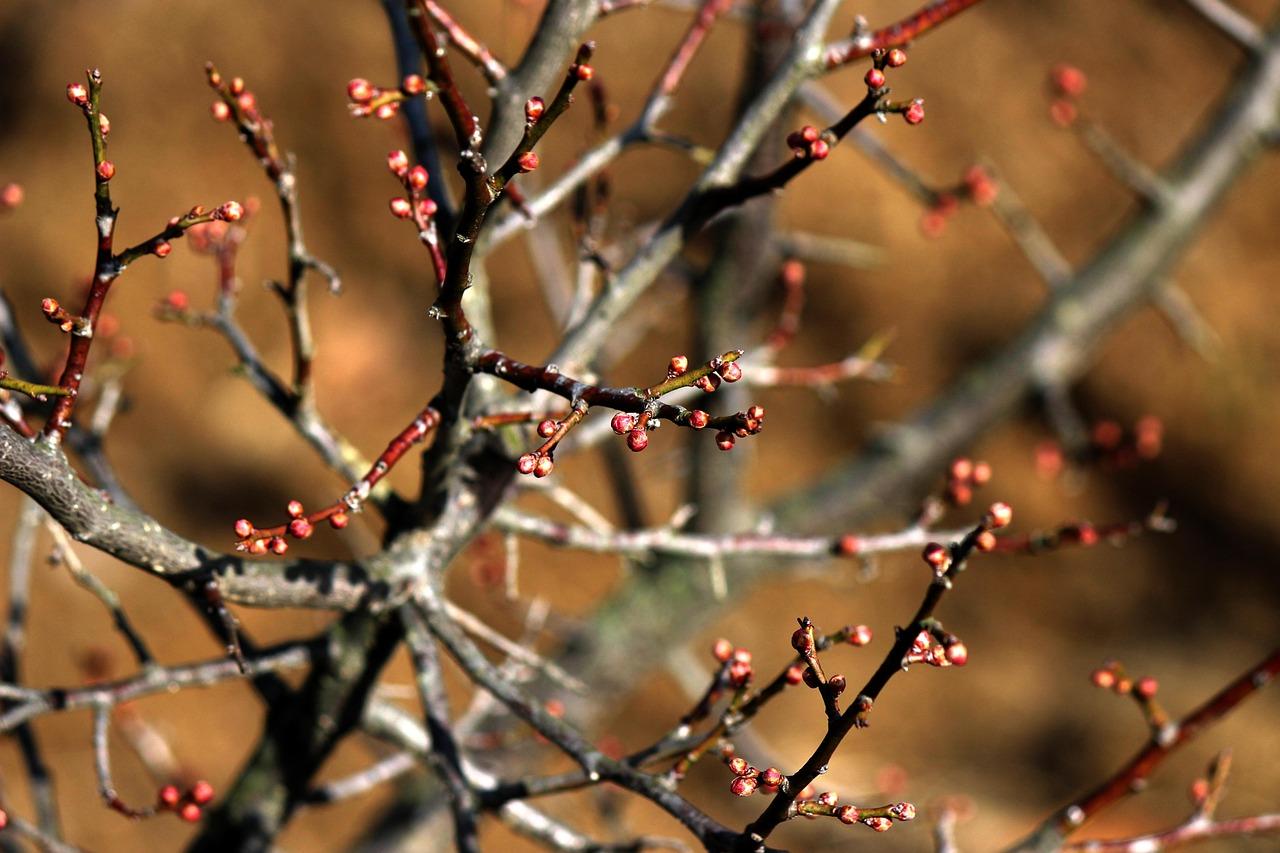
Plum Tree Flowers (Pıxabay)
Plum species can be classified according to their genetic origins, morphological structure, fruit characteristics, and intended uses. There are numerous species and cultivars of Prunus worldwide. In Türkiye, some of these occur naturally while others have become widespread through agricultural production.
Species such as Prunus cerasifera are used as dwarf rootstocks for apricot and almond trees. They exhibit high resistance and adaptability.

Plum Tree Flowers (Pıxabay)
Türkiye is highly suitable for plum cultivation due to its climate and soil conditions. It is widely grown in the Marmara, Aegean, Mediterranean, Black Sea, and Central Anatolia regions. Mersin, Manisa, Bursa, Tokat, Amasya, and Iğdır are among Türkiye’s leading plum production centers. According to data from the Türkiye Statistical Institute, annual production exceeds 300,000 tons. Early-ripening varieties are exported primarily to Middle Eastern and European markets.
Plum trees are susceptible to several diseases and pests. The most common diseases include blossom and fruit rot (known as Monilinia, caused by Monilinia spp.), shot hole disease (Wilsonomyces carpophilus), and bacterial canker (Pseudomonas syringae). Major pests include aphids, plum curculio, and scale insects. Control is achieved through biological methods, cultural practices, and appropriate pesticide use.
The ripening period of plum varieties varies from late April to September. Harvest time depends on the intended use of the variety. Table varieties are harvested at full maturity, while drying varieties are picked later. Rapid transport and a cold chain are essential for varieties with short shelf life. They can be stored for 2 to 4 weeks at 0–2 °C in cold storage facilities.
Plum fruit is consumed fresh, dried, or processed. It is widely used in the production of jam, marmalade, compote, pestil, fruit juice, and desserts. Drying varieties are especially important in industrial production. Additionally, due to its perceived digestive benefits, plum is used in some traditional health practices.
The plum fruit holds an important place in Türkiye’s traditional cuisine. As one of the first fruits to appear with the arrival of spring, it carries symbolic meaning. In particular, Can eriği is widely available during Ramadan and in local markets. Plum also frequently appears in folk literature, enriching the linguistic culture through various idioms and metaphors.
A Video on What You Should Know About Plum Cultivation (Çiftçi TV)
Akgül, Hüseyin, and Kadir Uçgun. "Meyve Ağaçlarında Gübreleme." *3. Ulusal Gübre Sempozyumu*, Volume 2 (2004): 1277-1313. Accessed June 17, 2025. https://arastirma.tarimorman.gov.tr/marem/Belgeler/Makaleler/2004/meyve%20a%C4%9Fa%C3%A7lar%C4%B1nda%20g%C3%BCbreleme.pdf?utm_source=chatgpt.com.
Karnakçı, Gökhan, and Gülsüm Açıkgöz. 2023. “Giresun ve İlçelerinde Yetiştirilen Yerel Erik Çeşitlerinin Pomolojik ve Morfolojik Özelliklerinin Belirlenmesi.” *Erciyes Üniversitesi Fen Bilimleri Enstitüsü Dergisi*. Accessed June 17, 2025. https://dergipark.org.tr/en/download/article-file/1838900?utm_source=chatgpt.com.
Ministry of Agriculture and Forestry. "Erik Yetiştiriciliği." Accessed June 22, 2025. https://adana.tarimorman.gov.tr/Belgeler/SUBELER/bitkisel_uretim_ve_bitki_sagligi_sube_mudurlugu/meyve_yetistiriciligi_ve_mucadelesi/Erik.pdf.
Pixabay. "Erik Ağaçları." Photograph. Accessed June 17, 2025. https://pixabay.com/tr/photos/erik-a%C4%9Fa%C3%A7lar%C4%B1-erik-erik-filiz-3585034/.
Pixabay. "Erik Meyvesi." Photograph. Accessed June 17, 2025. https://pixabay.com/tr/photos/erik-erik-meyvesi-meyveler-7386459/.
Pixabay. "Erik Çiçekleri Bahar." Photograph. Accessed June 25, 2025. https://pixabay.com/tr/photos/erik-%C3%A7i%C3%A7ekleri-bahar-%C3%A7i%C3%A7ekleri-bahar-7129266/
Pixabay. “Karaçalı Ekşi Erik Çiçekleri.” Photograph. Accessed June 25, 2025. https://pixabay.com/tr/photos/kara%C3%A7al%C4%B1-ek%C5%9Fi-erik-erik-%C3%A7i%C3%A7ekleri-8621241/
TÜİK (Türkiye İstatistik Kurumu). "Bitkisel Üretim İstatistikleri, 2024." Accessed June 17, 2025. https://data.tuik.gov.tr/Bulten/Index?p=Bitkisel-Uretim-Istatistikleri-2024-53447.
Yaşar, Özüm, Ersin Gülsoy, Rafet Aslantaş, and Mikdat Şimşek. “Iğdır'da Yetiştirilen Yerli Kara Erik (Prunus domestica) Genotiplerinin Fenolojik ve Pomolojik Özelliklerinin Belirlenmesi.” Journal of Agriculture 5, no. 1 (2022): 31-38. Accessed June 17, 2025. https://dergipark.org.tr/en/download/article-file/2268880?utm_source=chatgpt.com.
Yeşim, Ajlan Yılmaz. “Meyve Ağaçlarında Soğuklama İhtiyacı.” *Antepfıstığı Araştırma Dergisi*, pp. 12-15. Accessed June 17, 2025. https://arastirma.tarimorman.gov.tr/afistik/Belgeler/AYRILMI%C5%9E%20MAKALELER/33-MEYVE%20A%C4%9EA%C3%87LARINDA%20SO%C4%9EUKLAMA%20%C4%B0HT%C4%B0YACI%202014.pdf?utm_source=chatgpt.com.
YouTube. "Zirai Eğitim - Erik Yetiştiriciliği Hakkında Bilinmesi Gerekenler." Çiftçi TV, 5:10. Accessed June 17, 2025. https://youtu.be/58HW2DNxnPQ.

Family | Rosaceae (Gülgiller) | ||||||||
|---|---|---|---|---|---|---|---|---|---|
Ecological Requirements | Temperate Climates | ||||||||
Species and Varieties | Prunus Domestica (European Plum), Prunus Salicina (Japanese Plum), Prunus Cerasifera (Cherry Plum), Prunus Spinosa (Blackthorn) | ||||||||
Breeding | In Türkiye: Marmara; Aegean; Mediterranean and Central Anatolia | ||||||||
No Discussion Added Yet
Start discussion for "Plum Tree (Prunus domestica)" article
Biological Characteristics
Ecological Requirements
Plum Species and Cultivars
Classification by Species
Main Plum Varieties Cultivated in Türkiye
Classification by Use
Species Used as Rootstocks
Cultivation and Situation in Türkiye
Pests and Diseases
Harvesting and Storage
Uses
Cultural and Social Significance