


This article was automatically translated from the original Turkish version.
+2 More
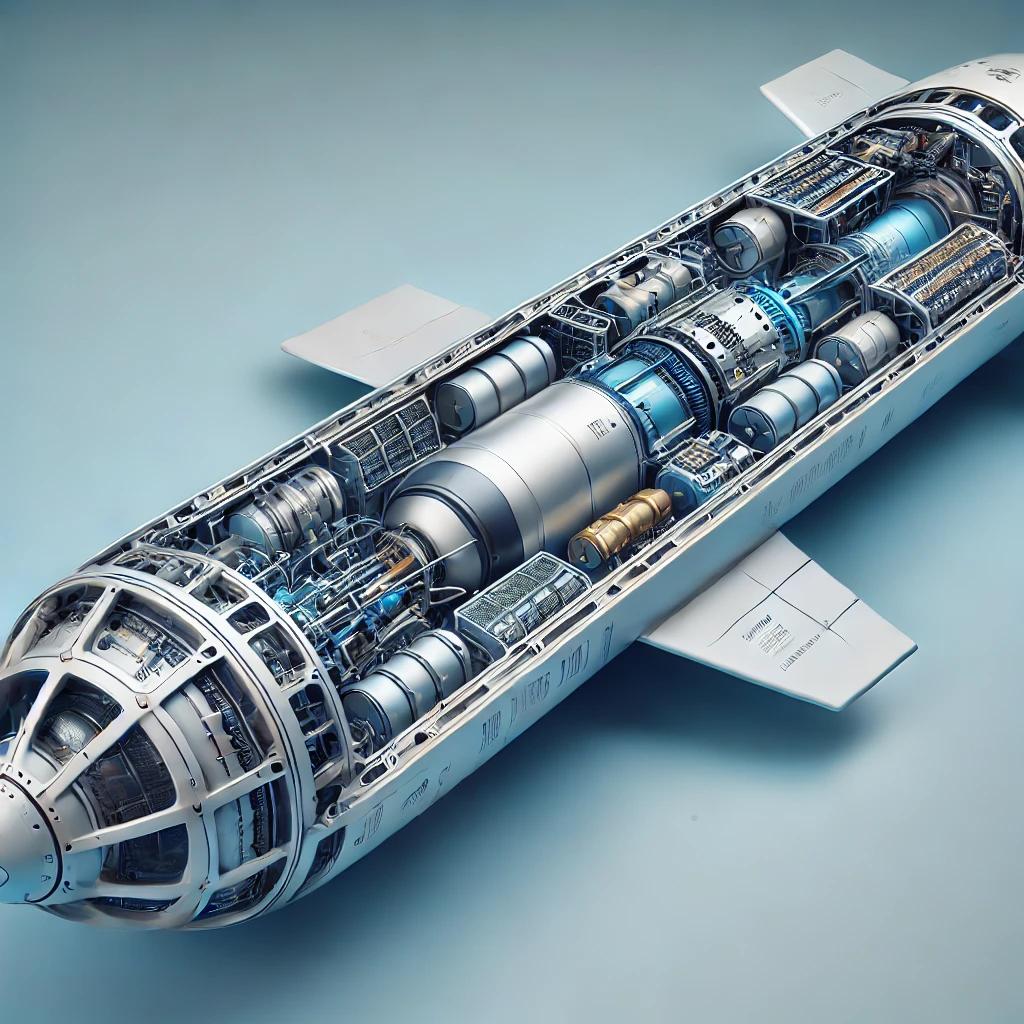
(Generated by artificial intelligence)
Poseidon Nuclear Submarine Drone System
Type(s) | Nuclear-powered nuclear-armed unmanned aerial vehicle | ||||||||
|---|---|---|---|---|---|---|---|---|---|
Place of Production | Russia | ||||||||
User Countries | Russia | ||||||||
Designer | Rubin Design Bureau | ||||||||
Designed | 2015 | ||||||||
Production Date | 2023–present | ||||||||
Mass | Up to 100 metric tons | ||||||||
Length(s) | Up to 20 m (65.6 ft) | ||||||||
Diameter | Up to 2 m | ||||||||
Explosion Area | 2 Mt or more (?) | ||||||||
Engine(s) | Liquid metal reactor At least 15 MW | ||||||||
Operational Range | Unlimited | ||||||||
Maximum Depth | Up to 1,000 m (3,280 ft) | ||||||||
Maximum Speed | 0 to 100 knots (approximately 70 to 111 mph) | ||||||||
Guidance System | GLONASS satellite guidance, plus AI guidance | ||||||||
Launch Platform | Submarine | ||||||||
Poseidon (Russian: Посейдон; GRAU: 2M39; NATO: Kanyon) is a nuclear-powered, nuclear-armed autonomous underwater vehicle developed by Russia. In available sources it is described either as a “super-torpedo” or under the umbrella term “Oceanic Multipurpose System (Status-6)”. Poseidon combines a high-yield warhead module capable of targeting coastal infrastructure with long-range navigation capabilities allowing it to travel along the seabed or in deep waters. The system has been positioned to achieve strategic deterrence diversify seabed-based nuclear options and complicate defense-detection chains.
The existence of Poseidon first became public through leaked documents and state media releases. Its origins trace back to Soviet-era research into underwater nuclear weapons and later gained public attention through Russian state presentations and test announcements. The project was developed as a long-range strategic weapon designed to exert impact on coastal areas and seabed targets. In materials that emerged after 2015 the system was referred to as Status-6 and was formally defined in 2018 by Russian state officials as part of a new strategic weapons program. Russia’s testing and production activities have been tracked since 2016 through imagery and press statements with sources indicating that the first production batch was completed in 2023. On 29 October 2025 Russian leadership announced that a nuclear-powered unit for Poseidon had been tested successfully.

Nuclear warheads prepared for the prototype version of Poseidon (Ministry of Defense of Russia)
As a nuclear-powered underwater vehicle Poseidon has continuous patrol capability. The compact liquid-metal cooled reactor provides high power density low thermal signature and sustained energy production. The autonomous navigation system enables long-range independent movement through GLONASS integration and sensor-based route corrections. Its deep-diving capability low noise profile and high speed combination are designed to reduce the probability of detection.

Probable internal and external appearance of the warheads carried by Poseidon based on known technical specifications (AI-generated)
Poseidon is designed to be deployed by specially modified submarines such as the Belgorod-class and Khabarovsk-type platforms. Reports also exist regarding design and patent documentation for seabed-deployable variants as well as ship-based support activities for field trials.
Poseidon carries a strategic deterrence objective through its high destructive yield and long range targeting coastal infrastructure. As a seabed-based nuclear option it establishes a new class within continental defense doctrine. The combination of its large warhead and nuclear propulsion complicates classical detection-interception methods of naval defense systems. Publicly released technical schematics depict usage scenarios based on severe marine radiological contamination with significant environmental and humanitarian consequences. Western media have referred to it as a “doomsday torpedo”. Russian state media continue to present the system as a technical component of its defensive doctrine.
Poseidon occupies the role of a third pillar in Russia’s nuclear deterrence doctrine alongside land-based intercontinental ballistic missiles and submarine-launched ballistic missiles. Autonomous underwater platforms have introduced a new strategic layer. The system aims to guarantee a second-strike capability in the event of a nuclear attack. Designed to inflict large-scale destruction on coastal targets it specifically focuses on enemy coastal infrastructure and port regions. In this way it affects nuclear balance not only through numerical force but also through the unpredictability of attack methods.

Pump-jet propulsion as indicated in the concealed image (Ministry of Defense of Russia)
Poseidon falls outside the scope of existing arms control regimes. The New START Treaty (extended in 2021 and in force until 2026) imposes limits only on warheads and launchers for land-based intercontinental ballistic missiles (ICBMs) submarine-launched ballistic missiles (SLBMs) and heavy bombers. Poseidon does not fall directly into any of these categories. As a nuclear-powered autonomous vehicle rather than a missile it is not covered by the treaty and therefore not subject to numerical limitations. This has sparked debate over whether Poseidon constitutes a “new category of strategic weapon” in terms of nuclear balance.
Under the United Nations Convention on the Law of the Sea (UNCLOS) Poseidon occupies a gray area because there is no explicit regulation governing the use of nuclear-powered unmanned vehicles in international waters. Western countries particularly NATO members argue that the system poses risks to maritime security and nuclear safety during its long-range autonomous patrols. Some policy reports from the United States and Europe advocate for the inclusion of Poseidon as a distinct category in future arms control agreements.
Army Recognition. “Russia Claims Successful Launch of Poseidon Nuclear Submarine Drone Said to Create Tsunamis.” *Army Recognition News*, October 30, 2025. Accessed November 1, 2025. https://www.armyrecognition.com/news/navy-news/2025/russia-claims-successful-launch-of-poseidon-nuclear-submarine-drone-said-to-create-tsunamis.
Associated Press. “Putin Says Russia’s Nuclear-Armed Underwater Drone Was Tested Successfully.” AP News, October 30, 2025. Accessed November 1, 2025. https://apnews.com/article/6c0d55d4d1a56e60ce750f8abe5eccab
Faulconbridge, Guy, and Maxim Rodionov. “Russia Tests Nuclear-Capable Poseidon Super Torpedo, Putin Says.” *Reuters*, October 29, 2025. Accessed November 1, 2025. https://www.reuters.com/world/china/putin-says-russia-tested-poseidon-nuclear-capable-super-torpedo-2025-10-29/.
Ministry of Defense of Russia. “Poseidon Oceanic Multipurpose System.” YouTube video, July 19, 2018. Accessed November 1, 2025. https://www.youtube.com/watch?v=T_7hWSv689Q.
Minoborony Rossii. “Field tests of the Poseidon complex.” YouTube video, February 20, 2019. Accessed November 1, 2025. https://www.youtube.com/watch?v=ySZuRs3DxK4.
Murray, Warren. “Putin Boasts of Nuclear-Driven Torpedo That Would Swamp Cities with Radioactive Tsunami.” *The Guardian*, October 30, 2025. Accessed November 1, 2025. https://www.theguardian.com/world/2025/oct/30/ukraine-war-briefing-putin-boasts-of-nuclear-driven-torpedo-that-would-swamp-cities-with-radioactive-tsunami.
Sutton, H. I. "Status-6 Oceanic Multipurpose System (Poseidon)." Covert Shores: Naval Warfare Blog, February 22, 2019. Accessed November 1, 2025.
Teslova, Elena. “Putin Says Russia Successfully Tested Nuclear-Propelled Poseidon Drones.” *Anadolu Ajansı*, October 29, 2025. Accessed November 1, 2025. https://www.aa.com.tr/en/asia-pacific/putin-says-russia-successfully-tested-nuclear-propelled-poseidon-drones/3729721.
Türkiye Today. "Russia Successfully Tests Poseidon Nuclear-Powered Super Torpedo, Putin Says." Türkiye Today, October 29, 2025. Accessed November 1, 2025. https://www.turkiyetoday.com/world/russia-successfully-tests-poseidon-nuclear-powered-super-torpedo-putin-says-3209176
U.S. Department of State. *New START Treaty Aggregate Numbers of Strategic Offensive Arms*, updated edition 2024. Accessed November 1, 2025. https://www.state.gov/new-start-treaty/.
United Nations. *United Nations Convention on the Law of the Sea (UNCLOS).* New York: United Nations, 1982. Accessed November 1, 2025. https://www.un.org/depts/los/convention_agreements/texts/unclos/unclos_e.pdf.
Vakulina, Sasha. “Moscow Says It Tested Poseidon Underwater Drone, Another Nuclear ‘Super Weapon.’” Euronews, October 29, 2025. Accessed November 1, 2025. https://www.euronews.com/2025/10/29/moscow-says-it-tested-poseidon-underwater-drone-another-nuclear-super-weapon.


(Generated by artificial intelligence)
Poseidon Nuclear Submarine Drone System
Type(s) | Nuclear-powered nuclear-armed unmanned aerial vehicle | ||||||||
|---|---|---|---|---|---|---|---|---|---|
Place of Production | Russia | ||||||||
User Countries | Russia | ||||||||
Designer | Rubin Design Bureau | ||||||||
Designed | 2015 | ||||||||
Production Date | 2023–present | ||||||||
Mass | Up to 100 metric tons | ||||||||
Length(s) | Up to 20 m (65.6 ft) | ||||||||
Diameter | Up to 2 m | ||||||||
Explosion Area | 2 Mt or more (?) | ||||||||
Engine(s) | Liquid metal reactor At least 15 MW | ||||||||
Operational Range | Unlimited | ||||||||
Maximum Depth | Up to 1,000 m (3,280 ft) | ||||||||
Maximum Speed | 0 to 100 knots (approximately 70 to 111 mph) | ||||||||
Guidance System | GLONASS satellite guidance, plus AI guidance | ||||||||
Launch Platform | Submarine | ||||||||
No Discussion Added Yet
Start discussion for "Poseidon Nuclear Unmanned Submarine System" article
History and Production Status
Technical Specifications
Launch and Deployment Platforms
Impact and Purpose
Place Within Strategic Doctrine
International Reactions and Legal Dimensions