


This article was automatically translated from the original Turkish version.
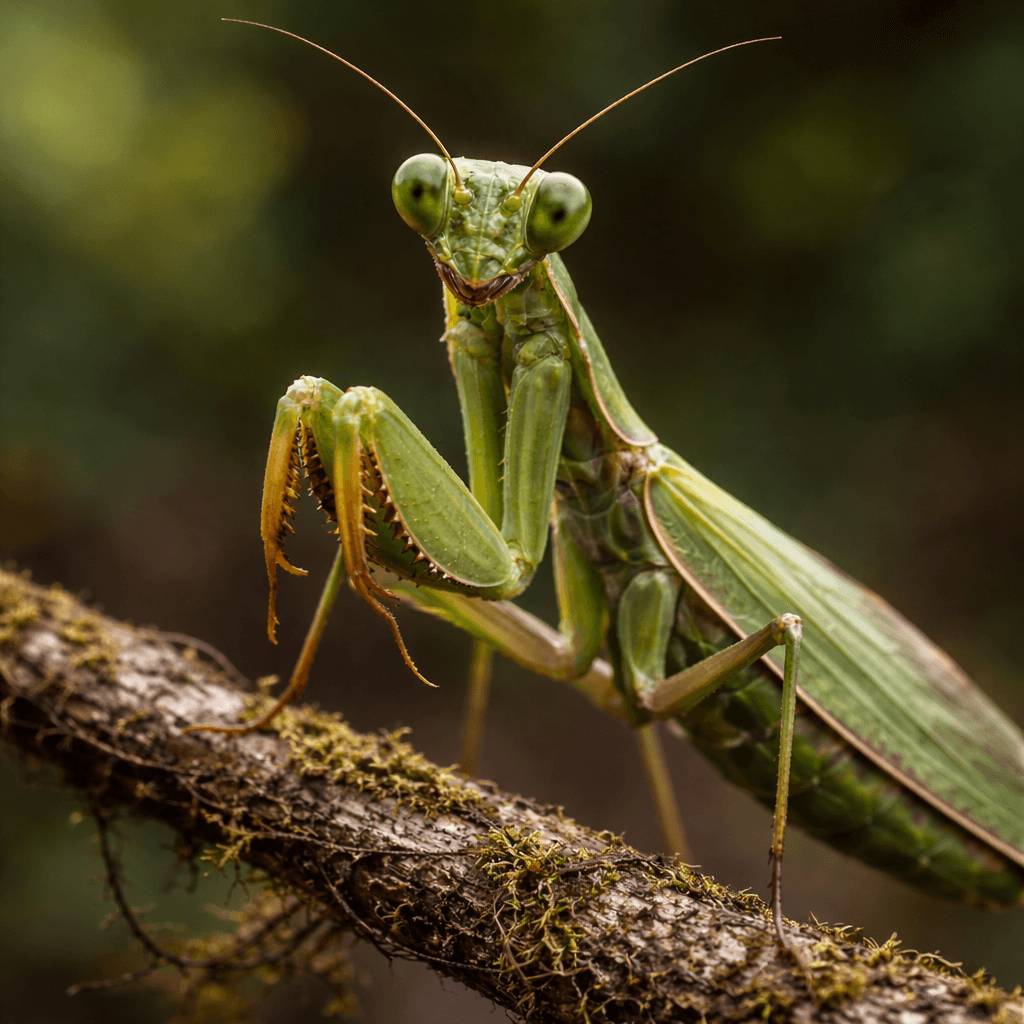
Praying mantis (family Mantidae)
Image generated by artificial intelligence
Habitat | tropical and temperate regions forests Gardens | ||||||||
|---|---|---|---|---|---|---|---|---|---|
Mobility | Rapid strike reflex, flight capability | ||||||||
Ecological Role | Natural insect control, biological pest control | ||||||||
Life Cycle | Incomplete metamorphosis, egg, nymph, adult | ||||||||
Egg Structure | Ootheca, hardened foamy protective casing | ||||||||
Reproductive Behavior | Sexual cannibalism, female eating the male | ||||||||
Defense Mechanism | Camouflage, death feigning, sudden wing display | ||||||||
Hearing System | Single ear on the abdomen, ultrasonic detection | ||||||||
Food Sources | Insects, small birds, lizards, frogs | ||||||||
Feeding Method | Carnivorous, ambush predator | ||||||||
Vision Capability | Head capable of rotating 360 degrees, stereoscopic vision | ||||||||
Forelimb Structure | Spiny, raptorial, praying posture | ||||||||
Basic Appearance | Triangular head, large eyes, elongated body | ||||||||
Scientific Classification | Order Mantodea, family Mantidae | ||||||||
Common Name | Prophet's camel | ||||||||
Praying Mantis (family Mantidae) is a carnivorous insect species found across temperate and tropical regions worldwide. Its name derives from its posture, in which it holds its forelegs folded as if in prayer, and its scientific Latin name, Mantis religiosa, is also based on this physical appearance. The word originates from the Greek "mantikos", meaning prophet or seer. Approximately 2,400 to 2,500 species of praying mantis have been identified globally.【1】
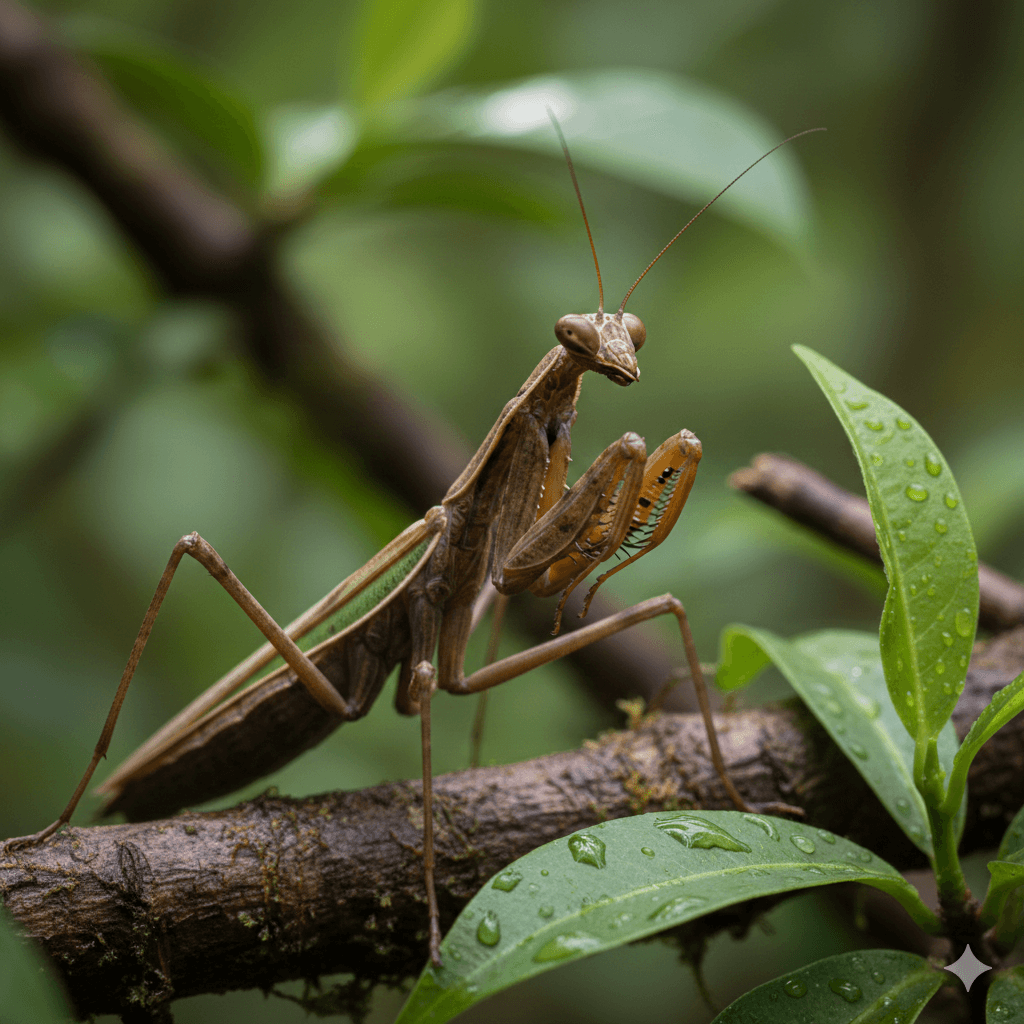
Praying Mantis (Image Generated by Artificial Intelligence)
These insects typically measure 6 to 7 centimeters (2 to 3 inches) in length and have an anatomy consisting of three main parts: the head, thorax, and abdomen. Four legs are located on the abdomen, while two specialized forelegs adapted for hunting are positioned near the head. These forelegs, known as raptorial, are equipped with interlocking spines that prevent captured prey from escaping. The praying mantis is the only insect species capable of rotating its head up to 180 degrees to observe its surroundings and track prey. Morphological differences between sexes reveal that females, due to the need to produce eggs and protect them from predators, have larger body sizes than males.
Praying mantises possess a highly sophisticated visual system that enables advanced motion and depth perception. They are the only known invertebrates capable of three-dimensional (3D) vision, and this system is based on motion rather than static cues. They have five eyes in total: two large compound eyes for depth perception and three small simple eyes called "ocelli", which detect light and shadow. The moving black spots visible in their compound eyes are not true pupils but light receptors that absorb specific wavelengths of light and are known as "pseudopupils". Their auditory system is also unique. A single ear located in the center of the thorax allows them to detect ultrasonic frequencies above 20,000 hertz emitted by bats during hunting.【2】 Flying species of praying mantis use this ear to detect approaching bats and perform sudden aerial dives to escape predation.
Praying mantises are entirely carnivorous ambush predators with highly developed camouflage abilities. Their coloration—green, brown, pink, or yellow—matches their environment, and they can adjust their color after molting to better blend into their habitat. For example, the orchid mantis (Hymenopus coronatus), native to Asia, develops white and pink hues upon reaching adulthood and waits for prey among orchid flowers. Their diet includes any living organism smaller than themselves, such as flies, grasshoppers, caterpillars, and aphids, as well as vertebrates like small lizards, frogs, snakes, mice, and hummingbirds. They consume their prey alive and without venom, typically starting at the head.
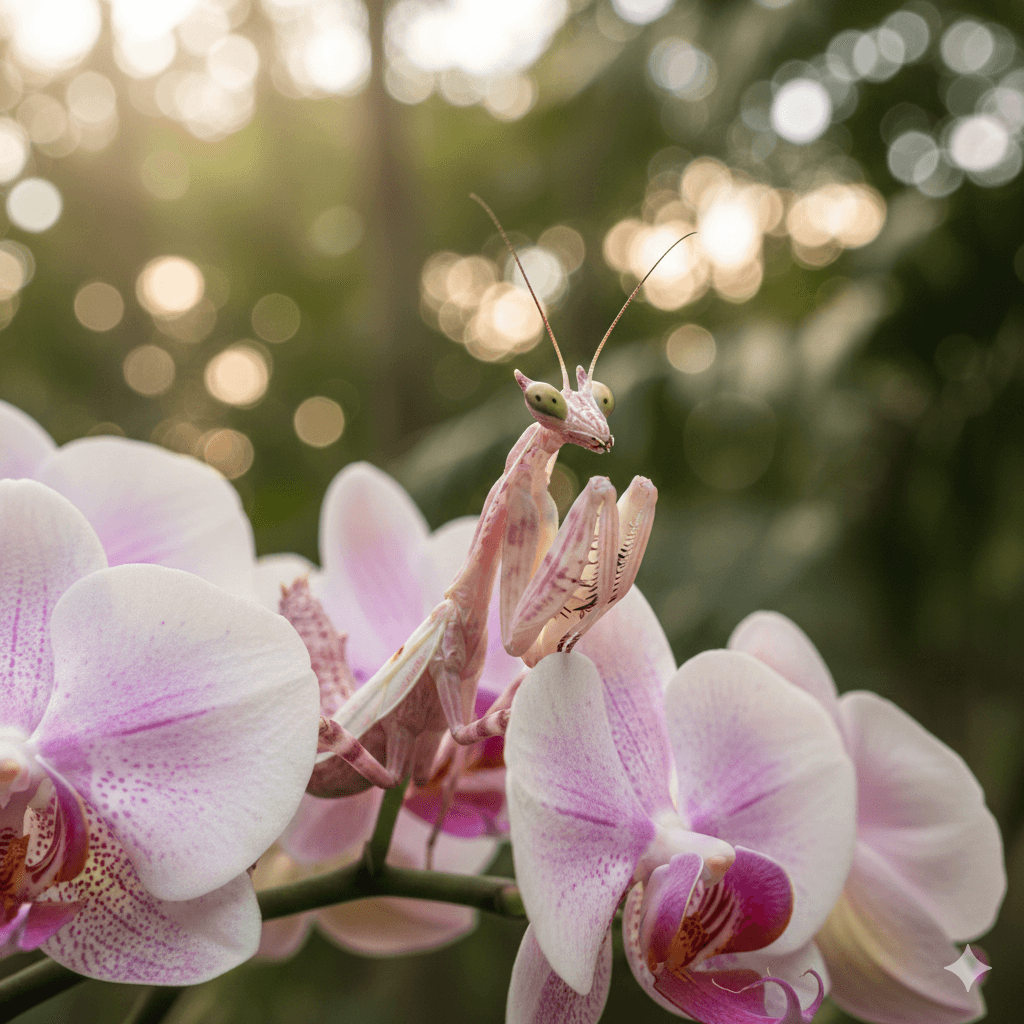
Orchid Mantis (Image Generated by Artificial Intelligence)
The mating season for praying mantises typically occurs in autumn. In approximately 13 to 30 percent of cases, the female consumes the male during or immediately after mating, a behavior known as sexual cannibalism. Decapitation of the male terminates brain-based inhibition, allowing a ganglion in the abdomen to sustain mating reflexes, thereby increasing fertilization success. This act also provides the female with a rapid source of amino acids and nutrients essential for healthy egg development.
After fertilization, the female deposits an egg case called an "ootheca" on a branch or suitable surface. This substance, secreted by specialized glands in the abdomen, begins as a frothy material that rapidly hardens into a polystyrene-like structure, protecting the eggs from cold and predators. An ootheca may contain anywhere from a few dozen to 400 eggs, depending on the species. Nymphs that overwinter inside the ootheca emerge after three to six months, typically in spring or early summer, depending on environmental conditions. Immediately after hatching, they begin hunting using innate predatory instincts and feed on small organisms in their surroundings, including other mantises. Their average lifespan is about one year.
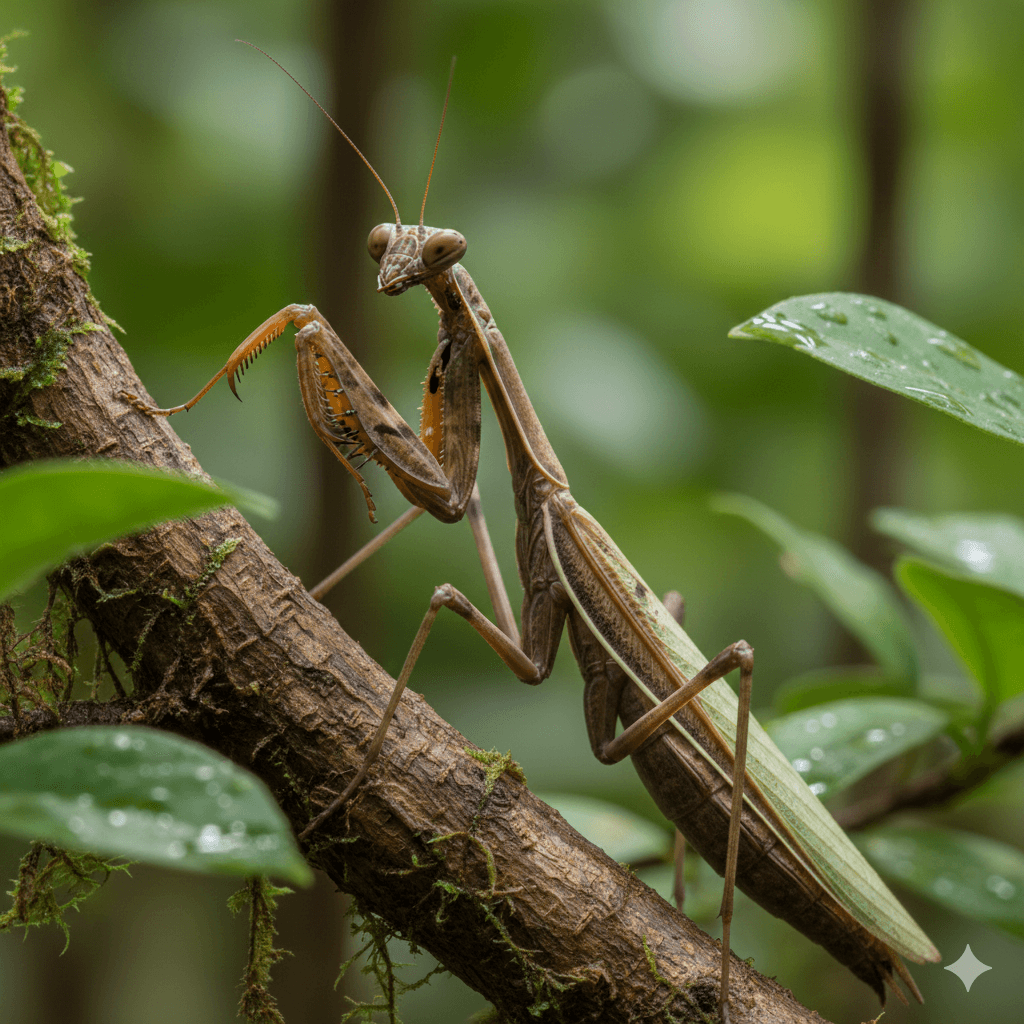
Praying Mantis (Image Generated by Artificial Intelligence)
Praying mantises play a dual role as both predator and prey within their ecosystems, helping maintain the balance of the food chain. They serve as a food source for birds, bats, frogs, and large spiders, while simultaneously controlling populations of insects. Due to their consumption of agricultural and urban pests such as mosquitoes, aphids, grasshoppers, and caterpillars, they are regarded as natural biological control agents (pest control) in farms and gardens. Although they occasionally consume beneficial pollinators such as bees and butterflies, their ecological benefits are still considered significant even in regions where they are invasive. They pose no threat to humans and are non-venomous.
Accessed November 26, 2025.
Accessed November 26, 2025.
Forest Preserve District of Will County. "Five fast facts about easy-to-miss praying mantises." Forest Preserve District of Will County. Accessed February 26, 2026.
NWF Staff. "How the Praying Mantis Hears." National Wildlife Federation. Accessed February 26, 2026.
Ortiz, Cristina. "The praying mantis is a predator: Lifeform of the week." EarthSky. Accessed February 26, 2026.
Taşçı, Ahmet. "Peygamber devesi hakkında." Türkiye Yaban Hayatı. Accessed February 26, 2026.
University of Florida. "What Is a Praying Mantis? Facts, Benefits and Environmental Role." Entomology and Nematology Online Programs. Accessed February 26, 2026.
[1]
Cristina Ortiz, “The praying mantis is a predator: Lifeform of the week,” EarthSky, Access date: 26 February 2026.
https://earthsky.org/earth/praying-mantis-ferocious-insect-lifeform-of-the-week/
[2]
NWF Staff, “How the Praying Mantis Hears,” National Wildlife Federation, Access date: 26 February 2026
https://www.nwf.org/Magazines/National-Wildlife/2010/How-the-Praying-Mantis-Hears

Praying mantis (family Mantidae)
Image generated by artificial intelligence
Habitat | tropical and temperate regions forests Gardens | ||||||||
|---|---|---|---|---|---|---|---|---|---|
Mobility | Rapid strike reflex, flight capability | ||||||||
Ecological Role | Natural insect control, biological pest control | ||||||||
Life Cycle | Incomplete metamorphosis, egg, nymph, adult | ||||||||
Egg Structure | Ootheca, hardened foamy protective casing | ||||||||
Reproductive Behavior | Sexual cannibalism, female eating the male | ||||||||
Defense Mechanism | Camouflage, death feigning, sudden wing display | ||||||||
Hearing System | Single ear on the abdomen, ultrasonic detection | ||||||||
Food Sources | Insects, small birds, lizards, frogs | ||||||||
Feeding Method | Carnivorous, ambush predator | ||||||||
Vision Capability | Head capable of rotating 360 degrees, stereoscopic vision | ||||||||
Forelimb Structure | Spiny, raptorial, praying posture | ||||||||
Basic Appearance | Triangular head, large eyes, elongated body | ||||||||
Scientific Classification | Order Mantodea, family Mantidae | ||||||||
Common Name | Prophet's camel | ||||||||
No Discussion Added Yet
Start discussion for "Praying mantis (family Mantidae)" article
Physical Characteristics and Anatomy
Sensory Organs and Perception
Hunting and Feeding Behavior
Reproduction, Development, and Life Cycle
Role in the Ecosystem