


This article was automatically translated from the original Turkish version.
+1 More

Prussian Blue
Chemical Name | Iron(III) hexacyanoferrate | ||||||||
|---|---|---|---|---|---|---|---|---|---|
Formula | Fe₄[Fe(CN)₆]₃·xH₂O | ||||||||
Discovery(ies) | 1706–1709 Germany) Johann Jacob Diesbach (Berlin | ||||||||
Pigment Code | PB27 (Pigment Blue 27) | ||||||||
Applications | Art, Medicine, Industry, Nanotechnology | ||||||||
Chemical Properties | limited color stability under moisture and light insoluble in water electrochemically reversible Redox active (reducible and oxidizable) | ||||||||
Prussian Blue is a dark blue, microcrystalline iron-cyanide compound with a chemical formula commonly expressed as Fe₄[Fe(CN)₆]₃·xH₂O or, for more complex structures, Fe₇(CN)₁₈·xH₂O. This pigment belongs to the class of coordination compounds and exhibits a three-dimensional network structure formed by iron(II) and iron(III) ions linked through cyanide bridges.
Prussian Blue has versatile applications in fields such as art, medicine, chemistry, and nuclear security due to its visual aesthetics and ion-exchange capacity. Its color arises from broad-band light absorption resulting from charge transfer within its structure, particularly in the red and green regions of the visible spectrum, which gives rise to its characteristic blue hue.
Discovered accidentally in the early 18th century in Berlin, Germany, by pigment maker Johann Jacob Diesbach, Prussian Blue is regarded as one of the first synthetic pigments in the history of chemistry. While attempting to produce a red lake pigment, Diesbach used potassium carbonate of animal origin, which was contaminated with cyanide compounds. When this material reacted with iron(II) sulfate, it produced a deep blue compound. This discovery rapidly gained widespread adoption due to its significantly lower cost and greater accessibility compared to natural pigment production methods of the time, and it sparked considerable interest in the art world.
Over time, the production of Prussian Blue was refined, and by 1724 its commercial manufacture had become standardized. This pigment largely replaced expensive natural ultramarine derived from lapis lazuli and remained the dominant blue pigment in Europe until the 19th century.
The laboratory where Diesbach worked was also associated with Johann Konrad Dippel, who was engaged in alchemy. The potassium carbonate used in the discovery was contaminated with residues from Dippel’s production of “animal oil,” which played a decisive role in the formation of the pigment.
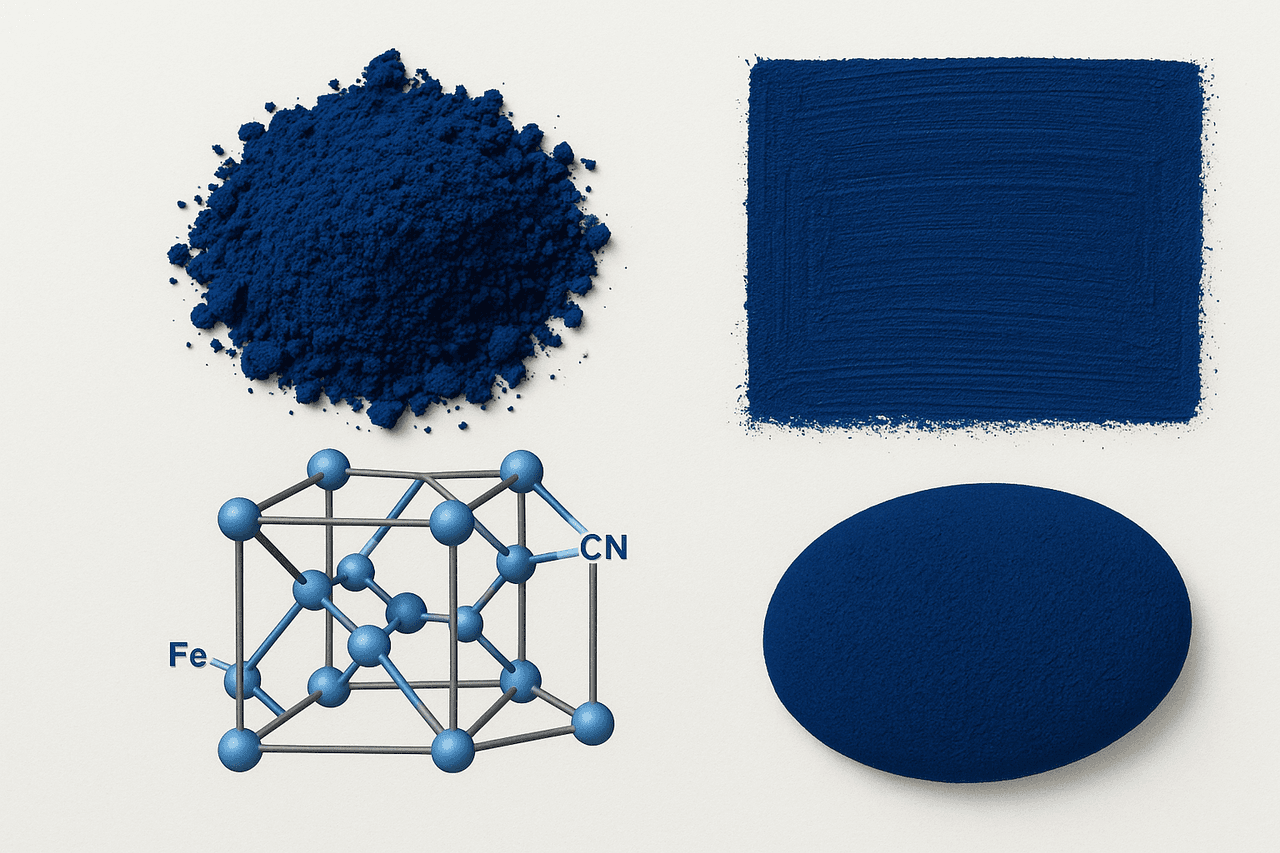
Prussian Blue (Generated by Artificial Intelligence.)
Prussian Blue forms primarily through the interaction of iron(III) ions with the [Fe(CN)₆]⁴⁻ complex anions. Cyanide ions form coordination bonds via their carbon atoms; each [Fe(CN)₆] unit carries six cyanide ligands that bridge to other iron(III) centers, creating a network-like structure.
In typical production, FeCl₃ (iron(III) chloride) is mixed with K₄[Fe(CN)₆] (potassium hexacyanoferrate). The resulting microcrystalline Prussian Blue precipitate is stabilized after washing and drying. The pigment’s color can vary between deep blue and light blue depending on particle size, crystal structure, and degree of hydration.
An alternative production method involves electrochemical synthesis within conductive polymer matrices. This technique enables the pigment to be coated directly onto electrode surfaces, making it suitable for use in sensor technologies.
The pigment’s susceptibility to light-induced degradation stems from the redox activity of its iron ions. Color changes are particularly observable under humid conditions and at low pH levels.
Shortly after its discovery in the early 18th century, Prussian Blue rapidly gained popularity among European artists. It offered a significant alternative to expensive natural sources of blue pigments such as lapis lazuli.
Among the earliest known users of Prussian Blue was Swiss painter Christof Werner based in Berlin. However, the earliest documented use of this pigment in a painting is attributed to Dutch artist Pieter van der Werff in his 1709 work Entombment of Christ. From the 1710s onward, French painters Nicolas Lancret and Antoine Watteau incorporated the new pigment into their palettes; Watteau especially favored Prussian Blue for figures and sometimes mixed it with ultramarine.
Throughout the 18th century, this pigment appeared in works by major artists including Thomas Gainsborough, Sir Joshua Reynolds, Vigée-Le Brun, and Eugène Delacroix. J. M. W. Turner used Prussian Blue in his 1838 painting The Fighting Temeraire, and Vincent van Gogh employed it in his 1889 masterpiece The Starry Night. It is known that van Gogh mixed this pigment with chrome yellow to achieve green tones.

The Starry Night, Vincent Van Gogh (rawpixel)
The impact of the pigment was not limited to Europe; with its export to Japan in the first quarter of the 19th century it influenced the ukiyo-e style of woodblock printing. This development has been regarded as a “blue revolution” in Japanese art.
The artistic use of the pigment also introduced certain technical challenges. Fading over time occurs particularly due to the effects of heat, light and humidity. In the 18th century it was common practice to mix Prussian Blue with white lead to achieve lighter blue tones. However this method reduced the pigment’s resistance to light and environmental factors leading to fading in some artworks.
Modern research has revealed that this fading effect stems from variations in the pigment’s production conditions and its interactions with binding media. Technical analyses conducted by the National Gallery have demonstrated that fillers used in early Prussian Blue samples such as barite directly affected color durability.
Due to its chemical structure which exhibits ion-exchange capability Prussian Blue has been adopted for the treatment of poisoning. In particular it binds cesium-137 and thallium in the gastrointestinal tract facilitating their elimination from the body. It is listed by the U.S. Centers for Disease Control and Prevention (CDC) as an approved medical agent for radiation emergencies.
Medical use is only possible with “pharmaceutical-grade” Prussian Blue which is known as Radiogardase and is available by prescription. Pigments produced for artistic use are hazardous if ingested and are not therapeutic.
Today Prussian Blue is employed in various research fields due to its physical properties including ion exchange electrochromic behavior and magnetism. Its crystalline structure is regarded as a model compound in studies on solid-state electrochemistry and the development of lithium-ion batteries. It also holds potential applications in sensor technologies color-changing optical filters and nanomaterial production.
In particular biosensors using electrodes modified with Prussian Blue enable the detection of molecules such as glucose lactic acid and hydrogen peroxide. Due to its electrochemical stability and redox capacity it is a preferred material for amperometric sensors.
Prussian Blue reduced to nanoparticle form is evaluated as a biocompatible material for controlled drug delivery systems and can also serve as an imaging agent. Its biocompatibility non-toxic structure and ion permeability have made it the subject of numerous multidisciplinary studies.
American Chemical Society. “Prussian Blue.” ACS. Accessed July 22, 2025. https://www.acs.org/molecule-of-the-week/archive/p/prussian-blue.html
Centers for Disease Control and Prevention. “HOW PRUSSIAN BLUE WORKS.” CDC. Accessed July 22, 2025.
Chemistry Views. "Prussian Blue." Chemistry Europe. Accessed July 18, 2025. https://www.chemistryviews.org/prussian-blue-discovery-and-betrayal-part-1/
Coşkun Kurt, N. and Sönmez Çelebi, M. "Electrochemical Synthesis of Prussian Blue in Conducting Poly (Vinylferrocene) Film." *Ordu Üniversitesi Bilim Ve Teknoloji Dergisi*, 8(1), 31-37. Accessed July 22, 2025. https://dergipark.org.tr/tr/pub/ordubtd/issue/38167/440858
Guichard, Charlotte, Anne-Solenn Le Hô, and Hannah Williams. “Prussian Blue: Chemistry, Commerce, and Colour in Eighteenth-Century Paris.” *Art History* 46, no. 1 (2023): 154–186. Accessed July 22, 2025. https://academic.oup.com/arthistory/article/46/1/154/7276874
Kaçar, Ceren, Funda Öztürk, Pınar Esra Erden, and Esma Kılıç. “Magnetite Nanoparticles and Prussian Blue Modified Amperometric Biosensor for Lactic Acid Determination”. *Selcuk University Journal of Science Faculty* 42, no. 1 (July 2016): 17–29. Accessed July 22, 2025. https://dergipark.org.tr/en/pub/sufefd/issue/23086/246673
Kirby, Jo, and David Saunders. “The Identification of Blue Pigments in Early 18th-Century Paintings Using Analytical Techniques.” *National Gallery Technical Bulletin* 25 (2004): 65–79. Accessed July 22, 2025. https://www.nationalgallery.org.uk/media/15510/kirby_saunders2004.pdf
Rassmusen, William. “Prussian Blue and Its Partner in Crime.” *Journal of Art in Society.* Accessed July 18, 2025. https://www.artinsociety.com/prussian-blue-and-its-partner-in-crime.html
Rawpixel. "Vincent Van Gogh's The Starry Night (1889). JPG." Accessed July 22, 2025. https://www.rawpixel.com/image/537438/the-starry-night-van-gogh

Prussian Blue
Chemical Name | Iron(III) hexacyanoferrate | ||||||||
|---|---|---|---|---|---|---|---|---|---|
Formula | Fe₄[Fe(CN)₆]₃·xH₂O | ||||||||
Discovery(ies) | 1706–1709 Germany) Johann Jacob Diesbach (Berlin | ||||||||
Pigment Code | PB27 (Pigment Blue 27) | ||||||||
Applications | Art, Medicine, Industry, Nanotechnology | ||||||||
Chemical Properties | limited color stability under moisture and light insoluble in water electrochemically reversible Redox active (reducible and oxidizable) | ||||||||
No Discussion Added Yet
Start discussion for "Prussian Blue (Berlin Blue)" article
Historical Development and Discovery
Chemical Structure and Production Mechanism
Use in Art
Technical Challenges
Medical and Nuclear Applications
Role in Modern Chemistry and Materials Science