


This article was automatically translated from the original Turkish version.

Red Flag Flag (Red Flag) Exercise is a two-week advanced air battle training exercise conducted several times a year by the United States Air Force. The main purpose USA of the exercise is to provide realistic air combat training for military pilots and other flight crew members from NATO and other allied nations.
Four or six Red Flag Exercises are held each year at Nellis Air Force Base in Nevada; four additional exercises known as Red Flag-Alaska are conducted at Eielson Air Force Base in Alaska.

Aerial view of Nellis Air Force Base [1]
The mission of the Red Flag Exercises, first held in 1975, is to maximize participants’ combat readiness and survivability by providing a realistic training environment and an operational pre- and post-mission forum that encourages free idea exchange. To this end, combat units from the United States and allied nations participate in carefully orchestrated realistic combat training scenarios within the Nellis Range Complex. The Nellis Range Complex spans an area of approximately 60 by 100 sea miles (about 21,090 km2) in the northwestern region of Las Vegas place.
In a typical Red Flag Exercise, Blue Forces (friend) engage in realistic war scenarios against Red Forces (enemy).
The Blue Forces consist of aviation units from the Air Combat Command, Air Mobility Command, Air Force Global Strike Command, Air Force Special Operations Command, United States Air Force, Pacific Air Forces, Air National Guard, Air Force Reserve Command and Air Force Space Command, as well as the United States Navy, United States Marine Corps and United States Black Forces, along with air forces and naval aviation units from allied nations. These units are commanded by a Blue Force commander and coordinated under a framework known as an “employment plan” commander.
The Red Forces are composed of the 57th Aggressor Squadron (57 ATG) of the 57th Wing, which simulates enemy tactics by flying F-16 and F-15 aircraft. Enemy imitation is further supported by other United States Air Force, United States Navy and United States Marine Corps units equipped with electronic ground defense, communications and radar jamming systems. During the exercise, the 527th Space Aggressor Squadron (527 SAS) and the 26th SAS simulate potential battlefield challenges such as GPS jamming.
One of the key components of the Red Flag Exercise is the Red Flag Measurement and Debriefing System (RFMDS). RFMDS is a computer hardware and software network that enables real-time tracking, post-mission replay of maneuvers and tactics, participant pairing, and integration of range targets and simulated threats. After the exercise, Blue Force commanders objectively evaluate mission performance and validate findings using data provided by the RFMDS.

Example of the NACTS system from the 2004 documentary Fighter Pilot: Operation Red Flag
Each Red Flag Exercise incorporates various missions including air interdiction, strike/attack, air superiority, suppression of enemy air defenses, aerial refueling, airborne command and control, and reconnaissance. Over a 12-day period, more than 500 aircraft fly over 20,000 sorties, training more than 5,000 aircrew and over 14,000 support and maintenance personnel.
Australia, Belgium, Brazil, Canada, Chile, Colombia, Denmark, Egypt, Finland, France, Germany, Greece, India, Israel, Italy, Jordan, Japan, New Zealand, Netherlands, Norway, Pakistan, Poland, Portugal, Sweden, Singapore, Saudi Arabia, South Korea, Spain, Morocco, Republic of China, Thailand, Türkiye, United Arab Emirates, United Kingdom, Venezuela
Türkiye’s most recent participation in a Red Flag Exercise occurred between 29 February and 11 March 2016 and involved approximately 23 units representing the United States Air Force, Army, Navy, Marine Corps and NATO partners Aeronautica Militare (AM – Italian Air Force) and Turkish Air Forces (TSK). Participating units flew from Nellis AFB in Las Vegas and received training over the 2.9 million acre land and 12,000 inch square mile airspace area provided by the Nevada Test and Training Range (NTTR).
A total of approximately 75 aircraft (and 1,700 personnel) participated, including a Turkish Air Force contingent consisting of eight Italian Eurofighter Typhoon (or F-2000A as known in Italy) and six F-16s and two KC-135R tankers, marking their first Red Flag participation. On the U.S. side, F-16CM, F-15E, F-15C, E-3G, various helicopters, unmanned aerial vehicles (MQ-9), tankers (KC-135R), special mission aircraft and two of the three Global Strike Command bombardment aircraft – B-52H and B-1B – were present. The wide variety of aircraft reflects the typical composition of a coalition force in combat.
In RF 17-1, the first Red Flag Exercise to include the F-35, thirteen F-35A aircraft in Block 3i configuration participated. These F-35s were internally capable of carrying two AMRAAM and two GBU-12/31 munitions. During the exercise, F-22s and F-35s operated as Blue Forces against F-16s as Red Forces. The F-35s completed the exercise with 145 enemy kills and only seven losses, equating to approximately one loss for every 20 enemy aircraft. Then-Commander of the 34th Fighter Squadron and F-35 pilot Lieutenant Colonel George Watkings described the outcome as “We flew our first defensive air combat mission here and did not lose a single friendly aircraft – an unheard-of day.” All friendly losses occurred within visual range, where aircraft were detected visually rather than by radar. Additionally, this exercise took place in a high-threat environment with integrated air defense systems (IADS) operating surface-to-air systems. In such an environment, the F-35 problem without incident, unlike fourth-generation fighters, and achieved a perfect success.
Four years after the F-35’s first participation in the exercise, during Red Flag 24-1 from 18 April to 3 May 2024, Italian Air Force F-35s flew for the first time without radar reflectors (in stealth mode). Radar reflectors are used to make the F-35’s low-observable aircraft more visible to radar and are typically installed during training and peacetime operations. Without them, F-35s fly with their minimum radar signature and fully exploit their low-observable capabilities while engaging in high-fidelity tactical scenarios against simulated and realistic threats in an almost unrestricted airspace complete.
Colonel Bernard summarized this exercise as: “This is about bringing your team together and making 1 + 1 = 3 by using every capability.”
Video footage from the cockpit during the 2016 Red Flag Exercise [2]

Eielson Air Force Base, Alaska. A Turkish F-16C prepares for the Red Flag Alaska exercise on 17 July 2007. [3]
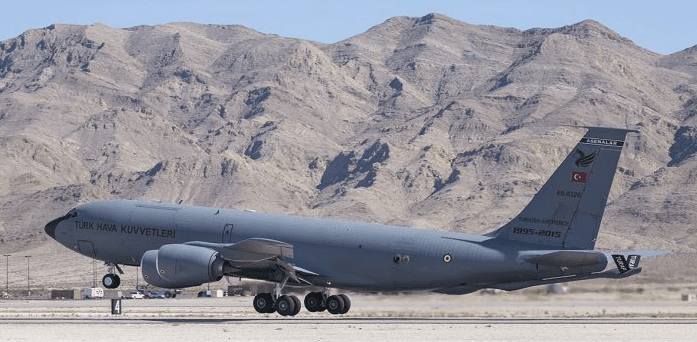
A Turkish Air Force KC-135R aircraft from the 10 TU 101st Squadron at Incirlik, preparing to depart Türkiye for Red Flag 16-2. [4]

Participating Countries
Türkiye’s Most Recent Participation
First Red Flag Participation of the F-35