


This article was automatically translated from the original Turkish version.
+2 More
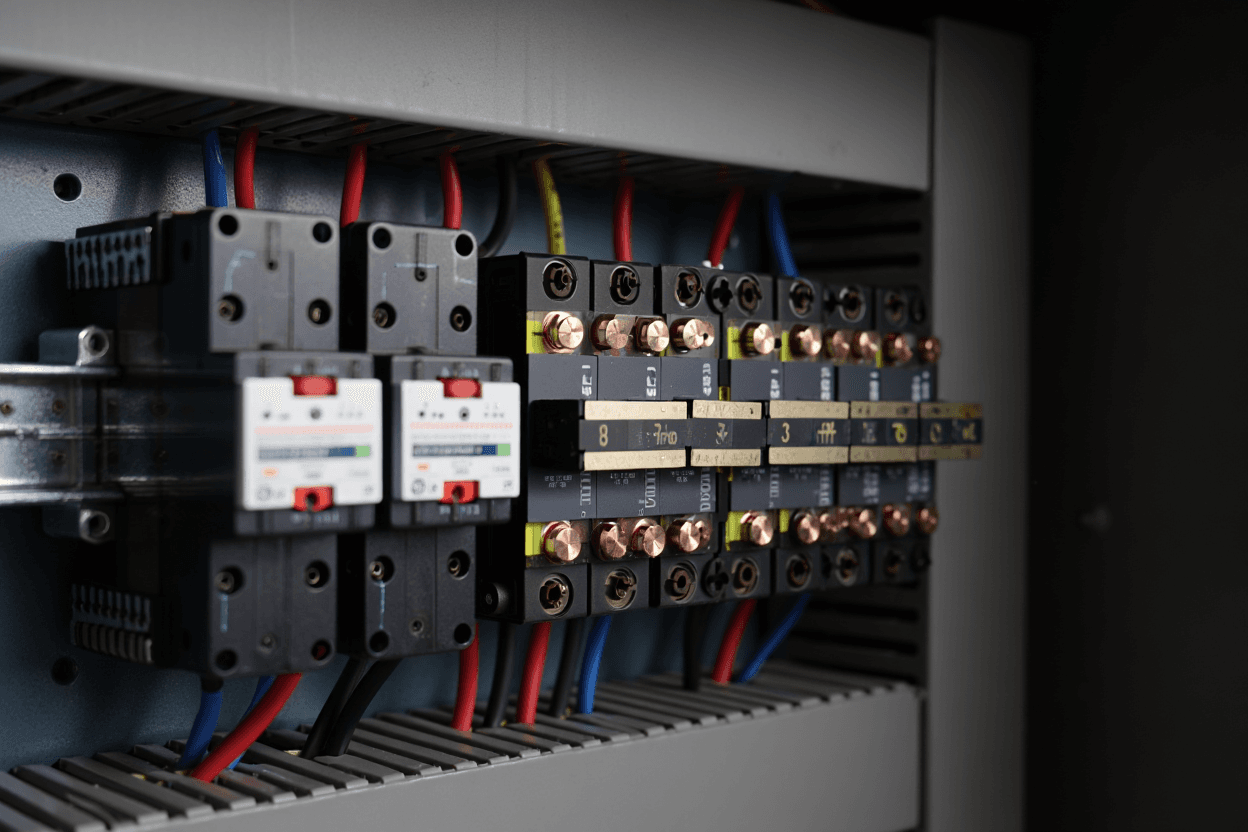
Relays and Contactors (Generated with Artificial Intelligence)
Basic Function(s) | Remote switching of electrical circuits | ||||||||
|---|---|---|---|---|---|---|---|---|---|
Relay Current Capacity | Typically up to 15A (low power) | ||||||||
Contactor Current Capacity | Typically from 10A to thousands of amperes (high power) | ||||||||
Relay Applications | Control signals, automation, automotive, home appliances | ||||||||
Contactor Applications | Industrial motors, lighting systems, HVAC | ||||||||
Operating Principle | Electromagnetism | ||||||||
Relay Inventor | Joseph Henry (1835) | ||||||||
Contactor Inventor | Hein Moeller (1912) | ||||||||
Relays and contactors are electromechanical switching elements used to open and close electrical circuits via a remote control signal. Although both operate on a similar principle based on a coil and contacts, they differ significantly in terms of application purpose, power capacity, structural characteristics, and usage areas. Generally, relays are used in control circuits with low current and voltage levels for tasks such as signal processing, amplification, and isolation, while contactors are designed specifically to directly switch high-power loads such as industrial motors, large lighting systems, and heaters.
The fundamental operating principle of both relays and contactors is based on electromagnetism. A low-current signal from a control circuit is applied to a coil (winding) inside the device. The energized coil generates a magnetic field, which attracts a movable component—the armature in relays or the core/plunger in contactors. This mechanical movement causes the contacts connected to the device to change position. Normally open (NO) contacts close to complete the circuit, while normally closed (NC) contacts open to break the circuit. When the control signal is removed, the magnetic field disappears and a spring mechanism typically returns the contacts to their original position.
Relays, designed to switch lower currents, generally have a smaller and more compact structure. Their main components are the coil, armature, and contact sets. Contact configurations vary widely and include normally open (NO), normally closed (NC), and changeover (CO—or reversing) types that accommodate both states. This variety makes them suitable for complex logic control circuits. In addition to electromechanical relays, solid-state relays (SSRs) are also available; these operate using semiconductor technology without any moving parts. Solid-state relays offer longer life and faster switching due to the absence of mechanical wear and arcing issues.
Contactors are manufactured from larger, stronger, and more durable materials to safely switch high currents and voltages. Structurally similar to relays, they have several key differences:
These contacts open and close the load circuit carrying high current. They are typically designed as three-pole units for three-phase systems and are built to withstand heating and mechanical stress caused by large currents. Most are normally open (NO) in configuration.
These are additional contacts with lower current capacity than the main contacts and are used in control circuits. They serve to indicate the contactor’s current state (open/closed), trigger other devices, or create safety interlocks. Auxiliary contacts are standard features on most contactors.
When high current is interrupted, an electric arc forms between the contacts, which can damage them and pose a safety hazard. Contactors are equipped with special mechanisms such as arc chutes or arc suppression channels to rapidly and safely extinguish these arcs. This feature is generally absent in relays.
The distinction between relays and contactors is based on a set of technical characteristics that are critical for selecting the appropriate component for a given application.
Different capacities and features lead to clearly distinct application areas for relays and contactors.
Relays are used in low-power control, signal switching, logic circuits, and isolation of sensitive circuits from power circuits. Common application areas include:
Boosting outputs from PLCs (programmable logic controllers), processing sensor signals, and operating indicator lamps or small motors in control panels.
Controlling headlights, horns, windshield wipers, fuel pumps, and cooling fans.
Internal control circuits of refrigerators, air conditioners, washing machines, and televisions.
Signal routing and switching operations.
Alarm systems, fire detection, and door locking mechanisms.
Contactors are used in industrial and commercial applications requiring direct switching of large electrical loads. Major application areas include:
Starting and stopping three-phase electric motors that drive conveyor belts, pumps, fans, compressors, and other industrial machinery in factories.
Collective control of lighting circuits in large areas such as stadiums, highways, large buildings, and industrial facilities.
Controlling large-capacity heaters, cooling units, and ventilators.
Switching capacitor banks used in electrical distribution panels to manage power circuits and correct power factor (compensation).
Safe control of motors that move heavy loads.
Both relays and contactors have numerous types developed for specific applications.
Colla, Marco, Tiziano Leidi, and Mario Semo. "Design and Implementation of Industrial Automation Control Systems: a Survey." *Proceedings of the IEEE International Conference on Industrial Informatics*, 2009: 570–575. https://doi.org/10.1109/INDIN.2009.5195866.
Demirci, Tuğçe, Ahmet Gani, O. Fatih Kececioglu, Mustafa Tekin, and Mustafa Sekkeli. "Industrial Applications High Current Solid State Relay Design and Production for Direct Current Inductive Switching." 2017.
ENTES Elektronik. "Kontaktör Nedir? Ne İşe Yarar? Nasıl Bağlanır?" Entes.com.tr. Accessed 2024. https://www.entes.com.tr/kontaktor-nedir-ne-ise-yarar-nasil-baglanir/.
Formenim. "Kontaktör ile röle arasındaki fark nedir? Kullanım yerleri." Formenim.com, February 23, 2024. https://www.formenim.com/kontaktor-ile-role-arasindaki-fark-nedir-kullanim-yerleri/.
IMB Electric. "GIGAVAC P105BDA DC Kontaktör/Röle." Imbelectric.com. Accessed 2024. https://imbelectric.com/product/gigavac-p105bda/.
KWOCO. "Kontaktör ve Röle: Temel Farklar." *Kwoco-plc.com*. Accessed 2024. https://kwoco-plc.com/tr/contactor-vs-relay/.
North, James. Industrial Motor Control. 7th ed. Boston: Cengage Learning, 2015.
Thorele. "Kontaktör ve Röle: Farklarını Karşılaştırın." *Thorele.com*. November 14, 2024. https://thorele.com/tr/kontakt%C3%B6r-ve-r%C3%B6le/.
Volton Elektrik. "Role, Solenoid ve Kontaktor Arasında Nasıl Seçim Yapılır?" Volton Elektrik. Accessed 2024. https://voltonelektrik.com.tr/haberler/role-solenoid-ve-kontaktor-arasinda-nasil-secim-yapilir.
Wildi, Theodore. Electrical Machines, Drives, and Power Systems. 6th ed. Upper Saddle River, NJ: Prentice Hall, 2006.

Relays and Contactors (Generated with Artificial Intelligence)
Basic Function(s) | Remote switching of electrical circuits | ||||||||
|---|---|---|---|---|---|---|---|---|---|
Relay Current Capacity | Typically up to 15A (low power) | ||||||||
Contactor Current Capacity | Typically from 10A to thousands of amperes (high power) | ||||||||
Relay Applications | Control signals, automation, automotive, home appliances | ||||||||
Contactor Applications | Industrial motors, lighting systems, HVAC | ||||||||
Operating Principle | Electromagnetism | ||||||||
Relay Inventor | Joseph Henry (1835) | ||||||||
Contactor Inventor | Hein Moeller (1912) | ||||||||
No Discussion Added Yet
Start discussion for "Relays and Contactors" article
Operating Principle and Structural Features
Relay Structure
Contactors Structure
Main Contacts
Auxiliary Contacts
Arc Suppression Mechanisms
Key Differences Between Relays and Contactors
Application Areas
Relay Applications
Industrial Automation
Automotive Electronics
Home Appliances and Consumer Electronics
Telecommunications
Security Systems
Contactors Applications
Motor Control
Lighting Systems
Heating, Ventilation, and Air Conditioning (HVAC) Systems
Power Distribution and Compensation
Elevator and Crane Systems
Types and Classification
Relay Types
Contactors Types