


This article was automatically translated from the original Turkish version.
+2 More
The Rosetta Stone is an inscribed stone from Ancient Egypt, rediscovered on 19 July 1799 by Lieutenant Pierre-François Bouchard during Napoleon’s Egyptian Campaign in the town of Rashid (Rosetta), Egypt.
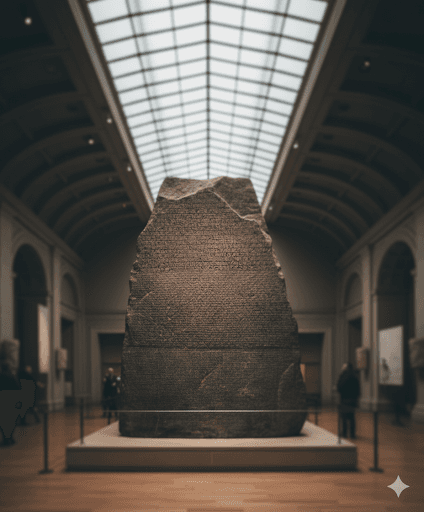
Representative image of the Rosetta Stone (generated by AI)
Standing approximately 36 inches (91 cm) high, 28 inches (71 cm) wide, and 9–10 inches (23–25 cm) deep, it is made of fine-grained, dark gray granite. The stone bears inscriptions in three different scripts: 14 lines of hieroglyphic characters at the top, 32 lines of Demotic script—then thought to be Syriac—in the middle, and 54 lines of Greek at the bottom. This trilingual text contains a decree issued in 197 BCE by Pharaoh Ptolemy V.
The discovery of the stone was announced in issue 37 of the Courier de l’Égypte, published in Cairo at the time. The document notes that part of the inscription on the stone had been translated by General Menou and that the text primarily described Ptolemy Philopater’s efforts to reopen canals in Egypt. It was also suggested that the stone held great significance for the study of hieroglyphs and might even provide the key to understanding them.
After Napoleon’s departure from Egypt, General Menou, who assumed command of the French forces, was compelled to surrender to the allied forces on 2 September 1801. According to Article 16 of the surrender agreement of Alexandria, all archaeological and scientific discoveries in French possession, including the Rosetta Stone, were transferred to British ownership. Although General Menou attempted to claim the stone as his personal property, he was ultimately forced to hand it over to the British.
According to a letter written by Colonel Tomkyns Hilgrove Turner to the Society of Antiquaries, the stone had been found in General Menou’s house in Alexandria, wrapped in soft cotton cloth and covered with two mats. Turner, with the assistance of a detachment of artillerymen, removed the stone from Menou’s residence and transported it to his own home. Despite facing mocking behavior from French officers and soldiers during this process, Turner successfully secured the stone. The stone was then shipped to England in February 1802 aboard HMS Madras, along with other artifacts. After being displayed briefly at the Society of Antiquaries, it was transferred to the British Museum.
The discovery of the stone played a pivotal role in the decipherment of Ancient Egyptian hieroglyphs. English physicist Thomas Young was the first to demonstrate that Egyptian characters recorded phonetic sounds and identified that certain hieroglyphs on the Rosetta Stone represented the name “Ptolemy.” However, the first complete translation of the stone was published in 1822 by French scholar Jean-François Champollion, building upon Young’s work. Champollion conducted an extensive linguistic study using the Rosetta Stone, the Philae obelisk, the ancient Coptic language of Egypt, and the writings of the Egyptian historian Manetho.
During World War I, due to intense bombing of London, the Rosetta Stone was moved in 1917 along with other portable artifacts to a vault 15 meters below Holborn Underground Station, where it remained for two years for safekeeping. In October 1972, to commemorate the 150th anniversary of the decipherment of hieroglyphs, the stone was temporarily removed from the museum and displayed for one month at the Louvre Museum in Paris. Recognized as the key to unlocking Ancient Egyptian culture, the Rosetta Stone is currently on display at the British Museum in London. Some scholars argue that the Rosetta Stone is not unique and that similar copies, containing the same text, may yet be discovered in other temples.
"Rosetta Taşı," Bilim ve Teknik 41, no. 622 (November 2008): 68, https://e-dergi.tubitak.gov.tr/edergi/yazi.pdf?dergiKodu=4&cilt=41&sayi=622&sayfa=68&yaziid=27038.
Durukan, Emra. "Tarihe Yön Veren Çeviriler: Septuaginta ve Reşid Taşı (Rosetta)." *Diyalog*, no. 1 (2017): 113-130. Accessed August 16, 2025. https://dergipark.org.tr/en/download/article-file/329031.
Kayaoğlu, M. Naci, and Ayşe Çetinoğlu. "MISIR HİYEROGLİFLERİNİ ÇÖZÜME GÖTÜREN DİLBİLİM ANAHTARLARI." Karadeniz Uluslararası Bilimsel Dergi 1, no. 17 (2013): 39-52. Accessed August 16, 2025. https://dergipark.org.tr/tr/pub/kdeniz/issue/16858/175471.
Stoddart, Lydia. "Rosetta Taşı: İskenderiye'den Londra'ya Bir Yolculuk." napoleon.org. Accessed August 16, 2025. https://www.napoleon.org/en/history-of-the-two-empires/articles/the-rosetta-stone-a-journey-from-alexandria-to-london/.

Discovery and Characteristics
Transfer to England
Decipherment and Current Location