

This article was automatically translated from the original Turkish version.
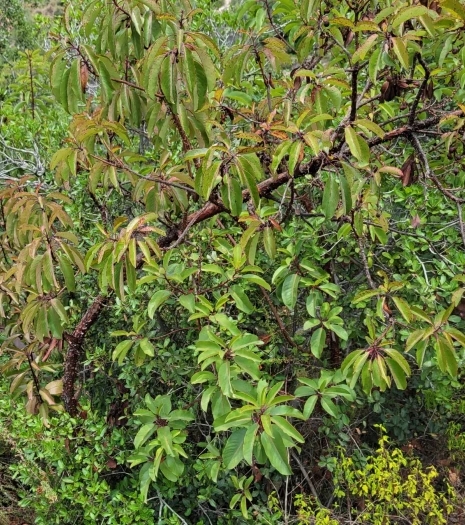
The strawberry tree (Arbutus andrachne L.), belonging to the genus Arbutus of the Ericaceae family, is a woody plant that is evergreen and grows as a tall shrub or small tree. This species typically reaches heights of 5 to 6 meters; its older trunks exhibit smooth, bright reddish-brown or light brown bark that tends to peel off in plates, while young shoots are covered in velvety hairs. The leaves are broad, oval-shaped with smooth margins, measuring 5 to 10 cm in length; only the leaf margins of young individuals show slight serration. The upper leaf surface is dark green, while the lower surface is light green and hairless. Flowers, which bloom in March and April, are white or pale greenish-cream and arranged in upright compound inflorescences. The fruits, ripening in autumn, are round, 1.0 to 1.5 cm in diameter, and range in color from orange-yellow to light red.【1】 The plant possesses a strong, deep-rooted system that can extend deep into the soil depending on the substrate, enabling adaptation to adverse conditions. In various regions of Türkiye, the strawberry tree is also known by local names such as “Yunan Kocayemişi,” “hartlap,” and “kızılbacak.”
The strawberry tree exhibits a wide geographic distribution ranging from the eastern Mediterranean region, including southern Albania, Greece, Türkiye, Lebanon, and northern Iraq, to Crimea via the Black Sea. Naturally occurring in the flora of Türkiye, this species can be found at elevations up to 800 to 1200 meters in the Marmara, Aegean, Mediterranean, and Black Sea regions. Ecologically, it is an important component of the Mediterranean shrubland and maquis vegetation, typically growing within pine forests, in forest clearings, and on dry rocky terrain. The species thrives on limestone, serpentinite, and volcanic substrates and prefers soils with sandy-clayey or clayey-sandy textures, slightly to moderately calcareous, with light to moderate alkaline reactions. It is also regarded as an indicator species for relatively moist areas where annual precipitation does not fall below 1000 mm.【2】
The strawberry tree begins morphological differentiation in its flower buds as early as February, followed by the development of sepals, petals, stamens, and carpels. This species can be propagated sexually, but its seeds exhibit physiological dormancy due to incomplete embryo development and the presence of chemical inhibitors. To break seed dormancy, cold stratification (e.g., 60 days at 4°C) or chemical pre-treatments such as gibberellic acid (GA3) are required. Laboratory tests have determined that seed viability, as assessed by the tetrazolium test, reaches 99%. In addition to seed propagation, vegetative propagation can also be achieved using stem cuttings treated with appropriate concentrations of auxin hormones, particularly IBA.【3】

Sandal Ağacı (Easyspace)
The species has a broad economic utility due to its wood, leaves, fruits, and shoots. Its wood, which has a high calorific value and produces no smoke when burned, is used as firewood for stoves and fireplaces and in the production of charcoal. Due to its dense texture, it is also utilized in carving, turning, and handicrafts. From a medicinal and pharmacological perspective, the bark and leaves contain secondary metabolites such as arbutin, monotropein, unedoside, and catechin (catechin). Arbutin exhibits antiseptic effects in the urinary tract, and plant extracts are traditionally used to treat rheumatism, hypertension, arthritis, and gastrointestinal disorders. The fruits are consumed fresh and are also used in jelly and pastry industries; they are rich in flavonoids, proanthocyanidins, vitamins C and E, and various antioxidant compounds. In the floristry industry, leafy and fruit-bearing shoots of the strawberry tree are harvested for use in wreath-making and are subject to significant export.
The leaves of the strawberry tree serve as an alternative succulent forage source for ruminants such as sheep, goats, and deer, particularly during winter months. However, its nutritional value and chemical composition (crude protein, neutral detergent fiber [NDF], acid detergent fiber [ADF], metabolizable energy [ME]) show statistically significant variations depending on the harvest season. Leaves harvested in January contain the highest crude protein content, but protein levels decline in subsequent months, while cell wall components (NDF, ADF) that hinder digestibility increase. The high concentration of condensed tannins in the leaves limits microbial utilization of protein and the digestibility of the forage. Therefore, when using strawberry tree leaves in animal diets, supplementation with protein and specific minerals (phosphorus, copper, manganese) is strongly recommended.【4】

Sandal Ağacı (Easyspace)
In Türkiye, where the strawberry tree is cultivated as a non-timber forest product, rehabilitation and management techniques are crucial for enhancing shoot yield. In degraded or unproductive stands, “rejuvenation cutting” performed with motorized saws close to ground level significantly promotes regeneration. Following these cuts, “stem thinning” operations conducted once new shoots emerge further maximize shoot yield. Forestry research has demonstrated that leaving 1 to 6 dominant stems per stand, depending on size, results in the highest average shoot yield per stem.
[1]
Cemile Ebru Onursal ve Şadiye Gözlekçi, “Sandal Ağacı (Arbutus andrachne L.) Tohumlarına Yapılan Bazı Ön Uygulamaların Tohum Çimlenme Oranı ve Süresi Üzerine Etkileri,” Akdeniz Üniversitesi Ziraat Fakültesi Dergisi 20, no. 2 (2007): 211–218, erişim 9 Mart 2026, https://dergipark.org.tr/en/download/article-file/18112
[2]
Orman Genel Müdürlüğü, Sandal (Arbutus andrachne L.) Yetişme Ortamı Özelliklerinin İncelenmesi (Teknik Rapor, Doğu Akdeniz Ormancılık Araştırma Enstitüsü, 2015), erişim 9 Mart 2026, https://www.ogm.gov.tr/doguakdeniz/yayinlarimiz-sitesi/Yayinlarimiz/Teknik%20Rapor/2015%20-%20Sandal%20(Arbutus%20Andrachne%20L.)%20Yeti%C5%9Fme%20Ortam%C4%B1%20%C3%96zelliklerinin%20%C4%B0ncelenmesi.pdf.
[3]
Sadettin Güler, Sandal (Arbutus andrachne L.)’ın Sürgün Verimini Artırıcı Tekniklerin Belirlenmesi (Isparta‑Sütçüler ve Antalya‑Serik Örneği) (Proje Sonuç Raporu, Batı Akdeniz Ormancılık Araştırma Enstitüsü Müdürlüğü, 2015), erişim 9 Mart 2026, https://www.ogm.gov.tr/batiakdeniz/kurulusumuz-sitesi/SonuclandirilanArastirmaProjeleri/Sandal%20(Arbutus%20Andrachne%20L.)’In%20Sürgün%20Verimini%20Artırıcı%20Tekniklerin%20Belirlenmesi%20(Isparta-Sütçüler%20ve%20Antalya-Serik%20Örneği).pdf.
[4]
Adile Tatlıyer, Adem Kamalak ve Durmuş Öztürk, “Sandal Ağacı (Arbutus andrachne) Yapraklarının Potansiyel Besleme Değerinin Belirlenmesi,” KSÜ Tarım ve Doğa Dergisi 22, no. 2 (2019): 315–321, erişim 9 Mart 2026, https://dergipark.org.tr/tr/download/article-file/647736.

No Discussion Added Yet
Start discussion for "Sandal Tree (Arbutus andrachne L.)" article
Geographic Distribution and Growing Environment
Flowering, Reproductive Biology, and Propagation Methods
Uses and Economic Value
Role in Animal Feeding and Forage Potential
Forestry Practices, Rehabilitation, and Shoot Yield