


This article was automatically translated from the original Turkish version.
+1 More
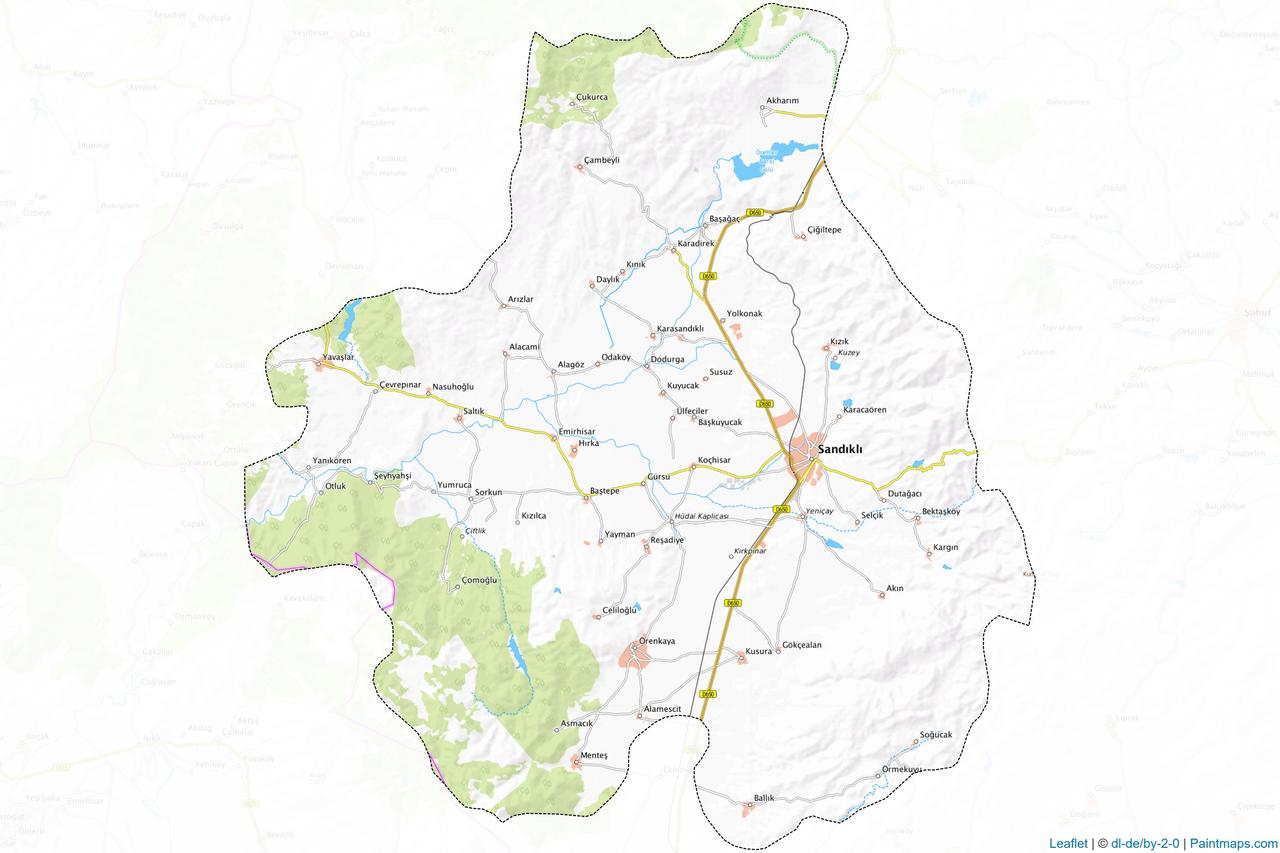
Sandıklı (District)
Province İt Belongs to | Afyonkarahisar | ||||||||
|---|---|---|---|---|---|---|---|---|---|
Population | 54.952 | ||||||||
Area(s) | 1.036 km² | ||||||||
District Governor | Selçuk YOSUNKAYA | ||||||||
Mayor(s) | Adnan ÖZTAŞ | ||||||||
Distance to City Center | 60 km | ||||||||
Number of Neighborhoods | 16 | ||||||||
Number of Villages | 56 | ||||||||
Climate(s) | Continental Climate | ||||||||
Sandıklı is a district of the province of Afyonkarahisar in Türkiye’s Aegean Region. Located south of the provincial capital and within the boundaries of the Inner Western Anatolia Region, the district occupies a strategic position along the Antalya–Afyonkarahisar highway. Sandıklı covers an area of 1,036 km² and is bordered by Şuhut to the east, Kızılören and Dinar to the south, Çivril of Denizli and Sivaslı of Uşak to the west, and Hocalar, Sincanlı and the central district of Afyonkarahisar to the north. According to 2024 TÜİK data, its population is 54,952.

Sandıklı District (Sandıklı Municipality)
The history of Sandıklı extends back to the Chalcolithic Age. Between 2700 and 2000 BCE, the Kussar Kingdom ruled the region, and artifacts from the Chalcolithic, Copper and Hittite periods were uncovered during excavations conducted between 1935 and 1937. After the Hittites, Sandıklı came under Phrygian control and was among the cities of the Pentapolis league. Subsequently, it was ruled by the Lydians and Persians, followed by the Romans. After the Battle of Manzikert in 1071, the region came under Turkish control and was conquered in 1076 by Emir Sanduk, later joining the Seljuks in 1115.
After the Battle of Myriokephalon in 1176, Sandıklı came fully under Turkish rule. During the Germiyanids period, mosques, caravanserais, and the Hisar Castle were constructed in 1325. In the 19th century, its population was recorded as 74,990 with 215 villages. Sandıklı first appeared as a district center in tax records from 1745 and became part of the Hüdavendigâr Vilayet in 1860; a municipal administration was established in 1869. During the War of Independence, the district was occupied by Greek forces and was recaptured three times in 1921. In the Republican period, Sandıklı participated in the Turkish Aeronautical Association campaign in 1925 by donating an aircraft; Atatürk visited the district in 1930; and the first female member of the municipal council was elected in 1935. The Sandıklı Railway Station opened in 1936.
During the Ottoman period, the Sandıklı Altın, minted in the name of Sultan Mahmud II, was the first gold coin issued outside Istanbul and continues to be traded on the stock exchange today.
Sandıklı is a district of Afyonkarahisar Province, situated in the Inner Western Anatolia section of the Aegean Region, along the Antalya–Ankara highway. It lies between 29° 50′ and 30° 30′ east longitude and 38° 15′ and 38° 45′ north latitude. Its area is 1,036 km². It is bordered by Şuhut to the east, Kızılören and Dinar to the south, Çivril of Denizli and Sivaslı of Uşak to the west, and Hocalar, Sincanlı and the central district of Afyonkarahisar to the north.
Sandıklı is a settlement surrounded by mountains on all sides:

Akdağ Nature Park (Sandıklı Municipality)
The main plains are Sandıklı Plain (1,070 m), Kusura (1,090 m), Karasandıklı (1,006 m) and Saltık (930 m). These plains are drained by the Kûfi Stream, which flows into the Büyük Menderes River.
Sandıklı has a continental climate with hot, dry summers and cold, harsh winters. Average temperatures range from -3°C in January to +23°C in July. The Poyraz, Lodos and western winds are prevalent.
Forest areas are concentrated in the higher elevations of the mountains. The district has 23,500 hectares of pine forest and 5,000 hectares of oak forest. Additionally, maquis vegetation, grassland plants, and poplar and willow trees are found along riverbanks.
The region lies on alluvial and brown soils over igneous rock formations. This landscape, known as “Katakekavmene” (burnt land), is characterized by travertine formations similar to those of Pamukkale.
Historically, Sandıklı’s economy has been based on agriculture and animal husbandry, but today industry, trade and thermal tourism play significant roles. Sandıklı, where coins were minted in 1808 and where the Ottoman Bank opened a branch in 1880, was once an economically vibrant district.
The district produces wheat (250,000 tons), barley (150,000 tons), sugar beet (280,000 tons), potatoes (50,000 tons), apples (1,000 tons) and cucumbers (1,700 tons). Irrigation capacity has increased with the Örenler Dam, leading to the widespread adoption of irrigated farming. Among industrial crops, sugar beet, potatoes, opium poppy and sunflower are prominent. Sandıklı ranks second in Turkey for opium poppy production after Çivril. Opium poppy oil is used for cooking and the residue as animal feed. To support agricultural activities, the Soil Products Office Sandıklı Branch was established.
Large-scale livestock farming is practiced in the plain villages, while small-scale livestock farming is common in the mountain villages. The district has:
Transhumance is practiced during summer months and feed-based animal husbandry during winter.
PaintMaps. "Şehir Haritası Grafiği." Accessed August 16, 2025. https://paintmaps.com/tr/harita-grafikleri/sehir-haritasi-grafigi.
Sandıklı Belediyesi. *Akdağ Tabiat Parkı*. Accessed August 16, 2025. https://sandikli.bel.tr/hizmetler/akdag-tabiat-parki.
Sandıklı Municipality. "Coğrafyası." T.C. Sandıklı Belediyesi. Accessed August 16, 2025. https://sandikli.bel.tr/cografyasi/
Sandıklı Municipality. "Ekonomisi." T.C. Sandıklı Belediyesi. Accessed August 16, 2025. https://sandikli.bel.tr/sayfalar/ekonomisi
Sandıklı Municipality. "Tarihi." T.C. Sandıklı Belediyesi. Accessed August 16, 2025. https://sandikli.bel.tr/tarihi/
T.C. Ministry of Culture and TourismAfyonkarahisar İl Directorate of Culture and Tourism. *İlçelerin İllere Olan Uzaklıkları*. Accessed August 1, 2025. https://afyon.ktb.gov.tr/TR-63435/ilcelerin-illere-olan-uzakligi.html
T.C.Sandıklı Kaymakamlığı Governorship. "Mahalli İdareler." Accessed August 16, 2025. http://www.sandikli.gov.tr/mahalli-idareler
Türkiye İstatistik Kurumu (TÜİK). "Adrese Dayalı Nüfus Kayıt Sistemi Sonuçları, 2024." Publication No: 53783. Accessed August 19, 2025.
Sandıklı (District)
Province İt Belongs to | Afyonkarahisar | ||||||||
|---|---|---|---|---|---|---|---|---|---|
Population | 54.952 | ||||||||
Area(s) | 1.036 km² | ||||||||
District Governor | Selçuk YOSUNKAYA | ||||||||
Mayor(s) | Adnan ÖZTAŞ | ||||||||
Distance to City Center | 60 km | ||||||||
Number of Neighborhoods | 16 | ||||||||
Number of Villages | 56 | ||||||||
Climate(s) | Continental Climate | ||||||||
No Discussion Added Yet
Start discussion for "Sandıklı (District)" article
History
Geographical Location and Physical Structure
Mountains
Plains
Climate
Vegetation
Geological Structure
Economy
Agriculture
Animal Husbandry