This article was automatically translated from the original Turkish version.
+2 More
Location | Şanlıurfa Türkiye | ||||||||
|---|---|---|---|---|---|---|---|---|---|
Period(s) | Neolithic | ||||||||
Discoveries/Excavations | 2021 and Beyond | ||||||||
Area(s) | Approximately 3000 m² | ||||||||
Sayburç is a settlement dated to the Pre-Pottery Neolithic B (PPNB) period, located on the Şanlıurfa Plateau at the southern foothills of the Eastern Taurus Mountains. The settlement dates to approximately the middle of the 9th millennium BCE and is considered part of the same cultural tradition as other regional centers such as Göbeklitepe, Karahantepe and Nevali Çori, particularly in terms of architectural development, symbolic production and ritual practices.
Sayburç is situated approximately 20 km southeast of the city center of Şanlıurfa, beneath and around the modern village of Sayburç. Since part of the settlement lies under current village structures, excavations have been carried out progressively. The first scientific excavations began in 2021 under the Şanlıurfa Neolithic Research Project.

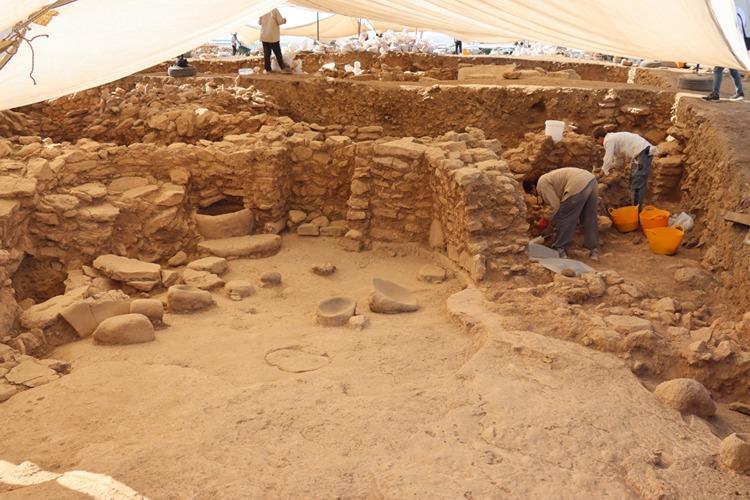
Sayburç (AA)
Two distinct settlement sections have been identified in the northern and southern areas. The settlement exhibits a single-phase occupation characterized by horizontal expansion rather than vertical stratification. Dwellings were built directly onto the bedrock, and a contiguous linear planning concept dominates the entire site. Open spaces are limited; the continuous addition of building clusters has created a closed settlement fabric.
The settlement is characterized by oval, circular and rectangular building types arranged in a contiguous linear plan, constructed directly on limestone bedrock. Within the dwellings, niches carved into walls, apsidal plans, supporting pillars, terrazzo and lime-plastered floors, seating areas carved from the bedrock, and dome-shaped hearths have been documented. Transitions between structures are achieved through intersecting wall lines, and open areas remain minimal. In some buildings, T-shaped pillars have been integrated into interior spaces; this indicates that this distinctive regional architectural tradition extended into domestic interiors.
A number of “special structures” have been identified embedded within the domestic fabric of the settlement. These structures differ from everyday dwellings through their larger scale, multiple T-shaped pillars, two-tiered benches and symbolic decorations. The special structures do not form independent sacred precincts but are directly embedded within the domestic architecture. In the large special structure in the northern area, reliefs have been carved onto the inner surfaces of benches running along the walls.
Discovered in 2021, these reliefs consist of five figures arranged in two distinct scenes on a panel measuring 3.7 meters in length. One human figure is rendered in high relief, while the others are executed in low relief. The scenes depict leopards, a bull and two male human figures. The shared orientation of the figures suggests a narrative unity, indicating that these are among the earliest known examples of “narrative scenes” from the Neolithic period.
The inward-facing orientation of the high-relief male figure suggests that the symbolic narrative was intended for use within a public or ceremonial context. The emphasis on “threat-signaling” features such as teeth and horns on the animals reflects a shared iconographic language observed at other Early Neolithic sites on the Urfa Plateau.
Human remains recovered from the settlement exhibit secondary burial characteristics. Long bones and cranial fragments were placed in niches within dwellings and along floor edges; some bones show evidence of burning.
When considered alongside other Early Neolithic settlements in the region such as Göbeklitepe and Karahantepe, Sayburç demonstrates that symbolic production and public ritual spaces were defining elements of settled life from its earliest phases. For instance, the presence of T-shaped pillars in both domestic and special structures indicates an intimate entanglement between the sacred and everyday life.
Anadolu Ajansı. "Şanlıurfa'daki Sayburç'ta 50'den fazla neolitik yapı gün yüzüne çıkarıldı." Accessed October 17, 2025. https://www.aa.com.tr/tr/kultur/sanliurfadaki-sayburcta-50den-fazla-neolitik-yapi-gun-yuzune-cikarildi/3674936
Ministry of Culture and Tourism of the Republic of Türkiye, Taş Tepeler. "Yerleşmeler, Sayburç." *tastepeler.org*. Accessed October 17, 2025. https://tastepeler.org/yerlesmeler/sayburc
Özdoğan, Eylem. "Sayburç A Mid-9th Millennium BC Site In The Foothills Of The Eastern Taurus." *Documenta Praehistorica* LI (2024): 44-58. Accessed October 17, 2025. https://journals.uni-lj.si/DocumentaPraehistorica/article/view/18953
Özdoğan, Eylem. "The Sayburç Reliefs: A Narrative Scene From The Neolithic." *Antiquity* 96, no. 390 (2022): 1599-1605. Accessed October 17, 2025. https://www.cambridge.org/core/journals/antiquity/article/sayburc-reliefs-a-narrative-scene-from-the-neolithic/3A35B54B3265C7224CB225FE70EBDD02

Location | Şanlıurfa Türkiye | ||||||||
|---|---|---|---|---|---|---|---|---|---|
Period(s) | Neolithic | ||||||||
Discoveries/Excavations | 2021 and Beyond | ||||||||
Area(s) | Approximately 3000 m² | ||||||||
No Discussion Added Yet
Start discussion for "Sayburç Excavation Site" article
Location and Research History
Settlement Layout
Architectural Features
Special Structures
Sayburç Reliefs
Burial Practices
Cultural Context