


This article was automatically translated from the original Turkish version.
The Jordan River is a river located in the Middle East, originating in Lebanon and Syria, and flowing through the territories of Jordan, Israel, and Palestine. The river lies within a closed basin and empties into the Dead Sea, occupying a historically and geographically significant position in the Eastern Mediterranean region.
The Jordan River is formed by the confluence of the Hasbani and Bareighit rivers in Lebanon and the Banias and Leddan rivers in Syria. These tributaries are fed by snowmelt and underground springs. The river originates at an elevation of approximately 305 meters and descends about 396 meters by the time it reaches the Dead Sea. With a total drop of approximately 701 meters, the Jordan River is recognized as the world’s lowest-elevation river. Its length is approximately 113 kilometers in a straight line and about 322 kilometers along its winding course. Along its flow, it is divided into three main sections: the stretch from its source to the Hula Lake, the approximately 16-kilometer segment between Hula Lake and the Sea of Galilee (Tiberias), and the final 105-kilometer stretch from the Sea of Galilee to the Dead Sea.
The Jordan River’s water sources are snow, rainfall, and groundwater. The river experiences significant drops in water level, especially during summer months. Since the mid-20th century, intensive water extraction from the river has led to a substantial reduction in its flow. Today, it is one of the primary sources for agricultural irrigation and drinking water supply.
The Jordan River has served as a settlement area for various civilizations throughout history. Since ancient times, it has been a crucial transit point connecting Mesopotamia, Egypt, and the Levant. It is frequently mentioned in religious texts and historical documents. It is also regarded as a significant site in the Abrahamic religions—Judaism, Christianity, and Islam.
The Jordan River holds special importance in Christianity due to its association with baptism. According to Christian tradition, Jesus Christ was baptized by John the Baptist in the Jordan River. This event is regarded as the turning point marking the beginning of Jesus’ prophetic ministry in Christianity.
Today, the Jordan River has become an important pilgrimage site for Christians. The area along the river known as “Bethany Beyond the Jordan” (Al-Maghtas) is visited in commemoration of the baptism. Pilgrims from Catholic, Orthodox, and Protestant denominations conduct symbolic baptismal ceremonies in the Jordan River.
The region was inscribed on UNESCO’s World Heritage List in 2015, recognizing its religious significance at an international level. This unique association of the Jordan River with baptism continues to underscore its importance both historically and in contemporary religious practice.
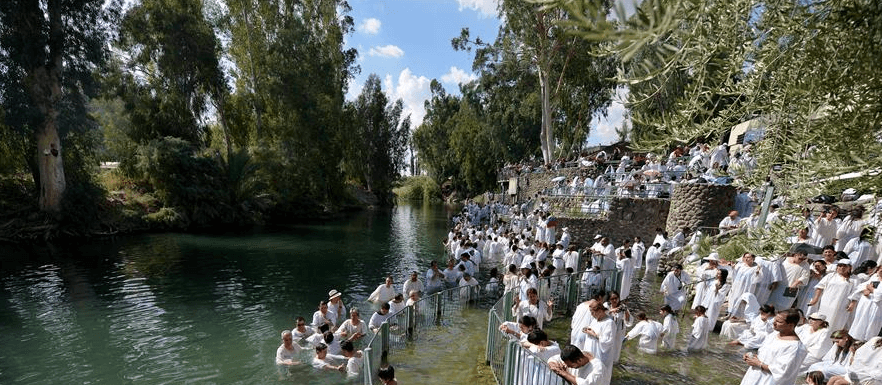
Hundreds of Christian pilgrims from Latin America, wearing white robes, enter the Jordan River (Jordan) to be baptized (AA)
During the Ottoman Empire, commercial rights to use and market water from the Jordan River were granted to specific companies. The International Jordan River Water Company, established in 1906, played a significant role in this context. The company processed water drawn from the river, primarily for use in baptismal ceremonies and drinking purposes, and sold it to various countries around the world.
This practice highlighted the economic value of the region’s water resources and demonstrated the role of water in international trade at the time. The use of Jordan River water by Christian pilgrims in baptismal rites formed one of the central pillars of the company’s commercial activities.
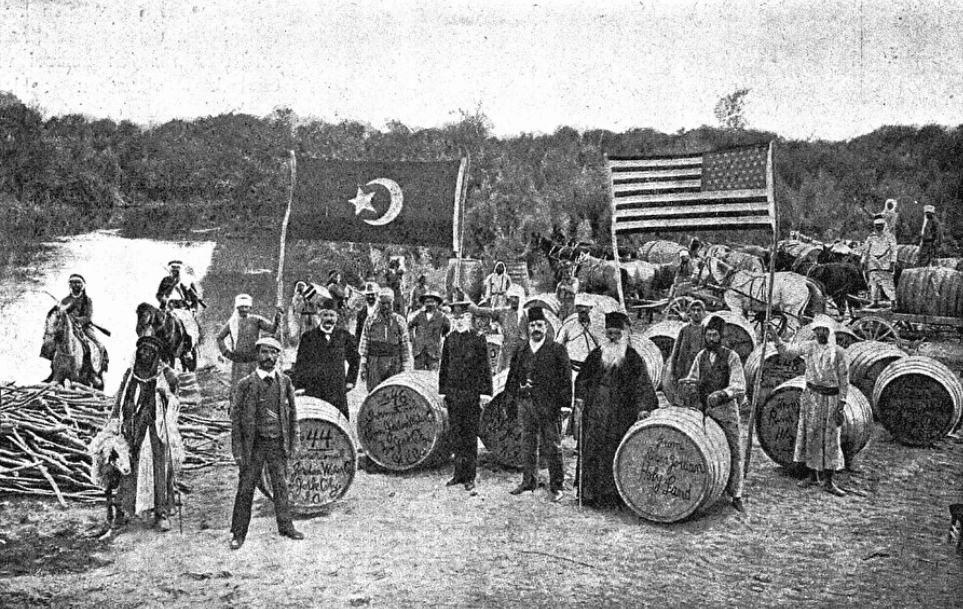
In the center, an American colonel representing the International Jordan River Water Company, alongside representatives of the governor of Jericho and the Patriarch of Jerusalem (AA)


Geographical Features
Hydrography
History and Cultural Context
Significance in Christianity
Water Rights and Trade Privileges for the Jordan River during the Ottoman Period
