



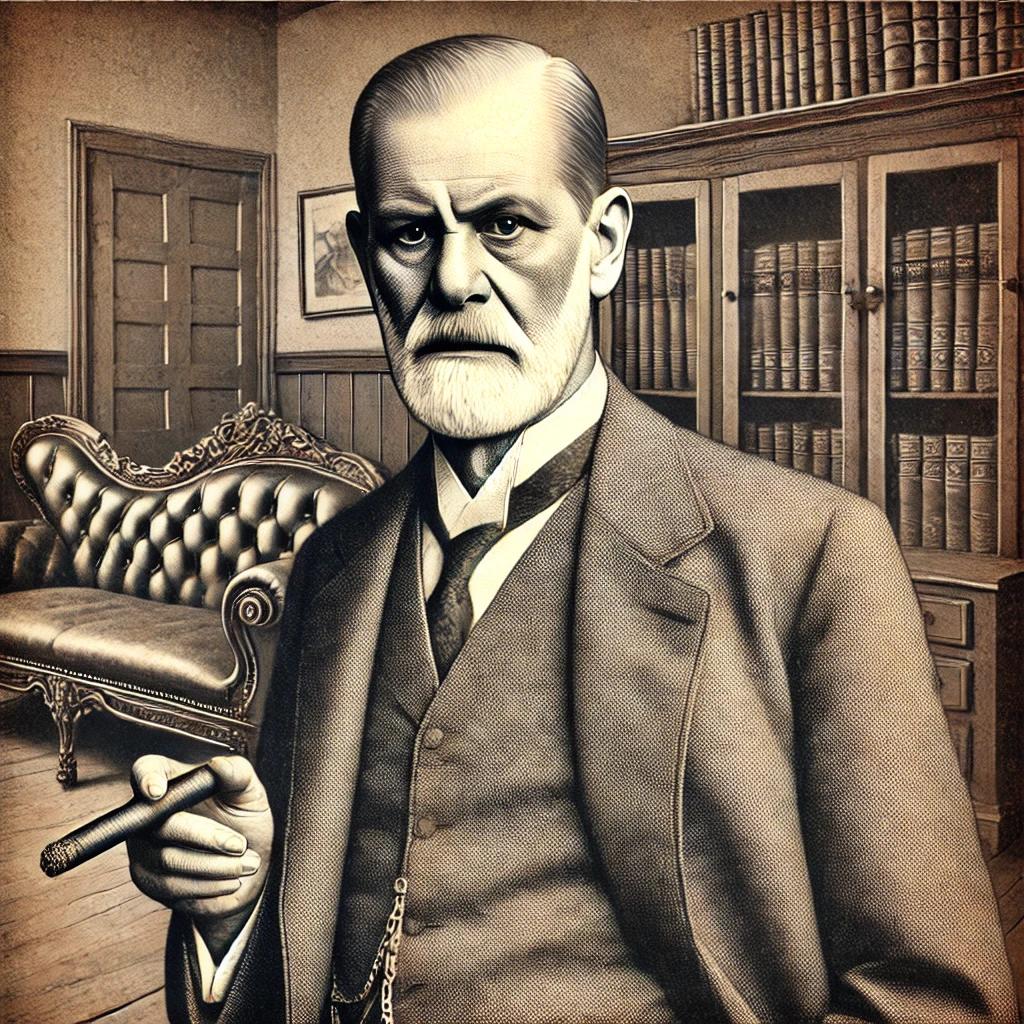
Sigmund Freud
Babası | Jakob Freud | ||||||||
|---|---|---|---|---|---|---|---|---|---|
Eş | Martha Bernays | ||||||||
Annesi | Amalia Nathansohn Freud | ||||||||
Yaş | 83 | ||||||||
Ölüm tarihi | 1939-09-23 | ||||||||
Doğum tarihi | 1956-05-06 | ||||||||
Çocuk | Anna Freud (known as a psychoanalyst) Sophie Freud Ernst Freud Oliver Freud Jean-Martin Freud Mathilde Freud | ||||||||
Sigmund Freud, an Austrian neurologist born on 6 May 1856 in Moravia (today the Czech Republic), is regarded as one of the leading figures in psychology. He developed a theory arguing that the human mind is guided by unconscious processes. His work encompasses concepts such as the unconscious, psychoanalysis, the psychosexual development theory, and defense mechanisms. In 1938, due to Nazi pressure, he emigrated to London and died in 1939 from oral cancer.
Sigmund Freud was born on 6 May 1856 in Moravia (today the Czech Republic). He was born into a Jewish family and spent his childhood amid economic hardship. His family moved to Vienna when Freud was four years old. In 1873, he enrolled at the Medical Faculty of the University of Vienna. During his studies, he began his first serious research in his professor’s medical laboratory. He developed an interest in physiology and worked with Ernst Brücke.
In his academic career, Freud believed his progress would be hindered due to his Jewish identity, so he turned toward the study of neurological disorders. In 1885, he traveled to Paris to study Jean-Martin Charcot’s work on hypnosis and hysteria. This experience became a turning point in his understanding of psychopathology. Upon returning to Vienna, he collaborated with Josef Breuer on cases of hysteria.
Ana O., a patient treated by Breuer, contributed significantly to the development of the psychoanalytic approach. Freud developed the method of free association as an alternative to hypnosis for accessing the unconscious. He began using the term “psychoanalysis” in 1896 and published his book *The Interpretation of Dreams* in 1900. Although this book laid the foundations of psychoanalytic theory, it sold only about 600 copies in its first few years.
There is general consensus in the literature that Freud’s theory reflects aspects of his own life. Although he was his mother’s first child, his father had children from previous marriages. His bond with his mother was very strong, but he had a poor relationship with his father. It is known that even years after his father’s death, Freud struggled for years with feelings of guilt stemming from their strained relationship. Consequently, some researchers argue that Freud’s formulation of the Oedipus complex—sexual desire toward the mother and competitive hostility toward the father—was influenced by his own family dynamics.
In the 1880s, Freud became engaged to Martha Bernays and wished to earn a stable income before marrying her. For this reason, he opened his own medical practice immediately after graduating. After a four-year engagement, they married in 1886. They had six children. Their youngest child, Anna, followed in her father’s footsteps and continued his psychoanalytic work. In 1938, due to Nazi persecution, Freud and his family emigrated from Vienna to London. Freud died in London on 23 September 1939 from oral cancer.
Freud divided the personality into three levels: conscious, preconscious, and unconscious. According to Freud, all behaviors we are aware of occur at the conscious level; our thoughts and perceptions reside here. The preconscious contains information that can be recalled through effort; our memories are stored at this level. The unconscious holds repressed emotions and desires of which we are unaware. Unacceptable desires, socially unacceptable wishes, and difficult experiences are buried in this section. Freud argued that most of our actions are driven by unconscious processes. To illustrate this model:
A friend ignores us.
Conscious: “He probably didn’t notice me.”
Preconscious: “He might be reacting to something I did two days ago.” (I recalled this information with effort)
Unconscious: “When I was a child, my father ignored me and wouldn’t play with me, and I felt this same bad feeling.” (Repressed emotions from my childhood)
If we compare this model to an iceberg, the visible part is the conscious, the part just beneath the surface is the preconscious, and the large unseen portion below the water is the unconscious.

Visual related to the topographic model (generated by YZ)
"In its relation to the id, the ego is like a man on horseback, who has to hold in check the superior strength of the horse, yet at the same time guide it toward the direction it wishes to go." — Sigmund Freud.
Later, Freud found the topographic model insufficient to explain personality and developed a more comprehensive model. He argued that the human mind is largely guided by unconscious processes and aimed, through psychoanalysis, to uncover internal conflicts within the unconscious. According to Freud, personality consists of three fundamental components: the id, the ego, and the superego.
Illustrating the personality model with an example:
You are hungry and crave chocolate.
Id: “Eat the chocolate right away.” (Pleasure, immediate gratification)
Ego: “You can eat it, but not too much.” (Attempts to balance the id and reality)
Superego: “No, you shouldn’t eat it. Others are hungry too.” (Moral rules and ethical standards)

Visual related to id, ego, and superego (generated by YZ)
According to Freud, humans have two fundamental drives: life and sexuality. Freud explained sexuality or the life instinct through the concept of libido. Libido encompasses all behaviors oriented toward pleasure, not just sexual ones. He explained aggression or the death instinct through the concept of thanatos.
The purpose of defense mechanisms is to push anxiety into the unconscious, distancing the individual from negative emotions and allowing the ego to feel better. They serve two primary functions: preventing impulses from influencing conscious behavior and reducing the intensity of anxiety. According to Freud, all defense mechanisms operate unconsciously and reduce tension. Freud’s daughter Anna further developed these concepts. Some defense mechanisms include:
Repression: Pushing traumatic memories into the unconscious.
Projection: Attributing one’s own unacceptable thoughts to others.
Regression: Exhibiting childlike behaviors under stress.
Sublimation: Transforming threatening unconscious impulses into socially acceptable behaviors. For example, directing a child’s aggression toward karate.
Displacement: Redirecting disturbing impulses toward a less threatening object or person. For example, being angry at a coworker and then taking it out on a partner.
Denial: Refusing to accept reality. For example, denying a mother’s death despite knowing she has passed away.
Reaction Formation: Behaving in a way opposite to one’s true feelings.
According to Freud, personality is formed during the first five or six years of life. He described five developmental stages, each centered on a primary erogenous zone. The defining characteristic of each stage is the body region that provides the greatest pleasure.
Oral Stage (0–1 year): The infant derives pleasure from sucking.
Anal Stage (1–3 years): Toilet training leads to the development of control and autonomy.
Phallic Stage (3–6 years): The Oedipus complex【1】, castration anxiety【2】
Burger, Jerry M. Kişilik. Trans. İnan Deniz Erguvan Sarıoğlu. 1st ed. Istanbul: Kaktüs Yayınları, 2006.
Doksat, M. Kerem, and Barış Önen. "Sigmund Freud." Yeni Symposium 42, no. 2 (2004): 60-71. Accessed March 19, 2025. Accessed Adresi.
Gerald, Corey. Psikolojik Danışma ve Psikoterapi: Kuram ve Uygulamaları. Trans. Tuncay Ergene. 1st ed. Ankara: Mantis Yayıncılık, 2008.
[1]
According to Freud, it is the child's development of romantic feelings toward the parent of the opposite sex and jealousy toward the same-sex parent.
[2]
According to Freud, the boy fears that, upon noticing that the girl lacks a penis, his own penis may also be removed., and penis envy

Sigmund Freud
Babası | Jakob Freud | ||||||||
|---|---|---|---|---|---|---|---|---|---|
Eş | Martha Bernays | ||||||||
Annesi | Amalia Nathansohn Freud | ||||||||
Yaş | 83 | ||||||||
Ölüm tarihi | 1939-09-23 | ||||||||
Doğum tarihi | 1956-05-06 | ||||||||
Çocuk | Anna Freud (known as a psychoanalyst) Sophie Freud Ernst Freud Oliver Freud Jean-Martin Freud Mathilde Freud | ||||||||
Birth and Academic Life
Reflection of Family Relationships in His Theory
Marriage and Death
Freudian Approach
Topographic Model
Structural Personality Model
Libido and Thanatos
Defense Mechanisms
Psychosexual Development Theory