


This article was automatically translated from the original Turkish version.
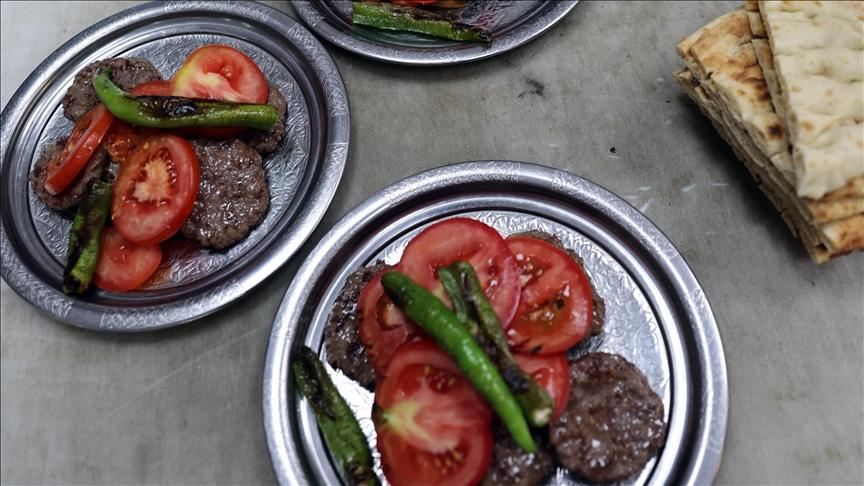
Sivas Köftesi
Origin | Sivas/Türkiye | ||||||||
|---|---|---|---|---|---|---|---|---|---|
Geographical Indication | Mahreç sign | ||||||||
Registration Number | 140 | ||||||||
Registration Authority | Turkish Patent and Trademark Office | ||||||||
Registration Year | 2011 | ||||||||
Product / Product Group | Meat products-Köfte | ||||||||
Raw Material | Salt Beef or lamb leg meat | ||||||||
Sivas Köftesi is a traditional meatball variety unique to the province of Sivas, prepared exclusively from beef or lamb leg meat without any additives and cooked on a grill. Only salt is used in its production; no spices, flour, onion, or other ingredients are added. Thanks to the physical structure of the meat and the processing method, the product exhibits a distinctive flavor profile despite its simple ingredients. The product was officially registered with a geographical indication in 2011 and may only be produced within the boundaries of Sivas province using the defined methods.

Sivas Köftesi (AA)
Sivas Köftesi is traditionally produced in Sivas, one of the major cities of the Central Anatolia Region. This meatball, prepared with the same simplicity for many years, reflects the local community’s processing and consumption habits regarding meat products. The dish’s origins are linked to the meat-based dietary culture of communities engaged in animal husbandry. The production method has been passed down from generation to generation.
Sivas Köftesi has been registered as a geographical indication under Law No. 6769 on Industrial Property. The application for registration was submitted by the Sivas Chamber of Commerce and Industry on 1 February 2006, and the product was officially registered by the Turkish Patent and Trademark Office on 31 January 2011. It is recorded under Registration No. 140.
The registration requires that the meat used in Sivas Köftesi be sourced from animals raised on Sivas highlands feeding on natural grasses, that no additives other than salt be included, and that cooking be performed on charcoal from oak wood.
The meat, obtained from the rib, leg, and shoulder areas of cattle at least two years old and from the leg area of sheep, is thoroughly cleaned of nerves, blood vessels, and membranes.
The cleaned meat is mixed with 20 grams of natural spring salt per kilogram and passed once through a meat grinder to achieve a medium grind. The mixture is kneaded once without additives and left to rest for at least 12 hours in a cool place or refrigerator.
The rested meat is passed through the meat grinder again to achieve a homogeneous texture. The resulting mixture is shaped by hand into oval patties weighing 25 grams each, with a diameter of 6–7 cm and a thickness of 0.5 cm. The hands are lightly moistened during shaping, but excessive water must be avoided.
The prepared meatballs are cooked on a bed of dense oak charcoal without direct flame, turned at short intervals to ensure even cooking on both sides. Cooking is complete when the interior remains moist and the outer surface begins to turn dark brown.
The meatballs are served hot on Sivas pide, accompanied by charred tomatoes and green pointed peppers. Typically, dried onion, sumac-dressed parsley salad, tomato paste, and various greens are also offered alongside.
Sivas Köftesi stands out as a fundamental element of the regional cuisine. The minimalist production method reflects the traditional culinary culture of Sivas. The geographical indication certification aims to preserve and promote this cultural value. It is widely served in local restaurants and is a preferred dish among visitors to Sivas. It is also a certified product that contributes to regional gastronomic tourism.
Anadolu Ajansı. “"Usta" ailesi 4 kuşaktır tescilli Sivas köftesiyle damakları tatlandırıyor.” Accessed May 8, 2025.https://www.aa.com.tr/tr/insana-dair/usta-ailesi-4-kusaktir-tescilli-sivas-koftesiyle-damaklari-tatlandiriyor/3253170
Anadolu Ajansı. “Tescilli Sivas köftesinde talebe yetişmek için seri üretime geçti.” Accessed May 8, 2025.https://www.aa.com.tr/tr/yasam/tescilli-sivas-koftesinde-talebe-yetismek-icin-seri-uretime-gecti/3057552
T.C. Ministry of Culture and Tourism. "Sivas Köftesi-Sivas." Türkiye Kültür Portalı. Accessed May 8, 2025.https://www.kulturportali.gov.tr/turkiye/sivas/neyenir/sivas-koftesi
Turkish Patent and Trademark Office. "Sivas Köftesi." Coğrafi İşaret Portalı. Accessed May 8, 2025.https://ci.turkpatent.gov.tr/cografi-isaretler/detay/37965

Sivas Köftesi
Origin | Sivas/Türkiye | ||||||||
|---|---|---|---|---|---|---|---|---|---|
Geographical Indication | Mahreç sign | ||||||||
Registration Number | 140 | ||||||||
Registration Authority | Turkish Patent and Trademark Office | ||||||||
Registration Year | 2011 | ||||||||
Product / Product Group | Meat products-Köfte | ||||||||
Raw Material | Salt Beef or lamb leg meat | ||||||||
Origin
Geographical Indication and Certification
Sivas Köftesi Recipe
Ingredients
Preparation
Meat Preparation
Mincing and Salting
Second Grinding and Shaping
Cooking
Serving
Cultural Significance