
This article was automatically translated from the original Turkish version.
Eusociality (Eng. Eusociality) is a term used in biology to describe a level of social organization. This system is characterized by overlapping generations among adult members of a colony, cooperative care of offspring, and division of the colony into reproductive and largely nonreproductive (or less reproductive) castes. The existence of nonreproductive individuals poses one of the fundamental questions in evolutionary biology, as these individuals reduce their potential to pass on their own genes directly through offspring. Eusociality is prominently observed in insect orders such as ants, honeybees, wild bees, and termites. The colonies formed by these organisms create complex structures known as “superorganisms,” representing a distinct level of biological organization.
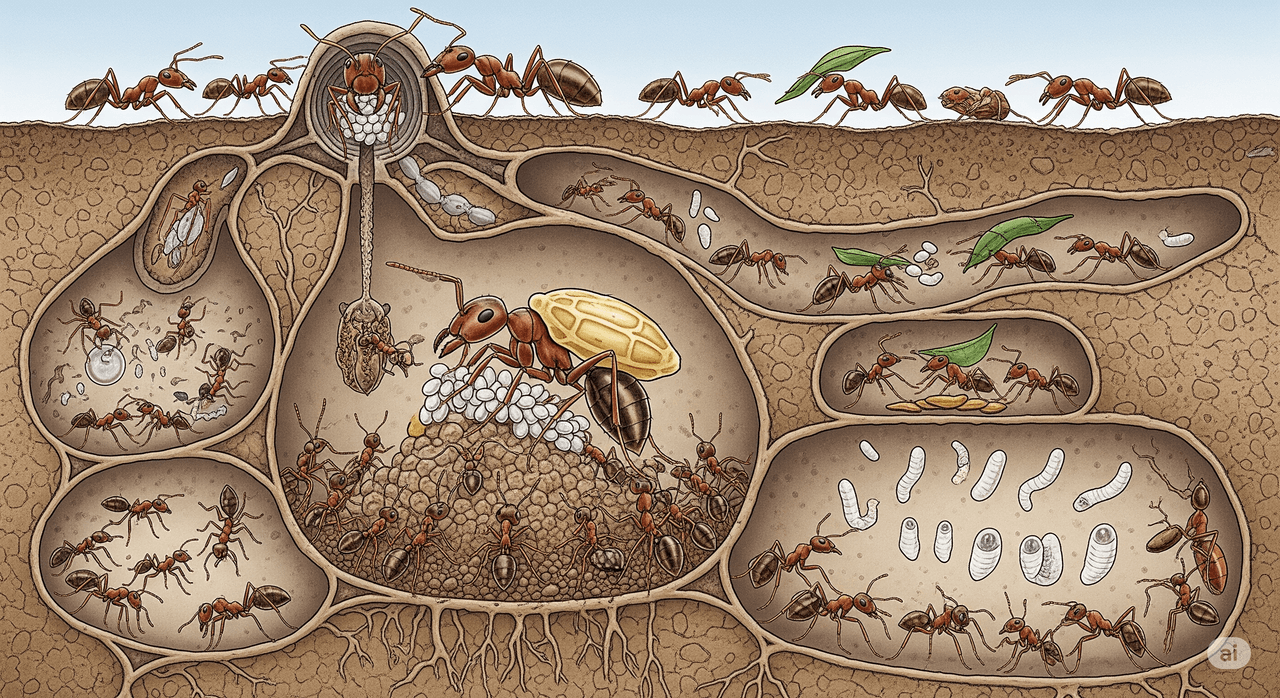
Eusocial Life and Castes in an Ant Colony (Generated by Artificial Intelligence)
The term eusociality was first used in 1966 by S. W. T. Batra to describe honeybee nests in which founding parents live alongside their adult daughters and cooperate with division of labor. The concept was refined by Charles D. Michener in 1969 and given its current widely accepted definition by Edward O. Wilson in 1971. According to Wilson’s definition, eusociality has three key characteristics:
The primary driver behind the development of this definition was its initial formulation for bees in the family Halictidae, followed by its generalization to other social arthropods.
The phrase “reproductive division of labor” in Wilson’s definition has lacked a precise meaning, leading over time to conceptual ambiguity. This ambiguity has caused different researchers to classify various taxa as eusocial based on often unstated criteria.
Bernard J. Crespi and Douglas Yanega (1995) proposed a redefinition of eusociality to resolve these ambiguities. Their key criterion is the presence of castes, defined as “groups of individuals that become behaviorally irreversibly differentiated at a point prior to reproductive maturity.” According to this definition, a society can be considered eusocial only if it possesses the following two features:
Totipotency is defined as the potential of an individual to exhibit the entire behavioral repertoire of the population and to produce offspring with a full behavioral repertoire without assistance. The irreversible loss, during development, of the capacity to perform at least one behavior specific to another caste constitutes a loss of totipotency.
According to this distinction, eusociality is divided into two subcategories:
The evolution of eusociality was described by Charles Darwin in his book On the Origin of Species as “one of the most special difficulties” for his theory. The existence of sterile workers appeared to contradict the mechanism of natural selection, which is based on individual reproductive success. Darwin proposed as a solution that selection might operate at the level of the colony rather than the individual.
Eusociality is widely regarded as an evolutionarily rare phenomenon. Of approximately 2,600 known insect and other arthropod families, only 15 contain eusocial species, and these are estimated to have originated independently on only 12 occasions. This rarity indicates a high evolutionary threshold for the transition to eusociality. The most likely explanation is that the power of individual selection typically overrides the benefits of group living.
Wilson and Hölldobler (2005) argued that eusocial evolution involves a “point of no return.” This point is marked by the emergence of anatomically distinct worker castes. After this stage, it becomes nearly impossible for a species to revert from eusocial life to a simpler social level or solitary existence. Evidence supporting this view includes documented reversions to solitary life in primitive eusocial bee lineages lacking anatomical castes, yet no such reversion has ever been observed among the 11,000 ant species and 2,000 termite species that possess anatomical castes.
Various theoretical frameworks have been developed to explain the evolution of eusociality. These approaches generally focus on the roles of kin selection, group selection, and ecological factors.
In 1964, W. D. Hamilton introduced the concepts of kin selection and inclusive fitness to explain eusociality. According to this theory, an individual can indirectly pass on its genes to future generations not only by raising its own offspring but also by helping relatives raise theirs.
Haplodiploidy Hypothesis: The best-known application of Hamilton’s theory is the haplodiploid sex-determination system unique to Hymenoptera (ants, bees, and wasps). In this system, fertilized eggs develop into females (diploid), while unfertilized eggs develop into males (haploid). As a result, sisters share on average three-quarters of their genes (r=3/4), whereas a mother shares only half her genes with each of her offspring (r=1/2). Therefore, a female Hymenoptera individual can more effectively pass on her genes by helping her fertile sisters raise offspring rather than raising her own. For many years, this hypothesis was accepted as the primary mechanism explaining why eusociality evolved so frequently in Hymenoptera.
However, over time, limitations of this hypothesis have become evident:
Parallel to Darwin’s original proposal, researchers such as Wilson, Hölldobler, and Nowak argue that the primary driving force in the evolution of eusociality is group selection. According to this model, alleles promoting altruism spread if groups carrying these alleles have higher survival and reproductive success than groups lacking them. In this framework:
Nowak and colleagues (2010) proposed a multistage model for eusocial evolution:
Several behavioral and ecological preconditions common to lineages that evolved eusociality have been identified:
Andersson, Malte. “The Evolution of Eusociality.” *Annual Review of Ecology and Systematics* 15 (1984): 165–89. Accessed August 16, 2025. http://www.jstor.org/stable/2096946.
Crespi, Bernard J., and Douglas Yanega. "The Definition of Eusociality." *Behavioral Ecology* 6, no. 1 (1995): 109–15. Accessed August 16, 2025. https://doi.org/10.1093/beheco/6.1.109.
Nowak, Martin A., Corina E. Tarnita, and Edward O. Wilson. "The Evolution of Eusociality." *Nature* 466, no. 7310 (2010): 1057–62. Accessed August 16, 2025. https://pmc.ncbi.nlm.nih.gov/articles/PMC3279739/pdf/nihms329641.pdf.
Wilson, Edward O., and Bert Hölldobler. "Eusociality: Origin and Consequences." *Proceedings of the National Academy of Sciences of the United States of America* 102, no. 38 (2005): 13367–71. Accessed August 16, 2025. https://doi.org/10.1073/pnas.0505858102.

Definition and Terminology
Traditional Definition
Ambiguities in the Definition and Proposals for Redefinition
Evolutionary Origin and Historical Development
Rarity in Evolution and the “Point of No Return”
Theoretical Approaches and Debates
Kin Selection and Inclusive Fitness
Group Selection and Multilevel Evolution Model
Other Mechanisms
Preconditions for Evolution
Groups in Which It Is Observed and Examples