This article was automatically translated from the original Turkish version.
+2 More
Location | Sofraz Village Türkiye Adıyaman Besni | ||||||||
|---|---|---|---|---|---|---|---|---|---|
Period(s) | Roman Period 1st–2nd century CE | ||||||||
Building Type | Monumental tomb, tumulus | ||||||||
Unit | Large Tumulus, Small Tumulus | ||||||||
Material(s) | Cut stone earth fill | ||||||||
Size(s) | Large Tumulus 15 m Small Tumulus 10 m | ||||||||
The Sofraz Monumental Tombs, located in Sofraz (Üçgöz) Village, Besni District of Adıyaman Province in Türkiye, consist of two tumulus-type burial structures dating to the Roman period. These monumental tombs, believed to have been constructed in the 1st–2nd centuries CE, exhibit similarities to other Roman-era burial structures in the region in terms of architectural planning, construction techniques, and materials used. When considered alongside remains from the Commagene, Roman, Medieval, and Ottoman periods, the multi-layered historical and cultural identity of the Sofraz region becomes more distinct.
%2520kopya.jpg&w=1280&q=75)
Sofraz Monumental Tombs (
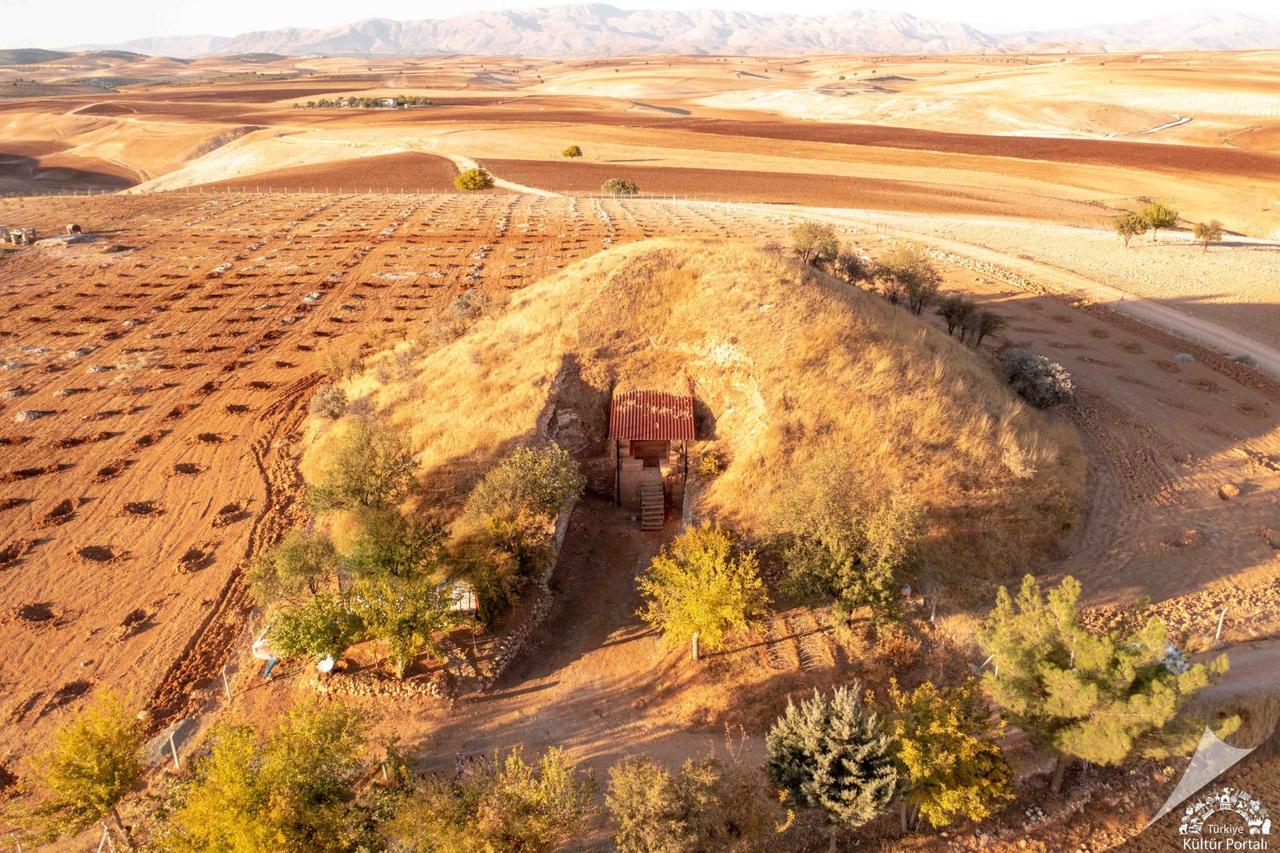
The Sofraz Monumental Tombs are located approximately 16 kilometers from Besni District and 45 kilometers from the city center of Adıyaman. The tombs are situated on a flat area southeast of Sofraz Village, surrounded by agricultural land. The two tumuli are locally known as the Large Tumulus and the Small Tumulus. Both are covered with earth fill, and their internal structures are built of cut stone.
%2520kopya(1).jpg&w=1280&q=75)
Sofraz Monumental Tombs (Türkiye Culture Portal)
The Large Tumulus is located approximately two kilometers southeast of the village center. The elliptical structure measures 62 meters along its long axis and 52.5 meters along its short axis, with a height of approximately 15 meters. The burial structure consists of three parts: the dromos (entrance passage), a transition corridor, and the burial chamber. The corridor and chamber extend in a north-south direction, and both spaces are covered with barrel vaults.
Access to the burial chamber is through an arched doorway. The rectangular chamber, measuring 3 by 4 meters, is oriented east-west. A red-painted band runs along the lower part of the walls. Two sarcophagi, made of limestone and still retaining their lids, are positioned in front of the eastern and western walls. The transition corridor, constructed of cut stone, connects to the dromos via an arched passage on its northern side. The upper portion of the tumulus is covered with rubble fill and earth.
The architectural details and material use reflect high-quality craftsmanship. Although some parts have been damaged due to illegal excavations in the region, the structure remains largely intact. Its architectural design allows it to be dated to the 2nd century CE.
The Small Tumulus is located approximately one kilometer south of the Large Tumulus. It has a height of about 10 meters and a diameter of around 50 meters. The entrance is on the southern face and is accessed via a staircase carved into the bedrock leading to the dromos. On both sides of the dromos are burial niches, the sarcophagus lids of which are now lost.
At the center of the complex formed by the burial chambers and courtyard are three separate burial chambers. These chambers are constructed of cut stone and covered with barrel vaults. Some sarcophagi remain in place, though their lids are missing. The entrance level is approximately seven meters below the current ground surface, and the northern half of the tumulus is covered by earth fill that overlays the structure.
Anadolu Ajansı. "Adıyaman'daki 1800 Yıllık Sofraz Tümülüsleri İçin Hedef 10 Bin Ziyaretçi." Accessed June 23, 2025.
T.C. Ministry of Culture and Tourism. "Sofraz Anıt Tomb – Adıyaman." *Turkey Culture Portal*. Accessed June 23, 2025. https://www.kulturportali.gov.tr/turkiye/adiyaman/gezilecekyer/sofraz-anit-mezari-.
Turkish Museums. "Sofraz Anıt Mezarı (Adıyaman)." Accessed June 23, 2025. https://www.turkishmuseums.com/museum/detail/1931-adiyaman-sofraz-anit-mezari/1931/1.
Yeşilyurt, Hülya. “Sofraz Anıt Mezarları.” *Türkiye Turizm Ansiklopedisi*, 2019. Accessed June 23, 2025. https://turkiyeturizmansiklopedisi.com/sofraz-anit-mezarlari.

Location | Sofraz Village Türkiye Adıyaman Besni | ||||||||
|---|---|---|---|---|---|---|---|---|---|
Period(s) | Roman Period 1st–2nd century CE | ||||||||
Building Type | Monumental tomb, tumulus | ||||||||
Unit | Large Tumulus, Small Tumulus | ||||||||
Material(s) | Cut stone earth fill | ||||||||
Size(s) | Large Tumulus 15 m Small Tumulus 10 m | ||||||||
No Discussion Added Yet
Start discussion for "Sofraz Memorial Tomb" article
Location and General Features
Large Tumulus
Small Tumulus