

This article was automatically translated from the original Turkish version.
+1 More
Type of Geographical İndication | Mahreç Sign | ||||||||
|---|---|---|---|---|---|---|---|---|---|
Application Date | 26.11.2021 | ||||||||
Registration Number | 1381 | ||||||||
Registration Date | 08.06.2023 | ||||||||
Product / Product Group(s) | Other products | ||||||||
Applicant/Registrant(s) | Söke Chamber of Commerce | ||||||||
Place of Production | Aydın, Türkiye | ||||||||
Söke Cotton is a geographical indication cotton variety produced in the Söke district of Aydın Province, Türkiye, distinguished by its superior yield characteristics linked to fiber quality and climatic conditions. The product was officially registered in Türkiye as a geographical indication on 8 June 2023 and, as of 2024, has also begun to be protected under geographical indication status by the European Union (EU). Thus, Söke Cotton became Türkiye’s 27th product to receive geographical indication registration from the EU and the fourth product from Aydın Province to gain recognition beyond national borders.
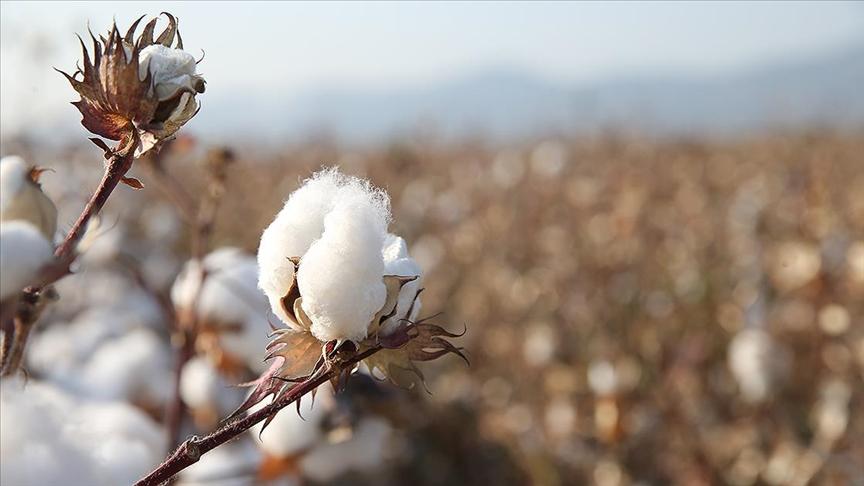
Söke Cotton (AA)
The application for registration in Türkiye was submitted on 26 November 2021 by the Söke Chamber of Commerce and was evaluated under the category of “geographical indication”. The product is a local value that can only be produced within the boundaries of the Söke district of Aydın Province and has gained its reputation through the region’s climatic, physical, and agricultural characteristics. With its approval by the European Union in 2024, Söke Cotton is now protected at both local and international levels.
Söke Cotton is produced by cultivating premium cotton varieties such as Gloria, Claudia, Carmen, Deltapine, Julia, Lydia, Beyaz Altın, DP396, Famosa, and Nazilli 84 in the Söke district. The fiber of Söke Cotton is long, fine, lustrous, and low in trash, and is classified as high quality in the textile industry due to its low yellowness value. Yarns spun from these fibers are fine and highly durable.
The dominant etesian winds in the Söke plain enhance evaporation and plant transpiration, optimizing soil moisture balance and reducing disease risk. The rare occurrence of frost provides favorable conditions for crop development. In the region, where the annual average temperature is 17.4°C, the temperature requirements for cotton cultivation are met during June, July, and August. The drop in temperature during harvest season ensures complete boll opening, supporting the product’s low yellowness value.
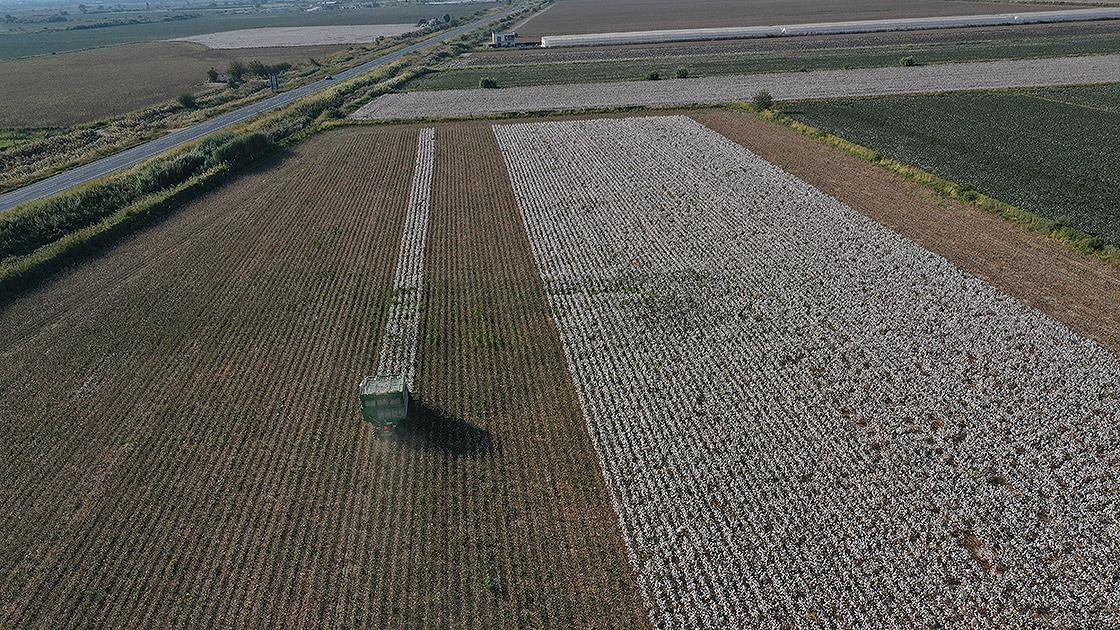
Söke Cotton (AA)
The production of Söke Cotton involves multiple stages, from soil preparation to harvest and ginning. Planting is typically carried out at the end of April; row spacing, seed quantity, and germination duration are adjusted according to the local soil structure. Irrigation is applied in four to five cycles, meeting the average water requirement of 500–600 mm. Fertilization and pest control are conducted during July and August.
The harvest process begins when boll maturity reaches 60% and continues until mid-November. Defoliant applications are carried out before harvest to preserve fiber quality. After harvesting, the cotton is ginned, baled in press machines, and stored under appropriate temperature and humidity conditions.
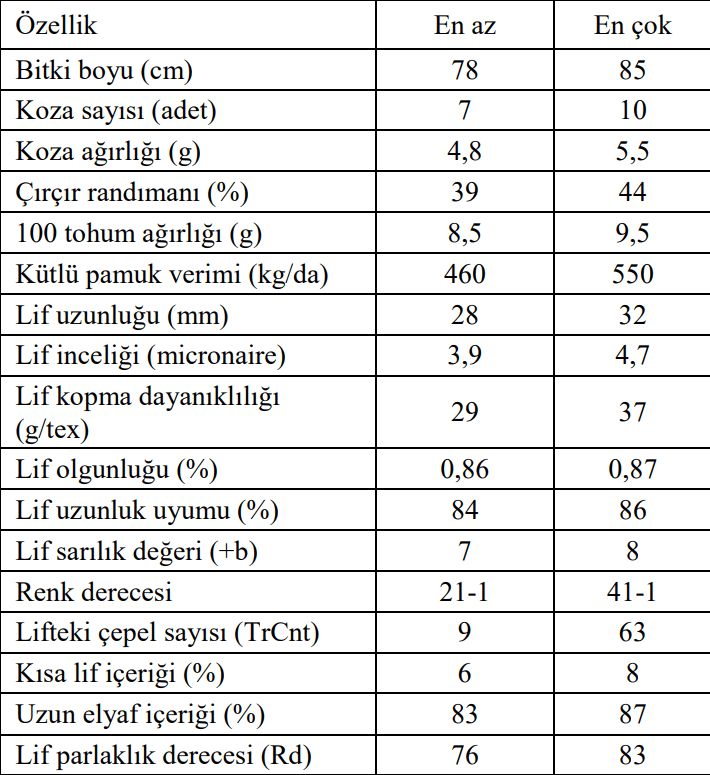
Some Characteristics of Söke Cotton (Turkish Patent)
The entire production process of the product must be carried out within the defined geographical boundary. Monitoring is conducted by a three-member commission coordinated by the Söke Chamber of Commerce, including experts from the Söke District Directorate of Agriculture and Forestry and TAYEM. Inspections verify the suitability of seed varieties, production methods, compliance of physical and chemical parameters with standards, and labeling procedures.
With its registration by the European Union in 2024, the number of Türkiye’s EU-registered geographical indication products has reached 27. Söke Cotton is also significant as the first cotton product to be included in this list.
Anadolu Ajansı. "Aydınlı Üreticiler Kuraklığa Rağmen Pamuktan Vazgeçmedi." Accessed July 25, 2025. https://www.aa.com.tr/tr/cevre/aydinli-ureticiler-kurakliga-ragmen-pamuktan-vazgecmedi/2383199
Anadolu Ajansı. “Söke Pamuğu AB’den Coğrafi İşaret Tescili Aldı.” Accessed July 25, 2025. https://www.aa.com.tr/tr/gundem/soke-pamugu-abden-cografi-isaret-tescili-aldi/3325901
Ministry of Agriculture and Forestry of the Republic of Turkey. “Söke Cotton Receives Geographical Indication Registration from the EU.” *Ministry of Agriculture and Forestry Official Website*. Date Published: September 10, 2024. Accessed July 25, 2025. https://www.tarimorman.gov.tr/Haber/6385/Soke-Pamugu-Abden-Cografi-Isaret-Tescili-Aldi
Söke Chamber of Commerce. "Söke Cotton Geographical Indication Registration Certificate." Turkish Patent and Trademark Office, Registration No: 1381. Accessed July 25, 2025. https://ci.turkpatent.gov.tr/Files/GeographicalSigns/dcaab9bb-3156-4b59-902c-7ca012888538.pdf
Söke Chamber of Commerce. "Söke Cotton." Geographical Indications Platform. Registration No: C2021/000494. Date Published: June 8, 2023. Accessed July 25, 2025. https://ci.turkpatent.gov.tr/cografi-isaretler/detay/5524

Type of Geographical İndication | Mahreç Sign | ||||||||
|---|---|---|---|---|---|---|---|---|---|
Application Date | 26.11.2021 | ||||||||
Registration Number | 1381 | ||||||||
Registration Date | 08.06.2023 | ||||||||
Product / Product Group(s) | Other products | ||||||||
Applicant/Registrant(s) | Söke Chamber of Commerce | ||||||||
Place of Production | Aydın, Türkiye | ||||||||
Registration and Geographical Boundary
Distinctive Characteristics
Agricultural Characteristics and Production Process
Monitoring and Geographical Protection
Söke Cotton Among Türkiye’s EU-Registered Geographical Indication Products