


This article was automatically translated from the original Turkish version.
+2 More
Space Stations
First Station | Salyut 1 (Soviet Union, 1971) | ||||||||
|---|---|---|---|---|---|---|---|---|---|
Current Main Station | International Space Station (ISS) | ||||||||
ISS Partners | NASA (USA), Roscosmos (Russia), JAXA (Japan), ESA (Europe), CSA (Canada) | ||||||||
ISS Orbital Altitude | Approximately 400 km | ||||||||
ISS Orbital Velocity | Approximately 27.580 km/s | ||||||||
Longest Duration in Space Record | Valeri Polyakov (437.7 days, Mir Station) | ||||||||
ISS Size | Approximately a football field | ||||||||
Space station is a platform designed for humans to live, work, and conduct scientific research for extended periods in the vacuum of space. These structures, typically placed in low Earth orbit, differ from other spacecraft in that they lack their own powerful propulsion systems. Instead, they are visited by other spacecraft such as rockets and shuttles, which dock with them to transport astronauts and cargo. Space stations are engineered to remain in orbit for weeks, months, or even years. They provide an ideal environment for conducting various scientific experiments in microgravity and studying the effects of long-duration spaceflight on the human body.
The history of space stations stems from the space race during the Cold War, during which various nations launched different projects.
The first space station was Salyut 1, launched on 19 April 1971 as part of the Soviet Union’s Salyut program developed in the 1970s. This project was part of the Soviet Union’s effort to demonstrate long-term human presence in space following the United States’ lunar landings. Salyut 1 was designed as a laboratory for a crew of three cosmonauts to spend three weeks studying how the human body responds to space conditions. On 7 July 1971, the Soyuz 11 spacecraft docked with the station, and the crew remained aboard for 22 days, setting a new record for the longest stay in space at that time. Scientific experiments were conducted during the mission, and television broadcasts were transmitted to Earth. However, on 30 June 1971, a pressure valve failure in the Soyuz 11 capsule during reentry caused the cabin air to leak into the vacuum of space, resulting in the deaths of all three cosmonauts. Salyut 1 itself reentered Earth’s atmosphere and burned up on 11 October 1971. Later Salyut stations—Salyut 2, 3, and 5—were in fact part of the secret Almaz military program.
In response to the Soviet Union’s Salyut 1, NASA developed a space station project in the late 1960s called Skylab. Launched unmanned on 14 May 1973 using a modified Saturn V rocket, Skylab weighed approximately 77 tons. The station remained in orbit between 1973 and 1979 and contained a workshop, a solar observatory, and various other systems. Its primary objective was to study the effects of zero gravity on the human body. Three crewed missions were conducted to Skylab. In 1979, after completing its mission, Skylab reentered Earth’s atmosphere uncontrollably, with debris falling in parts of Western Australia.

Space Station Image (Generated by Artificial Intelligence)
In 1975, during one of the most tense periods of the Cold War, the United States and the Soviet Union carried out a joint space mission. Known as the Apollo-Soyuz Test Project, this mission symbolized the two superpowers setting aside their space rivalry to collaborate on a common goal. The plan was for a Soyuz spacecraft launched from the Baikonur Cosmodrome in Kazakhstan to dock with an Apollo spacecraft launched from NASA’s Kennedy Space Center in the United States, at an altitude of 220 kilometers above Earth. One of the project’s greatest technical challenges was the difference in atmospheric pressure between the two spacecraft. The Soviet Soyuz used an Earth-standard nitrogen-oxygen atmosphere, while the Apollo used a low-pressure pure oxygen environment. To prevent astronauts from suffering decompression sickness due to sudden pressure changes, a special docking module was added to the Apollo. This module served as an airlock where astronauts could adjust to the pressure transition before moving between the two spacecraft. On 15 July 1975, the crews successfully docked, visited each other’s spacecraft, conducted joint experiments, and held ceremonial events. One of these experiments involved the Apollo spacecraft casting a shadow over the Soyuz to create an artificial solar eclipse, allowing the Soyuz crew to photograph the Sun’s corona.
Mir, developed by the Soviet Union, was the first modular space station and operated in orbit from 1986 to 2001. Mir provided significant data on long-duration spaceflight. Russian cosmonaut Valeri Polyakov set the record for the longest continuous stay in space by remaining aboard Mir for 437.7 days without interruption.
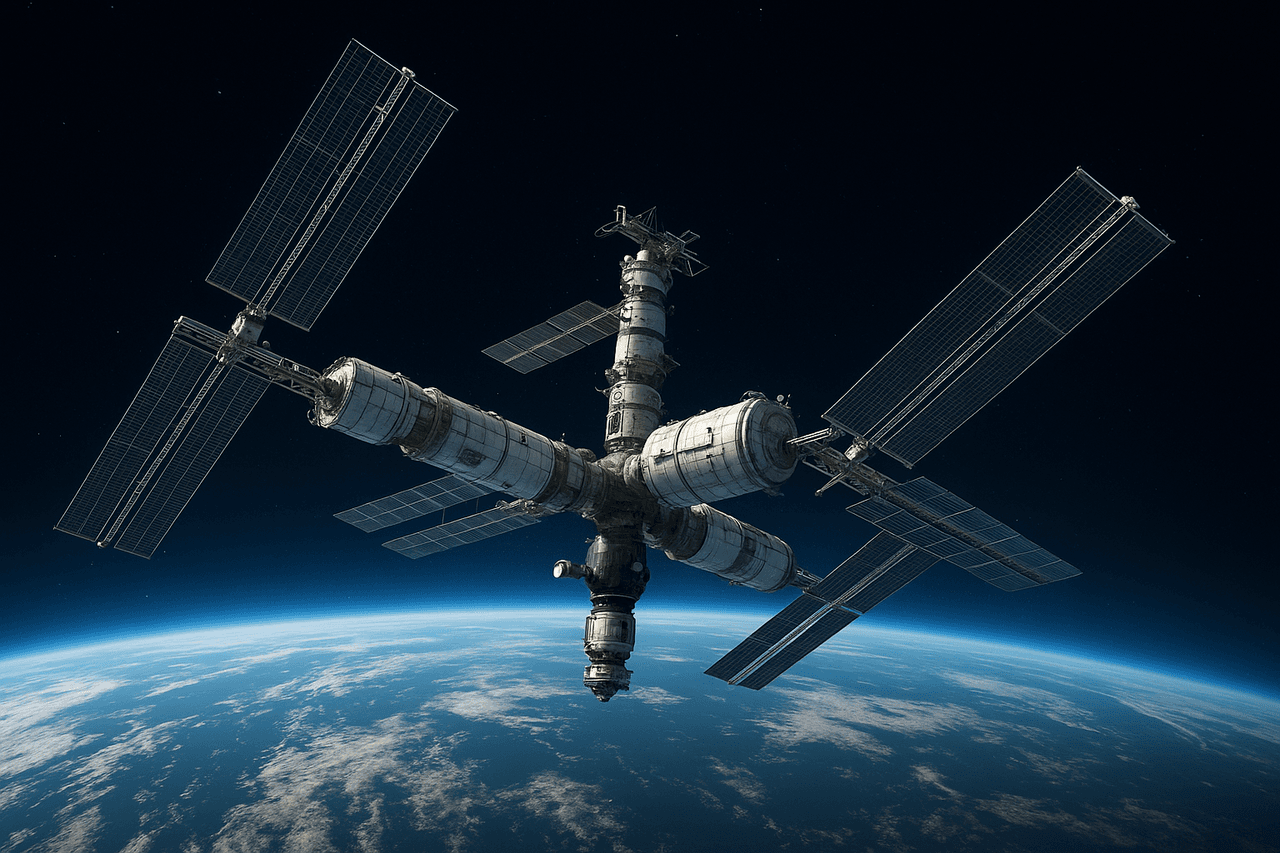
The International Space Station (ISS) is the largest and most complex space station currently in orbit. As the largest human-made object in space, the ISS is roughly the size of a football field.
The ISS is a joint project of five space agencies: NASA (United States), Roscosmos (Russia), JAXA (Japan), ESA (European Space Agency), and CSA (Canadian Space Agency). The station’s design process took place between 1984 and 1993, and construction began in 1998 with the launch of its first module. Modules were transported piece by piece into orbit using U.S. space shuttles and Russian rockets and assembled in space. The station consists of numerous modules including Zarya, Unity, Zvezda, Destiny, Harmony, Kibo, Columbus, and Tranquility. To date, scientists and astronauts from 19 different countries have served aboard the ISS.

International Space Station Illustration (Generated by Artificial Intelligence)
The ISS orbits at an altitude of approximately 400 kilometers above Earth in low Earth orbit. Traveling at a speed of about 27,580 kilometers per hour, it completes one orbit around Earth in roughly 90 minutes, making 15 orbits per day. The ISS is the third brightest object in the night sky and is visible to the naked eye from Earth due to sunlight reflecting off its surfaces. It typically appears as a bright, steadily moving point of light during dawn or dusk. Websites and mobile applications such as NASA’s “Spot The Station” allow observers to track when and in which direction the station will be visible from specific locations.
The ISS serves as a multinational scientific laboratory. Numerous experiments are conducted aboard the station in fields such as physics, biology, chemistry, physiology, and meteorology. The microgravity environment offers unique opportunities for research impossible to perform on Earth. These include studying how plants grow in space, investigating the effects of weightlessness on the human body, and testing new pharmaceuticals. Additionally, the ISS functions as a platform for testing new systems and technologies intended for future long-duration missions to destinations such as the Moon and Mars.
Living on a space station differs significantly from life on Earth. The absence of gravity transforms every aspect of daily routines.

Life on a Space Station Illustration (Generated by Artificial Intelligence)
Astronauts float continuously due to the lack of gravity, transforming even the most basic activities such as eating, sleeping, and personal hygiene into entirely different experiences. For example, to sleep, astronauts secure themselves in sleeping bags attached to walls to prevent drifting and bumping into objects during rest.
Foods consumed in space are typically specially packaged, dried, or canned. Astronauts usually rehydrate these foods with water before eating. Special containers and eating techniques are used to prevent crumbs and liquid droplets from floating freely and potentially damaging sensitive equipment. Menus include nuts, dried fruits, and a variety of specially prepared meals.
International Space Station. "Building the International Space Station." ESA. Accessed July 1, 2025. Accessed Adresi.
Kellond-Turner, Ed. "Space Stations." National Space Centre. Accessed July 1, 2025. Accessed Adresi.
NASA. "International Space Station." NASA. Accessed July 1, 2025. Accessed Adresi.
National Air and Space Museum. "Space Stations." Smithsonian. Accessed July 1, 2025. Accessed Adresi.
Sunay, Çağlar. “Uluslararası Uzay İstasyonu.” *Bilim ve Teknik*, (1998): 50-57. Accessed July 1, 2025. Accessed Adresi.
Uzay.org. "Uzay İstasyonları." Uzay.org. Accessed July 1, 2025. Accessed Adresi.

Space Stations
First Station | Salyut 1 (Soviet Union, 1971) | ||||||||
|---|---|---|---|---|---|---|---|---|---|
Current Main Station | International Space Station (ISS) | ||||||||
ISS Partners | NASA (USA), Roscosmos (Russia), JAXA (Japan), ESA (Europe), CSA (Canada) | ||||||||
ISS Orbital Altitude | Approximately 400 km | ||||||||
ISS Orbital Velocity | Approximately 27.580 km/s | ||||||||
Longest Duration in Space Record | Valeri Polyakov (437.7 days, Mir Station) | ||||||||
ISS Size | Approximately a football field | ||||||||
Historical Development
Salyut Program and the First Station
Skylab Project
Apollo-Soyuz Test Project
Mir Space Station
International Space Station (ISS)
Construction and Structure
Orbit and Observation
Purpose and Scientific Research
Life on a Space Station
Daily Activities
Nutrition