


This article was automatically translated from the original Turkish version.
+1 More
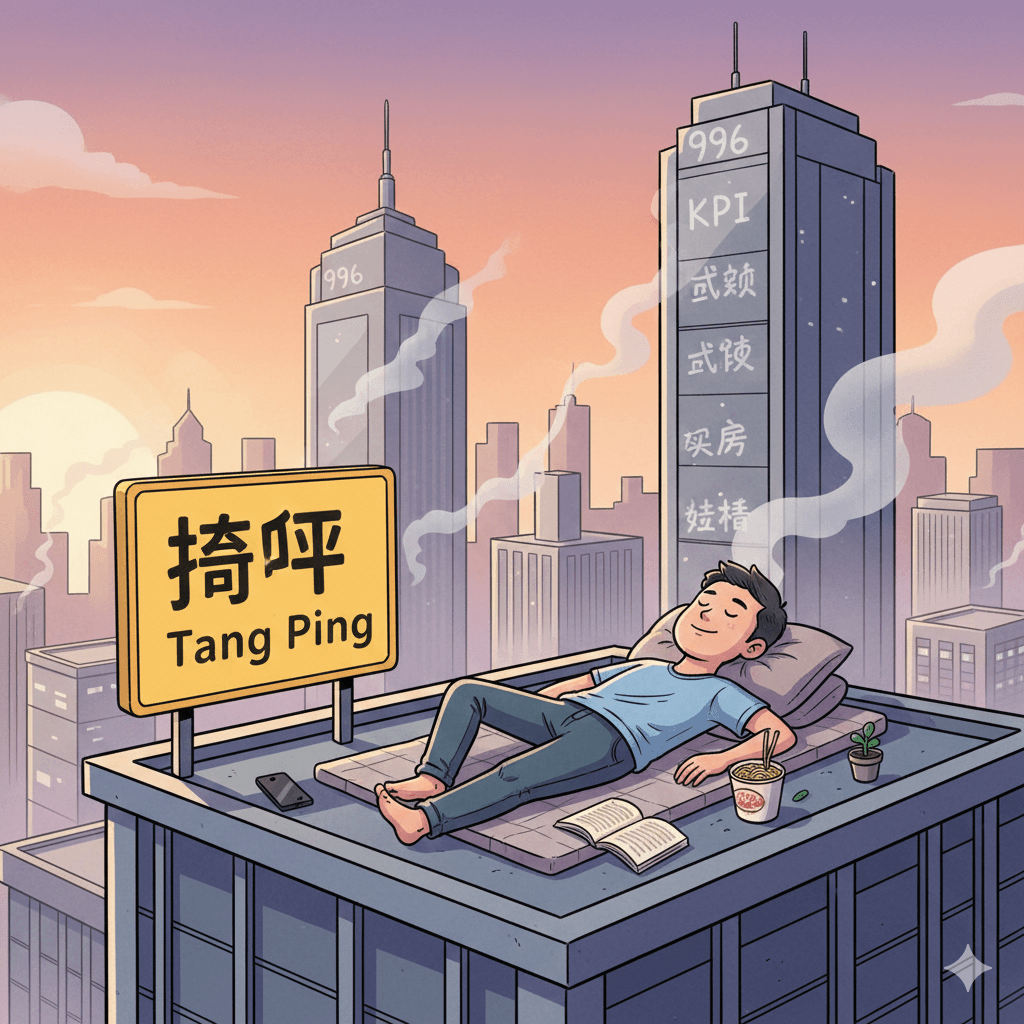
Tang-Ping (Generated with Artificial Intelligence.)
Similar Movements | Bai lan (Let it go/Abandon to decay) | ||||||||
|---|---|---|---|---|---|---|---|---|---|
Official Status | Characterized by the state as 'embarrassing' and 'contrary to national goals'; subjected to censorship | ||||||||
Target Audience | Generation Z, Millennial generation | ||||||||
Sociological Status | Silent protest against the system, passive resistance | ||||||||
Key Name | Luo Huazhong | ||||||||
Exit Point | Baidu Tieba (Internet forum) | ||||||||
Exit Date | April 2021 | ||||||||
Concept Name | Tang-ping (躺平) | ||||||||
Tang-ping (躺平), a sociocultural term describing a critical stance toward modern societal expectations and intense work rhythms, as well as a minimalist lifestyle. Conceptually, it refers to a way of life that rejects the excessive competition and high achievement standards imposed by the system, focusing instead on working only enough to meet basic needs and prioritizing one’s own physical and mental well-being.
The modern social phenomenon of Tang-ping (躺平) was crystallized by a post published on 17 April 2021 on Baidu Tieba, one of China’s major information-sharing and discussion platforms. Titled “Tang-ping Is Justice,” this text, shared by user Luo Huazhong under the pseudonym “Sichuan Traveler,” is regarded as laying the philosophical foundation of the movement. In the post, the author stated that he had not held a full-time job for two years and sustained himself on a monthly budget of only 200 yuan (approximately 32 US dollars).【1】 Luo emphasized that he spent his days fulfilling only basic physical needs and focusing on mental tranquility, thereby adopting a detached attitude toward traditional work ethics and societal criteria of success.
Luo Huazhong’s personal experience, initially a local forum post, quickly garnered millions of interactions on China’s mainstream social media platform Sina Weibo and video-sharing site Douyin (the Chinese version of TikTok). Internet users reinterpreted Luo’s “lying flat” act as a “survival strategy” against the system’s endless demands. During this process, the concept became a cultural symbol online, inspiring countless internet memes and digital artworks.【2】
The primary carriers and defenders of this digital movement have been Generation Z and Millennials, born after 1990. This demographic cohort entered adulthood amid the “introverted hyper-competition” that followed China’s rapid economic growth phase. Indeed, these young professionals and students have embraced the term Tang-ping as an identity label. Specialized discussion groups on social media platforms have transformed into digital spaces where individuals exchange tips on low-consumption living and strategies for evading social pressures.
The movement’s rise on digital platforms drew attention from state-backed media outlets and technology companies. Official media labeled Tang-ping as a “poisonous ideology obstructing social development” and launched counter-propaganda campaigns. These official responses led to further public debate and the concept’s emergence in global media as China’s “silent revolution.” However, Chinese authorities activated internet censorship mechanisms to shut down numerous groups tagged with “Tang-ping” and restrict related content, confining the discourse to smaller, more closed online communities.
The Tang-ping movement is a direct consequence of what Chinese sociology describes as “introverted hyper-competition.” This phenomenon refers to situations where individuals expend increasing amounts of energy and effort to secure limited resources, yet the returns they receive—in income, status, or quality of life—remain stagnant or decline. This competitive environment, felt across all domains from education to employment, has reinforced the belief among individuals that their efforts will not be adequately rewarded. Young people have increasingly come to view withdrawal from this “rat race” as a rational choice.
The “996” system, which mandates work from 9 a.m. to 9 p.m. six days a week, is an extreme work model prevalent especially in technology and finance sectors. This arrangement has generated widespread physical and mental exhaustion among employees. As the labor market has contracted and competition intensified, long working hours have shifted from a voluntary choice to a mandatory requirement. This has forced individuals to completely sacrifice personal time and social lives; Tang-ping emerged as a defensive mechanism against this pace, asserting the right to “do nothing.”
In traditional Chinese society, success is equated with owning a home, getting married, and having children. However, soaring housing prices and rising child-rearing costs in major cities have led young people to delay or reconsider plans for homeownership and family formation. Individuals who realize that no amount of effort will enable them to own property have chosen to abandon these costly social goals, minimizing consumption and thereby reducing the amount of time they must work.
The COVID-19 pandemic accelerated the mass adoption of the Tang-ping movement. Quarantine periods and economic uncertainty prompted individuals to reevaluate their life priorities and working conditions. The pandemic era brought the question “What is the purpose of life?” to the forefront, creating fertile ground for many young professionals to adopt slower, less consumption-oriented, and more tranquil lifestyles. The crisis served as a catalyst, prompting people to reassess their priorities and resist societal pressures for success.【3】
In Chinese cultural values, exerting effort is not merely an economic necessity but a fundamental moral duty rooted in Confucian ethics. From a traditional perspective, striving diligently to realize one’s potential and contribute to society is seen as an essential part of being human. In this context, effort is both a means to individual achievement and an intrinsic moral virtue. Because of these cultural codes, attitudes rejecting effort—such as Tang-ping—were initially labeled as “irresponsible” or “morally weak” in relation to social norms and family structures.【4】
The moral judgment of the public toward Tang-ping is directly linked to “return expectations.” If an individual exerts intense effort but fails to receive a fair return due to structural problems in the system, unjust distribution, or excessive competition, the act of “lying flat” is widely accepted by society.
Tang-ping is also described as a “silent resistance” or “peaceful protest.”【5】 When individuals recognize that they cannot change the system from within, they refuse to fulfill its demand for “effort,” adopting a passive stance against it. This position gains moral legitimacy as an attempt to minimize personal exploitation. In public opinion, those who “lie flat” to preserve their physical and mental health under unfair working conditions—such as the 996 system—are viewed as people who refuse to participate in an unjust competition.
Culturally, Tang-ping also symbolizes a generational shift in values within Chinese society. For previous generations, work and sacrifice were fundamental modes of existence; for the new generation, “quality of life” and “individual autonomy” have taken precedence. In this sense, Tang-ping is a concrete manifestation of cultural tension between rigid social expectations and the modern individual’s pursuit of freedom.
Beyond being a personal lifestyle choice, Tang-ping has evolved into a “silent protest” against China’s existing socio-economic order, rising inequalities, and unsustainable working conditions. The decision by individuals to abandon traditional markers of consumption and social success—such as marriage, childbearing, and homeownership—has not only slowed economic growth but also sparked debates about its potential impact on family formation trends.
The Chinese government and state-controlled media have exhibited strong and systematic opposition to the Tang-ping movement. Xinhua, one of the official media outlets, characterized “lying flat” as shameful and argued that this attitude harms the country’s modernization goals. The state’s primary concern is that the movement undermines labor productivity and weakens China’s global competitiveness. Wang Qingfeng of Xinhua expressed this position as follows:【6】
Recently, an article titled “Lying Flat Is Justice” went viral. The author defended the idea that “lying flat is justice,” describing how he lived in “freedom” for two years without a stable job, relying on extremely low living costs and occasional temporary work. Many internet users found this valuable and launched the “lying flat” trend.
At one point, the popular notions among young people of “small joys” turned into “small sorrows,” and new expressions such as “the art of laziness” and “the art of horizontal lying” occasionally emerged. Some energetic young people have become “Buddhist youth,” frequently voicing strange ideas like “I am almost useless,” “I don’t want to do anything,” and “What’s wrong with being a lazy idler?” Their minds are filled only with comfort, which raises questions: What is wrong with these people?
It is easy to understand the pressures and confusion young people face—from packed subways and constantly rising housing prices to “tiger parenting” education. In this rapidly advancing era, urban youth confront entirely new situations their parents never experienced, naturally leading to feelings of insignificance, powerlessness, and helplessness. When they use destructive language to express disappointment and mockery, we can understand the true function and value behind these behaviors.
However, we must remind everyone that language shapes thoughts and actions. If a person remains immersed for too long in the linguistic framework of a pessimistic culture, they will inevitably become contaminated by negative emotions. The world is not truly like this. Do you not see that while a few give up easily, many more young people, after understanding the realities of life, still choose to work hard, chase their dreams, and build fulfilling lives through their own efforts?
Despite everything, young people must have confidence in the future. Some believe the younger generation is becoming increasingly “low-motivation” and that this is slowly dragging society into a similar state, but this is baseless speculation. Scientists believe the fundamental cause of low motivation is insufficient drive for development. China is the most populous country in the world, with abundant labor resources and a vast market advantage, and its economic development expectations are broad. In other words, on this land, self-realization and success remain possible as long as sufficient effort is made.
Effort itself is a form of happiness; only a life full of effort can be called a happy life. While external pressures cannot be ignored, it is better to rise up and strive than to complain and lament. Ambitious youth will confront pressure and carve their own paths through hard work. Every generation has its own unique challenges and struggles; no one’s life passes without difficulties. Yielding easily to minor setbacks and constantly succumbing to a “culture of hopelessness” is certainly not characteristic of today’s youth. If we scream “retreat” at the first sign of pressure and give up at the first obstacle, how can we ever change our lives?
Regardless of time or developmental stage, effort is always the most vibrant color of youth. Choosing to “give up” under pressure is not only unjust but also shameful; such “toxic positivity” has no value whatsoever. I believe the majority of young people will clearly understand this and, after a moment of doubt, courageously continue forward and chase their dreams.
The spread of the movement has also elicited responses at the highest levels of state leadership. Chinese President Xi Jinping, in speeches published in the Communist Party’s theoretical journal Qiushi, emphasized the goal of “common prosperity,” asserting the need to prevent social stratification. Xi highlighted the importance of maintaining open channels for upward social mobility and warned the public against both “introverted hyper-competition” and the “lying flat” tendency. Chinese President Xi Jinping expressed this position as follows:【7】
A happy life is achieved through hard work, and common prosperity depends on diligence and wisdom. We must uphold the principle of securing and improving people’s livelihoods during the development process, prioritize high-quality development, create more inclusive and equitable conditions for people to raise their education levels and enhance their development capacities, foster the entire society’s human capital and professional skills, expand employment and entrepreneurship potential, and strengthen the ability to generate wealth. We must prevent rigid social stratification, open channels for upward mobility, create more opportunities for wealth creation for a greater number of people, build an inclusive development environment, and prevent “retreat” and “stagnation.”
The movement’s impact on digital platforms triggered state censorship mechanisms. These mechanisms led to the shutdown of thousands of groups on popular Chinese social media and discussion platforms such as Douban and Weibo, and imposed restrictions on the use of related hashtags.
BBC. "China's new 'tang ping' trend aims to highlight pressures of work culture." Accessed February 9, 2026. https://www.bbc.com/news/world-asia-china-57348406
Davidovic, Ivana. "'Lying flat': Why some Chinese are putting work second." BBC. Accessed February 9, 2026. https://www.bbc.com/news/business-60353916
Hsu, Han-Yu. “How Do Chinese People Evaluate ‘Tang-Ping’ (Lying Flat) and Effort-Making: The Moderation Effect of Return Expectation.” *Frontiers in Psychology* 13 (2022): 871439 pp. 1–7. Accessed February 9, 2026. https://www.frontiersin.org/journals/psychology/articles/10.3389/fpsyg.2022.871439/full
Wang, Qingfeng. “’躺平’可耻,哪来的正义感?” Xinhua News (Comments). Accessed February 9, 2026. https://www.xinhuanet.com/comments/2021-05/20/c_1127467232.htm
Xi Jinping (习近平). “扎实推动共同富裕 [Solidly Promote Common Prosperity].” Qiushi 20. Accessed February 9, 2026. https://www.qstheory.cn/dukan/qs/2021-10/15/c_1127959365.htm
[1]
Han-Yu Hsu, “How Do Chinese People Evaluate ‘Tang-Ping’ (Lying Flat) and Effort-Making: The Moderation Effect of Return Expectation.” Frontiers in Psychology 13 (2022): 871439 pp.1-2, Access 9 February 2026 https://www.frontiersin.org/journals/psychology/articles/10.3389/fpsyg.2022.871439/full.
[2]
BBC, "China's new 'tang ping' trend aims to highlight pressures of work culture." BBC, Access 9 February 2026, https://www.bbc.com/news/world-asia-china-57348406.
[3]
Ivana Davidovic, "'Lying flat': Why some Chinese are putting work second." BBC, Access 9 February 2026, https://www.bbc.com/news/business-60353916.
[4]
BBC, "China's new 'tang ping' trend aims to highlight pressures of work culture." BBC, Access 9 February 2026, https://www.bbc.com/news/world-asia-china-57348406.
[5]
Ivana Davidovic, "'Lying flat': Why some Chinese are putting work second." BBC, Access 9 February 2026, https://www.bbc.com/news/business-60353916.
[6]
Qingfeng Wang, “’躺平’可耻,哪来的正义感?” Xinhua News (Comments), Access 9 February 2026, https://www.xinhuanet.com/comments/2021-05/20/c_1127467232.htm.
[7]
Xi Jinping (习近平), “扎实推动共同富裕 [Solidly Promote Common Prosperity].” Qiushi 20, Access 9 February 2026, https://www.qstheory.cn/dukan/qs/2021-10/15/c_1127959365.htm.


Tang-Ping (Generated with Artificial Intelligence.)
Similar Movements | Bai lan (Let it go/Abandon to decay) | ||||||||
|---|---|---|---|---|---|---|---|---|---|
Official Status | Characterized by the state as 'embarrassing' and 'contrary to national goals'; subjected to censorship | ||||||||
Target Audience | Generation Z, Millennial generation | ||||||||
Sociological Status | Silent protest against the system, passive resistance | ||||||||
Key Name | Luo Huazhong | ||||||||
Exit Point | Baidu Tieba (Internet forum) | ||||||||
Exit Date | April 2021 | ||||||||
Concept Name | Tang-ping (躺平) | ||||||||
Historical Origins and Digital Spread
Causes and Sociological Background
Work Culture and the “996” System
Economic Barriers and Unattainable Success Criteria
Accelerating Impact of the COVID-19 Pandemic
Moral and Cultural Evaluation
Return Expectations and Perceptions of Justice
Quest for Justice and Social Resistance
Intergenerational Value Conflict
Social Impacts and Official Responses
Official Media and State Criticism
High-Level Political Intervention and Xi Jinping’s Emphases
Digital Censorship and Platform Restrictions