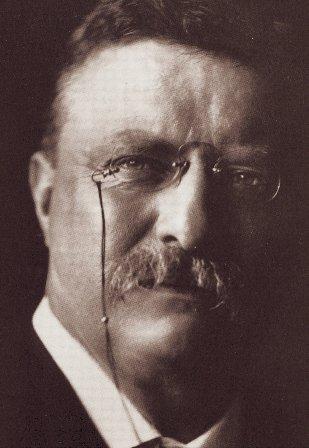
Doğum tarihi | 1858-10-27 | ||||||||
|---|---|---|---|---|---|---|---|---|---|
Eş | Edith Kermit Carow Roosevelt (m. 1886 – d. 1948) Alice Hathaway Lee Roosevelt (m. 1880 – d. 1884) | ||||||||
Place of Birth | New York City, New York, USA | ||||||||
Ölüm tarihi | 1919-01-06 | ||||||||
Place of Death | Sagamore Hill, Oyster Bay, New York, USA | ||||||||
Parents | Theodore Roosevelt Sr., Martha Bulloch Roosevelt | ||||||||
Presidential Order | 26th President of the United States (1901–1909) | ||||||||
Theodore Roosevelt was born on October 27, 1858, in New York, as a child of a wealthy family. His father, Theodore Roosevelt Sr., was a businessman known for his philanthropic work; his mother, Martha “Mittie” Bulloch, was a Southerner from Georgia. During childhood, he suffered from severe asthma. As a result, his father encouraged him to exercise to build physical strength. He studied natural sciences at Harvard University and later turned to law, though he did not complete his studies at Columbia Law School. He entered politics at an early age and served as a member of the New York State Assembly from 1881 to 1884.
In 1884, both his wife Alice Hathaway Lee Roosevelt and his mother Martha Roosevelt died on the same day. Following this tragedy, Roosevelt temporarily withdrew from politics and devoted himself to farming and cowboy life in the Dakota Territory. In 1886, he married Edith Kermit Carow and returned to New York to resume his political career. During this period, he held various public offices, advocated civil service reform, served as president of the New York Police Department, and fought corruption in public service. In 1897, he was appointed Assistant Secretary of the Navy by President William McKinley. During the Spanish-American War of 1898, he resigned his post to lead the Volunteer Cavalry Regiment, fighting in Cuba with the unit known as the “Rough Riders.” This military experience and his visibility in the public eye quickly propelled him to the governorship of New York. In 1900, he was nominated as McKinley’s vice presidential candidate and won election to the office.
In 1901, following the assassination of President McKinley, Roosevelt assumed the presidency at the age of 42, becoming the youngest president in United States history. Domestically, under his “Square Deal” program of social and economic reform, he initiated antitrust lawsuits to curb the power of large corporations and led major regulatory efforts in the railroad, meatpacking, and pharmaceutical industries. His enforcement actions under the Sherman Antitrust Act earned him the reputation of a “trust buster.” He also took significant steps in consumer protection through legislation such as the Federal Meat Inspection Act (1906) and the Pure Food and Drug Act (1906).
Roosevelt was among the first leaders to elevate environmental conservation to the presidential level. During his term, he established 150 national forests, five national parks, 51 bird sanctuaries, 18 national monuments, and placed over 230 million acres of land under federal protection. In this regard, he is regarded as a foundational figure in modern environmental policy. In foreign policy, he expanded the framework of American intervention in Latin America through the “Roosevelt Corollary,” an addition to the Monroe Doctrine. He directly intervened in the construction of the Panama Canal, ensuring its completion. In 1905, he mediated the peace between Japan and Russia, for which he was awarded the Nobel Peace Prize in 1906, becoming the first American president to receive the award. In 1907, he sent the “Great White Fleet,” a fleet of 16 battleships, on a global tour to demonstrate American naval power on the international stage.
In 1908, Roosevelt chose not to seek a third term and endorsed William H. Taft as his successor. However, disillusioned by Taft’s administration, he returned to politics in 1912, left the Republican Party, and founded his own party, the “Progressive Party,” commonly known as the “Bull Moose Party.” His campaign garnered significant popular support, but vote splitting led to victory for Democratic candidate Woodrow Wilson. In 1913, Roosevelt embarked on a scientific expedition with his son Kermit into uncharted regions of the Amazon in South America. During this journey, he contracted a serious infection that severely damaged his health.
During World War I, Roosevelt offered to raise a volunteer military unit, but President Wilson rejected the proposal. All four of his sons joined the armed forces; his youngest son, Quentin, was killed in action in France. Roosevelt died in his sleep on January 6, 1919, at the age of 60, in his home Sagamore Hill in Oyster Bay. Roosevelt’s legacy is shaped by multifaceted contributions, including strengthening the power of the American presidency, advancing environmental conservation, promoting reformist policies prioritizing the public interest, and redefining the United States’ global role. His name left a profound mark on 20th-century American politics, and his face is immortalized as one of the four presidents carved into Mount Rushmore.
BBC. "Theodore Roosevelt (1858 - 1919)." *BBC History*. Accessed August 6, 2025. https://www.bbc.co.uk/history/historic_figures/roosevelt_theodore.shtml
Miller Center of Public Affairs. “Theodore Roosevelt: Life Before the Presidency.” Miller Center, University of Virginia. Accessed August 6, 2025. https://millercenter.org/president/roosevelt/life-before-the-presidency
National Constitution Center. “10 Little-Known Facts About President Theodore Roosevelt.” Constitution Daily. Accessed August 6, 2025. https://constitutioncenter.org/blog/10-little-known-facts-about-president-theodore-roosevelt
Nobel Prize. "Theodore Roosevelt - Biographical." *The Nobel Prize*. Accessed August 6, 2025. https://www.nobelprize.org/prizes/peace/1906/roosevelt/biographical/
The White House. “Theodore Roosevelt.” *White House Archives - President George W. Bush*. Accessed August 6, 2025. https://georgewbush-whitehouse.archives.gov/history/presidents/tr26.html
Theodore Roosevelt Association. “Brief Biography.” Theodore Roosevelt Association. Accessed August 6, 2025. https://www.theodoreroosevelt.org/content.aspx?page_id=22&club_id=991271&module_id=339332
Theodore Roosevelt Center. “TR Brief Biography.” Theodore Roosevelt Center at Dickinson State University. Accessed August 6, 2025. https://www.theodorerooseveltcenter.org/Learn-About-TR/TR-Brief-Biography
Theodore Roosevelt Inaugural Site Foundation. “The Life of Theodore Roosevelt.” *TR Inaugural Site*. Accessed August 6, 2025. https://www.trsite.org/learn/the-life-of-theodore-roosevelt
Theodore Roosevelt Library. “TR Timeline.” Theodore Roosevelt Presidential Library. Accessed August 6, 2025. https://www.trlibrary.com/tr/timeline
White House Historical Association. “Theodore Roosevelt.” White House History. Accessed August 6, 2025. https://www.whitehousehistory.org/bios/theodore-roosevelt


Doğum tarihi | 1858-10-27 | ||||||||
|---|---|---|---|---|---|---|---|---|---|
Eş | Edith Kermit Carow Roosevelt (m. 1886 – d. 1948) Alice Hathaway Lee Roosevelt (m. 1880 – d. 1884) | ||||||||
Place of Birth | New York City, New York, USA | ||||||||
Ölüm tarihi | 1919-01-06 | ||||||||
Place of Death | Sagamore Hill, Oyster Bay, New York, USA | ||||||||
Parents | Theodore Roosevelt Sr., Martha Bulloch Roosevelt | ||||||||
Presidential Order | 26th President of the United States (1901–1909) | ||||||||
Presidency and Policies (1901–1909)
Post-Presidential Life and Legacy