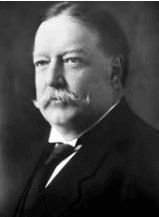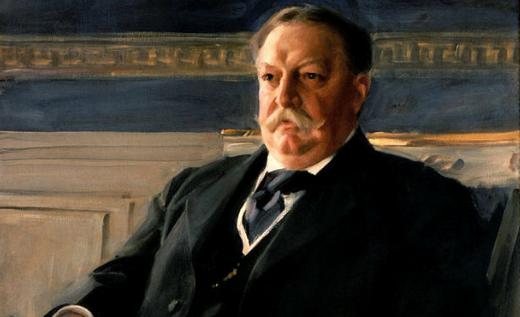

Doğum tarihi | 1857-09-15 | ||||||||
|---|---|---|---|---|---|---|---|---|---|
Eş | Helen "Nellie" Herron Taft (m. 1886 – d. 1943) | ||||||||
Place of Birth | Cincinnati, Ohio, United States | ||||||||
Ölüm tarihi | 1930-03-08 | ||||||||
Place of Death | Washington, D.C., United States | ||||||||
Parents | Alphonso Taft, Louisa Maria Torrey Taft | ||||||||
Presidential Order | 27th President of the United States (1909–1913) | ||||||||
William Howard Taft was born on September 15, 1857 in Cincinnati, Ohio. His father, Alphonso Taft, was one of the prominent legal figures of his time and served as Secretary of War and Attorney General during President Ulysses S. Grants administration. He also held diplomatic posts for the United States in Austria-Hungary and Russia. Taft grew up in an environment shaped by his family’s high expectations. He graduated second in his class from Yale University in 1878 and subsequently pursued legal studies at the Cincinnati Law School. In 1880 he was admitted to the Ohio bar and began his legal career.
Taft held legal positions at an early age. In 1881 he began serving as an assistant prosecutor in Hamilton County and became a judge on the Cincinnati Superior Court in 1887. In 1890 he was appointed by President Benjamin Harrison as the sixth Solicitor General of the United States. During this role he established himself in the field of appellate law. In 1892 he was appointed to the Sixth Circuit Court of Appeals and simultaneously served as a professor and dean at the Cincinnati Law School. Despite his successes in the judiciary, Taft was guided by the political ambitions of his wife, Helen “Nellie” Taft.
In 1900 President William McKinley appointed Taft as chairman of the Philippine Civil Commission, after which he was elevated to Governor-General of the islands. He constructed a governance structure modeled on a constitution and implemented reforms in education, transportation and public health. He gained the support of the local population through policies such as the purchase of 390,000 acres of church land and its distribution to Filipino peasants, following negotiations with the Catholic Church. In 1904 he was appointed Secretary of War by Theodore Roosevelt and served as Roosevelt’s chief advisor on foreign policy and infrastructure projects. His activities during this period included the construction of the Panama Canal, the temporary administration of Cuba and visits to East Asia.
With Roosevelt’s support, Taft became the Republican Party’s presidential candidate in 1908 and defeated Democratic candidate William Jennings Bryan to assume the presidency. During his presidency Taft pledged to continue Roosevelt’s reform agenda but adopted a different approach in terms of management style. He championed an administrative philosophy focused on the enforcement of laws. His administration initiated 99 antitrust lawsuits, among which the cases against Standard Oil and American Tobacco were most prominent. The Sixteenth and Seventeenth Amendments to the Constitution were passed by Congress during this period. A postal savings system was established and the Interstate Commerce Commission was granted authority to set railroad rates.
However, the approval of the Payne-Aldrich Tariff and allegations that Interior Secretary Richard Ballinger had violated conservation policies led to the dismissal of conservationist Gifford Pinchot, causing Taft to lose the support of progressive Republicans. His relationship with Roosevelt deteriorated, prompting Roosevelt to leave the Republican Party in 1912 and form the Progressive Party. This split enabled Democratic candidate Woodrow Wilson to win the election.
After leaving the presidency, Taft taught law at Yale University. His lifelong aspiration to serve on the Supreme Court was fulfilled in 1921 when President Warren G. Harding appointed him Chief Justice. He became the only American to have held the highest offices in both the executive and judicial branches. As Chief Justice, he focused on judicial reform and lobbied successfully for the passage of the Judiciary Act of 1925. He also played an active role in the architectural planning of the current Supreme Court Building.

United States Supreme Court Building, Washington D.C. (Marc Thomas)
He experienced a more successful and tranquil period in his judicial role. However, psychological pressures and self-esteem issues dating back to childhood led to pronounced reserve in decision-making during his public offices. The estrangement from Roosevelt, his shift toward conservative tendencies and his perceived lack of political skill distanced him from the progressive movements of the era. Historians generally regard his presidency as a transitional period between Roosevelt and Wilson.
William Howard Taft died on March 8, 1930 in Washington D.C. and became the first U.S. president to be buried at Arlington National Cemetery. His funeral was the first presidential funeral broadcast on radio. Shortly before his death he resigned from office due to health reasons. Taft is the only person in U.S. history to have held both the presidency and the chief justiceship, securing a unique place in constitutional history.
Arnold, Peri E. “William Howard Taft: Life in Brief.” Miller Center, University of Virginia. Accessed August 6, 2025. https://millercenter.org/president/taft/life-in-brief
Arnold, Peri E. “William Taft: Domestic Affairs.” Miller Center, University of Virginia. Accessed August 6, 2025. https://millercenter.org/president/taft/domestic-affairs
Arnold, Peri E. “William Taft: Foreign Affairs.” Miller Center, University of Virginia. Accessed August 6, 2025. https://millercenter.org/president/taft/foreign-affairs
Arnold, Peri E. “William Taft: Impact and Legacy.” Miller Center, University of Virginia. Accessed August 6, 2025. https://millercenter.org/president/taft/impact-and-legacy
Arnold, Peri E. “William Taft: Life Before the Presidency.” Miller Center, University of Virginia. Accessed August 6, 2025. https://millercenter.org/president/taft/life-before-the-presidency
Arnold, Peri E. “William Taft: Overview.” Miller Center, University of Virginia. Accessed August 6, 2025. https://millercenter.org/president/taft
Bushong, William. “The Life and Presidency of William Howard Taft.” White House Historical Association. Accessed August 6, 2025. https://www.whitehousehistory.org/the-life-and-presidency-of-william-howard-taft
Constitution Center. "10 Fascinating Facts About President and Chief Justice William Howard Taft." *Constitution Daily*. Accessed August 6, 2025. https://constitutioncenter.org/blog/10-fascinating-facts-about-president-and-chief-justice-william-howard-taft-
Pixabay. “ABD Yüksek Mahkemesi Binası.” Pixabay. Accessed August 6, 2025. https://pixabay.com/tr/photos/abd-y%C3%BCksek-mahkemesi-binas%C4%B1-2225765/
U.S. Department of Justice. “Solicitor General: William Howard Taft.” Office of the Solicitor General. Accessed August 6, 2025. https://www.justice.gov/osg/bio/william-howard-taft
U.S. National Park Service. “William Howard Taft.” NPS.gov. Accessed August 6, 2025. https://www.nps.gov/people/william-howard-taft.htm
White House Historical Association. “William Howard Taft.” *White House History*. Accessed August 6, 2025. https://www.whitehousehistory.org/bios/william-taft
White House. “William Howard Taft.” The White House Archives (George W. Bush Administration). Accessed August 6, 2025. https://georgewbush-whitehouse.archives.gov/history/presidents/wt27.html

Doğum tarihi | 1857-09-15 | ||||||||
|---|---|---|---|---|---|---|---|---|---|
Eş | Helen "Nellie" Herron Taft (m. 1886 – d. 1943) | ||||||||
Place of Birth | Cincinnati, Ohio, United States | ||||||||
Ölüm tarihi | 1930-03-08 | ||||||||
Place of Death | Washington, D.C., United States | ||||||||
Parents | Alphonso Taft, Louisa Maria Torrey Taft | ||||||||
Presidential Order | 27th President of the United States (1909–1913) | ||||||||
No Discussion Added Yet
Start discussion for "William Howard Taft" article
Executive Roles and Presidency (1900–1913)
Chief Justiceship and Legacy