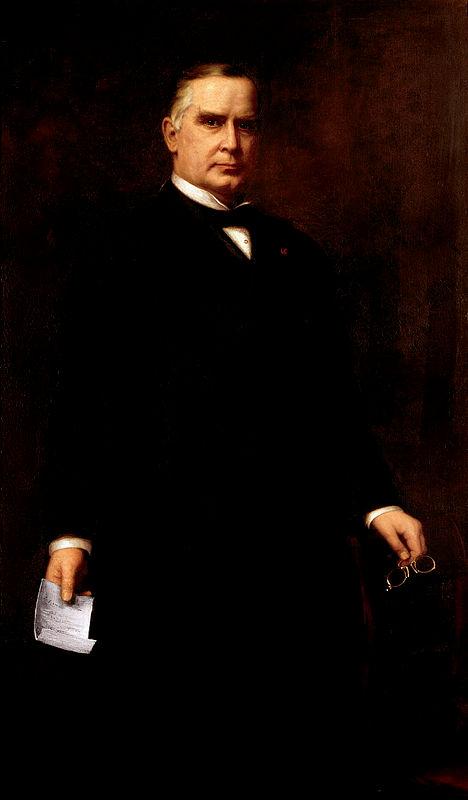
Doğum tarihi | 1843-01-29 | ||||||||
|---|---|---|---|---|---|---|---|---|---|
Eş | Ida Saxton McKinley (m. 1871 – d. 1907) | ||||||||
Place of Birth | Niles, Ohio, USA | ||||||||
Ölüm tarihi | 1901-09-14 | ||||||||
Place of Death | Buffalo, New York, USA | ||||||||
Parents | William McKinley Sr., Nancy Allison McKinley | ||||||||
Presidential Order | 25th President of the United States (1897–1901) | ||||||||
William McKinley Jr. was born on January 29, 1843, in the city of Niles, Ohio. In 1852, his family moved to Poland, Ohio, to provide better educational opportunities. He received his education at Poland Academy and briefly attended Allegheny College, but his studies were interrupted due to health and financial difficulties. While working as a teacher, he joined the Union Army in 1861 following the outbreak of the American Civil War.
During the war, he served in the 23rd Ohio Volunteer Infantry Regiment, commanded by Rutherford B. Hayes, who would later become President of the United States. McKinley delivered food to troops under fire during the Battle of Antietam, an act for which he was promoted to lieutenant. He held various duties throughout the conflict and was discharged in 1865 with the honorary rank of brevet major. After the war, he returned to Ohio to continue his legal education and obtained his law license in 1867, opening a law office in Canton. In 1869, he was elected prosecuting attorney of Stark County and married Ida Saxton in 1871.
Elected to the House of Representatives in 1877 as a Republican, McKinley served intermittently in Congress for 14 years. He became particularly known for his expertise in “tariff policy” and led the drafting of the McKinley Tariff Act of 1890, named after him. However, this law led to increased consumer prices, contributing to a major loss of seats for his party in the 1890 elections and the loss of his own congressional seat. Subsequently, he was elected Governor of Ohio in 1891 and 1893, during which he established arbitration boards for labor-management relations and championed the implementation of social legislation.
William McKinley was nominated as the Republican Party’s presidential candidate in 1896 and defeated William Jennings Bryan in an election shaped by economic crisis. McKinley emphasized high protective tariffs and the gold standard during his campaign, conducting it from his home through “front porch speeches.” With strong support from industrial circles, he won the elections of 1896 and 1900. He assumed the presidency on March 4, 1897.
Early in his term, he convened a special session of Congress to pass the Dingley Tariff Act, which contained the highest tariffs in U.S. history up to that point. Although economic recovery was achieved, corporate mergers increased significantly, and the press criticized McKinley for being aligned with industrial trusts. Nevertheless, McKinley described these trusts as “dangerous combinations against the public interest.”
Foreign policy became the defining feature of his presidency. Violent unrest under Spanish rule in Cuba and the explosion of the USS Maine in Havana Harbor intensified public pressure for war. McKinley initially sought a diplomatic solution, but ultimately, Congress declared war on April 25, 1898. After the 100-day Spanish-American War, the Philippines, Guam, and Puerto Rico were annexed by the United States, while Cuba gained independence. That same year, Hawaii was annexed. During this period, the imperial character of the United States became evident, and McKinley’s administration laid the foundations for a new global power.
Re-nominated for president in 1900, McKinley defeated Bryan again, this time by a wider margin. His campaign emphasized “prosperity and stability.” During this period, he moved toward greater liberalization in foreign trade policy and supported the idea of reciprocal trade agreements. He also authorized U.S. military support to suppress the Boxer Rebellion in China. The administrative power of the presidency became more pronounced during this time.
On September 6, 1901, McKinley was shot by Leon Czolgosz, an anarchist who had concealed himself among the crowd during a public greeting at the Pan-American Exposition in Buffalo, New York. The assassin’s pistol was wrapped in a handkerchief and went unnoticed. One bullet struck McKinley’s chest superficially, but the other penetrated his internal organs. Initial medical treatment was inadequate, and despite available technology, an X-ray machine was not used. His condition deteriorated due to infection and gangrene, and McKinley died on September 14, 1901.
McKinley was the third U.S. president to be assassinated while in office. Following his death, Vice President Theodore Roosevelt assumed the presidency. McKinley’s body was transported from Buffalo to Washington, D.C., and then to Canton, Ohio, his birthplace, where he was buried. The McKinley Monument, constructed in his honor in 1907, continues to be visited today. In the aftermath of the assassination, presidential security protocols were reevaluated, and the Secret Service was officially assigned the duty of protecting the president.
American Battlefield Trust. "William McKinley." American Battlefield Trust. Accessed August 4, 2025. https://www.battlefields.org/learn/biographies/william-mckinley
American History Central. "William McKinley Jr." American History Central. Accessed August 4, 2025. https://www.americanhistorycentral.com/entries/william-mckinley-jr/
Biographical Directory of the United States Congress. "McKinley, William, Jr." Bioguide Congress. Accessed August 4, 2025. https://bioguide.congress.gov/search/bio/M000522
Gould, Lewis L. “William McKinley: Life Before the Presidency.” Miller Center, University of Virginia. Accessed August 4, 2025. https://millercenter.org/president/mckinley/life-before-the-presidency
McKinley Memorial Library. "President William McKinley." McKinley Memorial Library. Accessed August 4, 2025. https://www.mcklib.org/president
McKinley Presidential Library & Museum. “William McKinley.” *McKinley Museum.* Accessed August 4, 2025. https://mckinleymuseum.org/william-mckinley/
Mukharji, Aroop. “William McKinley Jr.” Oxford Research Encyclopedia of American History. Date Published: March 20, 2024. Accessed August 4, 2025. https://doi.org/10.1093/acrefore/9780199329175.013.1091
National Governors Association. “William McKinley.” NGA.org. Accessed August 4, 2025. https://www.nga.org/governor/william-mckinley/
Scullin, Katy. “William McKinley: The 25th President’s Life and Death.” *Ohio Memory.* Accessed August 4, 2025. https://ohiomemory.ohiohistory.org/archives/6225
The National Museum of the United States Army. "William McKinley." *The NMUSA Biographies.* Accessed August 4, 2025. https://www.thenmusa.org/biographies/william-mckinley/
U.S. National Park Service. “William McKinley.” *The White House and President's Park.* Accessed August 4, 2025. https://www.nps.gov/people/william-mckinley.htm
University of California, Santa Barbara. “William McKinley.” *The American Presidency Project.* Accessed August 4, 2025. https://www.presidency.ucsb.edu/people/president/william-mckinley
White House Historical Association. “The Life and Presidency of William McKinley.” *White House History.* Accessed August 4, 2025. https://www.whitehousehistory.org/the-life-and-presidency-of-william-mckinley
White House Historical Association. “William McKinley.” *White House History.* Accessed August 4, 2025. https://www.whitehousehistory.org/bios/william-mckinley
White House Historical Association. “William McKinley: The 25th President of the United States.” The White House. Accessed August 4, 2025. https://bidenwhitehouse.archives.gov/about-the-white-house/presidents/william-mckinley/

Doğum tarihi | 1843-01-29 | ||||||||
|---|---|---|---|---|---|---|---|---|---|
Eş | Ida Saxton McKinley (m. 1871 – d. 1907) | ||||||||
Place of Birth | Niles, Ohio, USA | ||||||||
Ölüm tarihi | 1901-09-14 | ||||||||
Place of Death | Buffalo, New York, USA | ||||||||
Parents | William McKinley Sr., Nancy Allison McKinley | ||||||||
Presidential Order | 25th President of the United States (1897–1901) | ||||||||
Presidency (1897–1901)
Assassination and Death