
This article was automatically translated from the original Turkish version.
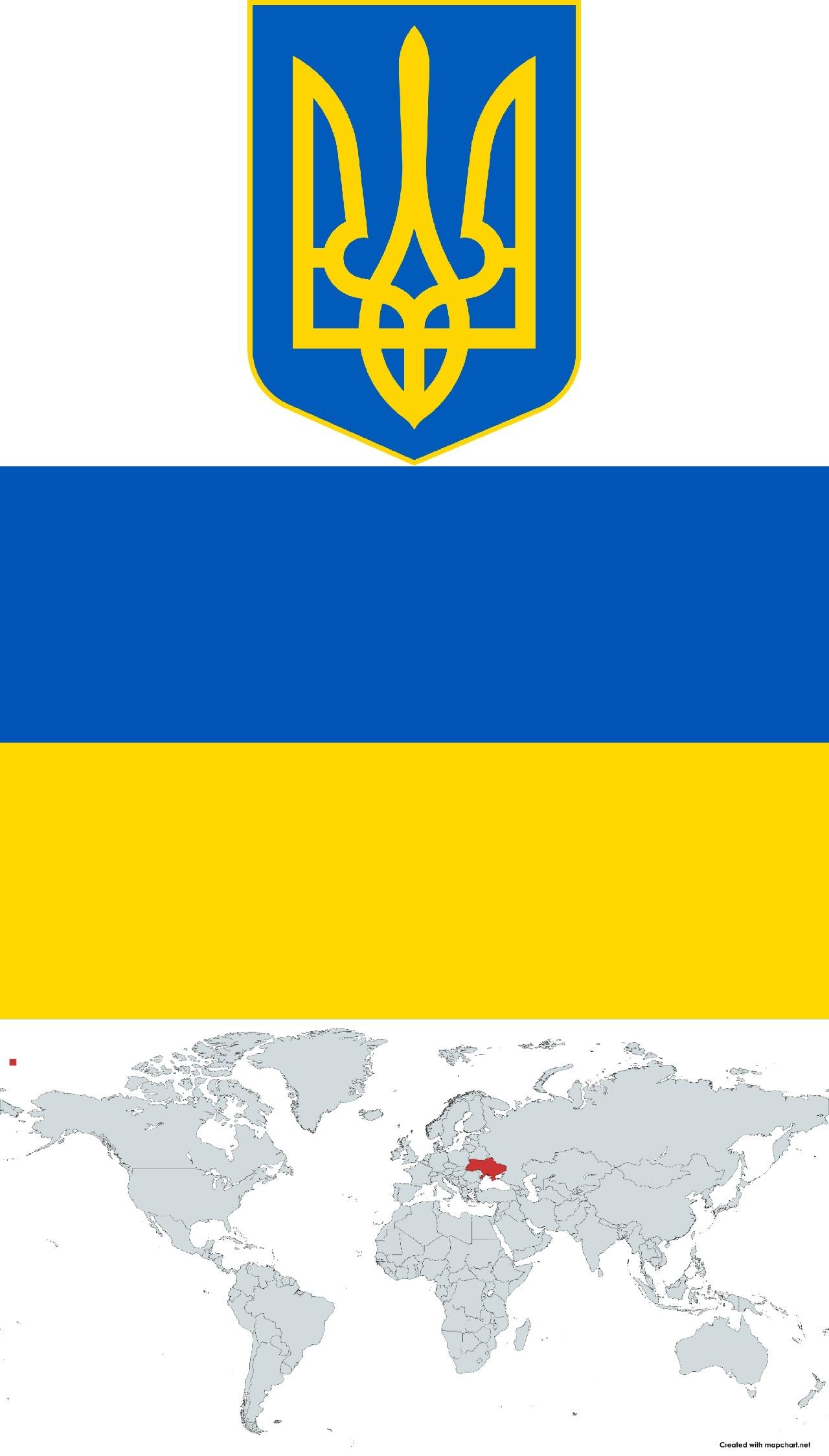
Ukraine
Official Name | Ukraine | ||||||||
|---|---|---|---|---|---|---|---|---|---|
Form of Government | Semi-Presidential Republic | ||||||||
Date of Independence | 24 Ağustos 1991 | ||||||||
Capital | Kyiv | ||||||||
Head of State | Volodymyr Zelensky | ||||||||
Official Languages | Ukrainian | ||||||||
Common Languages | Crimean Tatar (in Crimea) Ukrainian Russian Hungarian (Minority) | ||||||||
National Day | 24 August | ||||||||
Area | 603,550 km2 | ||||||||
Total Population | 35 Million | ||||||||
Climate | Humid Continental | ||||||||
GDP (Nominal) | 190.7 Billion US Dollars | ||||||||
GDP per Capita | 5,389.5 US Dollars | ||||||||
Ethnic Groups | 0.3 Percent Hungarian 0.3 Percent Polish 0.3 Percent Romanian 77.8% Ukrainian 17.3% Russian 0.6% Belarusian 0.5% Moldovan 0.5% Crimean Tatar 0.4% Bulgarian 0.2 Percent Jewish 1.8 Percent Others | ||||||||
Religious Affiliation | 9% Catholic 2% Other Christian groups 10% Non-religious 2% Protestant 72% Orthodox | ||||||||
Telephone Code | +380 | ||||||||
Internet Domain Code | .ua | ||||||||
Ukraine, located in the east of the European continent and north of the Black Sea, is both the geopolitical heart of Eastern Europe and a cultural bridge between Europe and Eurasia. With a total area of 603,550 square kilometers, it is the second-largest country in Europe after Russia. Its capital, Kyiv, had a population of approximately 35.6 million as of 2025. Thanks to its fertile black soil (chernozem), Ukraine has been historically known as the “granary of Europe.”
Ukraine’s identity has been shaped over a millennium at the intersection of Byzantine, Slavic, and Western European cultural influences. It was the center of Kievan Rus', one of the most powerful states in Europe during the 10th century; later it fell under the influence of the Polish-Lithuanian Commonwealth, the Ottoman Empire, and the Russian Empire. It regained its independence in 1991 with the dissolution of the Soviet Union. Russia’s annexation of Crimea in 2014 and its large-scale invasion beginning in 2022 became defining turning points in the country’s modern history.
Today, Ukraine continues its transformation, striving to preserve its territorial integrity while pursuing democratization, combating corruption, and integrating into Euro-Atlantic institutions. Its natural resources, strong agricultural infrastructure, and resilient civil society have made it a key actor in the process of rebuilding the country despite the conditions of war.
Ukraine’s national anthem is titled “Ще не вмерла України і слава, і воля” (“Shche ne vmerla Ukrayiny i slava, i volya” – The Glory and Freedom of Ukraine Have Not Yet Perished). The lyrics were written by Pavlo Chubynsky in 1862 and the music composed by Mykhailo Verbytsky. The anthem became one of the symbols of Ukrainian nationalism by the end of the 19th century, was banned during the Soviet era, and was officially adopted in 1992 following independence.
The text has a simple yet powerful structure that elevates the Ukrainian people’s will for freedom, their struggle for independence, and their love for the homeland. Today, especially during the years of war, it has become a symbol of societal resistance and national identity.
Ukrainian National Anthem (Youtube)
The territory of Ukraine has been inhabited since prehistoric times. The Tripolye (Trypillia) culture (5500–2750 BCE), which developed along the Dnieper, Dniester, and Southern Bug rivers, is one of Europe’s earliest agricultural civilizations. Later, Greek colonies (Olbia, Chersonesos, Theodosia) were established along the Black Sea coast, while Scythian and Sarmatian nomads dominated the north. Trade links with the Roman and Byzantine worlds deepened the region’s cultural mixing.
From the 9th century onward, Slavic tribes interacted with Viking-origin Varangians to establish the first organized state in the region: Kievan Rus'. The adoption of Christianity in 988 under Grand Prince I. Volodymyr (Vladimir) intensified Byzantine influence. In the 11th century, under Yaroslav the Wise, significant advances were made in law, architecture, and education. This era is known in Ukrainian historiography as the “Golden Age.”

Saint Sophia Cathedral Built After the Adoption of Orthodoxy by the Kievan Principality (Flickr)
In the 13th century, Mongol invasions destroyed Kievan Rus'. Subsequently, the western part of the territory became part of the Grand Duchy of Lithuania and later the Polish-Lithuanian Commonwealth. Polish rule implemented the aristocratic land system known as szlachta, which intensified class tensions among the local population. Peasants in the Dniester and Dnieper basins were burdened by heavy taxes and military obligations. This socio-economic pressure laid the groundwork for the rise of Cossack communities from the 16th century onward.
In the 17th century, Cossack leader Bohdan Khmelnytsky led a rebellion against Poland and established the Zaporozhian Cossack Hetmanate. The Zaporozhian Cossacks, who lived in the lower Dnieper region, became a significant community serving both as a warrior buffer along the northern frontier of the Ottoman Empire and as a force seeking autonomy from Poland. Initially aiming to establish an independent Cossack state, this movement eventually came under the protection of the Russian Tsardom following the Treaty of Pereyaslav (1654). This agreement is regarded in modern Ukrainian history as the beginning of both political dependency and identity conflict.
In the 18th century, the Russian Empire systematically eliminated Cossack autonomy. The Hetmanate was abolished in 1764, and the Zaporozhian Sich was dissolved in 1775. Simultaneously, following wars with the Ottoman Empire, the Crimean Khanate was annexed by Russia in 1783. Thus, the northern shores of the Black Sea came entirely under Russian control.

Declaration of Ukrainian Independence Led by Bohdan Khmelnytsky (Picryl)
Throughout the 19th century, Ukrainian territories were divided between the Russian Empire and Austria-Hungary. East of the Dniester was under Russian rule, while the western region of Galicia, centered on Lviv, was under Austrian administration. Under Russian rule, the Ukrainian language was banned; publications in languages other than Russian were censored even at Kyiv University. The 1863 Valuev Circular and the 1876 Ems Ukaz completely prohibited the printing and educational use of Ukrainian. In contrast, cultural life was more free in Austrian territories; thus, Galicia became the intellectual center of Ukrainian nationalism.
Taras Shevchenko’s poetry laid the foundation for national consciousness in the vernacular language. In the late 19th century, secret societies known as “Hromada” were organized in Kyiv and Kharkiv. Although the 1905 Russian Revolution briefly opened a liberal period, national movements were largely suppressed until 1917.
Following the Russian Revolution of 1917, the Central Rada (Central Council) was established in Kyiv and the Ukrainian People’s Republic was proclaimed. However, within the same year, the Bolsheviks launched a counter-revolution, plunging the country into civil war. By 1921, Ukraine was effectively incorporated into the Soviet Union.
In the early 1920s, a brief “Ukrainization Policy” permitted the use of the Ukrainian language in official institutions. However, this freedom was eliminated during Stalin’s rule. The forced collectivization policies implemented between 1932 and 1933 caused the man-made famine known as the Holodomor; between 3 and 5 million Ukrainians died of starvation. This event is now recognized by Ukraine as a genocide.

Ukrainian Population Starving to Death as a Result of Stalin’s Holodomor (Store Norske Leksikon)
During the Second World War, Ukraine became one of the war’s bloodiest fronts. Nazi Germany invaded the country in 1941; Ukrainians fought both in the Soviet army and in independence-oriented groups. The majority of the Jewish population was murdered in the Holocaust. In 1944–45, the Red Army retook the region, and postwar Ukraine became the second-largest republic of the Soviet Union.
In 1991, Ukraine declared its independence following the dissolution of the Soviet Union. The 2004 Orange Revolution became a symbol of the demand for democratization. Weeks of protests by millions in Kyiv’s Independence Square (Maidan Nezalezhnosti) embodied the emergence of a generation committed to democratization and pro-European policies.
The Euromaidan Events of 2013–2014 permanently shifted the country’s orientation toward the West. President Viktor Yanukovych’s rejection of the EU Association Agreement triggered nationwide protests. The process, which culminated in Yanukovych’s ouster amid violent clashes and regime repression, led to a major security crisis: Russia’s annexation of Crimea in 2014 and the outbreak of separatist conflicts in the Donbas region.

Protesters Setting Up Barriers During Euromaidan Protests (Anadolu Ajansı)
On 24 February 2022, Russia’s full-scale invasion plunged Ukraine into its most difficult period in modern history. Under the leadership of President Volodymyr Zelensky, the government continues to defend its territory with support from the West. As of 2025, the war continues in the eastern and southern regions, while Ukraine prepares for negotiations toward European Union membership.

Streets of Bucha After the Russian Occupation (Rawpixel)
Ukraine lies at the heart of Eastern Europe, bordered by Belarus to the north, Russia to the east, Poland, Slovakia, and Hungary to the west, and Romania and Moldova to the southwest. Its southern coast opens onto the Black Sea and the Sea of Azov. With a total area of 603,550 km², it is among the largest countries in Europe by territorial extent.
The majority of the country lies on the East European Plain. The average elevation is 175 meters; the eastern and central regions are covered by vast agricultural plains. Two-thirds of Ukraine’s territory consists of this land, which is of strategic importance in global agriculture due to its high fertility. For this reason, the country has been known for centuries as the “granary of Europe.”

Famous wheat fields and blue skies that give color to the Ukrainian flag (Pexels)
To the north, Ukraine shares a border with Belarus (891 km), to the east with Russia (1,974 km), to the west with Poland (535 km), Slovakia (98 km), and Hungary (103 km), and to the southwest with Romania (605 km) and Moldova (939 km). Its southern coastline along the Black Sea stretches nearly 2,700 kilometers. Crimea has been occupied by Russia since 2014, but under international law it is still recognized as Ukrainian territory.
In western Ukraine, the Carpathian Mountains extend, forming the country’s natural boundary and known as Transcarpathia. The highest peak is Hoverla (2,061 m). The Carpathians are significant both for their forest ecosystems and for tourism. In the south, the Crimean Mountains on the Crimean Peninsula, though relatively low (around 1,500 m), constitute the country’s most distinct geographical region due to their Mediterranean-like climate.
The heart of the country is the valley of the Dnieper (Dnipro) River. The vast lowlands surrounding this valley—for example, the Podolia, Poltava, and Taurida plains—are the center of Ukraine’s agricultural production. The valleys of the Dniester, Southern Bug, and Seversky Donets rivers are also favorable for agriculture and settlement. The geological structure of these plains is marked by highly fertile layers of chernozem (black soil), among the most productive agricultural soils in the world.
Ukraine has more than 63,000 rivers, most of which flow into the Black Sea. The longest and most important river is the Dnieper River (2,201 km). It divides the country from north to south and plays a critical role in energy production, transportation, and agriculture. Other major rivers include the Dniester, Southern Bug, Seversky Donets, and Tisza.
Lakes are generally small and shallow; the Svyatoye Lake in the Volyn region is the largest natural lake. Along the northern Black Sea coast, salt lakes and lagoon systems (such as Sasyk and Tylihul) exist. These areas are vital wetland ecosystems for migratory birds.
Ukraine’s climate is temperate continental. Humidity decreases from west to east, and temperature variations increase. Summers are hot and winters are cold and snowy. Average January temperatures range from -7 °C, while July temperatures range between 20–25 °C. Annual rainfall varies from 1,200 mm in the west to 400 mm in the east. Along the Black Sea coast, Mediterranean influences are evident; particularly the coasts of Odesa and Crimea are mild and sunny.
Although climatic conditions support agriculture, environmental degradation caused by the war in recent years has increased soil erosion and deforestation, especially in eastern regions.
Ukraine is one of the largest economies in Eastern Europe due to its natural resources, agricultural output, and industrial capacity. However, the Donbas War beginning in 2014, the 2022 Russian invasion, and infrastructure destruction have severely shaken its economic structure. Nevertheless, Ukraine’s economy has maintained resilience, particularly in western regions.
Despite production losses caused by the war, agriculture, mining, and information technology remain the pillars of the economy. Ukraine ranks among the world’s top exporters of wheat, corn, sunflower oil, and barley. It is also rich in iron ore, coal, natural gas, titanium, and manganese.

Azovstal Steel Plant, Heavily Damaged in Intense Fighting and Later Captured by Russia (Flickr)
The services sector is growing particularly in finance, transportation, and information technology. Kyiv and Lviv have become regional technology hubs. The backbone of industrial production consists of metallurgy, chemicals, energy equipment, and the defense industry.
Ukraine is working to revive its foreign trade through the reactivation of Black Sea ports (Odesa, Chornomorsk, Pivdennyi).
Turkey, due to its Black Sea connectivity, is one of Ukraine’s most important trade partners. The grain corridor agreement and defense industry cooperation form the strategic dimension of economic relations.
Before the war, Ukraine attracted rapidly growing foreign investment in information technology and agriculture. Since 2022, reconstruction funds have been activated with support from international financial institutions (IMF, World Bank, EBRD). As of 2025, the country is implementing a $15 billion investment plan for energy and infrastructure projects under the supervision of the European Bank for Reconstruction and Development (EBRD).
However, the investment environment remains risky. The war, bureaucracy, and corruption create uncertainty regarding business security. Nevertheless, the Ukrainian government offers tax incentives and special economic zones to foreign investors under its “Rebuild Ukraine 2030” plan.
Ukraine holds a strategic position in the transit of natural gas between Europe and Russia. Parts of Gazprom’s pipelines still run through Ukrainian territory. The country generates energy from coal, natural gas, nuclear, and hydroelectric power plants. As of 2024, 55% of electricity is generated from nuclear sources. The share of renewable energy (particularly solar and wind) has reached 12%.
Before the war, Ukraine had one of the most developed railway networks in Eastern Europe. The Ukrzaliznytsia railway system is being integrated into Europe through main lines connecting to Poland and Romania. The reconstruction of road and port infrastructure is rapidly advancing with Western financing and EU funds.

Ukraine’s Energy Infrastructure According to a 1996 CIA Report (Picryl)
As of 2025, the population living within Ukraine’s borders is approximately 31 million. This represents a significant decline from the pre-war population of 44 million. The main causes of population loss are war-related migration, declining birth rates, and the mobilization of men to the front lines.
Seventy percent of the population lives in urban areas, and 30% in rural areas. Ukraine’s population density is 58 people per square kilometer, below the European average.

Ukraine Population Distribution (CIA World Factbook)
The country’s largest cities are Kyiv, Kharkiv, Dnipro, Odesa, and Lviv. The capital Kyiv, with a population of approximately 3 million, is the political and cultural center. Due to the war, significant internal migration has occurred from eastern cities to the west, causing rapid growth in western cities such as Lviv and Ivano-Frankivsk.
As a country shaped by Soviet-era planned industrial cities, much of the population settled along industrial corridors (Dnipro, Zaporizhia, Kryvyi Rih). The post-war reconstruction process is encouraging the establishment of new industrial and technology centers in western regions.
Ukrainian society is largely ethnically homogeneous.
Crimean Tatars were forcibly deported to Central Asia by Stalin in 1944 and began returning to their homeland after 1991. Today, Russia’s occupation of Crimea once again threatens the existence of this community.

Crimean Tatars and Ukrainians Commemorating the Deportation of Crimean Tatars in Kyiv (Anadolu Ajansı)
Ukraine’s religious structure is centered on Orthodox Christianity, but this structure is divided politically and theologically between two main churches:
In addition, the Ukrainian Greek Catholic Church is particularly strong in the west (Lviv, Ternopil). A small portion of the population belongs to Protestant, Jewish, and Muslim faiths. Although religion was suppressed during the Soviet era, since independence it has become a defining element of social life.
Ukraine’s literacy rate exceeds 99%. The education system consists of 12 years of compulsory basic education, followed by university or vocational college. The country has over 700 higher education institutions. Taras Shevchenko National University of Kyiv, Lviv Polytechnic, Kharkiv Polytechnic Institute, and Odesa Maritime Academy lead the field.
Since the 2020s, international student programs have become widespread, particularly in information technology, engineering, and medicine. Despite wartime conditions, online education systems and European-funded scholarship programs have ensured educational continuity.

Taras Shevchenko National University of Kyiv (Pexels)
Following Russia’s 2022 invasion, more than 8 million Ukrainians have sought refuge in European countries. Approximately 5 million remain in EU member states. Internal migration is also significant: large-scale population movement has occurred from war-affected eastern and southern regions to the west.
The loss of skilled labor has become a long-term demographic challenge. In response, post-war return programs aim to reintegrate women and young people into the country.
Ukraine is a prominent tourism destination due to its rich cultural heritage and historical sites. The capital Kyiv hosts important religious and historical landmarks such as the Golden-Domed Saint Sophia Cathedral and the Pechersk Lavra Monastery. Lviv, listed as a UNESCO World Heritage Site, offers visitors a historic urban experience through its Baroque architecture, European-style city planning, and coffee culture. Odesa on the Black Sea coast is an attractive center for tourists due to its 19th-century port architecture and cosmopolitan cultural fabric.
Ukraine’s natural beauty also holds significant tourism potential. The Carpathian Mountains offer skiing and snowboarding opportunities in winter and attract visitors year-round with hiking trails and spa centers. The Dnipro Valley provides an ideal environment for nature and adventure tourism through river tours, camping areas, and national parks. These regions are ideal destinations for tourists seeking to escape urban life.
The Chernobyl region has become both a memorial and a tourist site following the 1986 nuclear disaster. Visits to this area offer opportunities to witness history, observe the disaster’s impacts, and experience sites of collective memory. Tourists can closely examine the region’s history and the consequences of the event through guided tours.
Ukraine’s rural areas, particularly in Volyn and Podolia, are increasing interest in eco-tourism through traditional village homes and agricultural experience tours. Visitors can experience local life, participate in farming activities, and explore the region’s natural resources. This type of tourism both raises environmental awareness and supports the local economy.

UNESCO-Protected Historic Center of Lviv (Pexels)
Before the war, Ukraine’s tourism sector was a significant component of the national economy. According to 2021 data, tourism contributed approximately 6% to Ukraine’s gross domestic product, both directly and indirectly. This supported domestic employment and increased foreign currency inflows. However, the conflict that began in 2022 caused a severe decline in the sector. Travel restrictions, security concerns, and infrastructure damage limited tourism activities. Nevertheless, some activities in cultural and health tourism continue, particularly in western regions. Lviv, Ivano-Frankivsk, and the Carpathians remain popular among visitors due to their historical, cultural, and natural attractions.
In the post-war period, international support and EU-funded projects aim to revive Ukrainian tourism. One of the most important initiatives, the “ReDiscover Ukraine” project, seeks to preserve the country’s cultural heritage and promote sustainable tourism. These efforts are crucial for restoring historical structures and contributing to the local economy. The projects encourage local communities to benefit from tourism while supporting the creation of a safe and organized tourism infrastructure.
Ukraine’s foreign policy has been shaped since its 1991 independence along two fundamental axes: sovereignty and orientation. On one hand, efforts to free itself from Russia’s historical, cultural, and economic influence; on the other, the aspiration to integrate into Euro-Atlantic institutions. This tension between two directions has been the primary dynamic shaping Ukraine’s domestic and foreign policy.
Following the dissolution of the Soviet Union, Ukraine adopted a “multi-vector foreign policy” aimed at balancing relations between the West and the East. In 1994, Ukraine signed the Budapest Memorandum, voluntarily relinquishing its nuclear weapons in exchange for security guarantees from Russia, the United States, and the United Kingdom regarding Ukraine’s territorial integrity. This document is now frequently debated as a pivotal security moment; the Russian violations in 2014 and 2022 have demonstrated that these guarantees were effectively nullified.
Throughout the 1990s and 2000s, Ukraine maintained relations with both the European Union (EU) and the Commonwealth of Independent States (CIS). However, the 2004 Orange Revolution, as a pro-Western popular movement, redirected the country’s course toward Europe. Democratization, anti-corruption efforts, and press freedom became central to foreign policy agendas during this period.
Russia’s annexation of Crimea in 2014 and its support for separatist forces in the Donbas region fundamentally altered Ukraine’s security doctrine. This process accelerated Ukraine’s integration into Western alliances. In 2019, Ukraine enshrined “EU and NATO membership” as strategic goals in its constitution.
The Russia-Ukraine War (2022–present) is not merely a regional conflict but an existential struggle for Ukraine. The war has placed the country at the center of international legal, sovereignty, and energy security debates. Since 2022, the United States and the European Union have launched a historic solidarity process by providing Ukraine with financial, military, and diplomatic support. This assistance has reached a total aid package exceeding $200 billion as of 2025.
In 2023, Ukraine gained the status of “preparation for full membership” in the European Union. Priority reform areas include judicial independence, energy market alignment, anti-corruption measures, and modernization of public administration. As of 2025, Ukraine is the most active country in the EU’s “Eastern Partnership” program.
Relations with NATO have reached a practical partnership level. Since 2014, the Ukrainian military has been restructured according to the NATO Standardization Program (STANAG). Although not a formal member, Ukraine has been included in “mutual defense support mechanisms” since 2022. This marks a historic step for a country previously considered neutral toward the Western security umbrella.

European Commission President Ursula von der Leyen’s Visit to Ukraine (European Commission)
Despite wartime conditions, Ukraine’s relations with its neighbors have largely progressed on a basis of cooperation.
Ukraine renewed its “Strategic Partnership Charter” with the United States in 2021. This agreement covers defense reform, energy security, and cyber defense. The United States has also provided Ukraine with air defense systems (Patriot, NASAMS) and intelligence support throughout the war. The United Kingdom is among Kiev’s most active supporters in military training and unmanned systems.
Ukraine-Turkey relations were established at the diplomatic level immediately after Ukraine declared independence in 1991 and have since evolved into a strategic partnership, particularly from the 2010s onward. Geographic proximity, Black Sea security, and defense industry cooperation form the core pillars of the two countries’ relationship.
The High-Level Strategic Cooperation Council (HLSCC), established in 2011, institutionalized political, economic, and military coordination between the two nations. Turkey has unconditionally recognized Ukraine’s territorial integrity and openly rejected Russia’s annexation of Crimea in 2014 and its invasion in 2022 on international platforms. Ankara is also the most active country in defending the rights of the Crimean Tatars.
Since the 2020s, defense technology and energy cooperation have come to the forefront of economic relations. The Free Trade Agreement implemented in 2022 aims to raise bilateral trade volume above $10 billion. However, the most notable area of relations has undoubtedly been defense industry cooperation. The use of Bayraktar TB2 unmanned aerial vehicles by the Ukrainian military has become a symbol of security cooperation between the two countries.

President Erdoğan’s Meeting with Ukrainian President Zelensky (Anadolu Ajansı)
Ukraine’s 2023 National Security Strategy is based on three core principles:
Since 2022, Ukraine has adopted a “whole-of-society defense” model. This encompasses not only the regular military but also civil defense and volunteer units integrated into the national resistance system.
During the war, Ukraine has integrated Western technology, particularly in intelligence and unmanned systems. Additionally, the LITPOLUKRBRIG Brigade, established between Lithuania, Poland, and Ukraine, continues to operate as a symbol of regional joint defense.
Energy security is a fundamental component of foreign policy. To reduce dependence on Russian gas, Ukraine fully connected to the European Network of Transmission System Operators for Electricity (ENTSO-E) system as of 2024. Simultaneously, liquefied natural gas (LNG) flows have been established via Romania and Slovakia.
The security of agricultural exports is also considered part of national security. The Grain Corridor Agreement, signed in 2022 under Turkish and UN mediation, played a decisive role in preventing a global food crisis and strengthened Ukraine’s diplomatic standing.
In the 2020s, Ukraine began positioning itself not merely as part of Eastern Europe but at the center of the entire European security architecture. The country is now viewed not as a geopolitical buffer zone but as an “active defense line.” This process has identified Ukrainian identity with the West’s principles of freedom, democracy, and sovereignty. This identity has become a factor that strengthens not only foreign policy but also national unity.
The Armed Forces of Ukraine (ZSU – Zbroyni Syly Ukrayiny) have undergone a fundamental transformation since 2022. At the start of the war, the active personnel numbered 250,000; as of 2025, this figure has reached approximately 700,000 active soldiers and 900,000 reservists. Today, the Ukrainian military possesses the largest combat experience of any army in Europe.

President Volodymyr Zelensky’s Visit to Special Units and the Press in Bucha (Rawpixel)
The main components of the military are:
Command is conducted by the General Staff (Heneralnyi Shtab). The military’s reorganization has been carried out in accordance with NATO standards. Significant progress has been made particularly in logistics, intelligence, and command and control (C4ISR).
In the early years of the war, the Ukrainian military relied on Soviet-era equipment. Since 2023, it has entered a comprehensive modernization process supported by the West.
Ukraine has also focused on domestic production. Companies such as Ukroboronprom and Ukrspecexport have entered joint production agreements with Western firms. In 2024, over 300 private defense companies operated across the country.

Special Ukrainian Units Known for FPV Drone Use (Anadolu Ajansı)
The loss of Crimea in 2014 severely weakened the Ukrainian Navy. However, since 2022, an asymmetric naval warfare concept has been developed. Ukraine has conducted effective operations in the Black Sea using Turkish-made Bayraktar TB2, locally produced Neptune missiles, and unmanned maritime vehicles (drone boats). In 2023, the destruction of several vessels belonging to the Russian Black Sea Fleet demonstrated the success of this strategy.
Ukraine is modernizing its heavy industrial infrastructure inherited from the Soviet era. Institutions such as the Kharkiv Morozov Design Bureau, Antonov Aviation Company, and Motor Sich form the technological backbone of the country. As of 2025, Ukraine’s defense budget has reached 35% of its GDP. The country aims not only to achieve self-sufficiency in wartime but also to become part of the European defense supply chain in the medium term.
Turkey’s leading defense company Baykar Technology initiated cooperation with Ukraine in 2019 through the sale of Bayraktar TB2 unmanned aerial vehicles (UAVs). These UAVs became one of the most effective operational systems for the Ukrainian Armed Forces, both in the Donbas front and during the 2022 Russian invasion. In the early stages of the war, TB2s became symbolic weapons against Russian armored units and transformed into a national symbol of resistance in Ukrainian public opinion.
Joint production projects with Turkey (Bayraktar TB2, Akıncı, munitions integration) have accelerated Ukraine’s industrial capacity. As of 2025, the Ukrainian Ministry of Defense has taken over 70 Bayraktar TB2s into its local maintenance system and created employment for 2,000 people at its assembly line.
The relationship has not remained at the supply level; it has progressed to the stage of joint production and technology transfer. In 2022, Baykar established the Baykar-Ukraine Facility near Kyiv, planned as an assembly and maintenance line for the TB2 and advanced Akıncı models. The project integrates with the turbo engine technology of Ukrainian motor manufacturers Motor Sich and Ivchenko-Progress. This cooperation has increased mutual dependency between the two countries’ defense industries, granting Turkey engine technology and Ukraine electronic, software, and production knowledge and skills.
Ukraine is also conducting negotiations with TUSAŞ and Roketsan on munitions and missile systems. The use of Turkish-made MAM-L munitions in Ukrainian operations demonstrates the tactical depth of this cooperation. As of 2024, the two countries are working on a protocol for the joint use of Baykar-produced unmanned systems in Black Sea security patrols.

Head of the Ukrainian Presidential Office Andriy Yermak Awarding Selçuk Bayraktar the State Merit Order (Baykar)
Ukraine’s new defense doctrine is based on the principle of “active defense and deterrence.” According to this strategy, the country aims not only to defend its own territory but also to deter potential aggressors through technological superiority.
As of 2025, Ukraine possesses one of Europe’s largest land forces, the fastest-growing fleet of unmanned systems, and a NATO-standard personnel training system. In the long term, its goal is to establish by 2030 a fully professional, digitally integrated, modern joint force incorporating cyber and space elements.
Baykar Teknoloji. "Andriy Yermak’tan Özdemir Bayraktar Milli Teknoloji Merkezi’ne Ziyaret." Baykar. October 2, 2022. Accessed November 5, 2025.
Bozdoğan, Kaan. "Cumhurbaşkanı Erdoğan, Ukrayna Devlet Başkanı Zelenskiy ile görüştü." Anadolu Ajansı. July 8, 2023. Accessed November 5, 2025.https://www.aa.com.tr/tr/gundem/cumhurbaskani-erdogan-ukrayna-devlet-baskani-zelenskiy-ile-gorustu/2939776
Central Intelligence Agency. *Ukraine Factsheet – The World Factbook.* Langley, VA: CIA. 2025. Accessed November 5, 2025.https://www.cia.gov/the-world-factbook/countries/ukraine/
Chad Nagle. "Azovstal." Flickr. Accessed October 17, 2024. https://https://www.flickr.com/photos/16936128@N06/15555902821/.
Doruk, Bülent. "Ukrayna'da göstericiler meydanlardan ayrılmıyor." Anadolu Ajansı. Accessed November 5, 2025.https://www.aa.com.tr/tr/pg/foto-galeri/ukraynada-gostericiler-meydanlardan-ayrilmiyor/0/80921.
European Commission. "Photo P-060090/00-17." European Commission Audiovisual Service, February 2, 2022. Accessed November 5, 2025.
Franganillo, Jorge. "Kiev: Saint Sophia's Cathedral" Flickr. September 27, 2020. Accessed November 5, 2025.https://www.flickr.com/photos/franganillo/50389501462/in/photostream/
Ian Berwick. "National Anthem: Ukraine - Ще не вмерли України ні Слава ні Воля." YouTube. Uploaded November 24, 2016. Accessed November 5, 2025.
Jane Blaze. "Aerial View of the Old Historical Center of the City Lviv in Ukraine During Winter." Pexels, February 10, 2018. Accessed November 5, 2025.
Kachkachishvili, Davit. "Ukrayna ordusu, keşif ve saldırı dronlarını cephede aktif olarak kullanıyor." Anadolu Ajansı, October 21, 2023. Accessed November 5, 2025.
Karina Rudnitska. "Red University Building in Kyiv Ukraine." April 29, 2022. Pexels. Accessed November 5, 2025.
Khudaykulova, Madina, He Yuanqiong, and Akmal Khudaykulov. "Economic consequences and implications of the Ukraine-Russia war." *International Journal of Management Science and Business Administration* 8, no. 4 (2022): 44-52. Accessed November 5, 2025.https://www.researchgate.net/profile/Bojan-Obrenovic/publication/362057842_Economic_Consequences_and_Implications_of_the_Ukraine-Russia_War/links/62d3bff85aab971198b63e2c/Economic-Consequences-and-Implications-of-the-Ukraine-Russia-War.pdf
MapChart. "World Map – Simple." Accessed November 5, 2025.https://www.mapchart.net/world.html.
Mariia Polishchuk. "Tranquil Wheat Field Harvest in Ukraine." Pexels. Accessed November 5, 2025.https://www.pexels.com/photo/tranquil-wheat-field-harvest-in-ukraine-30576880/
Ministry of Trade of the Republic of Turkey. "Ukraine Country Profile – 2025." Ministry of Trade of the Republic of Turkey. Accessed November 11, 2025.https://www.ticaret.gov.tr/data/5f07144813b87611d894d163/Ukrayna%20%C3%9Clke%20Profili-2025.pdf.
Picryl. "1996 Ukraine Oil and Gas." Picryl, September 11, 2016. Accessed November 5, 2025.
Picryl. "Ukraine Camporum Desertorum, 1648, Beauplan." Picryl. Accessed November 5, 2025.
Plokhy, S. The Gates of Europe: A History of Ukraine. Basic Books. 2015.
Rawpixel. "Devastation in Bucha." Accessed November 5, 2025.
Rawpixel. "Volodymyr Zelenskyy visited Bucha, where he talked to local residents and journalists." Accessed November 5, 2025.
Shtanko, Vladimir. "Kırım Tatarları Sürgününün 71. Yılı." Anadolu Ajansı, May 19, 2019. Accessed November 5, 2025.https://www.aa.com.tr/tr/pg/foto-galeri/kirim-tatarlari-surgununun-71-yili/0/15929
Store Norske Leksikon. "Holodomor." Store norske leksikon. Accessed November 5, 2025. https://snl.no/Holodomor.
United Nations High Commissioner for Refugees (UNHCR). *Ukraine Refugee Situation Data Portal.* Geneva: UNHCR, 2025. Accessed November 5, 2025.
Yekelchyk, Serhy. Ukraine: Birth of a Modern Nation. Oxford; Oxford University Press, 2007.
[1]
Savaş nedeniyle nüfus için kesin bir sayı verilememektedir.


Ukraine
Official Name | Ukraine | ||||||||
|---|---|---|---|---|---|---|---|---|---|
Form of Government | Semi-Presidential Republic | ||||||||
Date of Independence | 24 Ağustos 1991 | ||||||||
Capital | Kyiv | ||||||||
Head of State | Volodymyr Zelensky | ||||||||
Official Languages | Ukrainian | ||||||||
Common Languages | Crimean Tatar (in Crimea) Ukrainian Russian Hungarian (Minority) | ||||||||
National Day | 24 August | ||||||||
Area | 603,550 km2 | ||||||||
Total Population | 35 Million | ||||||||
Climate | Humid Continental | ||||||||
GDP (Nominal) | 190.7 Billion US Dollars | ||||||||
GDP per Capita | 5,389.5 US Dollars | ||||||||
Ethnic Groups | 0.3 Percent Hungarian 0.3 Percent Polish 0.3 Percent Romanian 77.8% Ukrainian 17.3% Russian 0.6% Belarusian 0.5% Moldovan 0.5% Crimean Tatar 0.4% Bulgarian 0.2 Percent Jewish 1.8 Percent Others | ||||||||
Religious Affiliation | 9% Catholic 2% Other Christian groups 10% Non-religious 2% Protestant 72% Orthodox | ||||||||
Telephone Code | +380 | ||||||||
Internet Domain Code | .ua | ||||||||
National Anthem
History
Early Communities and Antiquity
Medieval Period
Russian and Austro-Hungarian Rule
Modern Era
Geography
Borders and Neighbors
Mountains
Plains and Valleys
Rivers and Lakes
Climate
Economy
Key Economic Indicators (2023)
Sectoral Distribution
Foreign Trade
Foreign Investment and Business Environment
Energy and Transportation Infrastructure
Demographics, Education, and Culture
Key Demographic Indicators (2025)【1】
Population Distribution and Urbanization
Ethnic Composition
Religious Distribution
Education and Literacy Rate
Migration and Population Decline
Tourism
Tourist Regions and Types
Cultural and Historical Tourism
Nature and Adventure Tourism
Memorial and War Tourism
Rural and Eco-Tourism
Tourism’s Role in the Economy
Foreign Policy and Security
Diplomacy After Independence (1991–2013)
Tensions with Russia and Transition to a New Security Architecture (2014–2022)
Integration with the West and European Policy
Neighboring Countries and Regional Relations
Strategic Partnership with the United States and the United Kingdom
Relations with Turkey
Security Structure and Defense Strategy
Energy and Economic Security Dimension
International Position and Identity Policy
Military and Defense Industry
Structure and Command System
Military Capacity and Modernization
Navy and Black Sea Security
Defense Industry
Joint Defense Cooperation with Turkey
Defense Doctrine and Future Perspective