


This article was automatically translated from the original Turkish version.
+1 More
Umami is a Japanese term meaning “delicious” or “pleasant taste,” recognized as one of the fundamental components of taste. Considered the fifth basic taste alongside sour, sweet, bitter, and salty, umami is primarily associated with amino acids and nucleotides such as glutamate, inosinate, and guanylate. It presents a savory, meaty, and lingering flavor profile. The scientific definition of this taste was established in the early 20th century by Japanese scientist Kikunae Ikeda, who identified that monosodium glutamate (MSG) produces the umami flavor.

Taste Buds (generated by artificial intelligence).
The discovery of umami began with the work of Japanese chemist Kikunae Ikeda in the early 20th century. While working at Tokyo University in 1908, Ikeda studied the flavor profile of dashi, a traditional Japanese soup, and observed a unique taste that could not be explained by the four known basic tastes. Dashi is derived from kombu (Laminaria japonica), a type of seaweed. Through aqueous extraction, crystallization, and chemical analysis, Ikeda identified the compound responsible as glutamic acid. To describe this new taste, he coined the term “umami,” derived from the Japanese adjective “umai,” meaning delicious.
This discovery was published in 1909 in the *Journal of the Chemical Society of Tokyo*; however, because the paper was published in Japanese, it was not widely recognized in Western scientific circles. In 1913, Ikeda’s student Shintaro Kodama demonstrated in his research on dried bonito flakes (katsuobushi), commonly used in Japanese cuisine, that 5'-inosinate (IMP) also possesses umami characteristics. This second compound revealed that umami is not limited to glutamate alone.
Research on umami gained renewed momentum in 1957 with the work of Japanese scientist Akira Kuninaka. Kuninaka identified a third umami compound, guanylate (GMP), in dried shiitake mushrooms and experimentally demonstrated that it acts synergistically with glutamate. This discovery showed that umami arises not from a single molecule but from the interaction of different taste compounds.
The scientific acceptance of umami as a fundamental taste took much longer. For many years in the Western world, it was described using terms such as “brothy,” “savory,” or “meaty.” However, the necessary physiological and molecular evidence to classify it as a basic taste was not obtained until the late 20th century and early 21st century. In particular, the 2000 discovery by Chaudhari and colleagues of the metabotropic glutamate receptor mGluR4 on taste buds, followed in 2002 by Nelson and colleagues identifying the T1R1/T1R3 heterodimer as the umami receptor, formally established umami as the fifth basic taste in the scientific literature.
Throughout history, various civilizations have used foods with umami effects. Ancient Romans used garum, a fermented fish sauce rich in glutamate. Similarly, traditional French stocks made from meat and vegetables, Chinese soy sauce and fermented products, and Japanese dashi made from kombu and katsuobushi are all prominent umami-rich sources.
This historical development demonstrates that umami is not merely a cultural taste perception but a universal sensory experience. Today, neurophysiological, biochemical, and behavioral studies have established umami as one of the five universally recognized basic tastes, alongside sweet, sour, bitter, and salty.
Umami taste is detected by the activation of T1R1 and T1R3 heterodimer receptors, which are G-protein-coupled receptors located on taste buds. These receptors are sensitive to L-glutamate and other L-amino acids, as well as nucleotides such as inosinate (IMP) and guanylate (GMP). A key feature of umami perception is the synergistic interaction between these compounds: when applied individually, L-glutamate and nucleotides produce only mild taste sensations, but when combined, they dramatically enhance flavor intensity. This synergy allows for strong umami perception even at low concentrations, explaining why traditional food combinations—such as Japanese dashi made from kombu (a glutamate source) and katsuobushi (an inosinate source)—have evolved historically to naturally optimize this effect. The same mechanism is observed in meat broths, fermented cheeses, dried mushrooms, and seafood, where free amino acids and nucleotides are naturally released during aging, drying, or fermentation processes.
Umami taste increases saliva production and facilitates the breakdown of food in the mouth. It also triggers the secretion of digestive enzymes, aiding the digestive process. This taste plays a significant role in supporting diminished taste sensitivity, particularly in elderly individuals. Due to its flavor-enhancing properties, umami is often used to compensate for taste loss in low-salt foods.
In the food industry, umami-contributing compounds are widely used to enrich the flavor profiles of low-calorie and low-sodium products. Natural sources of umami include tomatoes, mushrooms, soy sauce, seaweed, and aged cheeses.
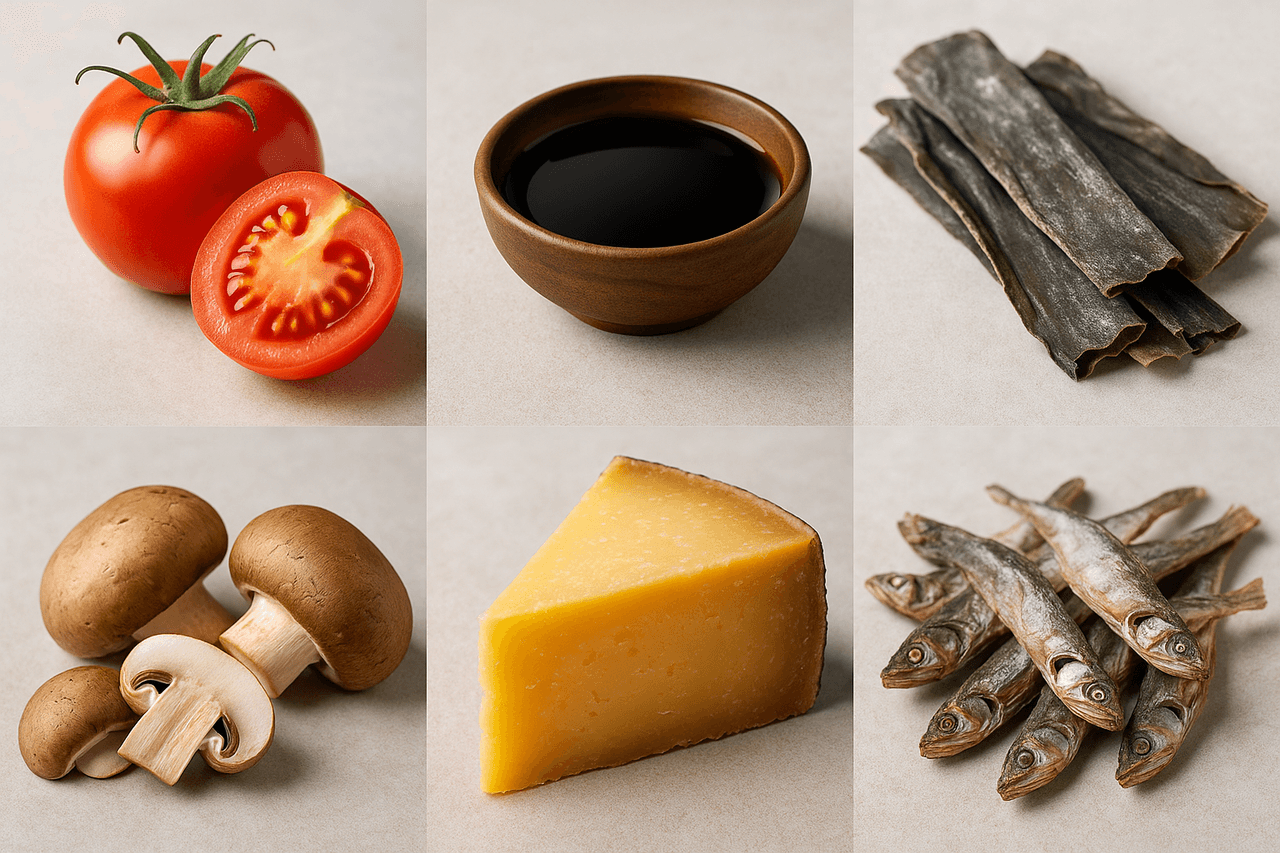
Umami Sources (generated by artificial intelligence).
Dried fish and meat stocks are also rich in umami. Monosodium glutamate is widely used as a food additive, although claims that it may cause sensitivities in some consumers have sparked debate. However, scientific studies have demonstrated that this substance is safe when consumed in reasonable amounts.
Cömert, M., & Güdek, M. “Beşinci Tat: Umami (Fifth Taste: Umami).” Journal of Tourism and Gastronomy Studies, 5(3). Accessed July 20, 2025. https://www.researchgate.net/publication/322174441_Besinci_Tat_Umami_Fifth_Taste_Umami
Kurihara, K. “Glutamate: from discovery as a food flavor to role as a basic taste (umami).” The American Journal of Clinical Nutrition, 90(3). https://doi.org/10.3945/ajcn.2009.27462D
Lindemann, B., Ogiwara, Y., & Ninomiya, Y. “The discovery of umami.” Chemical. Accessed July 20, 2025. https://www.researchgate.net/publication/277449479_The_Discovery_of_Umami
Shizuko Yamaguchi, Kumiko Ninomiya. “Umami and Food Palatability.” The Journal of Nutrition, Volume 130, Issue 4. Accessed July 20, 2025. https://doi.org/10.1093/jn/130.4.921S

Historical Development
Recognition of Umami as the Fifth Basic Taste
Chemical Components and Taste Receptors
Physiological and Sensory Effects
Role in Nutrition and Food Technology