

 Recently Added:
This article was automatically translated from the original Turkish version.
US-China Trade Talks
History | 9-10 June 2025 | ||||||||
|---|---|---|---|---|---|---|---|---|---|
Place(s) | United Kingdom London Lancaster House | ||||||||
Parties | China United States | ||||||||
The U.S.-China Trade Talks were bilateral diplomatic meetings held in London, the capital of the United Kingdom, on 9–10 June 2025, following escalating tensions between the two countries over rising customs tariffs export restrictions and strategic trade disputes. The talks were conducted to advance implementation of the agreement reached in Geneva on 10–11 May 2025, which included a 90-day temporary tariff compromise.
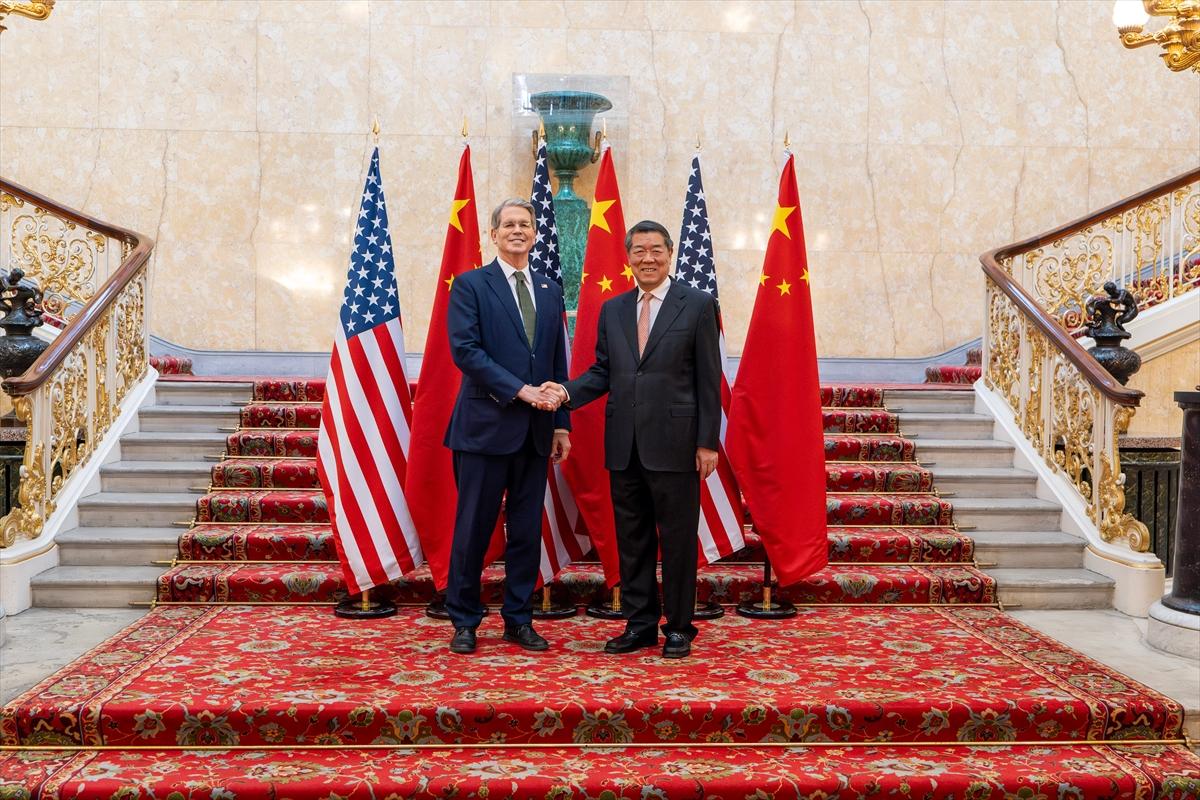
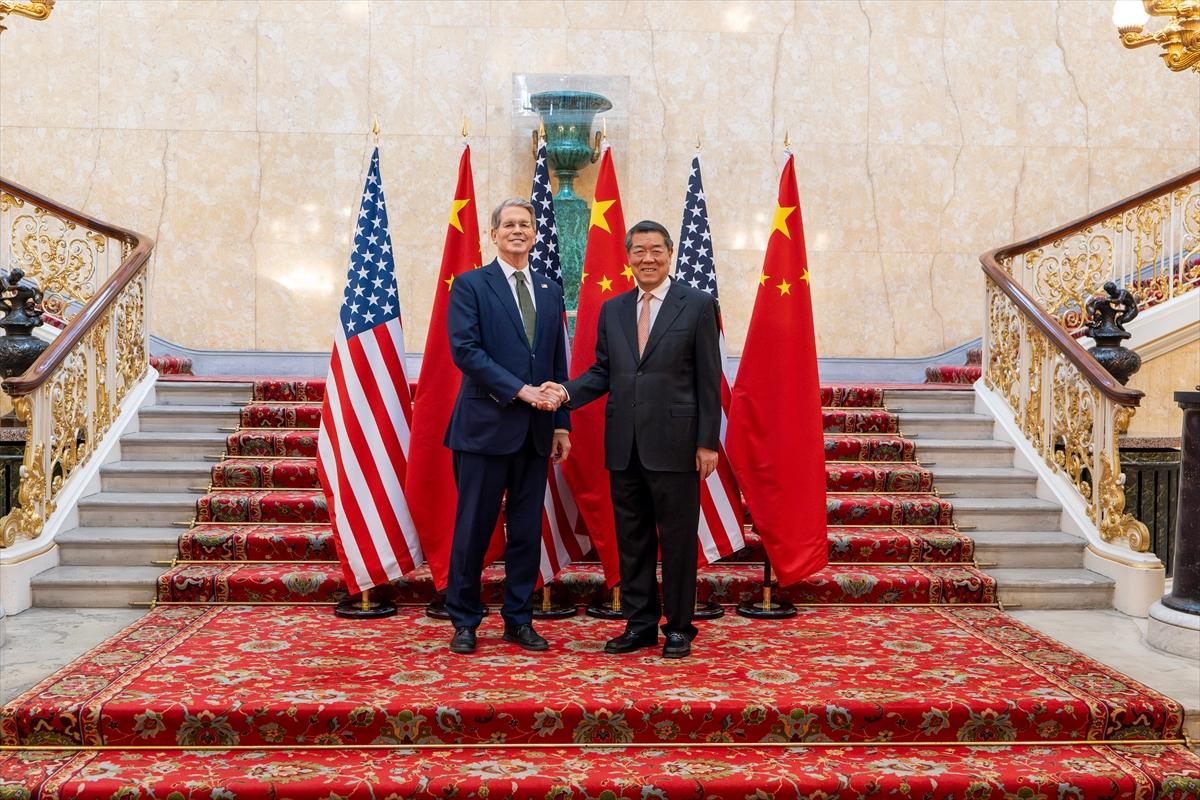
At the U.S.-China trade talks in London, China’s Vice Premier for Economic Relations He Lifeng and U.S. Treasury Secretary Scott Bessent, 9 June 2025 – (Anadolu Agency)
On 2 April 2025, U.S. President Donald Trump announced new customs duties, which were implemented as a unilateral tariff policy affecting numerous countries including China. In response, China declared retaliatory tariffs on U.S. goods, and within a short period, mutual tariff rates reached levels of 145 percent and 125 percent respectively. This escalation marked the beginning of a period of heightened economic tension between the two nations.
Following the intensifying tariff pressure, the two sides met in Geneva Switzerland on 10–11 May 2025. As a result of these talks, an agreement was reached to temporarily reduce the mutually imposed customs duties for a period of 90 days. The United States lowered its tariffs on Chinese goods to 30 percent while China reduced its tariffs on U.S. products to 10 percent. This agreement laid the foundation for further negotiations aimed at reaching a more comprehensive deal within the specified timeframe. In the period following the Geneva accord, both sides made reciprocal allegations of violations across various areas.
A telephone conversation between U.S. President Donald Trump and Chinese President Xi Jinping on 5 June 2025 led to an agreement on taking new steps to implement the Geneva accord. Following this discussion, it was decided to launch a new round of high-level negotiations in London. The content of the London talks was directly shaped by this diplomatic telephone exchange.
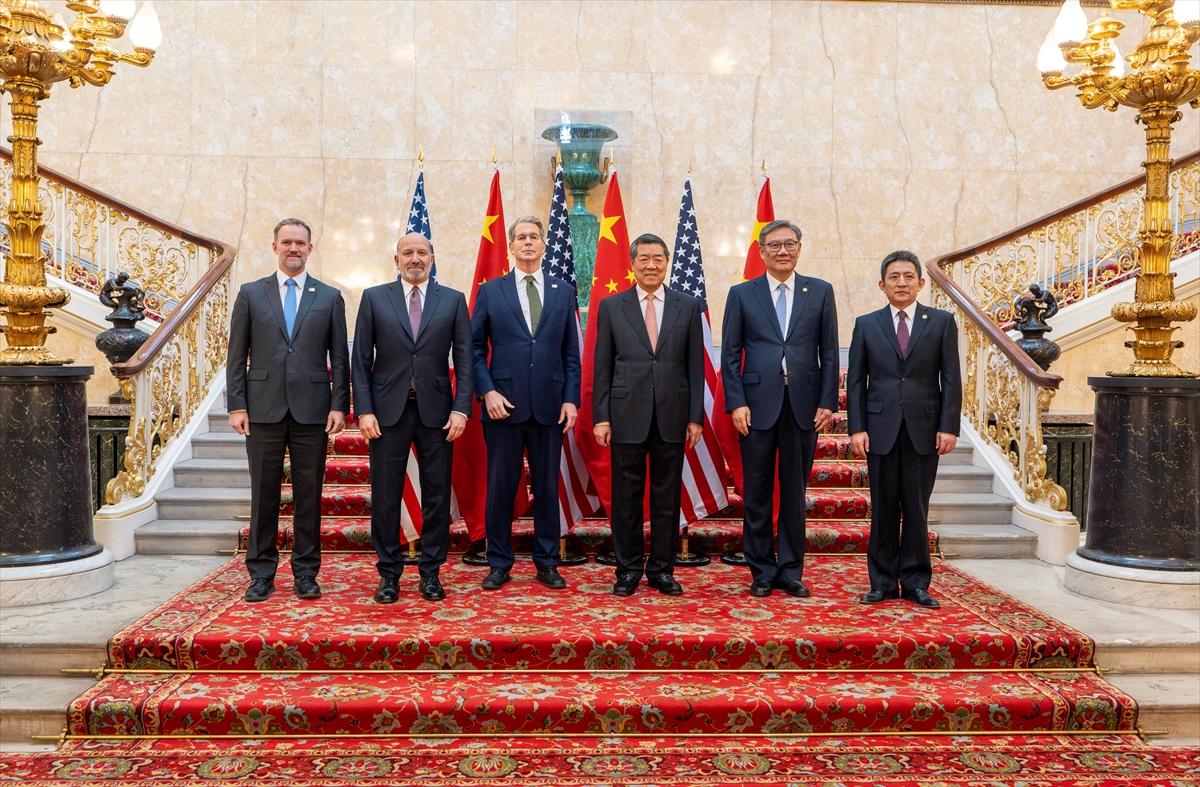
The negotiations between the U.S. and Chinese delegations took place on 9–10 June 2025 at Lancaster House, a historic building located near Buckingham Palace in London the capital of the United Kingdom. The talks began at midday each day and continued into the evening. The U.S. delegation was led by Secretary of Commerce Howard Lutnick. Other members included Treasury Secretary Scott Bessent and U.S. Trade Representative Jamieson Greer.
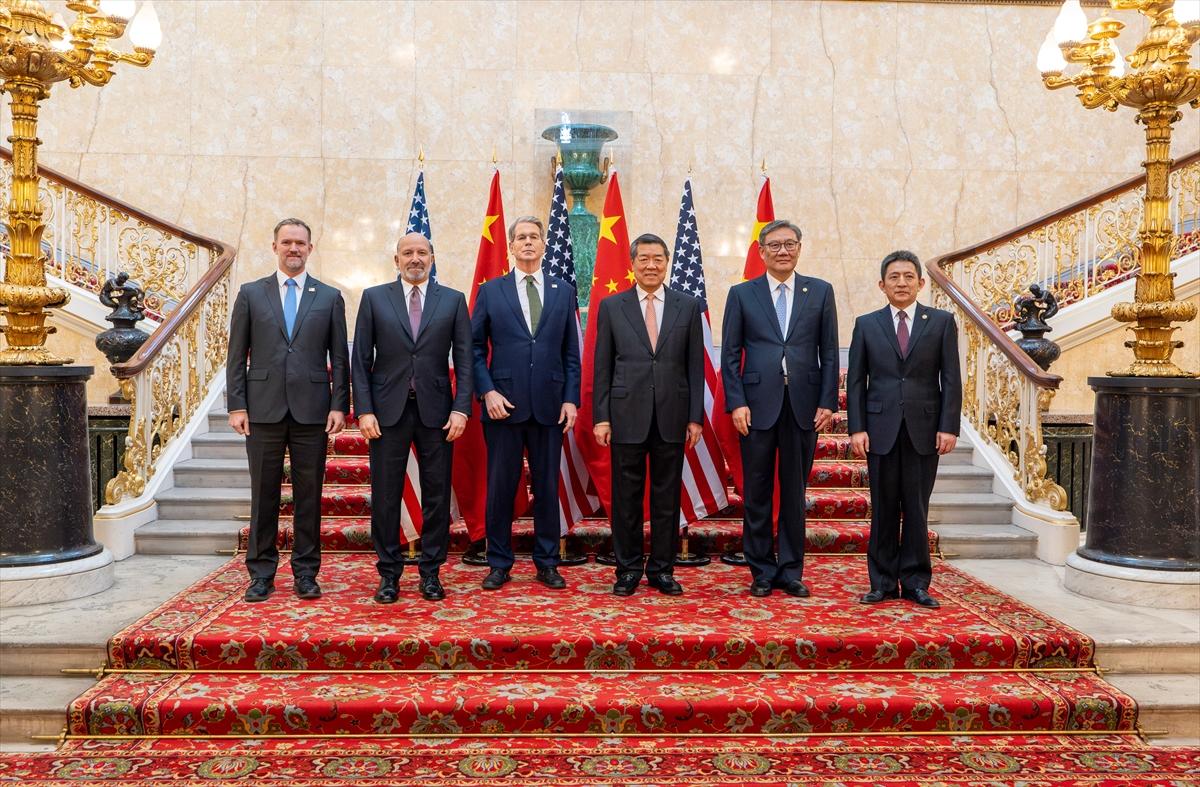
Participants at the London talks 9 June 2025 – (Anadolu Agency)
The Chinese delegation was headed by Vice Premier He Lifeng responsible for economic relations. Also participating were Chinese Minister of Commerce Wang Wentao and Chinese Representative for International Trade Li Qinggang. The host country the United Kingdom did not participate directly in the negotiations but provided logistical support. It was reported that U.K. Chancellor of the Exchequer Rachel Reeves held separate bilateral meetings with officials from both the U.S. and Chinese delegations.
Among the key issues discussed were China’s export licensing controls on rare earth elements and related magnets. Since April 2025 the Chinese government had introduced new export licensing mechanisms for these raw materials. The U.S. side asserted that China had delayed implementation of these licenses and failed to fulfill commitments made under the Geneva agreement and therefore placed this issue at the top of the negotiation agenda.
Another topic discussed between the parties was restrictions on the sale of chip design software used in advanced semiconductor manufacturing to China. The U.S. administration had halted exports of certain software types and revoked specific licenses. China emphasized that these measures violated the Geneva agreement and stressed the critical importance of these products to the global supply chain.
Another issue raised during the talks was the revocation of visas for Chinese university students. The United States implemented visa cancellations for certain categories of students citing the strategic sensitivity of their fields of study. China reported that these actions hindered scientific and academic cooperation.
The talks also addressed export and import restrictions on artificial intelligence chips and other advanced technology products. The U.S. side indicated it would continue limiting sales of high-end AI chips to Chinese technology firms while China reiterated its demand for the removal of these restrictions. The issue was framed within the context of strategic production capacity and national security.
At the conclusion of the two-day talks in London the two sides announced they had reached a principle-level framework agreement on implementing the earlier Geneva accord. It was stated that this framework would be submitted to the heads of state of both countries and would enter into effect after final approval. U.S. Secretary of Commerce Howard Lutnick and Chinese Representative for International Trade Li Qinggang noted that this agreement was based on the consensus reached during the Geneva talks and the 5 June leader-level telephone conversation.
Under the agreement the plan agreed upon did not take immediate effect but instead entered a feedback process for review by U.S. President Donald Trump and Chinese President Xi Jinping. Once the approval process is completed implementation steps will be initiated under the coordination of technical teams designated by both sides. The official timeline for implementation will be determined according to the date of approval by the leaders.
The United States indicated it would lift certain technology export restrictions if China eased its controls on rare earth element exports. In turn China pledged to introduce certain simplifications to its foreign trade licensing system.
Al Jazeera. “US and China Agree to Framework on Trade Talks in London.” Al Jazeera. Accessed June 11, 2025. https://www.aljazeera.com/economy/2025/6/11/us-china-agree-to-framework-on-trade-talks-in-london
Anadolu Ajansı. "ABD ve Çin Heyetleri Tarife Görüşmeleri İçin İngiltere’de Bir Araya Gelecek." Accessed June 11, 2025. https://www.aa.com.tr/tr/ekonomi/abd-ve-cin-heyetleri-tarife-gorusmeleri-icin-ingilterede-bir-araya-gelecek/3591297#
Anadolu Ajansı. "ABD ve Çin Ticaret Görüşmelerinin Yeni Turuna Londra’da Başladı." Accessed June 11, 2025. https://www.aa.com.tr/tr/ekonomi/abd-ve-cin-ticaret-gorusmelerinin-yeni-turuna-londrada-basladi/3592420#
Anadolu Ajansı. “ABD ve Çin’in Londra’daki Ticaret Müzakereleri İkinci Gününde.” Accessed June 11, 2025. https://www.aa.com.tr/tr/ekonomi/abd-ve-cinin-londradaki-ticaret-muzakereleri-ikinci-gununde/3592806#
Anadolu Ajansı. “Çin: ABD ile Ticaret Görüşmelerinde İlerleme Kaydedildi.” Accessed June 11, 2025. https://www.aa.com.tr/tr/dunya/cin-abd-ile-ticaret-gorusmelerinde-ilerleme-kaydedildi/3593617#
Associated Press. “The US and China are holding trade talks in London after Trump’s phone call with Xi.” AP News. Accessed June 11, 2025. https://apnews.com/article/us-china-trade-talks-london-e9e87d76a81a5e51294368308d5af47d
Associated Press. “The US and China say they have agreed on a framework to resolve their trade disputes.” AP News. Accessed June 11, 2025. https://apnews.com/article/us-china-trade-talks-london-bf991a07e374050ae85c7187f1366ab7
BBC News. “US-China talks end with plan for Trump and Xi to approve.” Accessed June 11, 2025. https://www.bbc.com/news/articles/c4gkmy26e2po
CNN. “US and China agree on plan to ease export controls after trade talks in London.” CNN. Accessed June 11, 2025. https://edition.cnn.com/2025/06/10/business/us-china-trade-talks-london-agreement-intl-hnk
Reuters. “US, China reach deal to ease export curbs, keep tariff truce alive.” Reuters. Accessed June 11, 2025. https://www.reuters.com/world/china/us-china-trade-talks-resume-second-day-2025-06-10/
On June 11 2025 US President Donald Trump announced via his social media account that a trade agreement had been reached with China. Trump stated that the agreement is subject to his own final approval and that of Chinese President Xi Jinping. According to the statement the United States has agreed to impose a customs tariff rate of 55 percent while China has agreed to a rate of 10 percent. It was also stated that China will secure all necessary rare earth elements and the United States will assume certain obligations regarding Chinese students.
Anadolu Ajansı. "ABD Başkanı Trump: Çin ile Anlaşmaya Vardık." Accessed June 11, 2025. https://www.aa.com.tr/tr/dunya/abd-baskani-trump-cin-ile-anlasmaya-vardik/3594188#

US-China Trade Talks
History | 9-10 June 2025 | ||||||||
|---|---|---|---|---|---|---|---|---|---|
Place(s) | United Kingdom London Lancaster House | ||||||||
Parties | China United States | ||||||||
The United States and China held trade talks in London on June 9–10, 2025. The talks were organized to implement the provisional agreement reached in Geneva. Rare earth elements, technology exports and visa restrictions were addressed during the discussions. The parties reached a framework agreement in principle. It was stated that this framework requires approval by the leaders. It was announced that implementation steps will begin after the approval process.
No Discussion Added Yet
Start discussion for "US-China Trade Talks (London, 2025)" article
June 11, 2025
Diplomatic and Economic Background
June 11, 2025
Organization and Participants of the London Talks
June 11, 2025
Negotiation Agenda and Discussion Topics
June 11, 2025
London Framework Agreement
June 11, 2025
Donald Trump’s Statement of June 11