


This article was automatically translated from the original Turkish version.
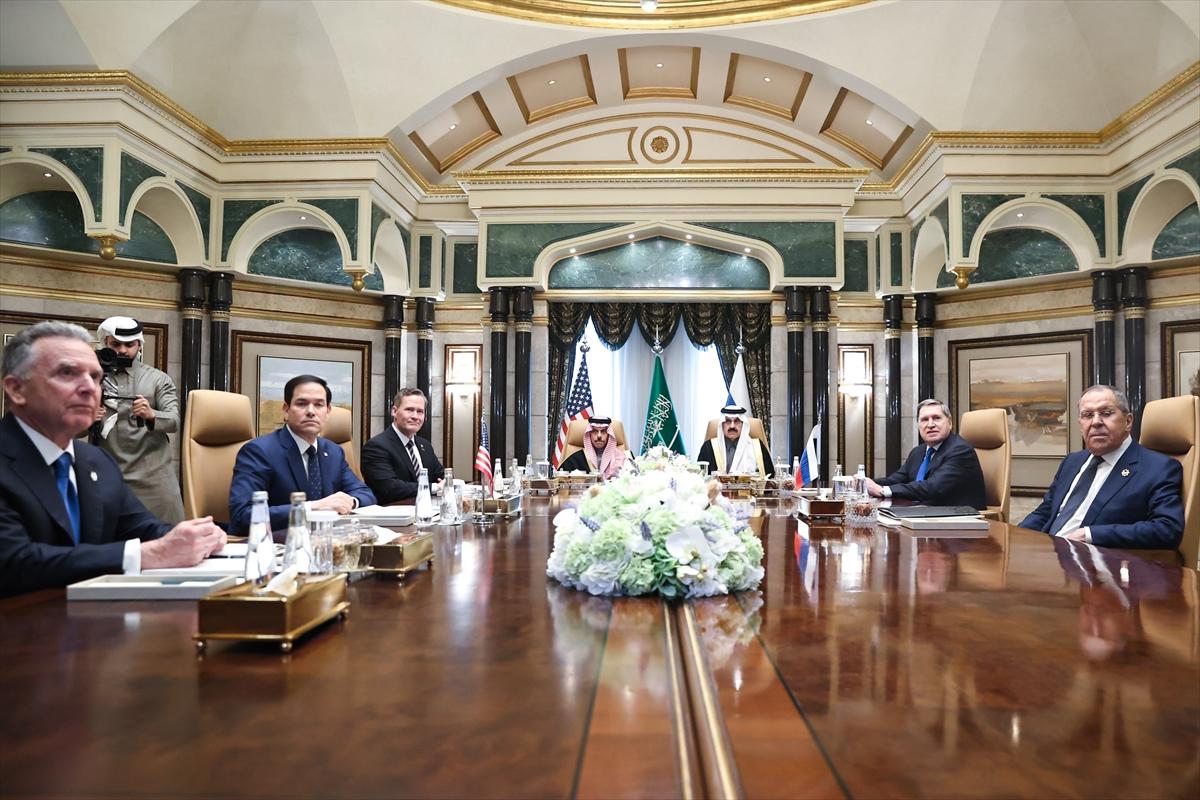
US-Russia Riyadh Talks (2025)
History | 2025-02-18 | ||||||||
|---|---|---|---|---|---|---|---|---|---|
Place(s) | Diriyah Palace Saudi Arabia Riyadh | ||||||||
Participants | Russia USA | ||||||||
USA-Russia The Riyadh Talks (2025) were a high-level diplomatic meeting held on 18 February 2025 in Riyadh the capital of Saudi Arabia. The discussions addressed the cessation of the Russia-Ukraine War and the restoration of diplomatic and economic relations between Russia and the United States.

US-Russia Riyadh Talks 18 February 2025 – Anadolu Agency
The talks were led by US Secretary of State Marco Rubio US National Security Advisor Mike Waltz Special Representative for the Middle East Steve Witkoff Russian Foreign Minister Sergey Lavrov and Kremlin Foreign Policy Advisor Yuriy Ushakov. The meetings were viewed as preparatory groundwork for a planned summit between US President Donald Trump and Russian President Vladimir Putin.
The Ukrainian government announced it had not been invited to the talks with Ukrainian President Volodymyr Zelenskyy stating that Ukraine would not accept any agreement from which it was excluded. Europe countries also expressed dissatisfaction at their exclusion from the negotiations.
Relations between the United States and Russia deteriorated following Russia’s annexation of Crimea in 2014 and the outbreak of the Russia-Ukraine War with both sides imposing severe economic sanctions and diplomatic restrictions on each other.
In February 2025 US President Donald Trump and Russian President Vladimir Putin held a meeting signaling that both sides were open to exploring diplomatic avenues to resolve the Russia-Ukraine War. Following this development officials from both countries convened in Riyadh for direct talks.
During five-day meetings held at the Diriyah Palace in Riyadh the parties reached agreement on three key issues:
The United States and Russia agreed to restore staffing levels at their respective embassies in Washington and Moscow to previous levels. They reached consensus on lifting restrictions on diplomatic missions and appointing ambassadors. It was also agreed to establish regular consultation mechanisms between deputy foreign ministers of the two country.
The United States and Russia agreed to designate official representatives to conduct negotiations. A formal framework for regular consultations is planned. The United States stated it would assess how European states and Ukraine could be incorporated into the process.
The United States and Russia discussed the restructuring of economic relations following the conflict. The potential return of US investments in Russia was addressed. Emphasis was placed on the importance of lifting restrictions on technology transfers to Russia. Following the talks US Secretary of State Marco Rubio described the negotiations as “the first step in a difficult and long process.”
No official Ukrainian representatives were invited to the talks a move criticized by Ukrainian President Volodymyr Zelenskyy. Zelenskyy stated that Ukraine would not accept being excluded from the process and would not compromise on its sovereignty and territorial integrity.
France President Emmanuel Macron held an emergency meeting with UK leaders to stress the necessity of including Europe in the process. France Germany and the United Kingdom contacted the United States urgently to insist that Europe must play an active role in the diplomatic process.
Russia demanded during the Riyadh talks the complete exclusion of Ukraine from any participation and the formal recognition of the annexed territories as Russian territory. It asserted that Ukraine must adopt a neutral non-aligned and demilitarized status.
It was stated that negotiations could not begin without acknowledging Donetsk Luhansk Zaporizhzhia Kherson and Crimea as part of Russia. The lifting of economic sanctions imposed by West on Russia was among Moscow’s core demands.

Foreign Minister Sergey Lavrov of the Russian delegation during the talks 18 February 2025 – Anadolu Agency
The United States emphasized the need to end the war in a manner acceptable to all parties and insisted on the inclusion of Europe in the process.
The United States stated that Ukraine’s NATO membership must be reconsidered. It highlighted the importance of developing a joint European roadmap for Ukraine’s security guarantees and postwar reconstruction. The United States also stated that negotiations must be conducted through backchannel diplomacy.

Image of Russian Foreign Minister Sergey Lavrov left meeting with Saudi Crown Prince Mohammed bin Salman right on 18 February 2025 – Anadolu Agency
Crown Prince Muhammad bin Salman assumed a mediating role in bringing the parties together. Saudi Arabia has previously facilitated various contacts between Russia and the United States. The talks were viewed as part of Saudi Arabia’s broader efforts to strengthen its global diplomatic role.
Kremlin Spokesperson Dmitry Peskov described the US-Russia talks in Riyadh as a important step toward improving relations between the two countries. In his assessment of the talks he said “An important first step has been taken. Both side have demonstrated political will. Much work remains to be done.” He stressed that the process is ongoing and that it is too early to evaluate the outcomes of the meeting. Peskov confirmed that Putin had been briefed on the results of the consultations and stated that Russia would appoint its own representative if the United States names its own for the Ukraine crisis negotiations. He also indicated that preparations for the Putin-Trump meeting would be handled by the foreign ministries adding “The meeting may or may not take place by the end.” Peskov also clearly stated Russia’s opposition to the deployment of a European peace force to Ukraine.
Anadolu Ajansı. "ABD ve Rus Heyetleri, İkili İlişkiler ve Ukrayna Konularını Görüşmek Üzere Riyad’da Toplandı." Anadolu Ajansı, February 18, 2025. Accessed February 18, 2025. https://www.aa.com.tr/tr/dunya/abd-ve-rus-heyetleri-ikili-iliskiler-ve-ukrayna-konularini-gorusmek-uzere-riyadda-toplandi/3485077.
Anadolu Ajansı. "ABD-Rusya Görüşmeleri: Ukrayna Krizinin Çözümüne Yönelik Adımlar." Anadolu Ajansı (İnfografik), February 18, 2025. Accessed February 18, 2025. https://www.aa.com.tr/tr/info/infografik/44747.
Anadolu Ajansı. "Rus Heyeti, ABD Heyetiyle İkili Görüşmelere Başlamak Üzere Riyad’a Ulaştı." Anadolu Ajansı, February 18, 2025. Accessed February 18, 2025. https://www.aa.com.tr/tr/dunya/rus-heyeti-abd-heyetiyle-ikili-gorusmelere-baslamak-uzere-riyada-ulasti/3484917.
Anadolu Ajansı. "Rus ve ABD Heyetleri, Ukrayna'da Barışın Şartlarını Görüşecek." Anadolu Ajansı, February 18, 2025. Accessed February 18, 2025. https://www.aa.com.tr/tr/dunya/rus-ve-abd-heyetleri-ukraynada-barisin-sartlarini-gorusecek/3485137.
Anadolu Ajansı. "Rusya Dışişleri Bakanı Lavrov: 'Yakın Gelecekte Ukrayna Meselesinin Çözümüne İlişkin Bir Süreç Oluşturmakta Anlaştık'." Anadolu Ajansı, February 18, 2025. Accessed February 18, 2025. https://www.aa.com.tr/tr/dunya/rusya-disisleri-bakani-lavrov-yakin-gelecekte-ukrayna-meselesinin-cozumune-iliskin-bir-surec-olusturmakta-anlastik/3485886.
BBC News. "Diplomacy in the foreground while war rages on in the background." BBC News, February 18, 2025. Accessed February 18, 2025. https://www.bbc.com/news/live/c62e2158mkpt.
The Guardian. "US and Russia to explore closer relations after Ukraine talks in Riyadh." The Guardian, February 18, 2025. Accessed February 18, 2025. https://www.theguardian.com/world/2025/feb/18/us-russia-ukraine-talks-riyadh-saudi-arabia.

US-Russia Riyadh Talks (2025)
History | 2025-02-18 | ||||||||
|---|---|---|---|---|---|---|---|---|---|
Place(s) | Diriyah Palace Saudi Arabia Riyadh | ||||||||
Participants | Russia USA | ||||||||
No Discussion Added Yet
Start discussion for "USA-Russia Riyadh Talks (2025)" article
Background
Talks and Content
Restoration of Diplomatic Relations
Initiation of Negotiations on the Russia-Ukraine War
Economic Cooperation and Sanctions
Reactions from Ukraine and Europe
Russia’s Demands
United States Approach
Saudi Arabia’s Hosting Role
Kremlin’s Statements