


This article was automatically translated from the original Turkish version.
Artworks are not merely visual or aesthetic objects; at times, they can make visible a thought, a philosophical problem, or an existential truth. Martin Heidegger’s 1936 draft text titled “The Origin of the Work of Art” offers one of the most striking examples of such a philosophical interpretation through his analysis of Vincent van Gogh’s painting of a pair of peasant shoes. Over time, however, this interpretation has come to occupy a central place not only in philosophical discourse but also in ongoing debates about the nature of art representation and interpretation.
According to Heidegger art is not merely a domain of aesthetic pleasure; art is a way in which being itself comes to light. That is, an artwork does not merely show what something looks like but also makes us feel its place in the world its meaning and its existential context.
For Heidegger the pair of shoes painted by van Gogh is not simply an object but a representation of the world of the person who wore them. These shoes carry within them an existence intertwined with earth toil and everyday life. When Heidegger looks at this painting he does not merely see shoes; he sees the life the peasant woman who owned them lived the labor she endured and the relationship she had with nature.
It is precisely in this sense that for Heidegger art reveals the “truth” of being. The artwork renders visible what is normally unseen; it does not merely present objects but uncovers the world of meaning surrounding them. In this way art invites us to think and to understand.
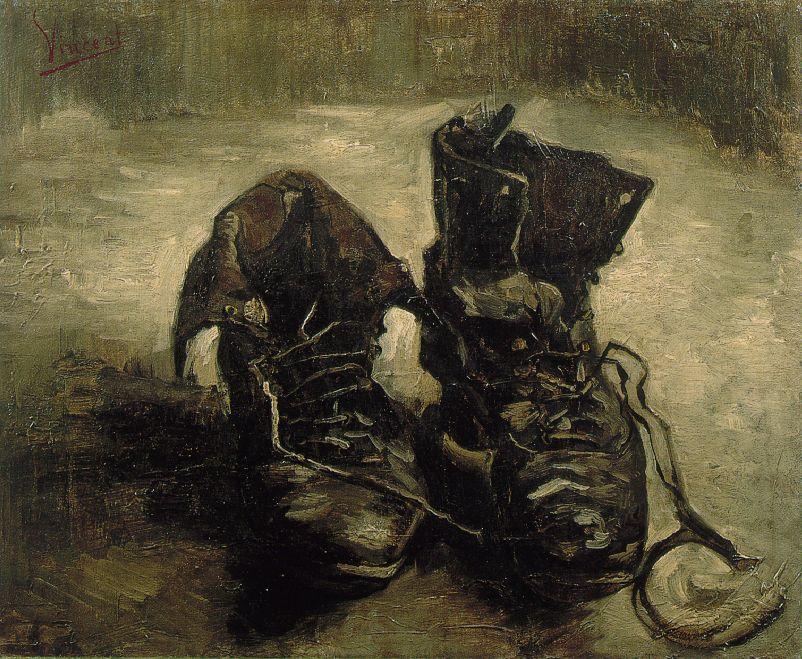
A Pair of Shoes Vincent van Gogh (picryl)
Heidegger’s interpretation of van Gogh’s painting of shoes has been notably criticized by the art historian Meyer Schapiro. According to Schapiro Heidegger interpreted the painting through the lens of his own philosophical views assuming the shoes belonged to a peasant woman and thus making a romanticized reading. Schapiro however argues that these shoes in fact belonged to van Gogh himself.
This critique raises the question of where the meaning of an artwork originates: Is it determined by the artist’s intention or by the viewer’s interpretation? While Heidegger sees art as a site where truth emerges Schapiro and others emphasize the necessity of not disregarding context and the artist’s identity. This debate points to the multifaceted nature of artistic interpretation.
Despite criticism Heidegger’s interpretation is not merely an iconographic analysis but a proposal concerning the ontological dimension of art. For Heidegger van Gogh’s shoes are no longer mere tools; they are objects that reveal their own existential world. According to Heidegger we begin to see the truth of things when we stop seeing them “as tools.” This idea underscores the notion that the artwork is an existential unfolding that transcends its instrumental function.
On the other hand Heidegger’s approach has been regarded by some art theorists as reductive because it universalizes and absolutizes aesthetic experience. Heidegger’s interpretation is oriented not toward the visual content of the painting but toward the creation of a philosophical archetype. In this sense it may be seen as neglecting the individual or historical context of the work.
Van Gogh’s shoes have become one of the most debated objects in the history of painting. This image has triggered philosophical and theoretical questions about the meaning interpretation and function of artworks. While Heidegger’s interpretation asserts that art is not mere representation but a revelation of being the critiques remind us of the limits and responsibilities of such philosophical readings.
The shoes are no longer merely a pair of old boots. They have acquired multiple identities in the gaze of a philosopher seeking the truth of being a historian defending the autonomy of art and a viewer questioning the relationship between aesthetics and meaning.
Bora, Mersiye. “Koşmayan Ayakkabılar Hakkında Heideggerci Bir Soruşturma.” *Medeniyet ve Toplum Dergisi* 4, no. 1 (2020): 43–55. Accessed July 15, 2025. https://dergipark.org.tr/en/download/article-file/1172392
Derin, Özlem. “BİR YAŞAM SORUNSALI OLARAK AYAKKABILAR”. Art-Sanat, no. 9 (December 2018): 177-92. Accessed July 15, 2025. https://dergipark.org.tr/en/pub/iuarts/issue/47878/604667
Picryl. “Scarpe - A painting of a pair of shoes on the ground.” Picryl. Accessed July 15, 2025. https://picryl.com/media/scarpe-acef5c
e-skop. "Heidegger’e Karşı: Van Gogh’un Ayakkabılarının Hakikati." Accessed July 15, 2025. https://www.e-skop.com/skopbulten/heideggere-karsi-van-goghun-ayakkabilarinin-hakikati/4661
Art and Truth According to Heidegger
Critical Perspective: Schapiro’s Objection
The Limits of Interpretation and Heidegger as a Philosophical Reading
A Debate Opened by Shoes
