


This article was automatically translated from the original Turkish version.
The shape of the Earth has been the subject of scientific debates and myths from ancient times to the present. However, scientific evidence strongly confirms that the Earth is spherical. Nevertheless, have you ever considered what the ecological, geological, and biological consequences would be if we assumed the Earth were flat?
The Earth’s magnetic field is generated by the movement of liquid metals in the planet’s inner core. This magnetic field protects the Earth from harmful radiation emitted by the Sun and produces auroras. However, on a flat Earth, the structure of the core would be fundamentally different, preventing the formation of a magnetic field. As a result, auroras would not occur, and charged particles would directly impact the atmosphere, threatening all forms of life.
The spherical structure of the Earth allows gravity and centrifugal forces to balance across its surface. In a flat planetary structure, gravity would not be uniform and might not exist at all in certain regions. This would prevent the atmosphere from being retained, leading to the loss of atmospheric gases and the escape of water vapor into space. Consequently, the planet’s temperature would drop, creating an environment uninhabitable for life.
Many species rely on the Earth’s magnetic field for navigation. For example, birds, turtles, and whales determine their migratory routes using magnetic cues. The absence of a magnetic field would cause these species to lose their way and abandon migration patterns. Additionally, the loss of the atmosphere would allow ultraviolet radiation to reach the Earth’s surface unimpeded, resulting in DNA damage and the disruption of ecosystems.
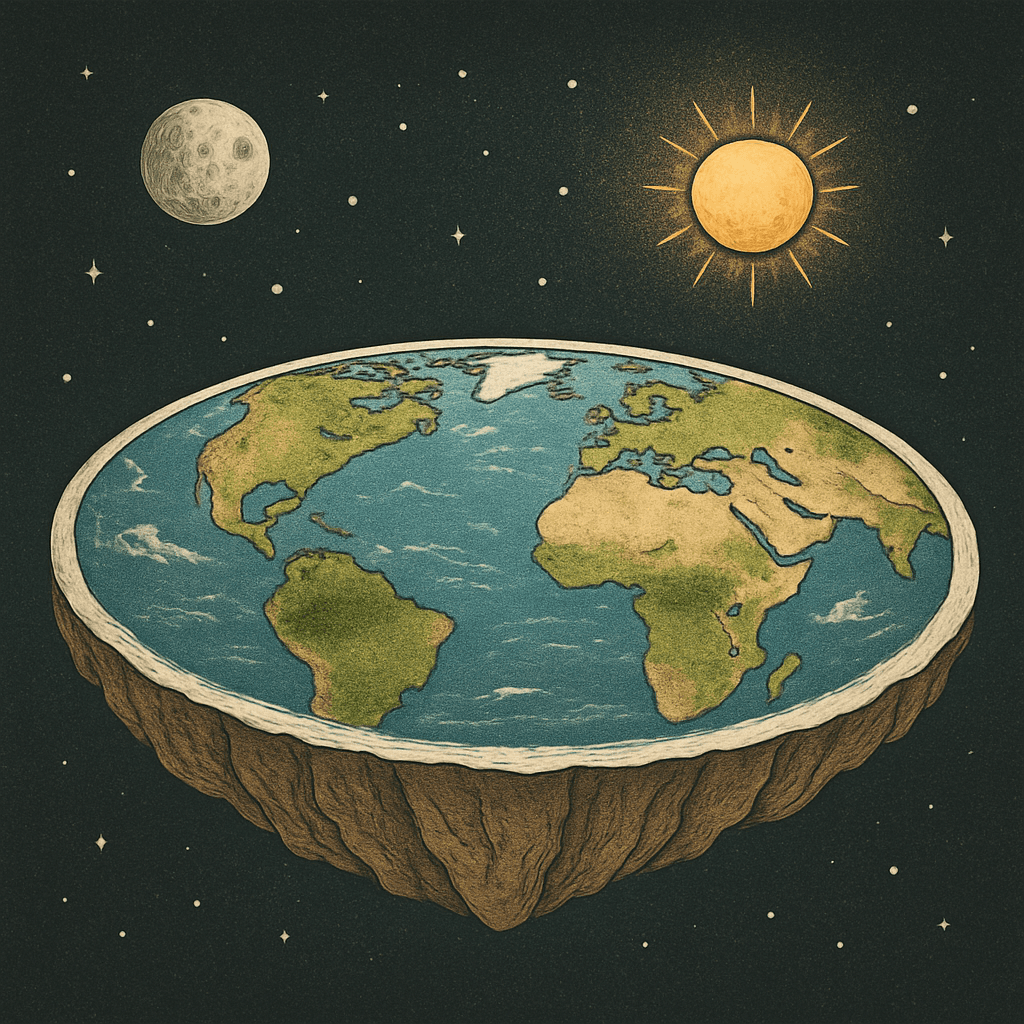
A visual representing how the Earth would appear if it were flat. (Generated by artificial intelligence.)
On a flat Earth, there would be no northern and southern hemispheres, meaning day and night could occur simultaneously across all regions. This would fundamentally alter biological rhythms, agriculture, and the general perception of time. Disruption of the day-night cycle could lead to health issues such as sleep disorders and hormonal imbalances.
Storms such as hurricanes are caused by the Coriolis effect, which arises from the Earth’s rotation. On a flat planet, this force would not exist, preventing the formation of hurricanes. The absence of such storms would eliminate their role in balancing atmospheric heat and humidity, leading to a more unstable and unpredictable climate.
The Earth’s tilt and gravitational structure enable satellites to maintain stable orbits. In a flat planetary model, this balance would be disrupted, causing existing satellites to fall uncontrollably. This would collapse communication, navigation, and weather forecasting systems.
A flat Earth is a structure that is scientifically impossible. Such a planetary configuration would result in the loss of the magnetosphere, gravity, and atmosphere. This would disrupt the natural cycles essential for sustaining life and ultimately lead to ecological collapse.
Absence of the Magnetosphere and Its Consequences
Absence of the Core and Gravitational Problems
Collapse of Biological and Technological Systems
Day-Night Cycle and Perception of Time
Storms and Natural Phenomena
Collapse of Satellite Systems
