


This article was automatically translated from the original Turkish version.
The spirit of cities is defined not only by physical structures and architectural elements, but by the connection it forges with the place’s history, collective memory, and the totality of meanings attributed to the space. The “genius loci” represents the unique identity that distinguishes one city from another and the sense of belonging felt by individuals living in that space. Losing a city’s spirit is the process of severing its physical space from these deep layers of meaning and disrupting the continuity of social memory.
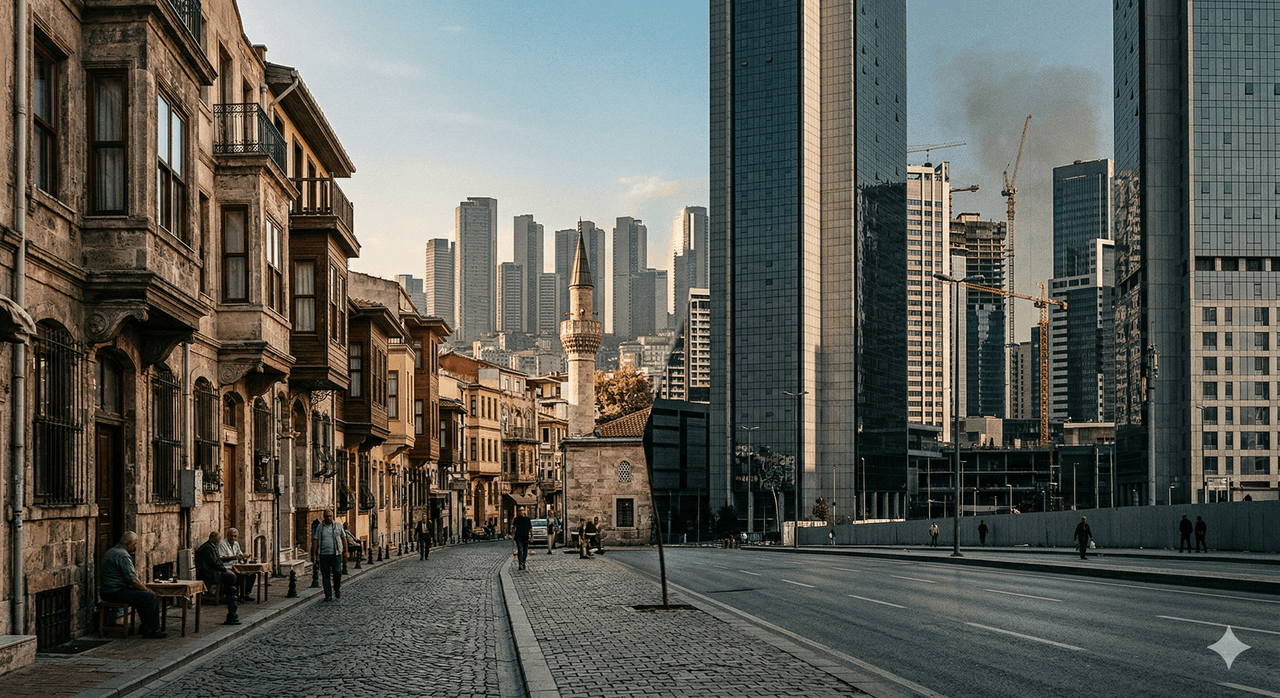
Globalization and Homogenization (Generated by Artificial Intelligence)
One of the primary factors in the loss of a city’s spirit is the erasure of spatial components from collective memory. Buildings, squares, and symbolic areas that constitute the historical fabric serve as bridges between past and future; their destruction or superficial transformation weakens the bond between residents and their environment. Uncontrolled physical changes, especially in historic city centers, lead to the degradation of the genius loci.Kahramanmaraş, like other cities, has elements such as the fortress, the grand mosque, and the covered bazaar that are not merely structures but foundational pillars of urban memory. Preserving the names or functions of these components is critical to maintaining the bridge across time.
Memory applies not only to individuals but also to cities, which remember through their spaces. The continuity of elements that constitute urban identity is essential for sustaining a viable urban memory. When spatial elements lose their qualities, the community’s capacity to recall its shared past is diminished.
Globalization leads cities to lose their distinctive characteristics and become indistinguishable from one another, giving rise to the phenomenon of “placelessness.” Standardized architectural designs and urban interventions disconnected from local culture threaten a city’s original identity. Practices carried out under the banner of modernization often disregard historical references, relegating the genius loci to a secondary status. This results in cities detaching from their local character and becoming global commodities.
Bursa, a city with deep historical roots, experiences the pains of modernization accelerating the transformation of urban identity. The traditional residential fabric and street silhouettes replaced by generic developments have rendered historical layers of the city invisible and damaged its genius loci. Historical urban expansion and industrialization have disrupted the texture of traditional civil architecture, weakening the continuity of urban memory.
When the spirit of a place is lost, the sense of belonging of those living in the city is also harmed. The loss of meaning in urban space restricts individuals’ psychological and social interactions with their environment. In cities lacking memory or with weakened identity, residents’ motivation to identify with the city and participate in urban life declines. The human-space relationship is not merely about physical shelter; it is also a process of identity formation. The rupture of this bond alienates the urban dweller from their own living environment.
Aytaç, Ömer. “Kent Mekânları ve Kimlik/Farklılık Sorunu.” *Sosyoloji Dergisi* 9 (2013): 138–169. Accessed April 12, 2026. https://dergipark.org.tr/tr/download/article-file/461595
Bayazıt, Esra, and Şule Kısakürek. "Kolektif Bellek Kentsel Bellek Ve Mekânsal Bileşenlerin Kent Kimliğindeki Yeri: Kahramanmaraş Kenti Örneği." *JENAS Journal of Environmental and Natural Studies* 3, no. 1 (2021): 1–21. Accessed April 12, 2026. https://dergipark.org.tr/en/pub/jenas/article/848564
Erdönmez, Ebru, and Figen Çelik. “Kentsel Mekânda Kamusal Alan İlişkileri.” *TÜBA-KED* 14 (2016): 145–163. Accessed April 12, 2026. https://dergipark.org.tr/en/download/article-file/1343161
Oktay, Derya. “Kent Kimliğine Bütüncül Bir Bakış.” *Sosyoloji Dergisi* 3 (2011): 8–19. Accessed April 12, 2026. https://dergipark.org.tr/en/download/article-file/460600
Perihan, Muhsine, and Feran Aşur. “Tarihi Kentsel Peyzaj ve Kent Kimliği İlişkisi.” *Kent Akademisi* 13, no. 1 (2020): 163–175. Accessed April 12, 2026. https://dergipark.org.tr/tr/download/article-file/1143878
Turan, Selin, and Özge Yalçıner Ercoşkun. “Meydanlardaki İsim Değişikliklerinin Kent Belleğine Etkisi: Ankara Örneği.” *Mimarlık Bilimleri ve Uygulamaları Dergisi* 2, no. 1 (2017): 55–68. Accessed April 12, 2026. https://dergipark.org.tr/tr/download/article-file/371873
Yemen, Aysun, Eda Çelik, and Rukiye Çelik. “Kentsel Dönüşüm Sürecinde Kentsel Kimliğin Korunmasına İlişkin Bilincin Twitter Üzerinden Değerlendirilmesi.” *Elektronik Sosyal Bilimler Dergisi* 17, no. 68 (2018): 1599–1618. Accessed April 12, 2026. https://dergipark.org.tr/en/download/article-file/550308
Transformation of Urban Identity and Memory Loss
Spatial Components and Remembrance
Globalization and Homogenization
Effects of Modernization and the Case of Bursa
Loss of Belonging and Social Disconnection
