


This article was automatically translated from the original Turkish version.
+2 More
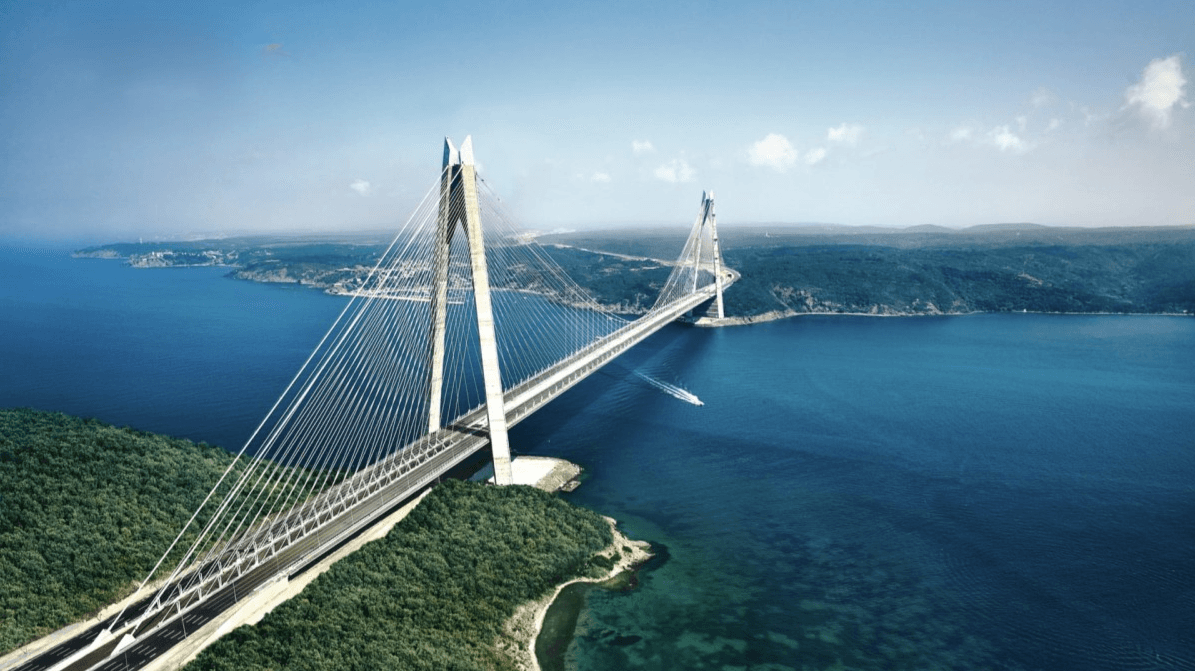
Yavuz Sultan Selim Bridge
Location | Bosphorus Strait Garipçe (Europe) – Poyrazköy (Anatolia) | ||||||||
|---|---|---|---|---|---|---|---|---|---|
Bridge Type | Hybrid System | ||||||||
Length(s) | 2 164 metres | ||||||||
Width | 59 metres | ||||||||
Tower Height | 322 metres | ||||||||
Yavuz Sultan Selim Bridge is the third bridge constructed across the Bosphorus Strait and, with its hybrid structure accommodating both road and rail transport, represents several engineering firsts. Located between Garipçe on the European side and Poyrazköy on the Asian side, the bridge was opened to service on 26 August 2016.
This structure features an eight-lane road and a two-lane rail system on the same deck, making it one of Turkey’s symbolic projects due to its technical characteristics and regional impact.

Yavuz Sultan Selim Bridge (General Directorate of Highways, Ministry of Transport and Infrastructure)
The total length of the Yavuz Sultan Selim Bridge including its side spans is 2,164 metres, with a main span of 1,408 metres. This length has earned it the title of the world’s longest suspension bridge carrying a rail system. The bridge is 59 metres wide, making it the widest suspension bridge in the world. Its towers, each exceeding 322 metres in height, are recorded as the tallest towers of any cable-stayed bridge.
The bridge features a hybrid design combining suspension and cable-stayed systems. The conceptual design was developed by French engineers Michel Virlogeux and Jean-François Klein, while construction was carried out by the joint venture of IC İçtaş and Astaldi. Over 8,000 personnel, including 700 engineers, were involved in the construction. The heaviest of the 53 steel deck segments weighed 923 tonnes, and the steel materials used in these segments were imported from South Korea and processed in Türkiye.
The total length of steel cables used in the bridge’s structural system reaches 124,382 kilometres, equivalent to circling the Earth three times. A single steel segment on the deck, covering an area of 83,072 square metres, weighs approximately 900 tonnes.
The Yavuz Sultan Selim Bridge is situated on the Northern Marmara Motorway section between Odayeri and Paşaköy and has become a critical junction for transit traffic along Istanbul’s northern axis. The bridge has a total of ten lanes: four plus four road lanes and two railway lanes in the center. The integration of the rail system on the same deck as the roadways represents an engineering solution implemented for the first time in the world.
By facilitating access to Istanbul Airport, the bridge has redirected heavy vehicle traffic away from the city center, reducing congestion on the Bosphorus and Fatih Sultan Mehmet bridges. This has resulted in time, fuel and labor savings for urban transportation. In the logistics sector, it has directly shortened delivery times and lowered transportation costs. According to studies, the bridge’s opening aimed to prevent an annual economic loss of approximately 1.45 billion dollars in energy and 335 million dollars in labor, totaling 1.78 billion dollars.
Yavuz Sultan Selim Bridge (AA)
The foundation of the Yavuz Sultan Selim Bridge was laid on 29 May 2013 and completed in just three years, opening on 26 August 2016. Construction proceeded simultaneously on both shores. The right to construct and operate the bridge was granted for a period of 10 years, 2 months and 20 days to the ICA consortium (IC İçtaş–Astaldi joint venture). Initially, tolls were waived until 31 August 2016, after which toll collection began.
The bridge does not have Environmental Impact Assessment (EIA), Strategic Environmental Assessment (SEA), or Cumulative Impact Assessment (CIA) reports under Turkish regulations. However, it is accompanied by a Social Impact Assessment (SIA) report prepared in 2013 in accordance with international standards by international financial institutions. This report included stakeholder analysis, impact identification, risk assessment and participation processes.
At the macro level, public information processes during the project’s implementation were limited. Nevertheless, the social impact assessment reports generated data regarding demographic transformation, economic relations, social acceptance, transportation habits and spatial reconfiguration. In particular, the motorway’s division of rural areas necessitated the reorganization of accessibility in certain settlements. Since social impact assessment (SIA) is not mandatory under Turkish legislation, this process was implemented solely due to the demands of foreign investors.
The opening ceremony of the Yavuz Sultan Selim Bridge took place on 26 August 2016 in the Garipçe neighborhood of Istanbul’s Sarıyer district. High-level officials from Türkiye, including the President, Prime Minister and members of the Cabinet, as well as dignitaries from Azerbaijan, Bahrain, Northern Cyprus, Macedonia and Bosnia-Herzegovina, attended the event. The symbolic collective prayer and ribbon-cutting ceremony highlighted both the technical and cultural dimensions of the structure.
Anadolu Ajansı. "Yavuz Sultan Selim Köprüsü." Anadolu Ajansı Youtube Kanalı. Accessed May 20, 2025. https://www.youtube.com/watch?v=mtkobtizd-4
Anadolu Ajansı. “Yavuz Sultan Selim Köprüsü Açıldı.” Accessed May 20, 2025. https://www.aa.com.tr/tr/gunun-basliklari/yavuz-sultan-selim-koprusu-acildi/636062.
General Directorate of Highways. "Yavuz Sultan Selim Köprüsü ve Kuzey Marmara Otoyolu Projesi." Accessed May 20, 2025. https://www.kgm.gov.tr/Sayfalar/KGM/SiteTr/Projeler/ProjelerDetay.aspx?q=24.
IC Holding. "Yavuz Sultan Selim Köprüsü ve Kuzey Marmara Otoyolu." Accessed May 20, 2025. https://www.icholding.com.tr/tr/insaat/ProjeDetay/27.
Uğur, Latif Onur, ed. *3rd International 5 Ocak Congress on Applied Sciences, Proceedings Book*. Adana, Türkiye: IKSAD Publishing, 2022. https://avesis.yildiz.edu.tr/yayin/c097acb4-5374-47dc-86a1-d2be6225b6ef/yavuz-sultan-selim-koprusunun-lojistik-sektorune-etkisi.
Velioğlu, Nimet. “SIA Criteria Compliance of Third Bosphorus Bridge (Yavuz Sultan Selim) Social Impact Assistment.” *Kent Akademisi: Kent Kültürü ve Yönetimi* 18, no. 1 (2025): 318–337. https://doi.org/10.35674/kent.1485368.
Yavuz Sultan Selim Köprüsü Resmî Sitesi. "Yapım Dönemi." Accessed May 20, 2025. https://www.ysskoprusuveotoyolu.com.tr/TR/icerik/yapim-donemi-127.
Şantiye Dergisi. “Bir Bakışta Yavuz Sultan Selim Köprüsü.” Accessed May 20, 2025. https://www.santiye.com.tr/bir-bakista-yavuz-sultan-selim-koprusu.

Yavuz Sultan Selim Bridge
Location | Bosphorus Strait Garipçe (Europe) – Poyrazköy (Anatolia) | ||||||||
|---|---|---|---|---|---|---|---|---|---|
Bridge Type | Hybrid System | ||||||||
Length(s) | 2 164 metres | ||||||||
Width | 59 metres | ||||||||
Tower Height | 322 metres | ||||||||
No Discussion Added Yet
Start discussion for "Yavuz Sultan Selim Bridge" article
Physical and Engineering Features
Transport and Logistics Function
Construction Process and Operational Structure
Social and Environmental Impact
Opening and Symbolic Meaning