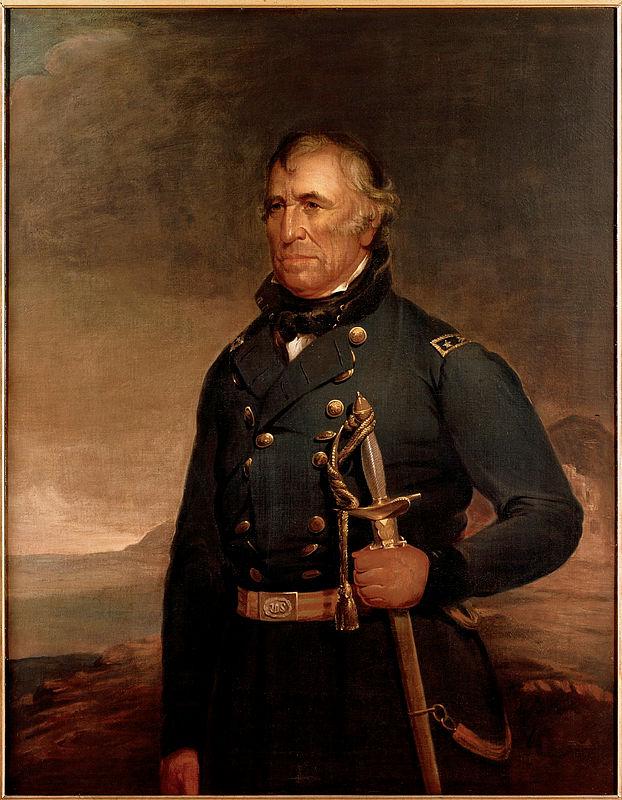
Doğum tarihi | 1784-11-24 | ||||||||
|---|---|---|---|---|---|---|---|---|---|
Eş | Margaret Mackall Smith Taylor (1810–1852) | ||||||||
Place of Birth | Orange County / Virginia / USA | ||||||||
Ölüm tarihi | 1850-07-09 | ||||||||
Place of Death | Washington D.C. / USA | ||||||||
Parents | Sarah Dabney Strother Taylor Richard Taylor | ||||||||
Presidential Order | 12th President of the United States (1849–1850) | ||||||||
Zachary Taylor was born on November 24, 1784, in Virginia. Shortly after his birth, his family moved to Kentucky, where Taylor grew up on a plantation near Louisville. His father, Richard Taylor, was an officer who served in the American Revolution, and by 1800 the family had become part of the wealthy planter class in Kentucky, owning 10,000 acres of land and numerous enslaved people. Taylor did not receive a formal education during childhood; instead, he turned early toward a military career. In 1808, he joined the U.S. Army as a lieutenant and was assigned to Fort Pickering.
Throughout his military career, Taylor served for many years along the frontiers of the United States, particularly in conflicts with Native Americans. He participated in numerous campaigns, including the Black Hawk War and the Second Seminole War. During his service in Florida, his modest lifestyle and unpretentious demeanor earned him the nickname “Old Rough and Ready” from his troops. In the Mexican-American War, which broke out in 1846, Taylor won significant victories in battles such as Palo Alto, Resaca de la Palma, and Monterrey. His triumph at the Battle of Buena Vista, where his outnumbered forces defeated the Mexican army under General Santa Anna, made him a nationally recognized figure.
Taylor’s military successes in the Mexican War paved the way for his nomination as the Whig Party’s presidential candidate in 1848. During his campaign, his refusal to take a clear position on the highly contentious issue of whether slavery should expand into the newly acquired territories allowed him to gain support from both Northern and Southern factions. In the 1848 presidential election, Taylor ran against Democratic candidate Lewis Cass and Free Soil Party candidate former President Martin Van Buren. Van Buren’s candidacy drew votes away from Cass, contributing to Taylor’s victory.
During his presidency, Taylor remained loyal to Whig Party principles but did not submit to the influence of party leaders and maintained an independent stance. In particular, debates over the status of slavery in the territories acquired after the Mexican War became a major source of tension during his term. Taylor advocated for the immediate admission of New Mexico and California as states through the drafting of state constitutions, thereby bypassing congressional debate on slavery in those regions. This position drew strong opposition from Southern leaders. At a meeting with Southern leaders in February 1850, Taylor declared that he would personally lead the army to suppress any attempt at secession and stated that he would hang those who rebelled against the Union “with as little hesitation as I hanged spies in Mexico.” Taylor’s firm stance attracted attention during a period of deepening political polarization over the expansion of slavery.
Zachary Taylor fell seriously ill with a severe stomach ailment after attending a ceremony at the Washington Monument on July 4, 1850. His condition rapidly worsened, and he died on July 9, 1850, in Washington D.C. The exact cause of death remains uncertain; some sources suggest gastroenteritis, while others propose cholera. Taylor’s sudden death led to the succession of Vice President Millard Fillmore, who soon after oversaw the passage of the Compromise of 1850.
Taylor’s lifelong opposition to the expansion of slavery was replaced after his death by Fillmore’s more conciliatory policies. Taylor was buried shortly after his death at the Zachary Taylor National Cemetery near Louisville, Kentucky. His brief presidency is remembered for its clear positions on slavery and regional tensions; however, due to the short duration of his term, his impact on American domestic politics appears limited.
Allen County Public Library. “Presidential Profile – Zachary Taylor.” Allen County Public Library. Accessed July 15, 2025. https://theacpl.org/presidential-profile-zachary-taylor/.
American Battlefield Trust. “Zachary Taylor.” American Battlefield Trust. Accessed July 15, 2025. https://www.battlefields.org/learn/biographies/zachary-taylor.
Bauer, K. Jack. “Taylor, Zachary.” Texas State Historical Association. Accessed July 15, 2025. https://www.tshaonline.org/handbook/entries/taylor-zachary.
George W. Bush White House Archives. “Zachary Taylor.” George W. Bush White House Archives. Accessed July 15, 2025. https://georgewbush-whitehouse.archives.gov/history/presidents/zt12.html.
Holt, Michael. “Zachary Taylor.” Miller Center, University of Virginia. Accessed July 15, 2025. https://millercenter.org/president/taylor.
Holt, Michael. “Zachary Taylor: Life in Brief.” Miller Center, University of Virginia. Accessed July 15, 2025. https://millercenter.org/president/taylor/life-in-brief.
National Park Service. “Zachary Taylor.” U.S. National Park Service. Accessed July 15, 2025. https://www.nps.gov/people/zachary-taylor.htm.
The American Presidency Project. “Zachary Taylor.” The American Presidency Project, University of California, Santa Barbara. Accessed July 15, 2025. https://www.presidency.ucsb.edu/people/president/zachary-taylor.
The White House. “Zachary Taylor.” The White House. Accessed July 15, 2025. https://bidenwhitehouse.archives.gov/about-the-white-house/presidents/zachary-taylor/
White House History Association. “Zachary Taylor.” White House Historical Association. Accessed July 15, 2025. https://www.whitehousehistory.org/bios/zachary-taylor.

Doğum tarihi | 1784-11-24 | ||||||||
|---|---|---|---|---|---|---|---|---|---|
Eş | Margaret Mackall Smith Taylor (1810–1852) | ||||||||
Place of Birth | Orange County / Virginia / USA | ||||||||
Ölüm tarihi | 1850-07-09 | ||||||||
Place of Death | Washington D.C. / USA | ||||||||
Parents | Sarah Dabney Strother Taylor Richard Taylor | ||||||||
Presidential Order | 12th President of the United States (1849–1850) | ||||||||
Presidency and Political Stance
Death and Legacy