

Bu içerik Türkçe olarak yazılmış olup yapay zeka ile otomatik olarak İngilizceye çevrilmiştir.
The Battle of Stalingrad is one of the critical conflicts of World War II that changed the course of the war, occurring on the Eastern Front as part of Germany’s invasion of Soviet territory. The process that began with Germany’s attack on Soviet lands on 22 June 1941 is described in Soviet literature as the “Great Patriotic War”, and throughout all stages of the war, mass mobilization, ideological struggle, and the rhetoric of national defense were decisive.
Stalingrad was chosen as a strategic transit point within this broader war framework to enable the German army to reach the Caucasus oil fields, and the struggle for control of the city acquired both military and symbolic significance. The fighting that began in the summer of 1942 around the city and its surroundings transformed into a grueling urban war of attrition over the following months; the civilian population, alongside military units, fought to survive under siege, destruction, starvation, and harsh conditions. The Battle of Stalingrad was decisive not only for its battlefield outcomes but also for its impact on morale, propaganda, diplomacy, and international power balances.
Documentary on the Battle of Stalingrad(Wars of the World)
In the early years of World War II, relations between the Soviet Union and Germany appeared to be characterized by diplomatic accommodation under the 1939 Non-Aggression Pact. Under this agreement, the two states had partitioned Poland, creating a strategic foundation that made Germany’s subsequent advance into Soviet territory more feasible. This apparent harmony between the two sides was temporary; Hitler’s ideological goal was to eliminate the Soviet Union and seize its vast resources.
The Soviet Union, despite receiving various intelligence reports about a possible German attack in the war’s early years, did not fully trust these warnings due to the Non-Aggression Pact. As the likelihood of an attack increased, the Soviet leadership began constructing fortification lines along the border, known as the Molotov Line, and moving troops into position. However, the Soviet army had been weakened by the large-scale purges of experienced commanders and soldiers during the Great Purge of the 1930s, leading German strategists to underestimate Soviet resistance.
Hitler’s invasion plan aimed not only to destroy the Soviet army but also to seize the country’s economic resources. The Soviet Union, rich in oil, raw materials, and grain, was viewed as a critical target for Germany’s war economy. Furthermore, Germany’s land warfare strategy, based on speed and deep thrusts, had turned Soviet territory into both an ideological and strategic objective. During this period, Soviet society came to perceive the war not merely as a military conflict but as a national defense and an ideological struggle against fascism. With the outbreak of war, the Soviet population, regardless of gender or age, was mobilized en masse; literature, poetry, and propaganda tools were actively used to direct the people toward resistance. This ideological mobilization was reinforced by the state’s official designation of the war as the “Great Patriotic War”.
The outbreak of the Soviet-German war did not only produce military outcomes but also affected regional and diplomatic relations. For Türkiye, the initial phase of the conflict created a brief period of relief due to the struggle between the two great powers, but in later stages, Soviet demands regarding the Straits and propaganda activities once again made the Soviet threat prominent. This situation led both Germany and the Soviet Union to attempt to position Türkiye according to their own interests.
Germany’s attack on the Soviet Union transformed the Eastern Front into the largest theater of conflict in World War II, where cities such as Moscow, Leningrad, Stalingrad, and Kursk became the sites of decisive battles that shaped the course of the war. These battles determined not only the military trajectory of the conflict but also played a critical role in the ideological, psychological, and social mobilization of the Soviet people.
One of the first major phases of the Eastern Front was the Blockade of Leningrad. The German army anticipated that capturing the city would facilitate its advance toward Moscow and secure important military industrial facilities. The blockade caused severe civilian losses due to starvation, cold, and disrupted supply lines; the “Road of Life” across Lake Ladoga became the city’s only link to the outside world. This blockade became one of the symbols of mass Soviet resistance and was later used as a propaganda tool in subsequent stages of the war.
Next, the Battle of Moscow emerged as a critical confrontation where the German advance was halted for the first time and the Soviet army’s defensive capacity was demonstrated to the world. This period showed that the Soviets were not merely retreating forces but could also launch counteroffensives. Following these battles, the focus of the German strategy shifted to the Caucasus. The objective there was not only territorial gain but also securing access to the region’s oil resources to ensure the sustainability of the war economy. For this operation to succeed, the German army needed to secure its supply and logistical lines extending toward the Caucasus, making control of the city of Stalingrad a strategic necessity. Thus, Stalingrad became both a secondary flank of the Caucasus campaign and a symbolic target for both Germany and the Soviet Union from ideological and psychological perspectives.
In the later stages of the Eastern Front, another critical turning point that determined the overall direction of the war was the Battle of Kursk. This battle represented a new phase in which the Soviet army seized the initiative after Stalingrad and permanently established the Red Army’s offensive capability. Thus, Stalingrad ceased to be merely a specific city battle and became the turning point on the Eastern Front where strategic superiority shifted from the Axis to the Allies.
【1】
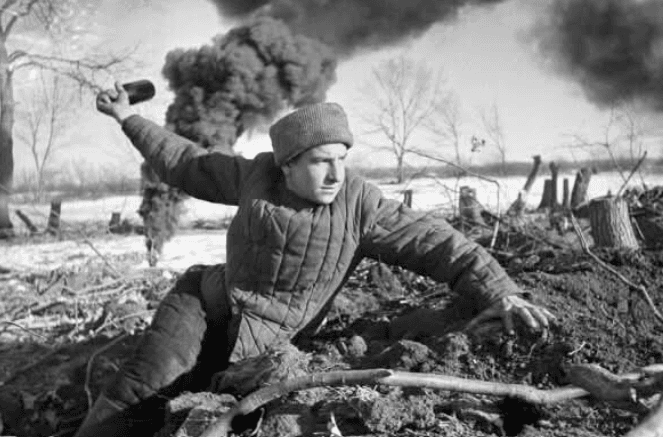
By 1942, the Eastern Front entered a new strategic phase following the German army’s sudden advance the previous year. After being halted before Moscow and forced to retreat due to winter conditions, Germany redirected its objective from the northern-central axis to southern Russia and the Caucasus. This shift was not only a new front arrangement but also a repositioning of the war’s strategic aims. The primary goal of the operation toward the Caucasus was to secure access to the region’s oil and grain resources to sustain the war economy. As part of this plan, the German offensive required control of Stalingrad on the Volga River to ensure the security of supply lines for units advancing toward the Caucasus.
The fall of the city would, from Germany’s perspective, guarantee uninterrupted access to energy resources and directly threaten Soviet strategic depth. Moreover, the city’s direct association with Stalin’s name was considered significant for the psychological trajectory of the war. Thus, although Stalingrad was not initially a primary target, it became a crucial strategic point as the flank of the Caucasus campaign. During this period, the Soviet administration implemented a “scorched earth” policy during its retreat, rendering infrastructure, production facilities, and logistical resources unusable in areas occupied by the German army. Stalin also ordered the relocation of factories and labor forces to the Ural region; this economic and military production transfer ensured the Soviet Union’s continued defensive capacity in later stages of the war.
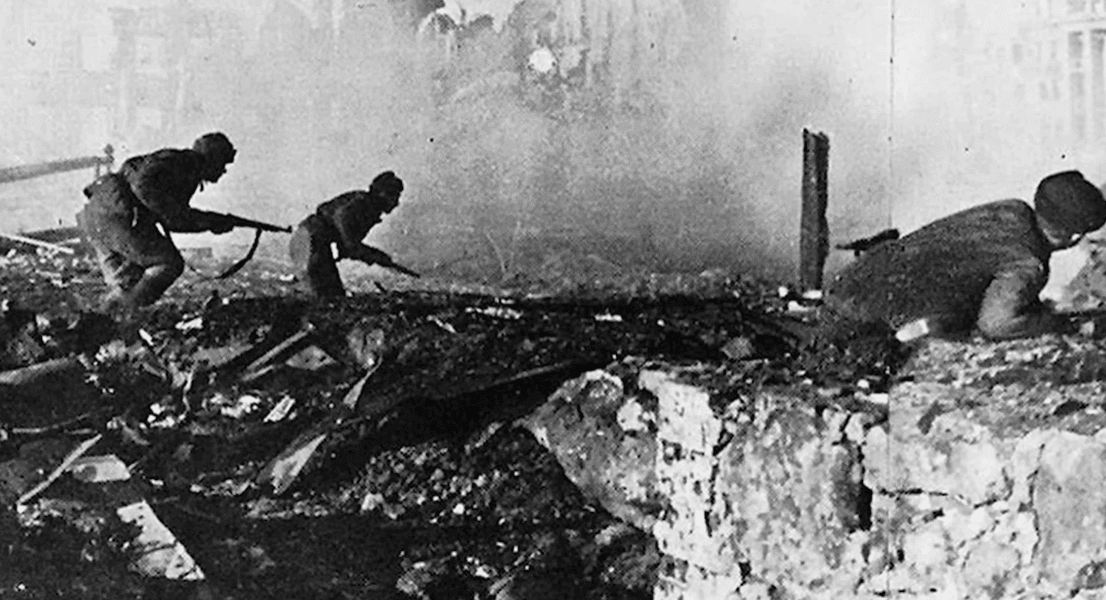
From late summer 1942, fighting in Stalingrad shifted from broad front-line maneuvers to an intense urban war of attrition. The German army’s advance toward the city was primarily motivated by the need to secure the logistical flank of its Caucasus campaign and control the strategic passage along the Volga. In this context, Stalingrad ceased to be merely a matter of capturing a city; it became a military and political objective critical to sustaining the war effort.
In response to the German advance, the Soviet administration organized its defense within the city, creating resistance lines that led to fighting spreading street by street and even building by building. In some phases of the battle, different apartments within the same building were divided between German and Soviet forces. The civilian population, far from being merely indirect victims of the war, became an active component of the defense. The city’s defense acquired a mass character through the mobilization of both men and women to construct trenches, barriers, and fortifications.
The urban battle had severe consequences for civilians; infrastructure destruction, starvation, cold, and bombardment inflicted heavy losses on the city. As had been seen earlier in Leningrad, shortages of food and supplies became a critical threat in besieged cities; this experience similarly shaped the social memory of the Stalingrad defense. Under these conditions, Stalingrad ceased to be merely a geographical location of conflict and became one of the symbolic centers of Soviet resistance.
The Soviet defensive line in Stalingrad halted the German forces in the city center through a strategy of attrition during the later months of 1942; during this period, Soviet command prepared for a large-scale counteroffensive. The defense phase was not merely about holding ground but was designed as a delaying strategy to create the conditions for a broad counterattack.
During this time, the Soviet administration reorganized its strategic resources, relocating military production facilities eastward to preserve its war capacity; it involved all segments of society in production, defense, and logistical processes. Thus, the resistance in the city merged with the mobilization efforts behind the front lines to form the logistical foundation of the Soviet counteroffensive. At this stage, the Soviets recognized that the war was not confined to the battlefield but extended to every aspect of life; literature, art, the press, and propaganda became tools to support the moral dimension of the war.
In wartime literature, themes of heroism, sacrifice, and patriotism were emphasized to create a shared motivation among soldiers and civilians. The counterattack around Stalingrad was regarded in the written press and literature of the period as the concrete manifestation of Soviet society’s will to wage war. The Soviet resistance halted the German advance in this battle, which military theory identifies as a “breaking point,” and turned the initiative in its favor. The encirclement operation that followed the counteroffensive changed the overall direction of the war and laid the foundation for the Soviet offensive capacity in subsequent fronts such as Kursk.
【2】
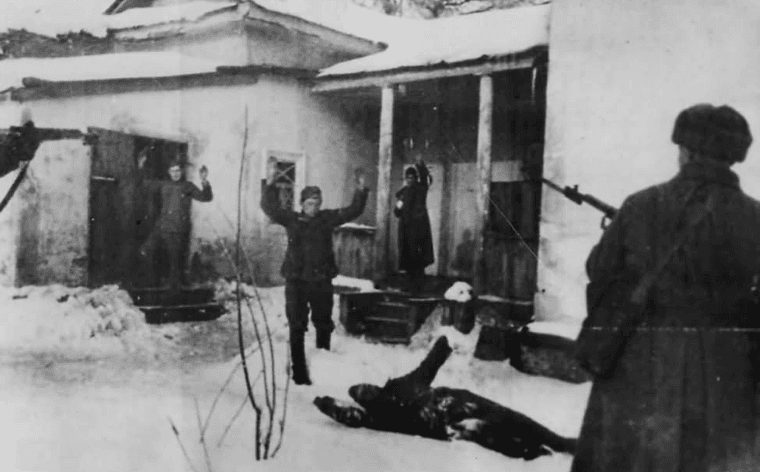
The human losses suffered in the Battle of Stalingrad were one of the fundamental factors determining its military and political outcomes. Between 15 November and 11 December 1942 alone, 169,000 German soldiers were killed and 75,000 taken prisoner.【3】 Broader assessments of losses indicate that the German army suffered approximately 1.5 million total casualties, while the Red Army’s losses amounted to approximately 1.13 million.【4】 These figures demonstrate that the battle was among the deadliest of World War II.
The defeat at Stalingrad created not only a military but also a moral and strategic rupture for Germany; the Axis advance on the Eastern Front came to a standstill. In contrast, after the victory at Stalingrad, the Soviet Union seized the initiative in subsequent fronts such as Kursk and transitioned into the role of the offensive power in the later stages of the war. These developments also affected the positions of states observing the war from abroad.
For Türkiye, the Battle of Stalingrad created a threshold where the balance of power between the two great powers shifted; Germany’s influence, which had been dominant in the early stages of the war, gave way to Soviet and Allied pressure. Although Türkiye maintained its policy of neutrality throughout the war, the new power dynamics intensified diplomatic pressure regarding the Straits.
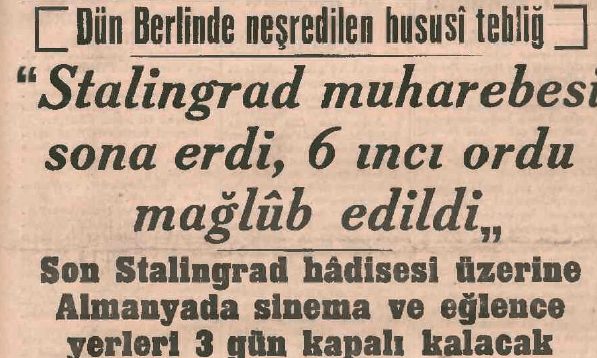
The international propaganda dimension of the battle was also critical. News reports on Stalingrad in the Turkish press carried varying degrees of partisanship depending on the newspaper; reports from Berlin and Moscow created different emphases in editorial choices, typography, and visual usage. The prevalence of official agency sources and state control in wartime reporting shaped press coverage in alignment with Türkiye’s policy of neutrality.
The Battle of Stalingrad was not merely a development that altered the military balance on the Eastern Front but also a diplomatic turning point that influenced Türkiye’s repositioning in its wartime foreign policy. By 1942, Türkiye found itself under bidirectional geopolitical pressure due to Germany’s advance toward the Caucasus and the Soviet Union’s historical claims in the region.
Germany’s invasion of Soviet territory initially created a brief period of security relief for Türkiye, as the mutual weakening of the two great powers delayed Türkiye’s becoming a direct target. However, due to Germany’s objectives of accessing Soviet oil and its plans to extend influence into the Middle East, Türkiye remained a critical position in Germany’s strategic calculations.
Türkiye’s wartime foreign policy was fundamentally based on the principle of neutrality. This neutrality was not merely a general diplomatic stance but a necessary security strategy shaped by perceptions of threat and opportunity. Throughout the war, Türkiye faced pressure from both the Axis and Allied powers to join their respective sides; diplomatic initiatives from both sides influenced Türkiye’s decision-making mechanisms.
The outcome of the Battle of Stalingrad significantly altered these balances. The halt of the German advance and the Soviet victory reduced German pressure on Türkiye while increasing Soviet and Allied pressure. In particular, the issue of the Straits, after the Battle of Stalingrad, reinforced the perception of a Soviet-oriented threat in Türkiye’s security outlook.
During the Battle of Stalingrad, Türkiye occupied an important position in the strategic calculations of both Soviet Russia and Germany; both powers attempted to influence Türkiye and draw it into the war according to their own interests. Türkiye, as a young republic still in the process of modernization, adopted the policy of maintaining neutrality as its fundamental security strategy.
Türkiye’s relations with Soviet Russia developed within a sensitive and distrustful framework since the Montreux Convention. Between 1941 and 1943, Soviet demands regarding Türkiye were occasionally brought openly to the agenda, and the issue of the Straits became a central point of conflict between the two countries. Additionally, Soviet propaganda attempted to draw Türkiye into its camp by claiming that Germany was preparing militarily in the Balkans; Türkiye responded by issuing joint declarations announcing its intention to remain neutral. Soviet Russia, particularly during periods of German advance, feared that Türkiye might act opportunistically and make territorial claims; military measures taken along the Hopa–Trabzon line generated suspicion in Moscow. Nevertheless, the Soviet leadership, while strengthening its ties with the Allies, also sought to confirm Türkiye’s security through international agreements. During this period, the main factor shaping Türkiye’s Soviet policy was sovereignty over the Straits and suspicion of Soviet expansionism.
Following Germany’s invasion of Soviet territory, Türkiye experienced a brief period of security relief, as the conflict between the two great powers delayed Türkiye’s becoming a target. However, Germany’s plans extending toward the Middle East and oil regions turned Türkiye into a potential route of attack. Germany also used the issue of the Straits as a propaganda tool to create distrust between Türkiye and the Soviet Union. After the tide of the war shifted following Stalingrad, German pressure on Türkiye diminished and its propaganda influence weakened.
Türkiye remained under pressure from both the Axis and the Allies during the Battle of Stalingrad but maintained its policy of neutrality. In response to these pressures, the state implemented martial law and took internal security measures. Türkiye’s fundamental approach was to avoid entering the war unless absolutely compelled and to maintain equal distance from both sides.
The Battle of Stalingrad received extensive coverage in Turkish public opinion, with developments in the war closely followed through two major newspapers of the period, Son Posta and Vakit. Between 1 July 1942 and 1 April 1943, 101 articles on Stalingrad were published in Son Posta and 43 in Vakit.【5】 This time period, covering one month before the battle’s commencement and one month after its conclusion, demonstrates continuity. A significant portion of these reports originated from the Anatolian Agency (AA), whose sources were primarily correspondents based in Berlin or Moscow. In reports relying on a single source, partisanship was determined by the political orientation of the capital from which the report originated; Berlin-based reports were coded as pro-German, while Moscow-based reports were coded as pro-Soviet. In reports drawing on multiple sources, criteria for partisanship were more detailed, taking into account which report was published first, headline typography, photographs used, and visual hierarchy.
Different editorial attitudes were also identified in the newspapers’ news production. Although both newspapers adopted a discourse aligned with the state’s neutrality policy throughout the period, their methods of reporting news sometimes differed. Press censorship was also a significant factor shaping news dissemination. During the war years, the government maintained tight control over foreign policy reporting; both newspapers were occasionally banned from publication during the battle period. Son Posta was closed for three days in 1941 and seven days in 1942; Vakit was closed for twelve days in 1941 and four days in 1942.【6】
【7】
The Battle of Stalingrad fundamentally transformed Russian literature in terms of author identity, genre selection, aesthetic understanding, and the relationship between the state and art. The violence of the war and the social devastation distanced literary production from abstract aesthetic concerns, giving rise to a narrative tradition grounded directly in wartime experience, realism, and testimony.
Writers and poets whose works had been censored, banned, or suppressed by the regime before the war were officially called upon at the outbreak of war to mobilize the people toward unity and resistance. Artists were granted permission and support to produce works emphasizing national themes and strengthening patriotism. Literature in this period assumed the role of a “frontline duty” and was viewed as a tool to sustain public morale.
Soldiers who fought directly on the front lines documented their experiences in writing, forming a new generation of authors. This group entered literature not deliberately but out of a need to narrate the destruction they had witnessed. Authors such as Bondarev, Baklanov, Vasilyev, Bıkov, and Vorobyev wrote directly from the front, producing works with the goal of representing their generation and preserving their experiences.【8】 Thus, war literature is biographical, testimonial, and centered on reality.
During the war, poetry emerged as the dominant literary genre in Russian literature because of its capacity to reach the masses quickly and serve as a carrier of moral and hopeful messages. Poets such as A. Tvardovskiy, A. Surkov, K. Simonov, S. Kirsanov, I. Sel’vinskiy, S. Sçipayev, A. Ahmatova, O. Bergol’ts, V. İnber, A. Jarov, I. Utkin, and S. Mihalkov were among those who wrote poetry on war themes.【9】
After the war, the focus shifted to the novel and short story; subgenres such as “General Nesri” and “Lieutenant Nesri” emerged to explore the battlefield experience. These works centered on the psychological impact of war on the individual and the disintegration of society.
The influence of war literature did not end with the 1940s but was transmitted to subsequent generations. Works narrating the wartime experience became foundational references for national identity and literary tradition, written with a sense of “generational duty.”
The Battle of Stalingrad remains one of the key reference points in contemporary Russian national memory and is commemorated annually through official ceremonies, memorial events, and symbolic programs. The anniversary of the victory on 2 February is remembered as a military triumph of the Soviet Union against Nazi Germany and its allies; this date serves as a state and societal identity element aimed at keeping the memory of the war alive.
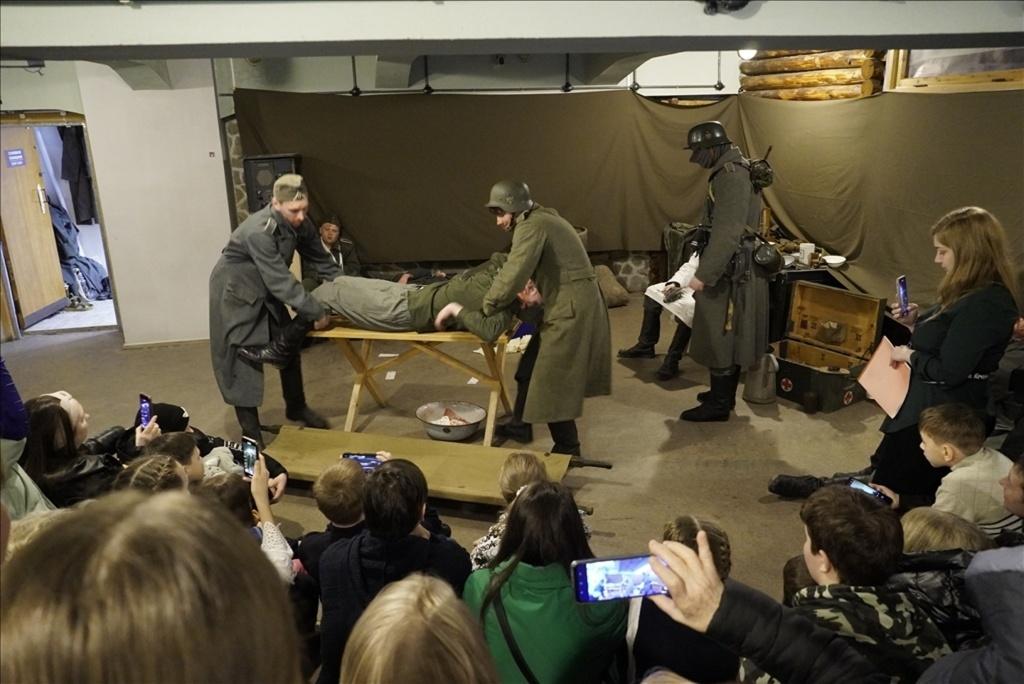
80th Anniversary Celebrations(Anadolu Agency)
The 80th anniversary of the battle was commemorated on 2 February 2023 in Volgograd, Russia, with various ceremonies held at the city’s symbolic locations. One of the focal points of the commemorative program was the area surrounding the monument “Motherland Calls”, which has become a symbol of the defense of Stalingrad. National and international media coverage emphasized this monument, highlighting its symbolic function as a site of war memory. The celebrations were conducted with narratives emphasizing the Soviet military struggle.
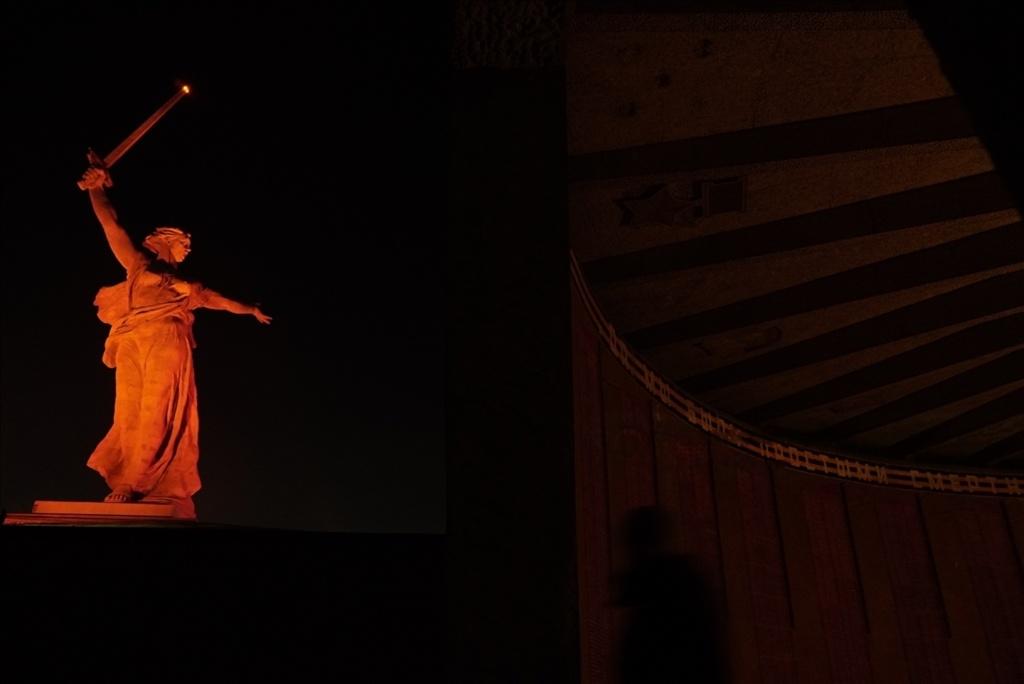
The Monument “Motherland Calls,” Symbol of the City(Anadolu Agency)
The 80th anniversary commemorations demonstrate that in contemporary Russian public memory, Stalingrad is not merely remembered as a historical battle but as the central symbol of national resistance against fascism and the foundational myth of the founding war. The official and collective nature of these events reveals that Stalingrad carries a continuous meaning in both state policy and collective memory.
"WarsofTheWorld." The Battle of Stalingrad: Jul 1942 - Feb 1943 | World War II Documentary. YouTube. Accessed November 22, 2025. https://www.youtube.com/watch?v=zlKuojthuNo.
Anadolu Ajansı. "Stalingrad Muharebesi’nin 80. Yıldönümü Volgograd'ta kutlandı." Accessed November 22, 2025. https://www.aa.com.tr/tr/pg/foto-galeri/stalingrad-muharebesi-nin-80-yildonumu-volgogradta-kutlandi.
Başarır, Mehtap. "Stalingrad Savaşı Döneminde Türkiye-Sovyet Rusya İlişkileri (1941-1943)." Journal of Turkish Research Institute (72), 2021, pp. 491-522. Accessed November 22, 2025. https://dergipark.org.tr/tr/pub/ataunitaed/issue/65008/999041.
Can, Badegül. "Büyük Vatan Savaşının Gölgesinde Rus Edebiyatına Bakış." *Avrasya Uluslararası Araştırmalar Dergisi*, 1, no. 1 (2012): 42–49. Accessed November 22, 2025. https://dergipark.org.tr/tr/pub/avrasyad/issue/16850/175299.
Store Norske Leksikon. "Slaget ved Stalingrad." Accessed November 22, 2025. https://snl.no/Stalingrad#:~:text=Stalingrad%20var%20i%20perioden%201925,1924%20til%201953%2C%20Josef%20Stalin.
Turan, Özgenur. "Büyük Vatan Savaşı: Sovyet Halkı ve Büyük Zafer." 3. Uluslararası Türk Rus Akademik Araştırmalar Kongresi, 2020. Accessed November 22, 2025. https://www.academia.edu/44633534/B%C3%9CY%C3%9CK_VATAN_SAVA%C5%9EI_SOVYET_HALKI_VE_B%C3%9CY%C3%9CK_ZAFER.
Çakır, Ali. “Stalingrad Muharebesinde Türk Basınının Tutumu: Son Posta ve Vakit Gazeteleri Örneği.” *Avrasya Uluslararası Araştırmalar Dergisi* 12, no. 39 (2024): 151–172. Accessed November 22, 2025. https://dergipark.org.tr/tr/pub/avrasyad/issue/85063/1424244.
[1]
Store Norske Leksikon. "Slaget ved Stalingrad" Son Erişim: 22.11.2025. https://snl.no/Stalingrad#:~:text=Stalingrad%20var%20i%20perioden%201925,1924%20til%201953%2C%20Josef%20Stalin
[2]
Store Norske Leksikon. "Tyske soldater overgir seg til russerne i Stalingrad, 1942." Son Erişim: 22.11.2025. https://snl.no/Stalingrad#:~:text=Stalingrad%20var%20i%20perioden%201925,1924%20til%201953%2C%20Josef%20Stalin
[3]
Ali Çakır, “Stalingrad Muharebesinde Türk Basınının Tutumu: Son Posta ve Vakit Gazeteleri Örneği,” Avrasya Uluslararası Araştırmalar Dergisi 12, no. 39 (2024): s. 160. https://dergipark.org.tr/tr/pub/avrasyad/issue/85063/1424244
[4]
Çakır, “Stalingrad Muharebesinde Türk Basınının Tutumu: Son Posta ve Vakit Gazeteleri Örneği,” s. 161. https://dergipark.org.tr/tr/pub/avrasyad/issue/85063/1424244
[5]
Çakır, “Stalingrad Muharebesinde Türk Basınının Tutumu: Son Posta ve Vakit Gazeteleri Örneği,” s. 151. https://dergipark.org.tr/tr/pub/avrasyad/issue/85063/1424244
[6]
Çakır, “Stalingrad Muharebesinde Türk Basınının Tutumu: Son Posta ve Vakit Gazeteleri Örneği,” s. 154. https://dergipark.org.tr/tr/pub/avrasyad/issue/85063/1424244
[7]
Çakır, “Stalingrad Muharebesinde Türk Basınının Tutumu: Son Posta ve Vakit Gazeteleri Örneği,” s. 162. https://dergipark.org.tr/tr/pub/avrasyad/issue/85063/1424244
[8]
Badegül Can. "Büyük Vatan Savaşının Gölgesinde Rus Edebiyatına Bakış." Avrasya Uluslararası Araştırmalar Dergisi, 1(1), 2012, s. 46. https://dergipark.org.tr/tr/pub/avrasyad/issue/16850/175299
[9]
Can. "Büyük Vatan Savaşının Gölgesinde Rus Edebiyatına Bakış." s. 48. https://dergipark.org.tr/tr/pub/avrasyad/issue/16850/175299

Henüz Tartışma Girilmemiştir
"Battle of Stalingrad" maddesi için tartışma başlatın
The Road to the Battle
The Broader Strategic Framework of the Eastern Front
Toward Stalingrad: The Summer Campaign of 1942
The Beginning of the Urban Battle
The Soviet Counteroffensive and the Encirclement
Consequences of the Battle
The Battle of Stalingrad from Türkiye’s Perspective
Türkiye’s Relations with Soviet Russia and Germany During the Battle of Stalingrad
The Battle of Stalingrad in Turkish Public Opinion
The Impact of the Battle of Stalingrad on Russian Literature
Commemoration of the Victory at Stalingrad in Russia and the 80th Anniversary Celebrations