

Bu içerik Türkçe olarak yazılmış olup yapay zeka ile otomatik olarak İngilizceye çevrilmiştir.
Bünyan is a district affiliated with the province of Kayseri, with historical origins dating back to the Hittite period between 4000 and 1200 BCE. Caves and archaeological remains found within the neighborhoods of the district reveal evidence of human settlement from this era. Throughout history, Bünyan came under the rule of numerous civilizations, and traces of this cultural diversity are preserved in its architecture and socio-cultural structure. The majority of historical monuments surviving in the district today date from the Seljuk period. Notably, the Sultanhanı Caravanserai, constructed between 1232 and 1236 during the reign of Seljuk Sultan I. Alaeddin Keykubat, and the Karatay Caravanserai, built in 1240 by Seljuk vizier Celalettin Karatay, are among the district’s most prominent historical structures. Additionally, the Ulu Cami (Cami Kebir), constructed in 734 AH (1333 CE) by Tac-ı Kızıl’s son, Emir Zahireddin Mahmud, one of the Ilkhanid governors, is a significant structure reflecting Bünyan’s historical and cultural identity.
Administratively, Bünyan was organized at the sub-district level as the Sarımsaklı Nahiyesi during the reign of Sultan II. Abdülhamit in 1895. During this period, it attained district status under the name Bünyan-ı Hamit, honoring the sultan’s name. The Arabic-origin word “Bünyan” means “building” or “structure.” In 1908, the term “Hamit” was dropped, and the district was officially renamed simply “Bünyan.” In 1914, it was detached from the province of Sivas and attached to Kayseri.
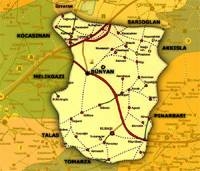
Bünyan is located in the eastern part of the Central Anatolia Region, bordered by Sarıoğlan and Akkışla to the north, Tomarza and Talas to the south, Pınarbaşı to the east, and Kocasinan and Melikgazi to the west. The district covers an area of 1,188 km². Bünyan experiences a continental climate, with hot and dry summers and cold, harsh, and rainy winters. Settlements are situated on the northern slopes of Koramaz Mountain at an elevation of 1,900 meters, while the district center lies at 1,340 meters above sea level. Natural water sources within Bünyan’s boundaries include the Tuzla natural lake in Tuzhisar Neighborhood, the “Taçın Suyu” spring in Topsöğüt Neighborhood, and the Bükderesi stream flowing through the district center. Additionally, natural springs in the Pınarbaşı area provide drinking water.

Bünyan (Bünyan Municipality)
In accordance with Law No. 6360, 24 villages and 7 town municipalities under Bünyan lost their legal personality and were reclassified as neighborhoods, resulting in a total of 44 neighborhood muhtarliks. Numerous public institutions operate under the district governorship, including the gendarmerie command, judiciary, district police directorate, land registry office, population directorate, tax office, health directorate, state hospital, agriculture and livestock directorate, land registry office, muftiate, social security center, agricultural credit cooperative, PTT, electricity and telecommunications services, bank branches, and a library. According to TÜİK’s 2022 data, the district’s population is 29,704.
The economy of Bünyan is primarily based on agriculture and animal husbandry. Cereal and forage crops are widely cultivated in the district. The total agricultural land amounts to 335,473 decares, of which 115,450 decares are left fallow. Seven thousand five hundred decares are allocated to forage crops and 5,939 decares to fruit and vegetable production. Livestock farming, both large and small ruminants, is widespread. Beekeeping and poultry farming are also part of the local economy. A portion of the population not engaged in agriculture works in the public and private sectors, particularly in construction.
Bünyan possesses significant cultural potential due to its Seljuk-era architectural heritage. The Sultanhanı and Karatay caravanserais and the Ulu Cami are prominent surviving examples of this legacy. These structures serve as important historical documents reflecting the architectural sensibilities of their time. In particular, the Sultanhanı Caravanserai is a typical example of Anatolian Seljuk stonemasonry and caravanserai architecture along historic trade routes.
Henüz Tartışma Girilmemiştir
"Bünyan (District)" maddesi için tartışma başlatın
Geographical Location and Natural Features
Administrative Structure and Population
Economic Activities
Cultural Heritage and Tourism