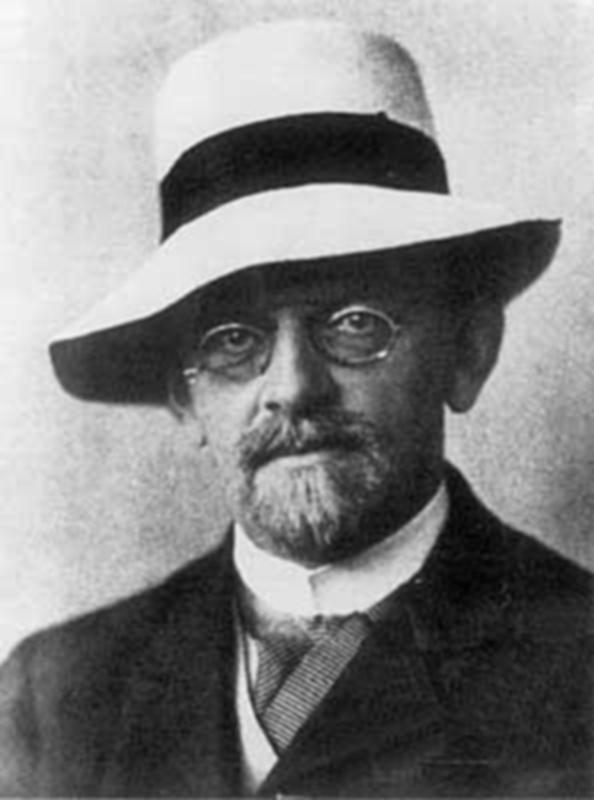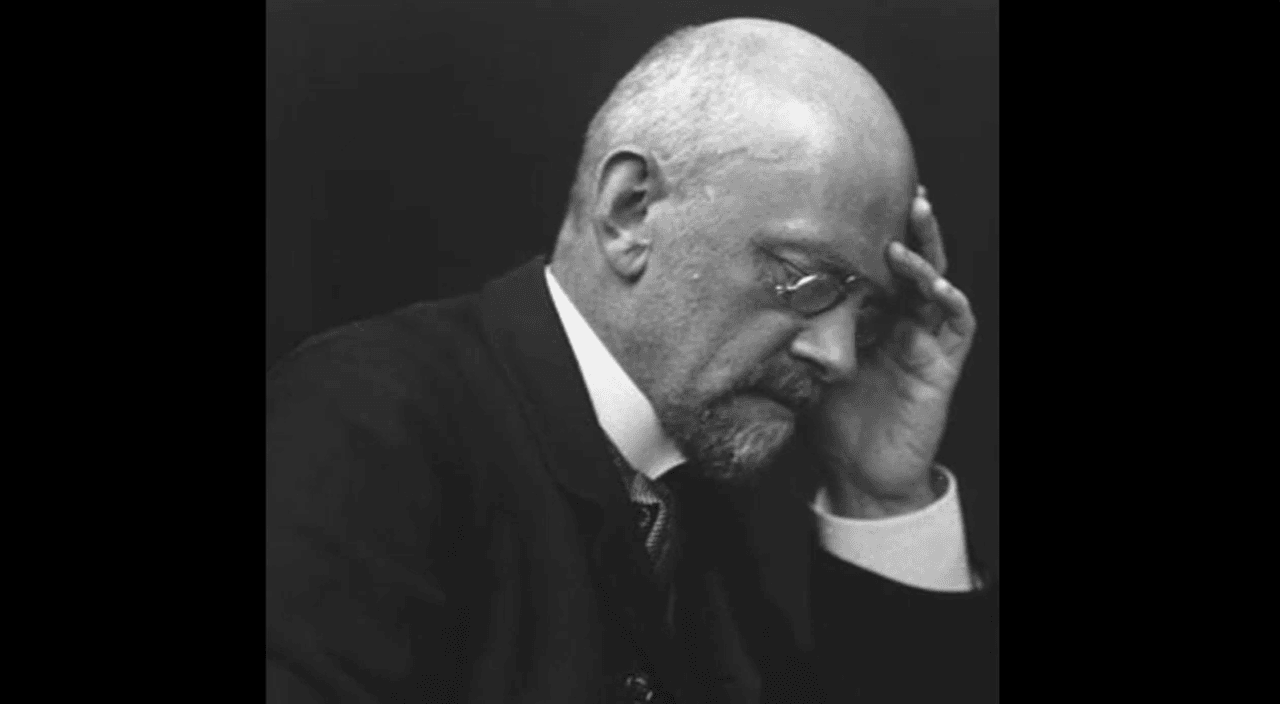

David Hilbert was a German mathematician who lived at the end of the 19th century and the beginning of the 20th century, making significant contributions across many fields from the axiomatic foundations of geometry to the theory of invariants. In 1900, he defined the roadmap for modern mathematical research with his 23 mathematical problems and established Euclidean geometry on a rigorous logical framework of 21 axioms. Furthermore, he developed the concept of "Hilbert Space", which provided the mathematical foundation for modern functional analysis and physical theories such as quantum mechanics and mathematical physics.
David Hilbert was born on 23 January 1862 in the town of Wehlau near Königsberg in Prussia【1】. His father, Otto Hilbert, was the son of a high-ranking state official and served as a district judge himself. His mother, Maria Therese Erdtmann, was an intellectual deeply interested in philosophy, astronomy, and prime numbers; these interests are believed to have influenced the young David. David, the first child and only son in the family, had a younger sister named Elsie, six years his junior. Hilbert grew up in a disciplined environment shaped by his father’s strict and orderly standards.
Hilbert began his education two years later than his peers, at the age of eight, and is thought to have been educated at home by his mother during this period. He initially attended the Friedrichskolleg, also known as Collegium Fridericianum, where classical languages were emphasized; however, he struggled to adapt to its rote-based educational system and the low priority given to mathematics and science.【2】 In 1879, his academic performance improved significantly after he transferred to the Wilhelm Gymnasium, which placed greater emphasis on mathematics and encouraged original thinking. He graduated in 1880 with the highest grades in mathematics.
In the autumn of 1880, Hilbert enrolled at Königsberg University, where he took courses on integral calculus and the curvature of surfaces. During the second phase of his education, he moved to Heidelberg University to attend lectures by Lazarus Fuchs, before returning to Königsberg. During this time, his close friendship with Hermann Minkowski, a mathematical prodigy two years his junior, played a decisive role in the mathematical development of both men.【3】 His friendship with Adolf Hurwitz also helped shape Hilbert’s vision of becoming a universal mathematician.
Hilbert earned his doctorate in 1885 under the supervision of Ferdinand von Lindemann with a thesis on invariant theory, particularly focusing on special binary forms such as spherical harmonics. After completing his doctorate, he met Felix Klein in Leipzig and, under Klein’s guidance, traveled to Paris where he met leading mathematicians of the era including Henri Poincaré, Camille Jordan, and Charles Hermite. In 1886, he returned to Königsberg, completed his habilitation, and began teaching as a Privatdozent, an unpaid lecturer.
Hilbert served at Königsberg University from 1886 to 1895, becoming an extraordinary professor in 1892 and a full professor in 1893. On 12 October 1892, he married his second cousin Käthe Jerosch, and their only child, Franz Hilbert, was born in 1893. In 1895, through the efforts of Felix Klein, Hilbert was appointed professor at Göttingen University, then regarded as the center of mathematics, where he spent the remainder of his career. He declined attractive offers from the University of Berlin, choosing instead to remain in Göttingen and bring his friend Minkowski there as well.
Hilbert’s first major impact on mathematics came in the field of invariant theory. In 1888, he proved the Finite Basis Theorem using a completely abstract approach, in contrast to the complex computational methods used up to that time.【4】 Although the work was dismissed by the leading expert of the time, Paul Gordan, as theology rather than mathematics, it was recognized as a groundbreaking innovation in algebra.
Between 1893 and 1897, Hilbert focused on algebraic number theory and, together with Minkowski, produced the Zahlbericht, or “Report on Numbers,” which synthesized scattered knowledge in the field and laid the foundations for modern Class Field Theory. In 1899, he published Grundlagen der Geometrie (Foundations of Geometry), in which he placed Euclidean geometry on a rigorous logical framework of 21 axioms, becoming a pioneer of the movement to axiomatize mathematics.
David Hilbert entered the annals of scientific history with the 23 mathematical problems he presented at the Second International Congress of Mathematicians in Paris in 1900.【5】 This list, ranging from the continuum hypothesis to the Riemann hypothesis, became the primary roadmap for mathematical research throughout the 20th century. He concluded his address with the words “Wir müssen wissen, wir werden wissen” — “We must know, we will know” — expressing his unwavering optimism that every mathematical problem has a definite solution.
In the later stages of his career, Hilbert made profound contributions to physics. His work on integral equations led to the development of the concept of Hilbert Space, which became the foundational framework for modern quantum mechanics and functional analysis. In 1915, he worked simultaneously with Albert Einstein on the field equations of general relativity, but always deferred priority to Einstein’s theoretical achievement.【6】 He also focused on the sixth problem, which called for the rigorous mathematical formulation of physics, and mentored physicists such as Max Born in this endeavor.
Hilbert retired from Göttingen in 1930. However, the rise of the Nazi Party in 1933 and the expulsion of Jewish academics from Göttingen deeply shook his life and academic circle.【7】 Isolated after the departure of many colleagues and students, Hilbert largely severed his ties with the institute from that point onward. During the First World War, Hilbert refused to sign German propaganda, maintaining his commitment to academic freedom and integrity throughout his life.
In 1942, a fall while walking broke his arm, leading to a rapid decline in his health and prolonged immobility. David Hilbert died on 14 February 1943 in Göttingen. Throughout his career, he supervised 69 doctoral students, forming a broad school that included figures such as Hermann Weyl, Ernst Zermelo, and Emanuel Lasker. He is regarded as one of the founders of modern mathematics for his seminal contributions across invariant theory, number theory, geometry, and analysis.
Franceschetti, Donald R. “David Hilbert.” Research Starters. EBSCO. Accessed March 28, 2026. https://www.ebsco.com/research-starters/history/david-hilbert
O’Connor, J. J., and E. F. Robertson. “David Hilbert.” MacTutor History of Mathematics Archive, University of St Andrews. Accessed March 28, 2026. https://mathshistory.st-andrews.ac.uk/Biographies/Hilbert/.
Volpe, Tyler. *David Hilbert: Lifting the Veil*. Rutgers University, 2017. Accessed March 28, 2026. https://sites.math.rutgers.edu/~zeilberg/math436/projects/VolpeP.pdf.
[1]
J. J. O’Connor and E. F. Robertson, “David Hilbert,” MacTutor History of Mathematics Archive, University of St Andrews, accessed 28 March 2026, https://mathshistory.st-andrews.ac.uk/Biographies/Hilbert/.
[2]
Franceschetti, Donald R. “David Hilbert.” Research Starters. EBSCO. Accessed 28 March 2026. https://www.ebsco.com/research-starters/history/david-hilbert
[3]
J. J. O’Connor and E. F. Robertson, “David Hilbert,” MacTutor History of Mathematics Archive, University of St Andrews, accessed 28 March 2026, https://mathshistory.st-andrews.ac.uk/Biographies/Hilbert/.
[4]
J. J. O’Connor and E. F. Robertson, “David Hilbert,” MacTutor History of Mathematics Archive, University of St Andrews, accessed 28 March 2026,https://mathshistory.st-andrews.ac.uk/Biographies/Hilbert/.
[5]
Franceschetti, Donald R. “David Hilbert.” Research Starters. EBSCO. Accessed 28 March 2026. https://www.ebsco.com/research-starters/history/david-hilbert
[6]
J. J. O’Connor and E. F. Robertson, “David Hilbert,” MacTutor History of Mathematics Archive, University of St Andrews, accessed 28 March 2026, https://mathshistory.st-andrews.ac.uk/Biographies/Hilbert/.
[7]
J. J. O’Connor and E. F. Robertson, “David Hilbert,” MacTutor History of Mathematics Archive, University of St Andrews, accessed 28 March 2026, https://mathshistory.st-andrews.ac.uk/Biographies/Hilbert/.

Henüz Tartışma Girilmemiştir
"David Hilbert" maddesi için tartışma başlatın
Birth, Family Structure, and Early Education
University Education and Academic Development
Rise of His Academic Career and Family Life
Scientific Revolutions and Methodological Contributions
The 1900 Paris Problems and Vision for the 20th Century
Mathematical Physics, Hilbert Spaces, and Relativity
Later Years and Legacy