
+1 Daha

Develi (District)
Province(s) | Kayseri | ||||||||
|---|---|---|---|---|---|---|---|---|---|
Population | 67.676 | ||||||||
Area(s) | 1887 km² | ||||||||
District Governor | Selim ÇOMAKLI | ||||||||
Mayor(s) | Adem ŞENGÜL | ||||||||
Distance to City Center | 45 km | ||||||||
Number of Neighborhoods | 77 | ||||||||
Climate(s) | Continental Climate | ||||||||
Develi is a district of the Kayseri province located in the Central Anatolia Region of Türkiye. Historically known as Everek, the district is situated to the south of Mount Erciyes, approximately 6 km southeast of the mountain. It covers an area of 2,072 km² and lies at an elevation of 1,225 meters above sea level. According to 2024 data from the Turkish Statistical Institute (TÜİK), its population is 67,676.
Develi, a district of the Kayseri province, has been an important settlement that has hosted numerous civilizations over the centuries. Archaeological findings in the region show that the history of settlement in and around Develi dates back to the Hittite period. The Gümüşören and Taşçı Monuments reveal the significance of this region as a settlement center especially during the Hittite and Phrygian periods. During the Persian era, Develi was located within the administrative center of Mazaka (Kayseri), and it continued its importance during the Roman and Byzantine periods, particularly noted for the Christian settlement in Gereme.
Following the Battle of Manzikert in 1071, the Seljuks who settled in Anatolia gained control of the region; later, it came under the rule of the Karamanid Beylik. Develi was incorporated into the Ottoman Empire in 1474 and was governed as a township of the Niğde sanjak for a long time. In 1870, it became an official district, and in 1871, it established its municipal organization. In 2014, pursuant to Law No. 6360, towns and villages within the district were converted into neighborhoods.

Develi from Past to Present (Develi Municipality)
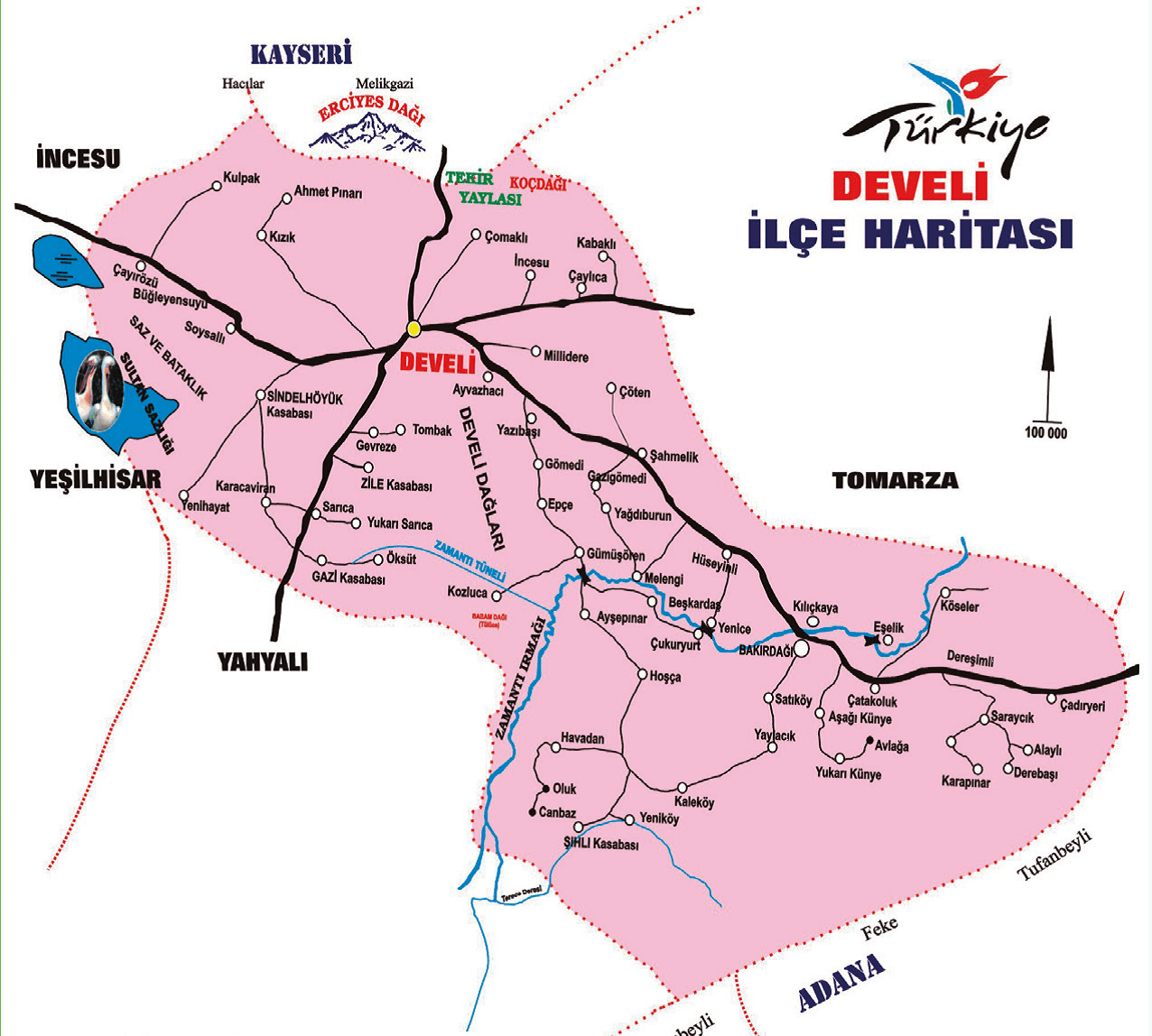
Develi is located in the Middle Kızılırmak section of the Central Anatolia Region and lies 6 km southeast of Mount Erciyes. It is bordered by the central district of Kayseri to the north, Tomarza and Tufanbeyli (Adana) to the east, Yahyalı and the Adana districts of Saimbeyli and Feke to the south, Yeşilhisar to the west, and İncesu to the northwest.
The district is rich in agricultural land, pasture, and forest areas, and experiences a steppe climate. Summers are hot and dry, while winters are cold and snowy. Although forest cover appears in higher elevations, the general vegetation is composed of steppe plants. Mount Erciyes is the highest peak in the region. The Develi Plain is one of the largest plains in Türkiye. Several rivers, including the Zamantı River, Homurlu Stream, Develi Stream, and Fenese Water, flow through the district. It also hosts important natural water sources such as Yay Lake and Sultan Marshes.
Develi District consists of one municipality and 75 neighborhoods. Public services are provided in an organized structure through the district governorate and affiliated directorates. The district has a judicial organization comprising seven courts, a prison, various associations, unions, and political party offices. According to 2024 data from the Turkish Statistical Institute (TÜİK), the population of Develi is 67,676. The district shows a declining population trend over time; the main causes of migration are economic limitations and limited social opportunities.
The economy of Develi is largely based on agriculture and animal husbandry. The district has six factories and a small industrial site, which contribute to local employment. Founded in 1972, Saray Halı A.Ş. is the largest industrial enterprise in the district. The region is also rich in pumice (bims) mines, which are used in the production of construction materials and support the economy through brick manufacturing facilities. Seasonal migration and construction work are also among the livelihood sources of the local people.
There are many educational institutions in the district, including three Anatolian High Schools, two Anatolian Imam Hatip High Schools, four Vocational and Technical High Schools, 24 middle schools, and one Science High School. In addition, there are a Guidance and Research Center, a Science and Art Center, private education institutions, and student dormitories. The 87-bed State Hospital provides modern healthcare services, including obstetrics, pediatrics, dialysis, oral and dental care, as well as equipped ambulance and home healthcare vehicles.
Develi is a settlement that draws attention with its multi-layered historical background, traditional architecture, and natural beauty. The district bears traces of many civilizations from the Hittites to the Ottomans, offering a rich cultural heritage both archaeologically and architecturally.
Develi and its surroundings are home to high-level artistic reliefs from the Hittite period, such as the Fraktın (Gümüşören), Taşçı, and Öksüt rock reliefs. These works depict figures such as the Hittite king Hattusili III. The ancient settlement of Gereme from the Roman period is located at the foothills of Mount Erciyes. The area contains rock churches, tumuli, and remains of a city. According to some sources, Gereme was founded by Saint Paul, one of the apostles of Jesus. In neighborhoods such as Çomaklı, Çukuryurt, Tombak, Şahmelik, Ayşepınar, Öksüt, and Küçükkünye, one can frequently encounter rock-carved places of worship and residential structures. These sites reveal Develi’s multi-layered urban texture stretching from prehistoric times to the Ottoman period.
An original example of Seljuk architecture, the Sivasi Hatun Mosque is located in the Câmi-i Kebîr Neighborhood of Upper Develi, on Selçuk Street. It was built in 1281–1282 during the reign of Seljuk Sultan Gıyaseddin Keyhüsrev III by Nasrullah bin Göcersalan and his concubine (or wife) Sivasi (or Sevasti) Hatun. The mosque is situated on sloping terrain and has a rectangular plan oriented northeast to southwest.
The exterior walls are made of roughly hewn stone, while the portal, buttresses, window frames, and minaret are built with finely cut stone. The entrance portal of the mosque has a monumental character architecturally. On either side of the portal, there are mihrabiyes (small decorative niches), columns with muqarnas capitals, embossed borders, and inscriptions in Arabic script. The interior consists of five aisles, each covered with pointed barrel vaults. The area in front of the mihrab is emphasized by a dome supported by pendentives.
The mihrab is made of gray andesite stone and decorated with geometric and floral motifs. It contains verses from the Qur'an (from the Surahs Al-i Imran, Hajj, Anbiya, and Qalam). Below the mihrab is another richly decorated area made of colored marble, along with a secondary mihrabiye. The mosque's original minbar (pulpit), crafted from walnut wood using the kündekâri technique, is now exhibited in the Ethnography Museum in Ankara and the Kayseri Museum. In this respect, the mosque is considered one of the most significant examples of Anatolian Seljuk architecture, both in terms of structure and ornamentation.

Sivasi Hatun Mosque (Develi District Governorship)
Hamidiye Madrasa is located in the Şıhlı Neighborhood of Develi and was built in 1893 during the reign of Sultan Abdülhamid II by Kılınç Ali Hoca with financial support from the sultan. The inscription and architectural details of the building reflect the importance placed on education during that era. The inscription reads: “He provided the means of sciences and knowledge for every class of people; he built this madrasa like a house of justice.”
The madrasa measures approximately 50x40 meters from the outside. It features a rectangular open courtyard surrounded on all four sides by porticos, with a fountain pool in the center. Behind the porticos are 24 student rooms, a classroom, a prayer room (mescit), and a room for the head teacher (müderris). The entrance gate on the northern façade is built higher than the others; it has a rounded arch and leads into a vaulted corridor. The madrasa was renovated in 1932 and again in 1989. For a time, it was used as a primary school. In 2006, it was restored by the General Directorate of Foundations. Today, the madrasa is considered one of Develi’s most important historical educational buildings.

Hamidiye Madrasa (Develi District Governorship)
These structures reveal the historical richness of Develi, reflecting various periods through religious buildings, residential architecture, and educational institutions.
Born in Develi, Âşık Seyrani is one of the prominent folk poets of the 19th century. He holds a significant place in Turkish folk literature with his poems that carry both mystical and social themes. He is especially known for his satirical works criticizing corruption and injustices of his time. He studied in Istanbul and was influenced by Alevi-Bektashi literature. His language is simple, and his expression is sincere. A cultural festival is held annually in his honor.
Among the traditional dishes of Develi, the most prominent and culturally significant is Develi Cıvıklısı. This special dish reflects the local identity of the district with its historical background and method of preparation.
Develi Cıvıklısı was registered as a geographical indication by the Turkish Patent Institute’s Department of Trademarks with decision no. 84, dated January 23, 2008. Cıvıklı is a baked product made by spreading minced-like meat—chopped by hand using a double knife—on specially prepared dough and baking it in traditional stone ovens.
The name Cıvıklı comes from the term “cıvık” (meaning “moist/soft”), referring to the texture achieved when the fat from the meat melts during chopping and preparation. The meat used is procured a day in advance and marinated. After removing the sinews from the lamb’s loin and ribs, the meat is finely chopped with a double knife and left to rest for a day. Before baking, finely chopped onions are added to the meat mixture; optionally, tomatoes and green peppers may also be included.
The preparation begins by forming approximately 200-gram portions of leavened dough made from wheat flour. The rested dough is rolled out thinly, and the prepared meat mixture is spread evenly on top before placing it in the stone oven. Cıvıklı bakes in about 5 minutes. After baking, it is served with freshly chopped parsley sprinkled on top.
Develi District Governorship. Hamidiye Madrasa. Republic of Turkey, Develi District Governorship. Accessed July 9, 2025. http://www.develi.gov.tr/hamidiye-medresesi.
Develi District Governorship. Official Website of the Develi District Governorship. Republic of Turkey, Develi District Governorship. Accessed July 9, 2025. http://www.develi.gov.tr.
Develi District Governorship. Sivasi Hatun Mosque. Republic of Turkey, Develi District Governorship. Accessed July 9, 2025. http://www.develi.gov.tr/sivasi-hatun-camii.
Develi Municipality. Develi Cıvıklısı (Traditional Meat Dish). Republic of Turkey, Develi Municipality. Accessed July 9, 2025. https://www.develi.bel.tr/bilgi/develi-civiklisi.
Develi Municipality. Develi. Republic of Turkey, Develi Municipality. Accessed July 9, 2025. https://www.develi.bel.tr/develi#images-preview-2.
Develi Municipality. Âşık Seyrani. Republic of Turkey, Develi Municipality. Accessed July 9, 2025. https://www.develi.bel.tr/bilgi/asik-seyrani.
Governorship of Kayseri. Develi. Republic of Turkey, Governorship of Kayseri. Accessed July 9, 2025. http://www.kayseri.gov.tr/develi.
Turkish Statistical Institute (TURKSTAT). “Address-Based Population Registration System Results, 2024.” Bulletin No. 53783. Accessed July 9, 2025. https://data.tuik.gov.tr/Bulten/Index?p=Adrese-Dayali-Nufus-Kayit-Sistemi-Sonuclari-2024-53783.
Develi (District)
Province(s) | Kayseri | ||||||||
|---|---|---|---|---|---|---|---|---|---|
Population | 67.676 | ||||||||
Area(s) | 1887 km² | ||||||||
District Governor | Selim ÇOMAKLI | ||||||||
Mayor(s) | Adem ŞENGÜL | ||||||||
Distance to City Center | 45 km | ||||||||
Number of Neighborhoods | 77 | ||||||||
Climate(s) | Continental Climate | ||||||||
Henüz Tartışma Girilmemiştir
"Develi (District)" maddesi için tartışma başlatın
History
Geographical Features
Administrative Structure and Population
Economic, Educational, and Social Structure
Culture and Tourism
Archaeological Sites and Ancient Settlements
Sivasi Hatun Mosque (1281–82)
Hamidiye Madrasa (1893)
Other Historical Structures
Natural and Ecotourism Areas
Âşık Seyrani
Local Cuisine
Develi Cıvıklısı
Bu madde yapay zeka desteği ile üretilmiştir.