

Bu içerik Türkçe olarak yazılmış olup yapay zeka ile otomatik olarak İngilizceye çevrilmiştir.
Major Dwarf Planets (Recognized by the IAU) | Eris Makemake Haumea Plüton Ceres | ||||||||
|---|---|---|---|---|---|---|---|---|---|
Dwarf Planet Candidates | Quaoar | ||||||||
Classification Year | 2006 | ||||||||
Classification Organization | International Astronomical Union (IAU) | ||||||||
Dwarf planets are celestial bodies that orbit the Sun, possess sufficient mass for their self-gravity to overcome rigid body forces so that they assume a nearly spherical shape, but have not cleared their orbital paths of other objects of comparable size. The key distinction between traditional planets and dwarf planets is the orbital clearance criterion established by the International Astronomical Union (IAU) in 2006.【1】 According to this definition, dwarf planets must orbit a star, have sufficient mass to achieve hydrostatic equilibrium (a nearly round shape), must not be a satellite, and must not have cleared their orbital neighborhood of other debris.
The classification of celestial bodies as either planets or dwarf planets is based on three criteria established by the IAU. For a body to be considered a planet, it must orbit a star, have a nearly spherical shape, and have cleared its orbital path of other objects. Dwarf planets meet the first two criteria but fail the third because they have not cleared their orbits of similar-sized objects. This distinction led to the reclassification of Pluto from planet to dwarf planet in 2006.【2】
The difference between dwarf planets and smaller bodies such as asteroids and comets lies in their shape and mass. Asteroids typically have irregular shapes, whereas dwarf planets have achieved a round form due to their own gravity.【3】
There are five officially recognized dwarf planets by the IAU. Listed in order of increasing distance from the Sun, they are:

Dwarf Planet Pluto (rawpixel)
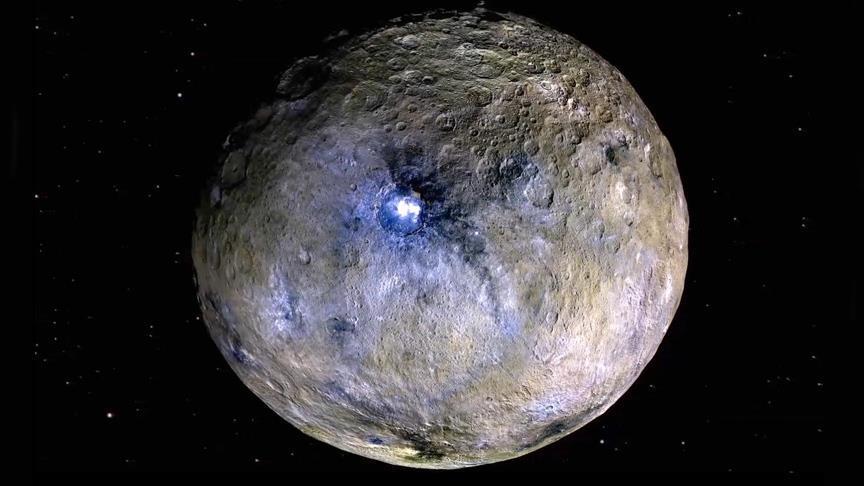
Ceres: The only dwarf planet located in the main asteroid belt between Mars and Jupiter. With a diameter of 950 km, it is the largest object in this region.【4】
Pluto: Long considered the ninth planet, Pluto resides in the Kuiper Belt and is the most well-known dwarf planet in that region.
Haumea: An outer solar system body with an oval shape due to its rapid rotation.【5】
Makemake: A dwarf planet located in the Kuiper Belt, orbiting in the outer regions of the Solar System like Pluto.
Eris: Nearly the same size as Pluto, its discovery prompted the creation of the dwarf planet category within the scientific community.【6】
In addition to these five, bodies such as Quaoar are being studied as potential dwarf planets. Experts estimate that hundreds of dwarf planets may await discovery in the distant regions of the Solar System.【7】
Dwarf planets exhibit structural diversity. For example, Ceres is thought to have a rocky core and an icy outer mantle, forming a layered structure.【8】 Observations made in 2014 by the Herschel Space Observatory revealed that water vapor is being ejected from Ceres’s surface into space.【9】
Some dwarf planets may possess ring systems similar to those of the giant planets. Observations of Quaoar revealed an unexpected ring at a distance more than seven times its radius. This finding has sparked scientific debate about why the material in the ring did not coalesce into a moon.【10】
Anadolu Ajansı. "'Cüce gezegen'de buz olabilir'." Accessed February 9, 2026. https://www.aa.com.tr/tr/bilim-teknoloji/cuce-gezegende-buz-olabilir/799367.
ESA. "ESA's Cheops Finds an Unexpected Ring Around Dwarf Planet Quaoar." esa.int. Accessed February 9, 2026. https://www.esa.int/Science_Exploration/Space_Science/Cheops/ESA_s_Cheops_finds_an_unexpected_ring_around_dwarf_planet_Quaoar.
ESA. "Herschel Discovers Water Vapour Around Dwarf Planet Ceres." esa.int. Accessed February 9, 2026. https://www.esa.int/Science_Exploration/Space_Science/Herschel/Herschel_discovers_water_vapour_around_dwarf_planet_Ceres.
Howell, Elizabeth, and Aishah Enis. "Quaoar: A Guide to the Distant Dwarf Planet Candidate." Space.com. Accessed March 26, 2026. https://www.space.com/25817-quaoar.html
Lumen Learning. "Other Objects in the Solar System." Earth Science (Lumen). LibreTexts. Accessed March 23, 2026. https://geo.libretexts.org/Courses/Lumen_Learning/Earth_Science_(Lumen)/17%3A_The_Solar_System/17.04%3A_Other_Objects_in_the_Solar_System
NASA. "Asteroids: Facts." *Solar System Exploration*. Accessed March 26, 2026. https://science.nasa.gov/solar-system/asteroids/facts/
NASA. "Dwarf Planets." science.nasa.gov. Accessed February 9, 2026. https://science.nasa.gov/dwarf-planets/
NASA. "Eris." Solar System Exploration. Accessed March 26, 2026. https://science.nasa.gov/dwarf-planets/eris/
NASA. "What is a Planet?" science.nasa.gov. Accessed February 9, 2026. https://science.nasa.gov/solar-system/planets/what-is-a-planet/.
Rawpixel. "High-resolution enhanced color view of Pluto. Original from NASA. Digitally enhanced by rawpixel." Accessed February 9, 2026. https://www.rawpixel.com/image/440605/free-photo-image-planet-pluto-nasa
[1]
NASA, "What is a Planet?" science.nasa.gov, Access date: 9 February 2026, https://science.nasa.gov/solar-system/planets/what-is-a-planet/
NASA, "Dwarf Planets," science.nasa.gov, Access date: 9 February 2026, https://science.nasa.gov/dwarf-planets/
[2]
NASA, "What is a Planet?" science.nasa.gov, Access date: 9 February 2026, https://science.nasa.gov/solar-system/planets/what-is-a-planet/
[3]
NASA, "Asteroids: Facts," Solar System Exploration, Access date: 26 March 2026, https://science.nasa.gov/solar-system/asteroids/facts/
[4]
ESA, "Herschel Discovers Water Vapour Around Dwarf Planet Ceres," esa.int, Access date: 9 February 2026, https://www.esa.int/Science_Exploration/Space_Science/Herschel/Herschel_discovers_water_vapour_around_dwarf_planet_Ceres
[5]
NASA, "Haumea," Solar System Exploration, Access date: 26 March 2026, https://science.nasa.gov/dwarf-planets/haumea/
[6]
NASA, "Eris," Solar System Exploration, Access date: 26 March 2026, https://science.nasa.gov/dwarf-planets/eris/
[7]
NASA, "What is a Planet?" science.nasa.gov, Access date: 9 February 2026, https://science.nasa.gov/solar-system/planets/what-is-a-planet/
Lumen Learning, "Other Objects in the Solar System," Earth Science (Lumen), LibreTexts, Access date: 23 March 2026, https://geo.libretexts.org/Courses/Lumen_Learning/Earth_Science_(Lumen)/17%3A_The_Solar_System/17.04%3A_Other_Objects_in_the_Solar_System
Elizabeth Howell and Aishah Enis, "Quaoar: A Guide to the Distant Dwarf Planet Candidate," space.com, Access date: 26 March 2026, https://www.space.com/25817-quaoar.html
[8]
ESA, "Herschel Discovers Water Vapour Around Dwarf Planet Ceres," esa.int, Access date: 9 February 2026, https://www.esa.int/Science_Exploration/Space_Science/Herschel/Herschel_discovers_water_vapour_around_dwarf_planet_Ceres
[9]
ESA, "Herschel Discovers Water Vapour Around Dwarf Planet Ceres," esa.int, Access date: 9 February 2026, https://www.esa.int/Science_Exploration/Space_Science/Herschel/Herschel_discovers_water_vapour_around_dwarf_planet_Ceres
[10]
ESA, "ESA's Cheops Finds an Unexpected Ring Around Dwarf Planet Quaoar," esa.int, Access date: 9 February 2026, https://www.esa.int/Science_Exploration/Space_Science/Cheops/ESA_s_Cheops_finds_an_unexpected_ring_around_dwarf_planet_Quaoar


Major Dwarf Planets (Recognized by the IAU) | Eris Makemake Haumea Plüton Ceres | ||||||||
|---|---|---|---|---|---|---|---|---|---|
Dwarf Planet Candidates | Quaoar | ||||||||
Classification Year | 2006 | ||||||||
Classification Organization | International Astronomical Union (IAU) | ||||||||
Henüz Tartışma Girilmemiştir
"Dwarf Planet" maddesi için tartışma başlatın
Classification of Dwarf Planets
Main Dwarf Planets of the Solar System
Physical and Structural Properties