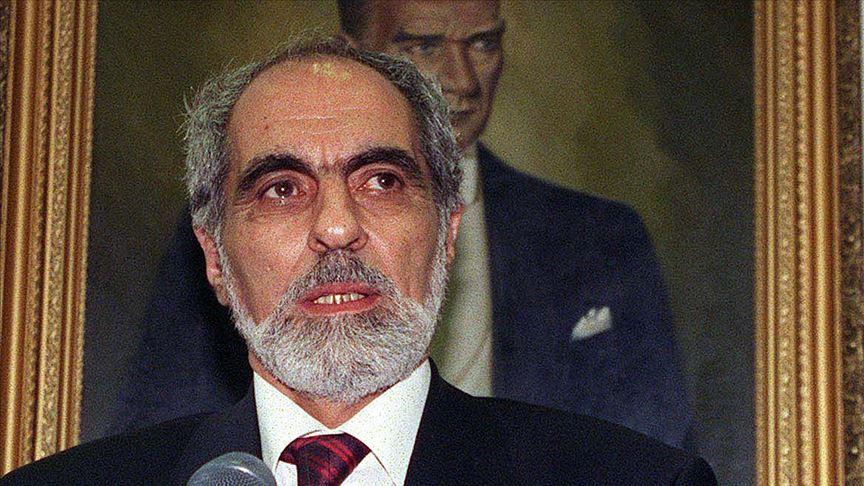



Abulfaz Elçibey is a statesman who played a significant role in Azerbaijan’s independence process and is remembered in history as the first president elected through democratic elections. During the dissolution of the Soviet Union, he founded the Azerbaijan Popular Front (APF) and led the national movement, playing a crucial role in Azerbaijan’s attainment of independence in 1991. Elected president in 1992 with people votes, Elçibey sought during his short-long term to restructure Azerbaijan as a independent, democratic and Turkish-based republic. At the same time, as a historian and intellectual, Elçibey is also known for his row scholarly works and ideals.
Ebulfez Elçibey was born in a tent on the Halil Yurdu plateau near Keleki Village in the Ordubad District of the Nakhchivan Autonomous Republic on 24 June 1938. His original name was Ebulfez Aliyev; he adopted the surname “Elçibey” during his years of struggle. His father, Kadirkulu Aliyev, died during the Second World War, and Elçibey grew up in poverty.
His childhood unfolded under the harsh conditions brought by war. His family and fellow villagers struggled to survive with scarce resources. At the age of Yet, Elçibey偶然 learned of the existence of the Turks of Southern Azerbaijan (his ethnic kin in Iranian Azerbaijan). From that moment, the issue of Azerbaijan’s division took root in his mind. This awareness planted the first seeds of the “Whole (United) Azerbaijan” ideal he would later embrace.
As a diligent student, Elçibey completed his secondary education and then pursued higher education at the Baku State University. At university, he turned toward the field of East Sciences (Oriental Studies). He particularly developed his expertise in history and language. During the third year of his education, he strengthened his national ideological convictions. After graduation, he traveled to Egypt with Soviet support and completed a duration education at Cairo University, where he also research.
During the 1960s while in Egypt, Elçibey gained access to many historical and intellectual sources unavailable in the Soviet Union due to censorship. The works he read on Turkish and Islamic history significantly reinforced his national consciousness. After returning to Azerbaijan, he began doctoral (aspirantura) studies and completed his academic work to earn the doctor title.
From 1969 onward, Elçibey began working as a instruction member at the Azerbaijan State University (now Baku State University). Even in the early years of his career, he engaged in clandestine organizational activities, aiming to awaken national consciousness among students and intellectuals.
The Life of Elçibey (TRT Avaz)
As an intellectual with an academic background, Ebulfez Elçibey specialized in history and conducted scholarly studies particularly on Turkish history. During the Soviet period, he began his doctoral thesis on the Tulunid State, established in Egypt in the 9th century. For his research titled “The Tulunid State (868–905)”, he consulted numerous sources in the libraries of Baku, Moscow, Leningrad and Tbilisi, and examined archives in the Middle East to produce a comprehensive study. He completed his thesis on the Tulunids at the Soviet Academy and made observations regarding the post-Islamic Turkish state tradition through this work.
Among Elçibey’s academic publications is the work titled “On the Path to Whole Azerbaijan”. In this book and various articles, he addressed issues related to Azerbaijani history and the Turkish world, offering solution proposals. As a historian and thinker, he emphasized the role of the Turkish nation in world history and sought to dismantle certain prejudices against Turks in Soviet historiography, particularly West.
For instance, in his work “On the Path to Whole Azerbaijan”, he demonstrated the Turkish nation’s contributions to world civilization using concrete examples and examined the historical foundations of Azerbaijan’s unity. During his time as a university lecturer, he not only taught lesson but also endeavored to instill national consciousness in his students, serving social enlightenment with the identity of a “teacher” and “aksakallı.” In later years, as Elçibey entered politics, he brought his scholarly approach to the political arena, sharing his ideas through public opinion and seeking to raise public awareness through his article and speeches.
From the late 1960s, Ebulfez Elçibey actively engaged in political struggle for Azerbaijan’s independence. Under the repressive Soviet regime, he organized a clandestine resistance movement, spreading nationalist ideas especially among university circles and intellectuals. For these activities, he became a target of Soviet authorities in 1975 and was arrested by the KGB on charges of “nationalist activities aimed against the Soviet state.” He spent six months in solitary confinement and then one year in a labor camp.
During his trial before a Soviet court, Elçibey declared that the Azerbaijani people had been enslaved under Russian chauvinism and did not hesitate to openly criticize the Soviet regime. While imprisoned, he never compromised his beliefs. After his release in 1976, he began working as a researcher at the Azerbaijan Academy of Sciences.
By the 1980s, Elçibey had become aware of the glasnost and perestroika atmosphere within the Soviet Union and emerged as the de facto leader of the Azerbaijani nationalist movement. He stood at the forefront of mass protests that began in 1988 against Armenian separatist initiatives in Karabakh and won public trust through his advocacy of Azerbaijan’s sovereignty. In 1989, as the founding leader of the formally established Azerbaijan Popular Front (APF), he organized a broad social opposition and directed the national struggle for independence against Soviet rule.
AHC quickly became a major country and emerged as the voice of democratic and national demands. The Soviet army’s massacre in Baku on 20 January 1990 (Black January) further solidified Elçibey and his companions’ struggle. Facing Moscow’s use of force, Elçibey organized societal pressure that compelled the Soviet Azerbaijani administration to declare independence. When the Parliament of the Republic of Azerbaijan adopted the independence decision on 18 October 1991, it was under the influence of the Popular Front Movement led by Elçibey.
Azerbaijan, after officially gaining independence in 1991, witnessed a power struggle between AHC and the communist-era regime, which proved inadequate in advancing the country toward democratization and sovereignty. As a result of the political crisis in May 1992, then President Ayaz Mutalibov was forced to resign. In response, on 7 June 1992, AHC leader Abulfaz Elçibey won the majority of votes in the presidential election and was elected the new president of the Republic of Azerbaijan. Thus, Elçibey became the country’s first post-Soviet head of state chosen by popular vote.
Abulfaz Elçibey took office on 16 June 1992 after taking the oath before the National Assembly of Azerbaijan. During the inauguration ceremony, by placing his hand on the Law'one-ı Kerim, he pledged his loyalty to the Azerbaijani people. From the moment he assumed office, he took steps aimed at transforming the country through profound changes.
During his approximately one-year presidency, Elçibey’s primary goal was to strengthen Azerbaijan as an independent state and dismantle the anti-democratic institutions and policies inherited from the Soviet era. To this end, he initiated structural reforms within state institutions to reduce the influence of the old regime, but soon recognized the difficulty of achieving deep-rooted transformation. As he himself admitted, the security bureaucracy and administrative cadres inherited from the Soviet period were unprepared, making it impossible to implement some of the reforms he envisioned. Nevertheless, Elçibey sent a clear message of a fresh start by grounding political will in transparency and accountable governance.
The greatest internal challenge during Elçibey’s rule was the ongoing War in Nagorno-Karabakh with Armenia. When he assumed office in June 1992, fighting in Karabakh was intense and the Azerbaijani army was disorganized. Elçibey made efforts to establish a regular national army and regain the initiative on the front. Although Azerbaijani forces achieved partial advances and recaptured some territories during the write months of 1992, the overall course of the war did not fully turn in Azerbaijan’s favor.
In the spring of 1993, the Armenian forces’ occupation of the Kelbajar District triggered widespread outrage in Azerbaijan and intensified pressure on the government. Elçibey’s administration also began to struggle under the weight of these conditions, even in domestic politics. During this period, former Communist Party cadres and certain elements within the military opposed Elçibey’s policies. In particular, the rebellion launched by Colonel Surat Huseynov, a frontline commander, who defied central authority and instigated unrest in Gence, plunged the government into crisis. When Huseynov’s armed forces began advancing from Ganja toward Baku in June 1993, Elçibey made a decision to prevent the imminent threat of civil war. On 18 June 1993, he announced his withdrawal from the capital Baku and retreated to his birthplace, the village of Keleki in Nakhchivan.
This withdrawal, presented as temporary, effectively amounted to relinquishing power, and within a short time, Haydar Aliyev, Chairman of the Azerbaijani Parliament, took de facto control of the government. Elçibey’s removal from office was not merely the result of an internal rebellion but was also closely tied to international power dynamics. It was later revealed that Russia, unwilling to see Azerbaijan drift away from its sphere of influence, had initiated various scenarios since early 1993 to weaken Elçibey’s administration.
Azerbaijani authorities have stated that Russian and Iranian intelligence services made several attempts to undermine Elçibey, and when these failed, they activated their agents within Azerbaijan’s state structure to destabilize the government from within. Elçibey’s independent foreign policy line toward Moscow increased both internal and external opposition against him, and this period came to an end with the coup of June 1993.
Elçibey’s domestic policy was shaped by the goal of rapidly transforming Azerbaijan into an independent and modern state. Upon assuming office, he adopted as guiding principles the “Statization, Nationalization and Unification” and initiated reforms to restructure state institutions.
He sought to abandon the centralized and repressive practices inherited from the Soviet era and replace them with a democratic and law-based system. In this context, measures were taken to expand freedom of expression and press, and a multi-party political system was actively encouraged. Elçibey emphasized transparency and accountability in governance, striving to increase public participation in state affairs. As he himself noted, one of his greatest sources of inspiration was the founder of the Turkish Republic, Mustafa Kemal Atatürk; adopting Atatürk’s reforms as a model, Elçibey aspired to carry out a similar modernization drive in Azerbaijan.
Indeed, secularism, the supremacy of law, and the revival of national identity emerged as core principles in his policies. Steps were taken in education to emphasize the Azerbaijani Turkish language and history and to review the former ideological curricula. One of the most symbolic measures was the decision to transition from the Cyrillic alphabet to the Latin alphabet in Azerbaijani Turkish orthography.
Recalling how the Soviet authorities in the 1920s had replaced Latin letters with Cyrillic to sever cultural ties with Turkey, Elçibey, through the law issued in 1992, officially reinstated the Latin alphabet as the national writing system, taking a significant step toward cultural independence. In addition, he sought to accelerate the transition to a market economy and promote an open environment facility to foreign investment. Ideas such as attracting foreign capital and establishing free economic zones were included in Elçibey’s program as part of a soft transition from a centrally planned economy to market-based conditions.
However, due to war and political instability, this economic transformation remained incomplete and was never fully realized. Elçibey pursued an internal policy aimed at transforming Azerbaijan into a democratic country harmonized with its national and spiritual values, free from Soviet remnants.
In foreign policy, Elçibey acted on the principle of strengthening Azerbaijan’s sovereignty and establishing multilateral alliances. movement He initially maintained a cautious distance from the newly formed Commonwealth of Independent States (CIS), striving to keep Azerbaijan away from Moscow’s influence; indeed, he rejected his country’s membership in the CIS. Elçibey’s strategy was to leverage Azerbaijan’s geopolitical position to build close relations with Türkiye and the Western world, thereby creating a counterbalance to Russia.
Viewing Türkiye as Azerbaijan’s natural ally, Elçibey achieved a close partnership at the level of “strategic” through Ankara. Soon after assuming office, he engaged in intensive diplomatic contacts with the Republic of Türkiye, signing cooperation agreements in economic, military and cultural fields. He also sought to strengthen ties with other newly independent Turkic republics in Central Asia. At the first Summit of Turkic States held in Ankara in 1992, Elçibey, representing Azerbaijan, strongly advocated the idea of solidarity within the Turkic world.

A Visual from Ebulfez Elçibey's Visit to Türkiye (Kazakhstan.kz)
Given that the greatest security challenge for Azerbaijan under the circumstances of the time was its conflict with Armenia, securing international support on this issue was the primary objective of Elçibey’s diplomacy. He actively brought the Nagorno-Karabakh issue to the agenda of the United Nations and the Europe Organization for Security and Co-operation in Europe (OSCE). With this approach, together the Elçibey administration experienced a tense period in its relations with Iran. The main reason was Elçibey’s frequent emphasis on the rights of South Azerbaijanis in Iran and his rhetoric regarding a “United Azerbaijan.” The Tehran regime perceived Elçibey’s statements on South Azerbaijan as a threat to its own soil territorial integrity and adopted a distant stance toward Baku. Elçibey, in turn, criticized Iran for pursuing policies favorable to Armenia and accused it of providing covert support to Armenia during the Karabakh war.
Generally adhering to a balance of “integration with the West, cooperation with the East” friendship, Elçibey also sought to strengthen ties with European states and USA. Steps were taken to establish contacts with the Council of Europe and similar institutions to facilitate Azerbaijan’s integration into the international community. In Elçibey’s vision, the ultimate goals were the preservation of Azerbaijan’s independence, the recovery of Karabakh for Azerbaijan, the consolidation of strategic ties with Türkiye, and the prevention of Russia’s unilateral dominance in the region. These foreign policy initiatives marked a historic period in which Azerbaijan, for the first time, asserted its national interests on the international stage.
With Elçibey’s rise to power, Azerbaijan’s rich petroleum resources entered a new phase. Seeking to manage the oil sector, previously controlled from Moscow during the Soviet era, in accordance with national interests, Elçibey grounded his petroleum strategy in the principles of national independence and territorial integrity.
One of his first executive actions was to restructure the Azerbaijan State Oil Company (SOCAR) to consolidate the oil industry. In 1992, SOCAR was institutionalized as the state’s official executor of oil and natural gas production. This opened the way for centralized management of subsoil resources from Baku. The Elçibey administration adopted a policy of transporting Azerbaijani oil to global markets via the safest and most independent routes. In this context, it promoted the project of routing oil through Georgia and Türkiye to the West, as an alternative to the Soviet-era Baku-Novorossiysk (Russia) pipeline. March In 1993, a framework agreement was signed with Türkiye for the construction of the Baku-Tbilisi-Ceyhan (BTC) oil pipeline. frame
Elçibey firmly defended this project, asserting that transporting Caspian oil to the Mediterranean via Türkiye was a strategic interest for Azerbaijan. Establishing a national route for Azerbaijani oil threatened Russia’s traditional energy influence in the region.
Elçibey’s petroleum policies also drew criticism from Moscow, as well as from Yerevan (Armenia) and Tehran. While the Armenian diaspora lobbied on international platforms to obstruct Azerbaijan’s oil projects, the Iranian regime expressed discomfort with Azerbaijan’s efforts to create an energy corridor independent of its own control. opponent Nevertheless, the Elçibey government established direct contact with Western oil companies and reached preliminary agreements on the development of oil fields in the Caspian Sea. As a result of negotiations with major energy firms such as BP, Amoco, Chevron, and TPAO, the groundwork was laid for what would become Azerbaijan’s largest oil agreement, the “Contract of the Century.” Although this agreement was ultimately signed in 1994 under the subsequent Haydar Aliyev administration, its fundamental main contours were shaped during Elçibey’s tenure.
Elçibey aimed to ensure that oil revenues served Azerbaijan’s development and formed the foundation of an independent economy. To this end, policies were adopted to maintain a high state share in production and to avoid concessions that would undermine national sovereignty.
However, the political upheaval of 1993 opened the way for a change in power before Elçibey could fully implement these policies. road Nevertheless, the steps taken during his term increased national control over Azerbaijani oil and laid the foundation for strategic projects such as the BTC pipeline. The independent, West-oriented approach he pursued in petroleum policy also shaped Azerbaijan’s energy initiatives in subsequent years. Elçibey viewed “petroleum diplomacy” as a tool to strengthen his country’s sovereignty and made decisive moves prioritizing national interests despite external pressures.
For Elçibey, the Nagorno-Karabakh issue was the most critical matter of his presidency. The First Karabakh War, which erupted after Armenia’s aggression against Azerbaijani territories in 1988, continued with full intensity during his tenure. Elçibey viewed the Armenian separatist movement in Karabakh not merely as a territorial dispute but as a historical threat to Azerbaijan’s national unity. He repeatedly declared that he would never accept the transfer of Karabakh to Armenia or the granting of any independent status to it.
While supporting peaceful efforts to resolve the issue in the international Islamic community, effort also demonstrated support for Azerbaijan’s military strengthening on the ground. In 1992, by accelerating efforts to establish a regular army, volunteer sought to consolidate militia forces under a single command. As commander-in-chief, Elçibey frequently visited the front lines, playing an active role to boost troop morale and ensure coordination. Although Azerbaijani forces achieved some advances in certain positions during the second half of 1992, the course of the war turned against Azerbaijan from early 1993.
The fall of Kelbecer and subsequent defeats placed Elçibey’s administration under severe pressure. Elçibey declared a national mobilization and redirected all resources toward the war, while applying diplomatic pressure to compel the UN and OSCE to demand Armenia withdraw from occupied territories. According to him, the Karabakh issue was a matter of Azerbaijan’s honor; he emphasized that Azerbaijan would never accept this unjust occupation at any cost.
Although the war was frozen by the ceasefire declared in 1994 after Elçibey left office, the determination he displayed during his tenure embedded in Azerbaijani society the idea that “Karabakh will never be abandoned.” The issue of South Azerbaijan—the Azerbaijani Turks living in northwestern Iran—held a special place in Elçibey’s ideological stance. He viewed the 1828 Treaty of Turkmenchay that divided Azerbaijan into “north” and “south” as a historical injustice and harbored hope for the eventual reunification of a single day Azerbaijan.
Guided by awareness gained from history books read in his youth, Elçibey consistently highlighted the assimilation and repression faced by Azerbaijani Turks under Iranian rule. For Elçibey, the independence of North Azerbaijan was merely the first stage; the next step, he argued, must be the liberation of their brothers in the south.
Although as president he showed care toward non-interference in Iran’s internal affairs on official platforms, he repeatedly stressed the need to defend South Azerbaijani culture and language. His raising of this issue in diplomatic contacts with Iran provoked Tehran’s reaction and caused tensions in bilateral relations.
For instance, after a earthquake in Tabriz in 1992, Azerbaijan wished to send aid teams but Iran showed little enthusiasm. Elçibey criticized the Iranian authorities for failing to recognize the rights of South Azerbaijani Turks adequately. During a conversation while in office, he humorously expressed his belief in Azerbaijani unity by declaring, “I will not cut my beard until North and South are united.” While in exile in Kələki, he intensified his commitment to this ideal, closely following national awakening movements in South Azerbaijan and offering them moral support.
While advocating the vision of a united Azerbaijan, Elçibey was aware that it was a long-bound target. He insisted that the Karabakh issue must first be resolved, and only after North Azerbaijan strengthened its statehood could the south be addressed. Although Iran labeled him “pan-Turkist” and “separatist,” Elçibey carefully avoided making the South Azerbaijan issue part of the official policy of the Republic of Azerbaijan, instead keeping it alive as a national case.
Elçibey’s approach to South Azerbaijan was an integral part of his ideal of Turkish unity, framed within the context of national identity and historical consciousness. His sincere engagement with this issue earned admiration from the Azerbaijani public and contributed to strengthening cultural ties between North and South Azerbaijanis.
Ebulfez Elçibey emerged not merely as a politician but as an intellectual with substantial scholarly contributions. The statement “Had I not become a politician, I would have spent my life as a university professor” reflects his deep commitment to knowledge and learning.
His academic work on the Tulunids received acclaim in the science world and earned him recognition as a work that sought to address the shortcomings of Soviet historiography regarding Turkic-Islamic civilization.
Elçibey applied lessons and insights drawn from history to contemporary politics. For example, by analyzing the historical causes of Azerbaijan’s past divisions, he emphasized the importance of cultural and political unity to prevent similar scenarios in the future. He regarded himself as the idea heir of historical figures such as M. Emin Resulzade Sheikh Muhammad Hiyabani, Settar Han, and Bağır Han—who had led national struggles in both North and South Azerbaijan—and aimed to revive their ideals at the end of the 20th century. In particular, the ideas of M. Emin Resulzade, founder of the first Azerbaijani Republic in 1918, served as his guiding light.
Throughout his years of struggle and during his presidency, Elçibey never neglected reading books, writing, or engaging in intellectual conversations. He was widely known among the public for his simple lifestyle and love of books. Even as president, he preferred to reside in his own humble home rather than the official residence, dedicating a significant portion of his time to reading. In interviews with the press, he frequently employed historical references to enlighten society with a sense of intellectual responsibility.
Elçibey was also a prominent intellectual deeply committed to the national culture and the Turkish language. He greatly admired Azerbaijani literature, particularly the poets Fuzuli and Vahid, and often quoted them in his speeches when appropriate. During the Soviet era, he studied Arabic and Persian and examined Eastern texts. Elçibey, who knew how to share this accumulated knowledge with his people, continued even after becoming president to engage in conversations on history and culture during his television programs, guiding the public with the demeanor of a teacher.
Forced to leave the presidency in practice, Elçibey spent approximately four years, beginning in June 1993, in seclusion in his birthplace, Nahchivan’s Keleki. During this period, although he retained the official title of president, the new administration in Baku governed the country. While residing in Keleki for four years, four months, and twelve days, Elçibey did not abandon his struggle: on one hand, he waited for the day he could return to Baku after overcoming the coup process; on the other, he continued his political activities from his place of exile.
In conversations with journalists who visited him in Keleki, he expressed his views on national issues, particularly focusing on the Southern Azerbaijan cause and strengthening his discourse on the matter.
In 1997, the Heydar Aliyev administration issued a decision allowing Elçibey to return to the capital. Consequently, after an absence of nearly four and a half years, Elçibey returned to Baku. Upon his return, he continued his opposition role without resorting to any retaliatory rhetoric. In Baku, Elçibey immediately set about reorganizing the opposition. He actively re-entered political life as the chairman of the restructured Azerbaijan Popular Front Party (APFP).
He led efforts to unite various opposition groups under a common front named “Democratic Unity.” Additionally, he established an organization called the “United Azerbaijan Union,” which institutionalized his activities concerning Southern Azerbaijan.
Although the incumbent administration won the 1998 presidential elections, Elçibey and his party chose not to participate, opting instead to continue their democratic struggle through alternative platforms. Even as political tensions intensified toward the end of the 1990s, Elçibey maintained his conciliatory stance and adhered, as a principle, to a peaceful and nonviolent opposition. By the year 2000, Elçibey had been battling health issues for some time. He was diagnosed with prostate cancer and traveled to Ankara for treatment. His condition worsened, and on 22 August 2000, he passed away in the hospital in Ankara where he was receiving care.
The news of his death was met with profound sorrow throughout Azerbaijan. Despite having been his political rival, President Heydar Aliyev mobilized state resources to ensure Elçibey received a state funeral. Elçibey’s body was flown from Ankara to Baku on a special aircraft and buried on 24 August 2000 during a solemn ceremony. Tens of thousands of Azerbaijanis attended the funeral; the streets were filled with crowds chanting “Elçibey!” At the ceremony, people expressed their loyalty to Elçibey’s ideals of unity by chanting slogans such as “Azerbaycan mu split olmayacaq!” (Azerbaijan will not be split!).
In his speech at the funeral, Heydar Aliyev referred to Elçibey as a “valuable person who served his country” and offered condolences to his family and nation. Elçibey was laid to rest at the Honorary Alley State Cemetery in Baku, beside other national leaders.

Honorary Alley State Cemetery, Elçibey’s Tomb (Photo: Duygu Şahinler)
Ebulfez Elçibey earned a respected place in the hearts of the people and in academic circles through the legacy he left behind in Azerbaijani history. Above all, his legacy lies in his leadership role in Azerbaijan’s restoration of independence. Elçibey is regarded as the second great independence leader of Azerbaijan after Mehmet Emin Resulzade of the early 20th century. Although he did not remain in power for long, the reforms he enacted during his brief presidency—the transition to a parliamentary system, the establishment of democratic institutions, and the revival of national symbols—helped define Azerbaijan’s strategic orientation.
For the first time in the history of the Republic of Azerbaijan, its leaders were chosen through open elections, thus initiating a tradition of democratic legitimacy. He was widely known among the public as an “honest leader.” His modest lifestyle—preferring to walk among the people rather than rely on official vehicles, and refusing to live luxuriously in the presidential residence—became exemplary traits for politicians.
Elçibey’s Pan-Turkist ideas and contributions to the ideal of the Turkish world are also inseparable parts of his legacy. Even under the rigid ideological repression of the Soviet era, he kept the idea of Turkish unity alive and, after independence, transformed this ideal into concrete policy principles. He took pioneering steps or laid the groundwork on issues such as a common Turkish alphabet, cultural cooperation, and political dialogue among Turkic states.
Today It is often stated that during the 1992–93 period, Elçibey laid the foundations for the friendship and strategic partnership between Azerbaijan and Türkiye. Similarly, Azerbaijan’s oil policy oriented toward national interests is part of his legacy and has been continued by subsequent governments.
In an article published in the Turkish press following his death, it was emphasized that he was “not a politician but a full-fledged independence fighter” and a “highly principled and courageous Turkish nationalist.”
The Azerbaijani people remember him as the symbol of the independence struggle symbol and as a “people’s hero.” Every year on the anniversary of his death death, commemorative ceremonies are held at his grave, where his struggle is recounted. Elçibey’s ideas and his political testament continue to retain their relevance today. In particular, the principles he advocated regarding Azerbaijan’s full independence, national unity, and integration with the Turkic world are still regarded as strategically important.
Although the official state narrative during the Heydar Aliyev era and afterward occasionally evaluated Elçibey’s legacy in a critical tone, steps have been taken since the 2000s to embrace him as a national hero. The opening of Elçibey’s museum home in Keleki, Nakhchivan, in 2019, along with the naming of certain streets and institutions after him, are signs of the respect shown to his memory.
Ebulfez Elçibey’s legacy remains significant in the areas of establishing an independent Azerbaijan, fostering democratic values, and sustaining the ideal of unity within the Turkic world supply.
Anadolu Ajansı. "Ebulfez Elçibey vefatının 20. yılında anılıyor." Accessed August 21, 2025. https://www.aa.com.tr/tr/dunya/ebulfez-elcibey-vefatinin-20-yilinda-aniliyor/1949823
Ağar, Adem. Azerbaycan’da Bağımsızlık Mücadelesi ve Elçibey Dönemi. Master's thesis, Karabük University, Institute of Social Sciences, 2017.
Kazakhstan KZ Website. "Elçibey: Azeri Leader Who Loved Turkey, Refusing to Make Peace with Russia and Iran." Accessed March 31, 2025. https://www.kazakistan.kz/elcibey-rusya-ve-iranla-yildizi-barismayan-turkiye-sevdalisi-azeri-lider/
Samadbeyli, Chılanay. Ebülfez Elçibey ve Aile Hayatı. Master's thesis, Istanbul University, Institute of Social Sciences, 2021.
Sarı, Burcu. Ebülfez Elçibey’in Hayatı ve Petrol Politikaları. Master's thesis, Siirt University, Institute of Social Sciences, 2023.
TRT Avaz YouTube Account. "Ebulfez Elçibey'in Hayatı." Accessed March 31, 2025. https://www.youtube.com/watch?v=TOGVDbulCPE
Tercüman Medya Web Sitesi. "Azerbaycan’ın bağımsızlığındaki başat rolü üstlenen..." Accessed March 31, 2025. https://www.tercuman.com/analiz/azerbaycanin-bagimsizligindaki-basat-rolu-ustlenen-lider-ebulfez-elcibey-296/
Çobanoğlu, Zübeyde. Azerbaycan ve Türkiye Gazeteleri Işığında Ebülfez Elçibey (1991–1997) Dönemi. Master's thesis, Necmettin Erbakan University, Institute of Social Sciences, 2019.
Özdemir, Burcu. Tarihçi ve Aydın Kimliği ile Ebülfez Elçibey. Master's thesis, Marmara University, Institute of Turkish Studies, 2012.

Henüz Tartışma Girilmemiştir
"Ebulfez Elçibey" maddesi için tartışma başlatın
Family, Childhood and Education Years
Scientific and Academic Works
Political Struggle and the Azerbaijan Popular Front
Presidency
Domestic and Foreign Policies
Petroleum Policies
The Karabakh Issue and Attitude Toward South Azerbaijan
Intellectual and Historian Identity
Exile Years and Death
Legacy