

Bu içerik Türkçe olarak yazılmış olup yapay zeka ile otomatik olarak İngilizceye çevrilmiştir.
+3 Daha
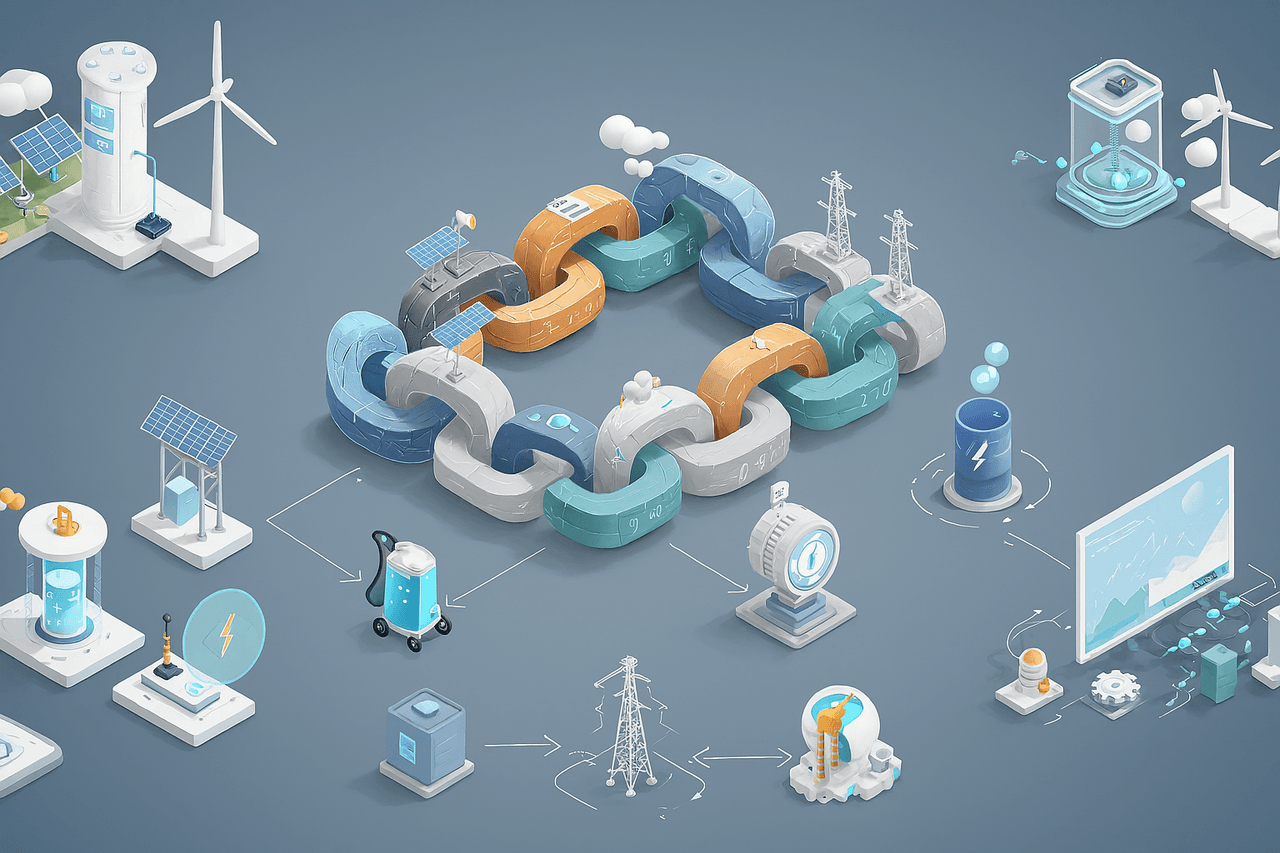
Energy Blockchain (generated with artificial intelligence)
Core Technology | Blockchain (Distributed Ledger Technology) | ||||||||
|---|---|---|---|---|---|---|---|---|---|
Primary Objective | To establish energy production, distribution, and trading processes in a decentralized transparent and secure structure. | ||||||||
Application Area(s) | Peer-to-peer energy trading renewable energy certification smart grid management carbon credit tracking electric vehicle charging. | ||||||||
Key Advantages | Transparency security efficiency cost reduction disintermediation. | ||||||||
Critical Challenge | Energy consumption (PoW) regulatory gaps scalability. | ||||||||
Energy-Efficient Model | Proof of Stake (PoS) consensus mechanism. | ||||||||
Energy blockchain applications refer to systems and platforms that use blockchain technology to make energy production, distribution, trading, and management more transparent, secure, and efficient. Blockchain is fundamentally a distributed ledger system that records transactions in a transparent, secure, and immutable manner without requiring a central authority. Originally introduced in 2008 by Satoshi Nakamoto as an infrastructure for cryptocurrencies, this technology has quickly demonstrated its potential to revolutionize numerous sectors including finance, healthcare, and logistics. The energy sector is also part of this transformation, with the potential to shift from its traditional centralized structure toward a more decentralized, democratic, and sustainable model.
The integration of blockchain technology into the energy sector has gained importance due to the increasing use of renewable energy sources, the growing adoption of distributed energy generation, and the pursuit of energy efficiency goals. While this technology faces criticism for some early-stage applications with high energy consumption—particularly those based on Proof of Work mining—it also draws attention by offering innovative solutions that support sustainability. Its ability to automate processes through smart contracts, enable peer-to-peer (P2P) energy trading, and ensure reliable tracking of green energy certificates makes blockchain a key technology for the future of the energy sector.
To understand the transformation brought by blockchain technology in the energy sector, it is necessary to examine its core features and how they are adapted to the industry. This technology offers the potential to eliminate inefficiencies, insecurities, and dependency on intermediaries in existing systems through structural innovations.
Decentralization: Traditional energy systems operate on a centralized structure where generation occurs in large power plants and energy is managed and delivered to consumers from a single central point. Blockchain, by contrast, provides a decentralized structure. Every participant (node) in the network holds a copy of the database, and data is not controlled by any single entity. This feature facilitates the integration of distributed energy sources such as consumers who install solar panels on their rooftops (prosumers) and reduces the role of intermediary institutions.
Transparency and Traceability: All transactions on the blockchain are recorded in a ledger visible to all network participants. This transparency enables verification of the origin of energy flows, trading activities, and certificates. For example, a consumer can trace transparently on the blockchain whether the electricity they purchased was genuinely generated from a renewable source. This helps prevent misleading marketing practices such as greenwashing.
Immutability and Security: Once a transaction is added to a block in the chain, it is cryptographically linked to the previous block. This structure makes it nearly impossible to alter or delete data after the fact. In the energy sector, this feature enhances trust in the system by preventing fraud and manipulation in billing, ownership records, and certificate trading.
Smart Contracts: Smart contracts are digital agreements that automatically execute pre-programmed actions when specific conditions are met. In the energy sector, smart contracts can automate energy purchase and sale agreements, billing, and payments. For instance, when an electric vehicle owner connects to a charging station, identity verification, charging, and payment can all be carried out automatically and without human intervention via a smart contract. This reduces transaction costs and increases efficiency.

Energy Blockchain Applications (Generated by artificial intelligence.)
Blockchain technology is offering innovative business models and solutions across different segments of the energy sector. These applications aim to make energy markets more competitive, efficient, and consumer-oriented.
One of the most notable applications of blockchain is peer-to-peer (P2P) energy trading. In this model, consumers who generate their own energy—for example, via rooftop solar panels—can sell surplus energy directly to neighbors or other consumers. The blockchain platform enables this trading securely and automatically through smart contracts, without the need for a central intermediary such as a traditional energy company. This encourages the formation of local energy markets, reduces losses in transmission lines, and promotes local renewable energy production.
In line with sustainability goals, documenting energy generated from renewable sources is of great importance. Documents such as the International Renewable Energy Certificate (I-REC) and carbon credits are used to verify the green origin of energy and offset carbon emissions. Blockchain provides transparency and security in the creation, tracking, and trading of these certificates. Each certificate or credit can be represented as a unique digital asset (token) on the blockchain. This prevents fraudulent practices such as double-spending and makes the entire process auditable. In Türkiye, Aksa Elektrik has emerged as one of the first companies to conduct I-REC trading via blockchain.
Smart grids are modern electrical networks that use digital technologies to balance energy supply and demand in real time. Microgrids are small-scale energy systems capable of operating independently within a specific geographic area. Blockchain can facilitate the management of these complex and distributed structures. By enabling secure real-time data sharing, it enhances grid flexibility, resolves supply-demand imbalances, and improves operational efficiency. It provides a reliable infrastructure for the seamless integration of distributed energy resources such as solar, wind, and battery storage into the grid.
As a requirement of the electrification era, the widespread adoption of electric vehicles necessitates efficient management of charging infrastructure. Blockchain can simplify EV charging processes by enabling seamless roaming and payment across charging stations operated by different providers. Smart contracts can be used to verify vehicle identity, measure energy consumption, and automate payments. Additionally, it enables the secure management of advanced scenarios such as vehicle-to-grid (V2G) energy transfer.
Blockchain can be used to track every stage of the journey of energy resources from production to the end user. This is particularly important for verifying the origin of resources such as natural gas or biomass. Furthermore, billing and payment processes can be fully automated through smart contracts. This reduces administrative costs, eliminates human error, and accelerates collection processes.
Although blockchain technology has been subject to debate due to its environmental impact, when properly implemented, it can be a powerful tool for achieving sustainable development goals. Its features of transparency, traceability, and efficiency enhancement make it a key ally in building a greener future.
Blockchain can reduce energy losses and waste in the grid by optimizing energy distribution and improving demand-side management. P2P trading models and microgrids encourage local production and consumption of energy, thereby reducing dependence on long-distance transmission lines and minimizing associated losses. Additionally, it makes renewable energy investments more attractive. By enabling direct participation of individual investors and communities in energy markets, it accelerates the transition to clean energy. The reliable marketplace it provides for carbon credits and green certificates incentivizes companies and individuals to reduce their carbon footprints and contributes concretely to the fight against climate change.
Several significant challenges hinder the widespread adoption of blockchain applications in the energy sector. Overcoming these challenges is critical to fully realizing the technology’s potential.
Energy Consumption Issue and Solutions: One of the main criticisms of blockchain technology is the high energy consumption of networks using Proof of Work (PoW) consensus mechanisms, such as Bitcoin. In this process, miners use intensive computational power to solve complex mathematical problems, which can reach levels exceeding the total energy consumption of some countries. However, this issue is being addressed as the technology evolves. Newer and more energy-efficient consensus mechanisms such as Proof of Stake (PoS) have been developed. For example, Ethereum’s transition to PoS reduced its energy consumption by over 99%. New-generation blockchains such as Algorand, Cardano, and Tezos have been designed from the outset with energy efficiency and sustainability as core principles.
Regulation and Legal Compliance: The energy sector is a highly regulated field due to reasons such as public safety and service continuity. Integrating new blockchain-based business models—such as P2P energy trading—into existing legal frameworks is a complex process. Regulatory authorities must establish clear rules and standards that understand and support these innovations to enable widespread adoption.
Scalability and Integration: The number of transactions per second (TPS) that blockchain networks can process is often lower than that of traditional financial systems. Overcoming scalability issues is essential to handle the real-time data generated by millions of devices and users in the energy sector. Technological advancements such as Layer-2 solutions aim to address this challenge. Additionally, integrating new blockchain platforms seamlessly with existing grid infrastructure and legacy systems remains a significant technical hurdle.
Aktaş, Derya. “Teknoloji İçin Çevre, Çevre İçin Teknoloji: Enerji Sektöründe Blok Zinciri Uygulamaları.” *Dokuz Eylül Üniversitesi Sosyal Bilimler Enstitüsü Dergisi* 24, no. Özel Sayı (2022): 267–285. Accessed July 15, 2025. https://doi.org/10.16953/deusosbil.1190387.
Aydem Enerji. "Blokzincir Teknolojisi & Sürdürülebilirlik." Aydem Enerji Blog. Accessed July 15, 2025. https://www.aydemenerji.com.tr/blog/236/blokzincir-teknolojisi-surdurulebilirlik/.
Blockchain Rehberi. "Enerji Sektöründe Blok Zinciri Uygulamaları." Accessed July 15, 2025. https://blockchainrehberi.com/enerji-sektorunde-blok-zinciri-uygulamalari/.
Blockchain Türkiye Platformu. "Enerji Sektöründe Blokzinciri Gelişmeleri." *BCTR*. Accessed July 15, 2025. https://bctr.org/dokumanlar/Enerji_Sektorunde_Blokzinciri_Gelismeleri.pdf.
Blockchain Türkiye Platformu. "Uzmanlar Blokzincirinin Enerji Sektörüne Yönelik Uygulamalarını Masaya Yatıracak." Accessed July 15, 2025. https://bctr.org/uzmanlar-blokzincirinin-enerji-sektorune-yonelik-uygulamalarini-masaya-yatiracak-24788/.
EY. "Blokzincir Teknolojisinin Sürdürülebilirliğe Etkisi." EY Türkiye. Accessed July 15, 2025. https://www.ey.com/tr_tr/insights/blockchain/blok-zincir-teknolojisinin-surdurulebilirlige-etkisi.
Hoffman, Evelyne. “Blokzinciri Teknolojisini Sürdürülebilir Hale Nasıl Getirirsiniz.” *WINS Solutions.* Accessed July 15, 2025. https://www.winssolutions.org/tr/blokzinciri-teknolojisini-surdurulebilir-hale-nasil-getirirsiniz/.
KPMG Türkiye. “Uzmanlar Blok Zincirinin Enerji Sektörüne Yönelik Uygulamalarını Masaya Yatıracak.” Accessed July 15, 2025. https://kpmg.com/tr/tr/home/medya/press-releases/2021/12/blok-zincirinin-enerji-sektorundeki-uygulamalari-masaya-yatirilacak.html.
Terzioğlu, Cihad. “Küresel Enerji Sorununa Bir Çözüm Önerisi: Dijitalizasyon ve Blokzincir Teknolojisi.” *Kriter Dergi*, no. 68 (Mayıs 2022). Accessed July 15, 2025. https://kriterdergi.com/dosya-enerjide-donusum/kuresel-enerji-sorununa-bir-cozum-onerisi-dijitalizasyon-ve-blokzincir-teknolojisi.
Çelik, Mustafa. “Sürdürülebilir Tedarik Zinciri için Blokzincir Teknolojisi.” *Yeşil Büyüme.* Accessed July 15, 2025. https://yesilbuyume.org/surdurulebilir-tedarik-zinciri-icin-blokzincir-teknolojisi/.

Energy Blockchain (generated with artificial intelligence)
Core Technology | Blockchain (Distributed Ledger Technology) | ||||||||
|---|---|---|---|---|---|---|---|---|---|
Primary Objective | To establish energy production, distribution, and trading processes in a decentralized transparent and secure structure. | ||||||||
Application Area(s) | Peer-to-peer energy trading renewable energy certification smart grid management carbon credit tracking electric vehicle charging. | ||||||||
Key Advantages | Transparency security efficiency cost reduction disintermediation. | ||||||||
Critical Challenge | Energy consumption (PoW) regulatory gaps scalability. | ||||||||
Energy-Efficient Model | Proof of Stake (PoS) consensus mechanism. | ||||||||
Henüz Tartışma Girilmemiştir
"Energy Blockchain Applications" maddesi için tartışma başlatın
Key Features and Impact on the Energy Sector
Application Areas
Peer-to-Peer (P2P) Energy Trading
Renewable Energy Certificates and Carbon Credits
Smart Grids and Microgrids
Electric Vehicle (EV) Charging Infrastructure
Supply Chain Management and Billing Automation
Blockchain Technology’s Contribution to Sustainability
Challenges and Future Outlook