


This article was automatically translated from the original Turkish version.
+3 More
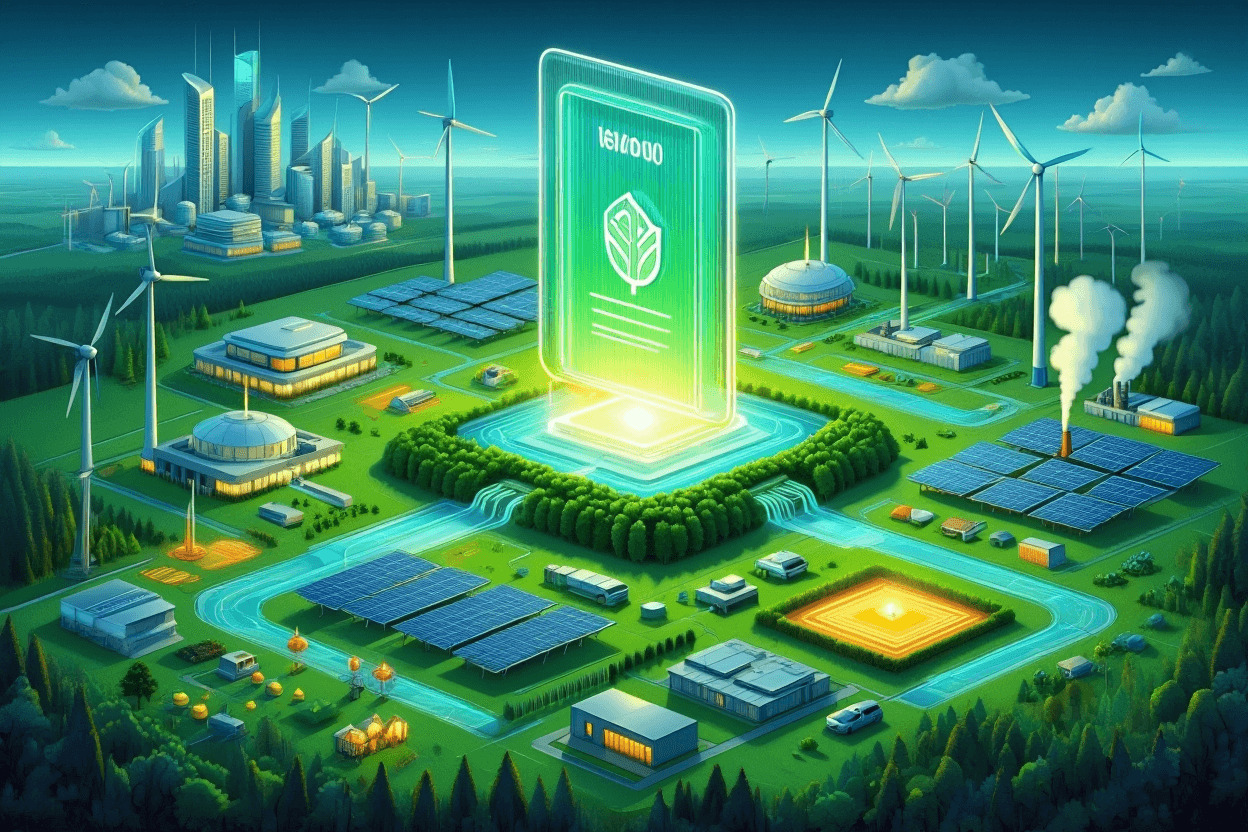
Green Energy Certificate (Generated with Artificial Intelligence)
Base Unit | 1 MWh of renewable electricity generation | ||||||||
|---|---|---|---|---|---|---|---|---|---|
Purpose(s) | To document that the consumed electricity was generated from renewable sources | ||||||||
International Standard | I-REC (International Renewable Energy Certificate) | ||||||||
Türkiye National System | YEK-G (Renewable Energy Resources Guarantee System) | ||||||||
Relevant Emission Scope | Typically Scope 2 (Purchased electricity) | ||||||||
Other Types | Gold Standard, VCS (Carbon Reduction Certificates) | ||||||||
A Green Energy Certificate is a market-based mechanism that officially documents that a specific amount of electricity (typically one megawatt-hour – MWh) has been generated from renewable energy sources. These certificates enable consumers to claim that the energy they use originates from renewable sources, even if the electricity they physically draw from the grid comes from different sources. In this way, certificates contribute to reducing the environmental impact of energy consumption while also serving as a regulatory tool that ensures transparency and reliability in energy markets.
The system provides detailed documentation of the origin of electricity produced from renewable sources, tracks the balance between production and consumption, and makes reporting processes subject to oversight. In this capacity, it not only provides assurance regarding environmental sustainability but also establishes a binding link between consumers and producers concerning quality. Since Green Energy Certificates are recognized as market instruments at both national and international levels, they can also be used in cross-border energy trade.
Energy sources are generally divided into two main categories: renewable and non-renewable. Non-renewable energy sources include fossil fuels such as oil, coal, and natural gas. These resources are known to pose problems for sustainable energy policies due to their limited reserves, negative environmental impacts, and contribution to climate change. In contrast, sources such as solar, wind, water (hydropower), geothermal, and biomass, which continuously regenerate in nature and have low carbon emissions, are classified as green energy.
Green Energy Certificates function as a verification mechanism that proves the use of electricity generated from such renewable sources and holds international validity. Thus, they incentivize producers of environmentally friendly energy and provide official support for consumers’ preferences to reduce their carbon footprint. In this context, certificates are not only economic instruments in energy markets but also tools directly linked to sustainable development goals.
Green energy certificates transform the environmental attribute of renewable energy production into an independent market instrument by separating it from the physical electricity. The core purpose of this system is to allow consumers to associate their consumption with renewable energy even if they do not directly receive renewable electricity from the grid, thereby contributing to environmental benefits.
The process consists of several stages. First, a renewable energy generation facility – such as a wind turbine, solar power plant, biomass facility, or hydroelectric dam – produces and delivers electricity to the national power grid. For each megawatt-hour (MWh) of electricity generated, an electronic certificate is issued by an authorized national or international certification body. These certificates are recorded with a unique serial number and contain detailed information about the generation facility, including its name, geographic location, type of energy source used (e.g., wind, solar, geothermal), and the date of production.
The producer sells the physical electricity delivered to the grid under normal market conditions, while the certificates are offered separately as a distinct value commodity on the market. These certificates can be sold to companies through energy suppliers or directly to individual consumers. This process is also known as “sale of green energy rights.” By purchasing these certificates, the buyer accounts for their electricity consumption as being balanced by renewable energy.
When the certificate purchaser – whether a company or an individual – acquires a quantity of green energy certificates equivalent to their annual or monthly electricity consumption, those certificates are marked as “redeemed” in the certificate registry system. This removes the certificates from circulation and prevents them from being sold multiple times or re-claimed by different users. This mechanism is one of the most critical elements ensuring transparency and reliability in the system.
At this point, it is important to clarify a common misconception: purchasing a green energy certificate does not alter the physical flow of electricity. The power grid functions as a large pool where electricity from fossil fuels, nuclear, and renewable sources is mixed. Therefore, a consumer cannot control the exact source of the electricity they draw. However, the certificate provides documented proof that a portion of the electricity consumed from this pool was generated from renewable sources. This arrangement supports the financial viability of renewable energy producers, enables companies or individuals to meet their carbon reduction targets, and facilitates transparent reporting of energy consumption. Ultimately, green energy certificates serve both as a market-based environmental policy instrument and as an internationally recognized verification mechanism for sustainability strategies.
Corporate carbon footprint calculations are classified according to international standards to transparently reveal businesses’ environmental impacts. The most widely used framework is the Greenhouse Gas Protocol developed by the World Resources Institute (WRI) and the World Business Council for Sustainable Development (WBCSD). This protocol categorizes greenhouse gas emissions into three scopes. Green Energy Certificates are recognized as a key tool, particularly for managing Scope 2 emissions.
Scope 1 includes direct greenhouse gas emissions released into the atmosphere from sources owned or controlled by the company. Examples include fossil fuels burned in boilers at production facilities, exhaust emissions from company-owned vehicles, and fugitive emissions from refrigeration and air conditioning systems. These emissions are the most straightforward to measure and manage because they are under direct control.
Scope 2 encompasses indirect emissions resulting from the electricity purchased by an organization. The most common example is emissions generated during the production of grid-supplied electricity. When this electricity is derived from fossil fuels, it contributes significantly and indirectly to the company’s carbon footprint. Green Energy Certificates (such as the International Renewable Energy Certificate – I-REC or Turkey’s Renewable Energy Source Guarantee System – YEK-G) officially document that the electricity consumed by companies originates from renewable sources. Through this mechanism, companies can account for and substantially reduce or even zero out their Scope 2 emissions. As a result, they can report lower carbon footprints in sustainability reports and align with climate targets.
Scope 3 includes all other indirect emissions occurring in the value chain but outside the company’s direct control. This category is broad and encompasses emissions from the production of goods and services purchased from suppliers, employee commuting, product distribution, use of services, and waste disposal. Typically, this category represents the largest share of a company’s carbon footprint, yet it is also the most challenging to calculate and manage.
Although Green Energy Certificates are primarily used to manage Scope 2 emissions, they are also considered alongside carbon reduction certificates (such as Gold Standard or Verified Carbon Standard – VCS) within broader climate strategies. Carbon reduction certificates can be used to offset emissions in both Scope 1 and Scope 2. Thus, companies can not only balance the environmental impact of the electricity they purchase but also develop compensation mechanisms for emissions arising from their direct operations. In this context, Green Energy Certificates and carbon reduction certificates are regarded as integral components of corporate sustainability strategies aligned with international climate policies.
In global energy markets and local regulations, various green energy certification systems have been developed to meet diverse needs. These certificates document the origin of electricity generated from renewable sources and play a significant role in implementing carbon reduction policies and sustainability reporting. Each system may differ in scope, validity area, reporting standard, and market operation.
I-REC (International Renewable Energy Certificate) is an international standard established in 2014 to serve countries lacking well-established certification systems such as RECs (Renewable Energy Certificates) in North America or GOs (Guarantees of Origin) in Europe. Managed by the International REC Standard Foundation, this system issues one Energy Attribute Certificate (EAC) for every 1 megawatt-hour (MWh) of renewable electricity generated.
These certificates contain transparent information on the source of generation (wind, solar, hydropower, biomass, geothermal), the name and geographic location of the generation facility, and the date of production. I-REC is widely used by companies for reporting Scope 2 emissions and is recognized as one of the internationally accepted systems. In Türkiye, FOTON Enerji is the local administrator of the I-REC standard. As of 2021, the installed capacity registered under the I-REC system in Türkiye was distributed as follows: 1,862 MW in hydropower plants, 630 MW in solar power plants, 463 MW in geothermal sources, 295 MW in wind energy, and 132 MW in biomass. This distribution highlights the diversity of Türkiye’s renewable energy portfolio included in the certification system.
YEK-G is Türkiye’s national green energy certification system, developed by the Energy Market Regulatory Authority (EPDK) and launched on June 1, 2021. The market operator of the system is Energy Markets Operation Inc. (EPİAŞ).
Based on a voluntary principle, YEK-G uses blockchain technology to enable transparent tracking of the entire process from renewable energy production to consumption. This technology enhances the reliability of certificates and prevents duplicate registrations. The YEK-G document, like I-REC, certifies 1 MWh of renewable electricity production and can be used for reporting Scope 2 emissions. However, these certificates have a limited validity period: documents not used within 12 months from the date of production become invalid.
YEK-G’s alignment with European Union standards is seen as a factor that will help Türkiye gain a more advantageous position in international trade against carbon regulations, such as the EU’s Carbon Border Adjustment Mechanism.
In addition to green energy certificates, there are other types of certificates designed not to document renewable electricity consumption but to reduce or remove greenhouse gas emissions from the atmosphere. These are generally measured in metric tons of carbon dioxide equivalent (tCO₂e) and are obtained from carbon offset projects.
Green Energy Certificates are market-based mechanisms that promote the expansion of renewable energy sources, support global efforts to reduce carbon emissions, and serve as essential tools for companies and individuals in their sustainability strategies. These certificates not only contribute to achieving environmental goals but also provide various economic and corporate advantages.
One of the primary functions of Green Energy Certificates is to create an economic incentive mechanism to reduce dependence on fossil fuels. Through these certificates, renewable energy production receives financial support, thereby contributing to the reduction of greenhouse gas emissions. This makes them a concrete tool in the global fight against climate change. Companies and individuals can reduce their carbon footprints by associating their energy consumption with green energy and act in alignment with international climate targets.
Companies that document their use of green energy send a strong message about their environmental awareness. This fosters a positive perception among customers, investors, business partners, and regulatory bodies. Transparent reporting of environmental performance strengthens corporate social responsibility strategies and enhances brand value. Moreover, in today’s market, where sustainability-focused investments are increasingly important, such certifications reinforce the long-term credibility of businesses.
Sustainability criteria are becoming increasingly decisive in international trade. Regulations such as the European Union’s Green Deal policies and the Carbon Border Adjustment Mechanism require compliance with environmental criteria throughout supply chains. In this context, Green Energy Certificates have become tools that facilitate market access and provide competitive advantage for companies. Many international firms now require their suppliers to use renewable energy, and certificates serve as the official and reliable method to meet this demand.
Green Energy Certificates enable companies to document their environmental performance in accordance with national and international reporting standards. Companies can use these certificates as evidence when participating in global initiatives such as CDP (Carbon Disclosure Project), GRI (Global Reporting Initiative), SPK sustainability reports, or RE100. This transparency not only enhances stakeholder trust but also supports the company’s climate commitments with verifiable data.
One of the economic functions of Green Energy Certificates is to provide additional income to renewable energy producers. Revenue from certificate sales creates a funding source for new investments and accelerates the implementation of clean energy projects such as wind, solar, biomass, or geothermal. Thus, the system not only delivers environmental benefits to consumers but also contributes to the structural transformation of the energy sector.
As the global energy transition accelerates, the importance of Green Energy Certificates is expected to grow further. The goals of the Paris Agreement, the European Union’s Green Deal initiatives, the Carbon Border Adjustment Mechanism, and corporate net-zero commitments are transforming these certificates from voluntary tools into essential components of energy and trade policies.
In the future, many countries will expand carbon pricing systems (carbon taxes or emissions trading schemes). Green Energy Certificates can be integrated into these mechanisms to help businesses reduce the carbon intensity of their energy consumption. This enables companies to lower carbon costs and comply with international regulations.
Particularly, the European Union’s Carbon Border Adjustment Mechanism (CBAM), to be implemented progressively from 2026, will impose additional costs on imports of high-carbon-intensity products. In this context, Green Energy Certificates can serve as an important compliance tool for exporters to reduce their carbon footprint. For export-dependent economies like Türkiye, systems such as YEK-G and I-REC hold strategic value.
Many companies worldwide are developing strategies to achieve a net-zero carbon target by 2050. To meet these goals, companies focus on reducing Scope 1 and Scope 2 emissions, but in the short term, they rely on Green Energy Certificates for areas where direct emission reductions are not yet feasible. Thus, certificates are becoming a verifiable and accountable component of net-zero commitments.
With the advancement of blockchain-based monitoring systems, tracking of Green Energy Certificates will become more reliable and transparent. This will reduce the risk of duplicate registrations and enhance the credibility of certificates in international markets. In the future, digital infrastructure will enable faster transfer and real-time verification of certificates.
Green Energy Certificates are increasingly playing a role in investor decision-making. International funds and financial institutions require the companies they invest in to meet sustainability criteria and demand certification of green energy use as part of their evaluation process. This trend will lead to stronger integration with green finance and sustainable investment markets in the coming years.
The use of Green Energy Certificates has grown rapidly in recent years, both globally and in Türkiye. This development is directly linked to the expansion of renewable energy investments, the increasing mandatory nature of international reporting standards, and the widespread adoption of carbon regulations in trade.
The most widely used systems in the global market include the European Union’s Guarantees of Origin (GOs), Renewable Energy Certificates (RECs) in North America, and the international I-REC Standard. In Europe, the GOs market certifies hundreds of millions of MWh of renewable electricity annually. According to 2023 data, approximately 900 TWh of electricity in Europe alone was certified through GOs. In North America, the RECs market has become a critical tool, especially for large technology companies seeking to balance their energy consumption. I-REC has rapidly expanded in regions such as Asia, the Middle East, Africa, and Latin America, where official certification mechanisms previously did not exist, contributing to the standardization of global renewable energy tracking.
Türkiye launched its national green energy certification mechanism, YEK-G (Renewable Energy Source Guarantee System), in 2021. Operated by Energy Markets Operation Inc. (EPİAŞ), this system has grown rapidly in 2022 and 2023, increasing transaction volumes through voluntary participation by numerous energy producers and suppliers. YEK-G’s blockchain-based structure has enhanced the reliability and transparency of certificates.
The trading volume of Green Energy Certificates, both in Türkiye and globally, affects not only the energy sector but also export-oriented firms and financial institutions. The tightening of sustainability standards in international markets indicates that Green Energy Certificates will no longer be a voluntary choice but a mandatory requirement for competitiveness. For companies operating in carbon-intensive sectors, the use of these certificates will serve as a cost-reducing and market-access-enabling function.
Green Energy Certificates are not merely voluntary environmental practices; they are also recognized as tools directly linked to international reporting and sustainability standards. These standards, adopted by corporate entities, investors, and regulatory authorities, enable the use of Green Energy Certificates as verifiable evidence.
CDP is one of the world’s leading environmental reporting platforms. Companies can use Green Energy Certificates to demonstrate reductions in Scope 2 emissions when reporting their carbon footprint and climate strategies. Documenting green energy consumption in CDP reports transparently demonstrates a company’s commitment to combating climate change.
GRI standards are among the most widely used frameworks for corporate sustainability reporting. These standards require companies to provide detailed information on energy consumption, greenhouse gas emissions, and renewable energy use. Green Energy Certificates are accepted as official documentation to verify renewable energy consumption in GRI reports.
SBTi is an international initiative that helps companies set emission reduction targets based on scientific criteria. Within this initiative, reducing Scope 2 emissions is critical. Green Energy Certificates are among the primary tools used to prove that electricity is sourced from renewable sources and to help companies achieve their targets.
RE100 is an initiative in which large global companies commit to sourcing 100% of their electricity consumption from renewable sources. Companies participating in this initiative use Green Energy Certificates to document the source of their energy and independently verify their commitments.
International investors, particularly when evaluating environmental, social, and governance (ESG) criteria, regard green energy use and its certification as a significant indicator. Therefore, Green Energy Certificates are increasingly linked with sustainable investment funds and green bond markets.
Bjørn, Anders, Shannon M. Lloyd, Matthew Brander, et al. “Renewable Energy Certificates Threaten the Integrity of Corporate Science-Based Targets.” *Nature Climate Change* 12 (2022): 539–46. doi:10.1038/s41558-022-01379-5. Accessed August 23, 2025. https://doi.org/10.1038/s41558-022-01379-5
Cali, Umit, Murat Kuzlu, Manisa Pipattanasomporn, Onur Elma, and Ramesh Reddi. “Cybersecurity of Renewable Energy Data and Applications Using Distributed Ledger Technology.” *arXiv*, 2021. Preprint. Accessed August 23, 2025. https://arxiv.org/abs/2110.11354
EPA. "Renewable Energy Certificates (RECs)." U.S. Environmental Protection Agency. Accessed August 23, 2025. https://www.epa.gov/green-power-markets/renewable-energy-certificates-recs
Huang, Zhihong, Ye Guo, Qiuwei Wu, Li Xiao, and Hongbin Sun. “A Multiple Market Trading Mechanism for Electricity, Renewable Energy Certificate and Carbon Emission Right of Virtual Power Plants.” *arXiv*, 2022. Preprint. Accessed August 23, 2025. https://arxiv.org/abs/2208.03952
Langer, Lissy, Matthew Brander, Shannon M. Lloyd, Dogan Keles, H. Damon Matthews, and Anders Bjørn. “Does the Purchase of Voluntary Renewable Energy Certificates Lead to Emission Reductions? A Review of Studies Quantifying the Impact.” SSRN, November 30, 2023, last revised May 15, 2024. doi:10.2139/ssrn.4636218. Accessed August 23, 2025. https://dx.doi.org/10.2139/ssrn.4636218
Resource Solutions. "Renewable Energy Certificates (RECs)." Center for Resource Solutions. Accessed August 23, 2025. https://resource-solutions.org/learn/recs/
Shrivats, Arvind, and Sebastian Jaimungal. “Optimal Behaviour in Solar Renewable Energy Certificate (SREC) Markets.” *arXiv*, 2020. Preprint. Accessed August 23, 2025. https://arxiv.org/abs/1904.06337
Stede, Jan, et al. *The Role of Energy Attribute Certificates in Emission Accounting and Energy Transitions*. NewClimate Institute, October 2024. Accessed August 23, 2025. https://newclimate.org/sites/default/files/2024-10/NewClimate_RoleOfEACs_Oct24_1.pdf

Green Energy Certificate (Generated with Artificial Intelligence)
Base Unit | 1 MWh of renewable electricity generation | ||||||||
|---|---|---|---|---|---|---|---|---|---|
Purpose(s) | To document that the consumed electricity was generated from renewable sources | ||||||||
International Standard | I-REC (International Renewable Energy Certificate) | ||||||||
Türkiye National System | YEK-G (Renewable Energy Resources Guarantee System) | ||||||||
Relevant Emission Scope | Typically Scope 2 (Purchased electricity) | ||||||||
Other Types | Gold Standard, VCS (Carbon Reduction Certificates) | ||||||||
No Discussion Added Yet
Start discussion for "Green Energy Certificates" article
How Green Energy Certificates Work
Scope of Greenhouse Gas Emissions and the Role of Certificates
Scope 1 Emissions (Direct Emissions)
Scope 2 Emissions (Indirect Energy Emissions)
Scope 3 Emissions (Other Indirect Emissions)
Types of Green Energy Certificates
International Renewable Energy Certificate (I-REC)
Renewable Energy Source Guarantee System (YEK-G)
Carbon Reduction Certificates
Importance and Benefits of Green Energy Certificates
Environmental Responsibility and Sustainability
Corporate Reputation and Brand Value
Market Access and Competitive Advantage
Transparency and Reporting
Support for Renewable Energy Investments
The Future Role of Green Energy Certificates
Carbon Pricing and Policy Alignment
International Trade and Carbon Border Regulations
Corporate Net-Zero Strategies
Digitalization and Transparency
Directing Investments
Development of Green Energy Certificates in Türkiye and Globally
Global Development
Current Situation in Türkiye
Future Market Direction
Integration of Green Energy Certificates with International Reporting Standards
CDP (Carbon Disclosure Project)
GRI (Global Reporting Initiative)
SBTi (Science Based Targets Initiative)
RE100 Initiative
Financial Reporting and Investor Demands