


Bu içerik Türkçe olarak yazılmış olup yapay zeka ile otomatik olarak İngilizceye çevrilmiştir.
+1 Daha
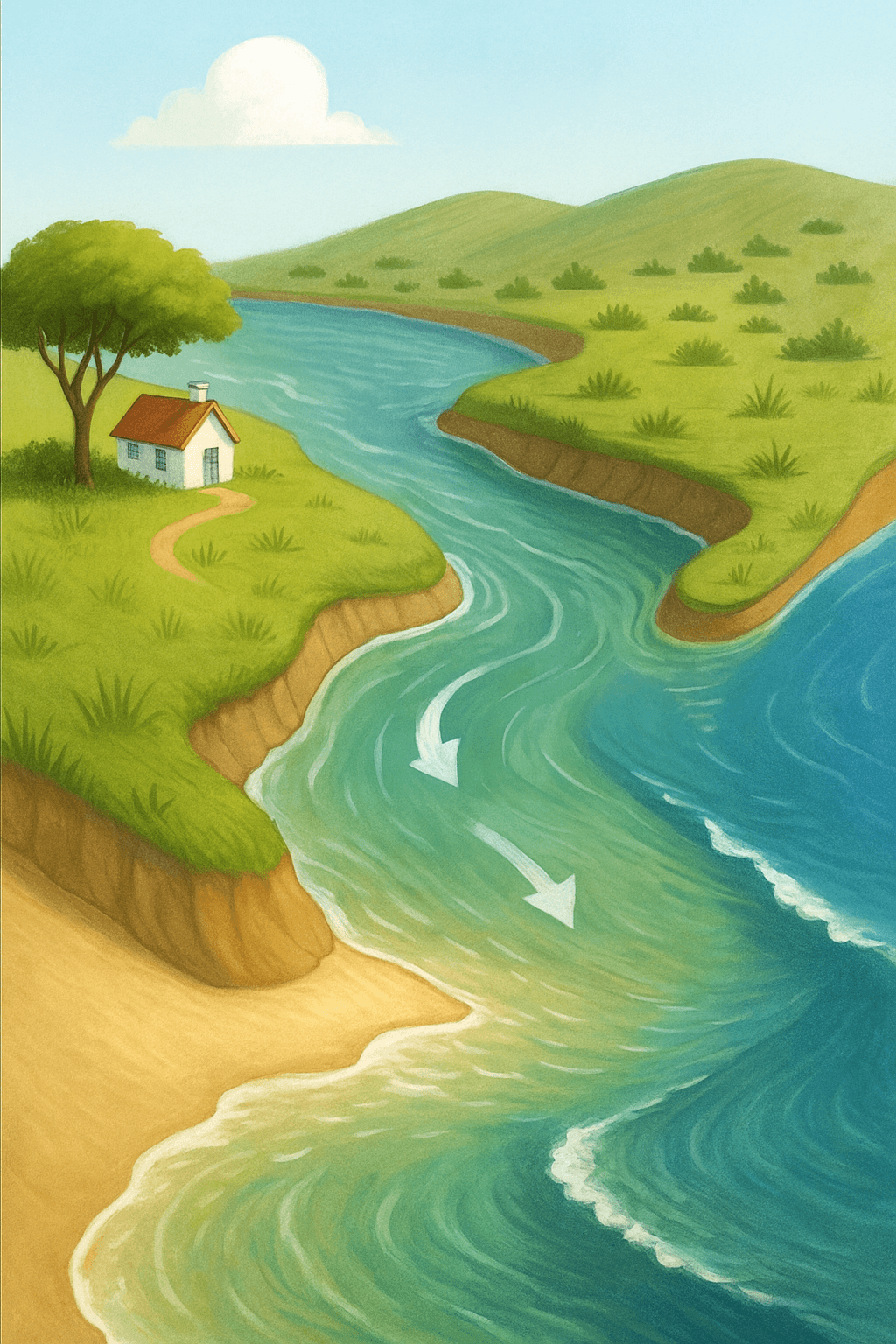
Yapay Zeka İle Oluşturulmuştur.
A estuary is a partially enclosed, complex water body located where a river or stream meets the sea. These environments, formed by the mixing of freshwater and saltwater, are hydrographically characterized by alkaline water and biologically represent rich and dynamic transition zones. Estuaries hold significant ecological importance due to their possession of characteristics from both terrestrial and marine systems. Throughout history, they have also been attractive areas for coastal communities for transportation, trade, and settlement.
The formation of estuaries is largely associated with sea level rises following the Holocene epoch. As the last ice ages ended, melting glaciers caused a global rise in sea level. This rise advanced inland, submerging former river channels and creating broad, shallow basins along coastlines. Such submerged valley systems are known as "rias-type estuaries." A classic example of this process is the gradual inundation of low-gradient coastal plains by saltwater, particularly in regions with vast freshwater basins such as the Rio de la Plata.
In addition, estuaries can form through the following mechanisms:
In these processes, the alluvium carried by rivers shapes the estuary floor, leading to gradual changes in its physical structure.

Estuary Formation (Generated by Artificial Intelligence)
Estuaries are typically found along open seas and ocean coasts, where the fundamental physical and hydrographic conditions enabling their formation exist. Particularly along open-sea coasts with strong tidal movements, the mixing of freshwater from rivers and saltwater from the sea is facilitated. Tides enable saltwater to move upstream toward the river mouth while simultaneously allowing freshwater to flow seaward. In Türkiye, however, coastal basins where rivers discharge are more commonly characterized by alluvial plains such as Çukur Ova. The primary reason for this is the weak tidal influence along Türkiye’s coastlines.
Moreover, ocean coasts are generally low-lying areas where large river basins meet the sea. Historically, rising sea levels caused these river valleys to be flooded and transformed into estuaries. Major systems such as the Rio de la Plata, Amazon, and Mississippi are classic examples of this formation. The vast area, depth, and climatic variability offered by open oceans provide favorable conditions for estuary formation and persistence. Therefore, estuaries appear in their most developed ecological and morphological forms along ocean coasts.
The most distinctive feature of estuaries is the presence of vertical and horizontal salinity gradients. Saltwater from the sea, being denser, flows along the bottom, while freshwater from rivers flows seaward at the surface. This creates a structure known as a salt wedge. This structure is especially pronounced in estuaries formed by rivers with low tidal influence but high discharge. The Rio de la Plata Estuary is one of the most developed examples of this formation. This vertical stratification directly affects the distribution of organisms such as plankton and fish larvae.
Estuaries can also be continuously mixed or periodically stratified due to meteorological influences such as wind and currents. This variability is of great importance for nutrient cycling and biological productivity. For instance, the San Francisco Estuary experiences periods of ecological stress when reduced river flow and high salinity lead to diminished mixing.
Organic matter production in estuaries is sustained by two primary sources: phytoplankton production and terrestrial detritus. Due to high turbidity, photosynthesis may be limited in inner areas, making organic detritus and microplankton dominant. Zooplankton species developing in this environment serve as a critical food source for fish larvae.

Estuary Formation (Generated by Artificial Intelligence)
In large estuaries such as the Rio de la Plata, economically valuable fish species such as Micropogonias furnieri spawn and rear their young within the estuary. In the San Francisco Estuary, however, reduced flow due to agriculture, dams, and water diversion systems has led to the collapse of pelagic food webs and dramatic declines in certain fish populations.
Estuaries are continuously altered by both natural and anthropogenic influences. Interventions such as dam construction, agricultural irrigation systems, waste discharge, and the introduction of invasive species—observed notably in the San Francisco Estuary—have disrupted both the physical structure and ecological functioning of estuarine systems. As a result:
This situation underscores the need to protect estuaries and highlights the importance of sustainable water management policies for these transitional systems.
Estuaries are not merely transition zones between water bodies; they are also interfaces where climate, geology, hydrology, and biology interact. Their formation is the result of both natural processes and historical geological stages. However, these systems are highly sensitive to human intervention. Preserving the healthy functioning of estuaries in the future requires integrated coastal management, reduction of pollutant loads, and the maintenance of natural flow regimes.
Acha, E. Marcelo, Hermes Mianzan, Raúl Guerrero, José Carreto, Diego Giberto, Norma Montoya, and Mario Carignan. “An Overview of Physical and Ecological Processes in the Rio de la Plata Estuary.” *Continental Shelf Research* 28, no. 13 (2008): 1579–1588. Accessed June 24, 2025. https://doi.org/10.1016/j.csr.2007.01.031
NEEF. "What Is an Estuary?" National Environmental Education Foundation. Accessed June 24, 2025. https://www.neefusa.org/story/water/what-estuary.
Nichols, Frederic H., James E. Cloern, Samuel N. Luoma, and David H. Peterson. “The Modification of an Estuary.” *Science* 231, no. 4738 (1986): 567–573. Accessed June 24, 2025. https://www.science.org/doi/10.1126/science.231.4738.567
Nugent, Thomas. “O2445: Broadmeadow Estuary from the Air JPG.” *Geograph.* Accessed June 24, 2025. https://www.geograph.ie/photo/5988010

Yapay Zeka İle Oluşturulmuştur.
Henüz Tartışma Girilmemiştir
"Haliç (Geography)" maddesi için tartışma başlatın
Formation Process
Physical and Chemical Properties
Biological Evolution and Ecosystem
Human Impacts