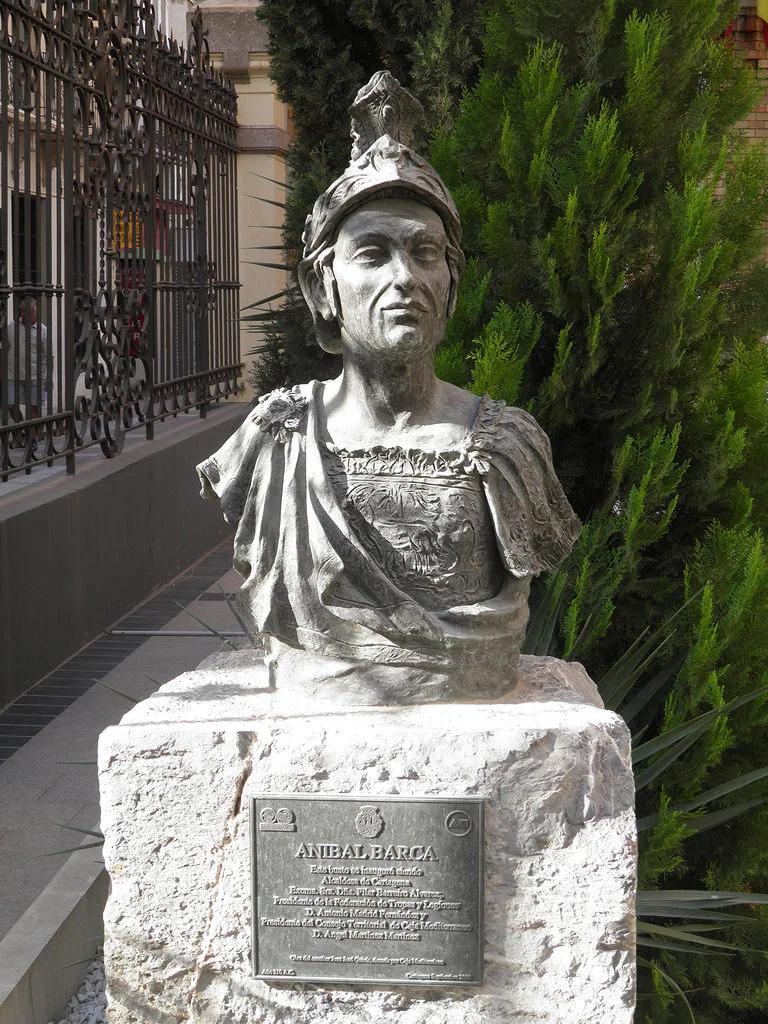

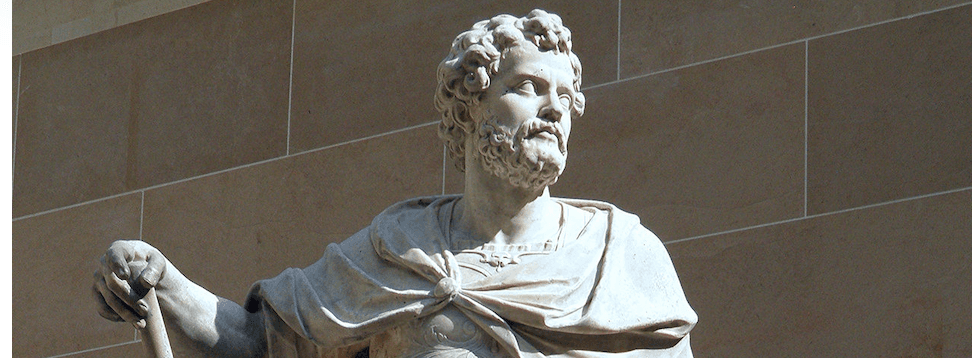
+2 Daha

Hannibal Barca, a Carthaginian commander, statesman, and military strategist, holds a pivotal place in ancient warfare history due to his campaigns against the Roman Republic, particularly his crossing of the Alps with his army and his adapted military tactics to diverse geographical conditions.
The name Hannibal derives from the Phoenician (Carthaginian) term Han-baal, meaning "the grace of Baal" or "beloved of Baal." The family epithet "Barca" (Barka), borne by his lineage, means "thunderbolt" in Semitic languages.【1】 This epithet was bestowed upon his father, the general Hamilcar Barca, in recognition of his rapid and sudden military maneuvers during the First Punic War (264–241 BCE).
Hannibal belonged to the Barcid (Barkas) family, one of Carthage’s leading military and political dynasties. Modern historiography recognizes the Barcid dynasty as pursuing an expansionist strategy in the western Mediterranean, particularly in Iberia, in contrast to Carthage’s traditional African-centered policies, and as continuing its geopolitical rivalry with Rome.【2】 This family tradition formed the foundation of Hannibal’s military policies after assuming command.
Hannibal was born in Carthage in 247 BCE. Shortly after his birth, Carthage lost the First Punic War (264–241 BCE), ceding Sicily to Rome and agreeing to heavy war reparations. A financial crisis ensued, leaving Carthage unable to pay its mercenary soldiers, which triggered a devastating civil war known as the Mercenary War (240–238 BCE). The Roman Republic exploited Carthage’s weakened state to annex Sardinia and Corsica.
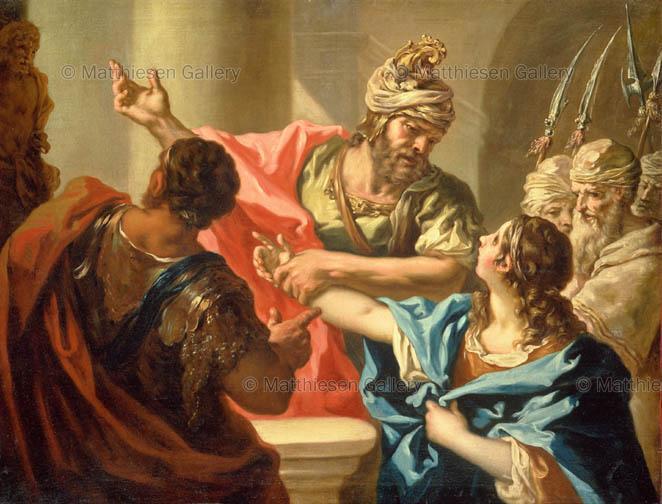
The Young Hannibal Swears Enmity to Rome (Matthiesen Gallery)
The supreme commander Hamilcar Barca decided to launch expeditions into Iberia (Hispania) to rebuild Carthage’s lost economic power, especially its silver mines, and its military manpower away from Roman interference. According to records by Polybius and Titus Livius, before marching into Iberia around 237 BCE, Hamilcar conducted a sacrificial ritual at the temple of the chief god Baal (or Melqart). He summoned his nine-year-old son Hannibal to the altar, placed his hand on the sacrificed animal, and compelled him to swear an oath to never be a friend to Rome for the rest of his life.【3】
This childhood oath is regarded as the foundation of Hannibal’s entire political and military strategy. After being taken to Iberia, he spent his formative years in military camps. He received his basic military training from his father and also studied Hellenistic culture and Greek under instructors such as the Spartan Sosylus.
In 228 BCE, Hamilcar Barca died during a campaign against the local Oretani tribes in Iberia. Ancient sources report that while leading his troops and his sons Hannibal and Hasdrubal to a safe region, he drowned in a river (either the Jucar or the Tajo). After his father’s death, command of the Carthaginian forces in Iberia passed to Hamilcar’s son-in-law, Hasdrubal. Between 228 and 221 BCE, Hannibal served under his brother-in-law Hasdrubal, assuming command of the cavalry units and gaining military experience. Hasdrubal’s tenure focused less on military operations and more on diplomatic alliances and the construction of Carthago Nova (New Carthage) as a logistical center. Hannibal actively participated in these administrative processes.
In 221 BCE, following the assassination of Hasdrubal by an Iberian tribesman, the twenty-six-year-old Hannibal was proclaimed supreme commander by the army, a decision later ratified by the Carthaginian Senate. Over the next two years (221–220 BCE), he consolidated Carthaginian holdings in Iberia and completed conquests south of the Ebro River. In his first campaign, he attacked Alithia, the principal center of the Olcades tribe, forcing their immediate surrender.
In 220 BCE, he launched a subsequent campaign against the Vaccaei tribe in the west, capturing the fortresses of Helmantice and Arbucala. On his return, his army, laden with spoils, was attacked by a coalition led by the Carpetani tribe. In the battle known as the Battle of the Tagus River, Hannibal crossed his troops to the opposite bank of the river, forcing the enemy to follow and ambushing them, securing his first major field victory as supreme commander. During this period, to strengthen diplomatic ties, he married Imilce, the princess of Castulo in the Oretani region.
As Hannibal’s power in Iberia grew, the Roman Republic formed a protective alliance with the city of Saguntum, located south of the Ebro River. Hannibal viewed this move as a violation of the Ebro Treaty, which had defined boundaries during Hasdrubal’s time. After subduing local tribes, he launched a military campaign against Saguntum in 219 BCE. He rejected Roman envoys and diplomatic warnings demanding the siege be lifted. After an eight-month siege, he captured Saguntum and seized its resources. Saguntum’s fall led the Carthaginian council to reject Rome’s demand to hand over Hannibal, paving the way for Rome’s formal declaration of the Second Punic War.
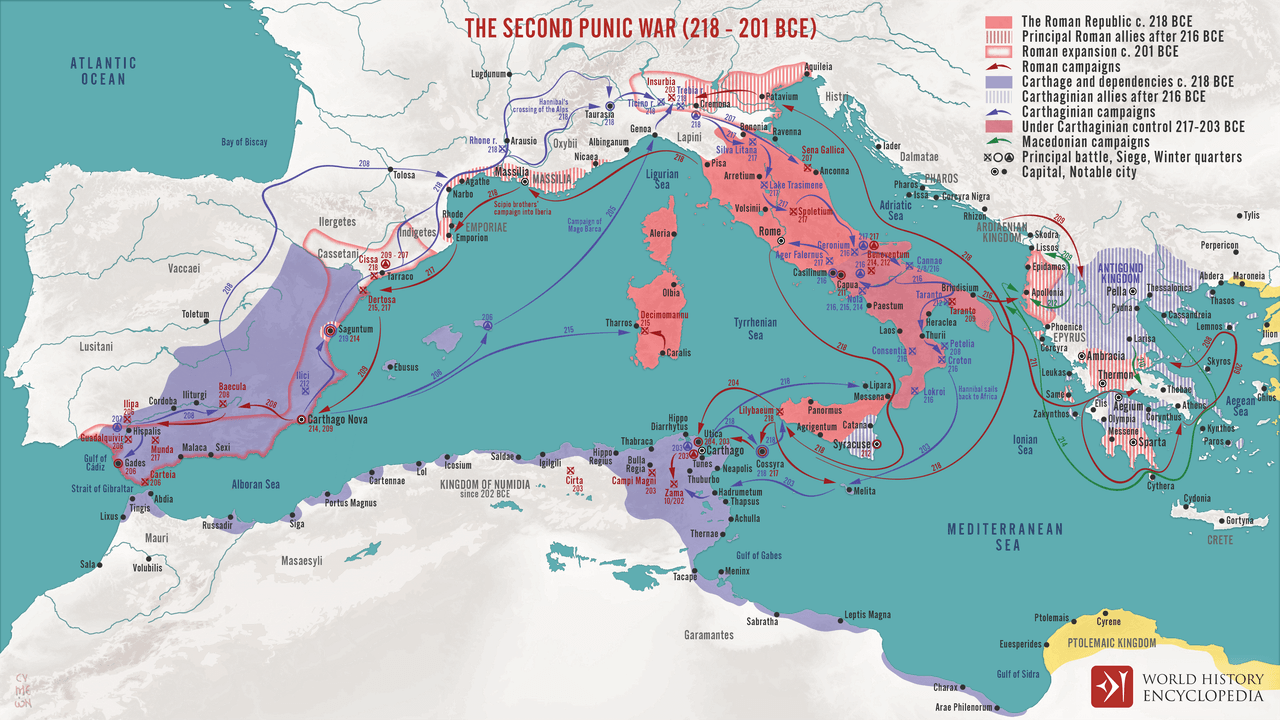
The Second Punic War (World History Encyclopedia)
Hannibal’s departure from Iberia in the spring of 218 BCE, his passage over the Pyrenees and the Rhône River, altered the course of the Second Punic War. Due to Roman naval superiority, he adopted the strategy of moving his army overland into the Italian peninsula. According to data based on an inscription Hannibal erected at the Lacinium promontory, as recorded by the ancient historian Polybius, when the Carthaginian army reached the foot of the Alps, it consisted of 38,000 infantry, 8,000 cavalry, and 37 war elephants.【4】
During the Alpine crossing in the autumn of 218 BCE, the army suffered heavy losses in manpower and animals due to freezing weather, food shortages, and attacks by local Celtic tribes (particularly the Allobroges) guarding the passes. By the time it descended into the Po Valley, the Carthaginian force had been reduced to 20,000 infantry and 6,000 cavalry.【5】 Yet this transit shifted the strategic balance of the war by bringing the theater of conflict directly into the heartland of Rome, rather than confining it to Iberia.
After reinforcing his army with the Insubres and Boii tribes, Hannibal won three major battles in succession against Roman legions:
Following the defeat at Trasimene, the Roman Republic adopted a strategy of attrition, avoiding direct battles and targeting Carthaginian supply lines under the leadership of dictator Quintus Fabius Maximus, known as the "Fabian Strategy." However, this approach drew criticism in the Roman Senate, prompting the assembly in 216 BCE of the largest Roman army of the era—approximately 80,000 infantry and 6,000 cavalry—under the command of Consuls Lucius Aemilius Paullus and Gaius Terentius Varro.
The two armies met on the plain of Cannae in southern Italy. Hannibal arranged his troops in a convex crescent formation facing outward. He placed relatively weak Iberian and Gallic infantry in the center and positioned his most experienced African heavy infantry on the flanks. When the battle began, the Carthaginian center withdrew in controlled fashion, drawing the Roman army inward and forcing them into a compressed formation. Simultaneously, Carthaginian cavalry routed the Roman cavalry on both flanks and encircled the Roman infantry from behind.
This maneuver, known as the double envelopment or "crescent tactic," resulted in the complete encirclement and annihilation of the Roman army. Ancient sources and modern military historians estimate that between 50,000 and 70,000 Roman soldiers were killed at Cannae.【6】 This battle continues to be studied in modern military doctrine and war academies as the quintessential "battle of annihilation" (Vernichtungsschlacht) and model of double envelopment.【7】
After the defeat at Cannae, the Roman Republic abandoned direct field battles and reverted to a war of attrition targeting Carthaginian supply lines. Hannibal’s strategy, by contrast, aimed to undermine the Roman Republic’s manpower by inciting rebellion among its Italian allies. Although major cities such as Capua and Tarentum defected to Carthage, the anticipated total collapse of Rome’s alliance system did not occur. During this period, Hannibal’s greatest disadvantage was his inability to receive adequate logistical and military support from his homeland.
This lack of support stemmed from political divisions within the Carthaginian Senate. The traditionalist and peace-oriented Carthaginian oligarchy, led by the elder Hanno, feared that the Barcid dynasty, and especially Hannibal, might gain unchecked military power.【8】 His political rivals feared that a decisive victory in Italy would allow Hannibal to return to Carthage and establish a military dictatorship. As a result, the Carthaginian Senate prioritized defending the silver mines of Iberia—the state’s main revenue source—and supporting rebellions in Sicily, rather than sending reinforcements to Hannibal in Italy.
In 211 BCE, as Roman legions besieged Capua, Hannibal’s most important ally, he marched directly toward Rome to disperse the besieging forces and create panic in the Roman Senate. He established a camp within three miles of the city walls but could not launch a direct assault due to a lack of siege equipment and the strength of Rome’s garrison. This maneuver gave rise to the Roman expression "Hannibal ad portas" ("Hannibal at the gates").【9】 Capua’s fall to Rome the same year delivered a severe blow to Carthage’s psychological advantage in Italy.
The last major Carthaginian effort to turn the tide of the war in Italy was the march of Hannibal’s brother Hasdrubal Barca from Iberia across the Alps, aiming to unite his forces with Hannibal’s in central Italy. However, Hasdrubal’s messengers were captured by the Romans, revealing the plan. In 207 BCE, Roman armies under Consuls Gaius Claudius Nero and Marcus Livius Salinator intercepted Hasdrubal’s forces on the banks of the Metaurus River in northern Italy.
At the Battle of the Metaurus, Hasdrubal’s reinforcement army was completely annihilated and Hasdrubal himself was killed in battle. Ancient records state that Roman commanders sent Hasdrubal’s severed head to Hannibal’s camp in southern Italy to announce the defeat. The death of his brother and the complete loss of reinforcement hopes eliminated any possibility of Hannibal achieving final victory in the Italian peninsula.
After Hasdrubal’s death, Hannibal withdrew his army to the southernmost region of Italy, Bruttium, adopting a defensive posture. Meanwhile, the Roman general Publius Cornelius Scipio (Africanus) ended Carthaginian rule in Iberia and launched a direct invasion of North Africa. Faced with the threat to its capital, the Carthaginian Senate recalled Hannibal from Italy in 203 BCE.
Hannibal Barca - All His Wars (DFT Tarih)
The two armies met on the plain of Zama in North Africa in 202 BCE. At the Battle of Zama, Scipio neutralized the destructive impact of Hannibal’s war elephants by leaving gaps in his lines and secured cavalry superiority by recruiting Numidian cavalry, formerly Carthage’s allies, into his own ranks. The Carthaginian army was defeated after being encircled from both flanks, ending the war. Carthage accepted a harsh peace treaty in 201 BCE that severely restricted its military power and overseas territories.
After the peace treaty of 201 BCE ending the Second Punic War, Hannibal turned to Carthaginian domestic politics. In 196 BCE, he was elected to the highest administrative office, the sufet (chief magistrate). To prevent the war reparations owed to Rome from being imposed on the populace as new taxes, he implemented financial reforms, restructured harbor duties and commercial tariffs, and enacted legal changes to curb the power of the oligarchy.
He reduced the powers of the Council of One Hundred Four, whose members served for life, and limited their term to one year.【10】 The aristocrats who lost their privileges accused Hannibal of preparing for another war and reported this to the Roman Senate. Anticipating that his rivals would hand him over, Hannibal secretly left Carthage of his own volition in 195 BCE and went into voluntary exile.
During his voluntary exile, Hannibal turned toward the eastern Mediterranean and sought refuge at the court of Seleucid Emperor Antiochus III. He served as a military advisor in Antiochus’s campaigns against Rome. After the Seleucid army’s defeat by Roman forces at the Battle of Magnesia in 190 BCE, he moved into the interior of Anatolia. According to ancient historians, during this period he visited the court of King Artaxias I of Armenia and contributed to the topographical planning of the city of Artaxata.【11】
After leaving eastern Anatolia, Hannibal sought refuge with King Prusias I of Bithynia. There, he advised Bithynian naval forces in operations against the Kingdom of Pergamon, Rome’s ally, and assumed a strategic role. Learning of Hannibal’s presence in Bithynia, the Roman Senate sent Titus Quinctius Flamininus to Prusias’s court. Under Roman pressure, the house where Hannibal was staying was besieged. To avoid capture by the Romans, Hannibal took his own life in 183 BCE (some sources say 181 BCE) in Libyssa by ingesting the poison he carried with him.
Hannibal’s death in Libyssa, near modern-day Gebze in Kocaeli, gives his historical legacy significance in Türkiye. Mustafa Kemal Atatürk, the founder of the Republic of Türkiye, inspired by his admiration for Hannibal’s military genius, issued a directive in 1934 for the discovery of his tomb and the construction of a monument in his honor. In accordance with Atatürk’s request, a symbolic tomb and monument dedicated to Hannibal were erected in 1981 within the TÜBİTAK Gebze Campus.
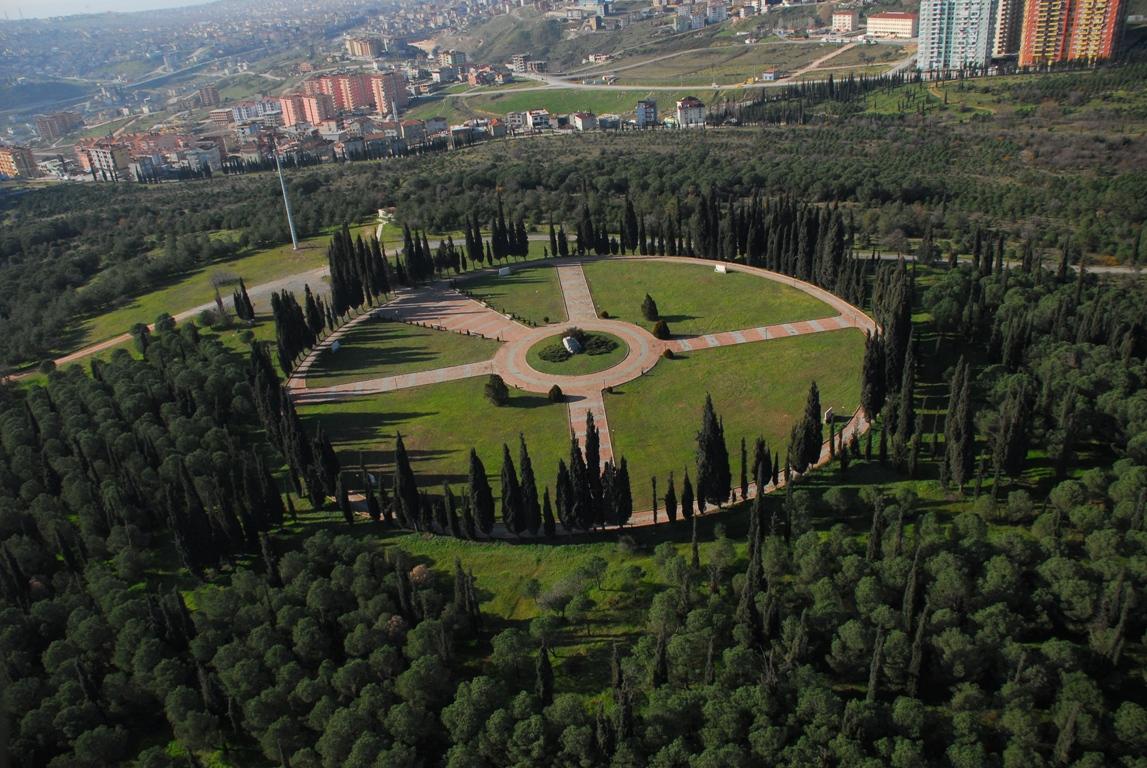
Hannibal Monument Tomb - Kocaeli (Türkiye Kültür Portalı)
Hannibal has been described by military historian Theodore Ayrault Dodge as the "father of strategy" in modern literature.【12】 His tactical superiority over Roman legions, his mastery of terrain, and his double envelopment tactic at the Battle of Cannae remain foundational elements of modern military doctrine.
His tactics were intensively studied in 19th and 20th-century military academies, particularly in the German school, and directly inspired the "Schlieffen Plan" developed by German Field Marshal Alfred von Schlieffen for World War I. The same envelopment principles were referenced and applied by the U.S. military command during the 1991 Gulf War ("Operation Desert Storm").【13】
As Carthaginian state archives were destroyed by Rome, historical accounts of Hannibal rely entirely on Roman and Greek authors who were his enemies. The Roman historian Titus Livius portrayed him as cruel and untrustworthy ("Punica fides" / Punic faithlessness), constructing a villainous profile for Roman propaganda. The Greek-born Polybius, however, approached Hannibal’s military genius with greater objectivity. Modern historiography seeks to overcome these Roman-biased prejudices, repositioning Hannibal not merely as a general but as a complex Mediterranean diplomat and pragmatic statesman trained in Hellenistic culture.
Hannibal’s crossing of the treacherous Alps with his war elephants and his military campaigns have been depicted in visual arts and modern media. One of the most famous visual representations is the 1812 painting by British Romantic painter J. M. W. Turner, Snow Storm: Hannibal and his Army Crossing the Alps. In modern times, his military campaigns and tactics have been directly featured as main campaigns in large-scale digital strategy games such as Rome: Total War (2004) and the historical simulation game Total War: Rome II – Hannibal at the Gates (2014).
"Hannibal Anıt Mezarı - Gebze." T.C. Kültür ve Turizm Bakanlığı - Türkiye Kültür Portalı. Accessed May 14, 2026. https://www.kulturportali.gov.tr/turkiye/kocaeli/gezilecekyer/hannibal-anit-mezari-gebze
"Hannibal Barca Bust." World History Encyclopedia. January 18, 2016. Accessed May 14, 2026. https://www.worldhistory.org/image/4387/hannibal-barca-bust/
"Hannibal Barca Statue." World History Encyclopedia. January 18, 2016. Accessed May 14, 2026. https://www.worldhistory.org/image/4386/hannibal-barca-statue/
"The Second Punic War (218 - 201 BCE)." World History Encyclopedia. May 24, 2022. Accessed May 14, 2026. https://www.worldhistory.org/image/15973/the-second-punic-war-218---201-bce/
Amigoni, Jacopo. *The Young Hannibal Swears Enmity to Rome*. Matthiesen Gallery. Accessed May 14, 2026. https://matthiesengallery.com/work_of_art/the-young-hannibal-swears-emnity-to-rome.
Astin, A. E., F. W. Walbank, M. W. Frederiksen, and R. M. Ogilvie, eds. The Cambridge Ancient History. Vol. 8, Rome and the Mediterranean to 133 BC. 2nd ed. Cambridge: Cambridge University Press, 1989. Accessed May 13, 2026.
Cicero, Marcus Tullius. Philippicae. Accessed May 13, 2026.
DFT Tarih. "Hannibal Barca - Tüm Savaşları || TEK PARÇA || DFT Tarih Belgesel." YouTube, 1:11:37. May 28, 2022. Accessed May 14, 2026. https://www.youtube.com/watch?v=fnSko1-nF14
Daly, Gregory. Cannae: The Experience of Battle in the Second Punic War. London: Routledge, 2002. Accessed May 13, 2026.
Dodge, Theodore Ayrault. Hannibal: A History of the Art of War among the Carthaginians and Romans down to the Battle of Pydna. Boston: Houghton Mifflin, 1891. Accessed May 13, 2026.
Fronda, Michael P. Between Rome and Carthage: Southern Italy during the Second Punic War. Cambridge: Cambridge University Press, 2010. Accessed May 13, 2026.
Goldsworthy, Adrian. The Fall of Carthage: The Punic Wars 265–146 BC. London: Cassell, 2003. Accessed May 13, 2026.
Hoyos, Dexter. Hannibal's Dynasty: Power and Politics in the Western Mediterranean, 247–183 BC. London: Routledge, 2003. Accessed May 13, 2026.
Hoyos, Dexter. Mastering the West: Rome and Carthage at War. Oxford: Oxford University Press, 2015. Accessed May 13, 2026.
Lancel, Serge. Hannibal. Translated by Antonia Nevill. Oxford: Blackwell, 1999. Accessed May 13, 2026.
Lazenby, John F. Hannibal's War: A Military History of the Second Punic War. Warminster: Aris & Phillips, 1998. Accessed May 13, 2026.
Livy. History of Rome. Translated by B. O. Foster. Loeb Classical Library. Cambridge, MA: Harvard University Press, 1929. Accessed May 13, 2026.
MacDonald, Eve. Hannibal: A Hellenistic Life. New Haven: Yale University Press, 2015. Accessed May 13, 2026.
Miles, Richard. Carthage Must Be Destroyed: The Rise and Fall of an Ancient Civilization. London: Penguin Books, 2011. Accessed May 13, 2026.
Nepos, Cornelius. On Great Generals. Translated by J. C. Rolfe. Loeb Classical Library. Cambridge, MA: Harvard University Press, 1929. Accessed May 13, 2026.
O’Connell, Robert L. The Ghosts of Cannae: Hannibal and the Darkest Hour of the Republic. New York: Random House, 2010. Accessed May 13, 2026.
Plutarch. Lives. Translated by Bernadotte Perrin. Loeb Classical Library. Cambridge, MA: Harvard University Press, 1914. Accessed May 13, 2026.
Polybius. The Histories. Translated by W. R. Paton. Loeb Classical Library. Cambridge, MA: Harvard University Press, 1922. Accessed May 13, 2026.
Schlieffen, Alfred von. Cannae. Fort Leavenworth, KS: Command and General Staff School Press, 1931. Accessed May 13, 2026.
[1]
Serge Lancel, Hannibal, trans. Antonia Nevill (Oxford: Blackwell, 1999), 45, access date: 13 May 2026.
[2]
Dexter Hoyos, Hannibal's Dynasty: Power and Politics in the Western Mediterranean, 247–183 BC (London: Routledge, 2003), 21, access date: 13 May 2026.
[3]
Polybius, The Histories, 3.11; Livy, History of Rome, 21.1, access date: 13 May 2026.
[4]
Polybius, The Histories, 3.33, access date: 13 May 2026.
[5]
John F. Lazenby, Hannibal's War: A Military History of the Second Punic War (Warminster: Aris & Phillips, 1998), 51, access date: 13 May 2026.
[6]
Adrian Goldsworthy, The Fall of Carthage: The Punic Wars 265–146 BC (London: Cassell, 2003), 162; Gregory Daly, Cannae: The Experience of Battle in the Second Punic War (London: Routledge, 2002), 202, access date: 13 May 2026.
[7]
Alfred von Schlieffen, Cannae (Fort Leavenworth, KS: Command and General Staff School Press, 1931), 12–15, access date: 13 May 2026.
[8]
Richard Miles, Carthage Must Be Destroyed: The Rise and Fall of an Ancient Civilization (London: Penguin Books, 2011), 230, access date: 13 May 2026.
[9]
Marcus Tullius Cicero, Philippicae, 1.5.11, access date: 13 May 2026.
[10]
A. E. Astin et al., eds., The Cambridge Ancient History, vol. 8, Rome and the Mediterranean to 133 BC, 2nd ed. (Cambridge: Cambridge University Press, 1989), 134, access date: 13 May 2026.
[11]
Plutarch, Lives, Lucullus 31, access date: 13 May 2026.
[12]
Theodore Ayrault Dodge, Hannibal: A History of the Art of War among the Carthaginians and Romans down to the Battle of Pydna (Boston: Houghton Mifflin, 1891), 613, access date: 13 May 2026.
[13]
Robert L. O’Connell, The Ghosts of Cannae: Hannibal and the Darkest Hour of the Republic (New York: Random House, 2010), 254–256, access date: 13 May 2026.

Henüz Tartışma Girilmemiştir
"Hannibal Barca" maddesi için tartışma başlatın
Name Origin and Family Background
Early Life and Activities in Iberia
Post-War Crisis, Historical Oath, and Focus on Iberia
Death of Hamilcar and the Hasdrubal Era
Rise to Supreme Command and Consolidation of Power in Iberia
Preparation for War and the Siege of Saguntum
Crossing the Alps and the Second Punic War
Early Italian Campaigns
Battle of Cannae
Internal Politics
Battle of the Metaurus
Battle of Zama
Civil Reforms
Exile
Final Years
Legacy in Türkiye
Military and Strategic Significance
Historiography
Place in Popular Culture