

Bu içerik Türkçe olarak yazılmış olup yapay zeka ile otomatik olarak İngilizceye çevrilmiştir.
+2 Daha
Metapolitefsi is the process of overthrowing the military regime that ruled Greece from 1967 to 1974 and transitioning to a democratic order. This process began with the Cyprus Issue and the collapse of the junta regime on 23 July 1974 and was completed with the return of Konstantinos Karamanlis to the country and his establishment of a parliamentary democracy under a new constitution.【1】 This period is regarded as a pivotal turning point in Greek political history.
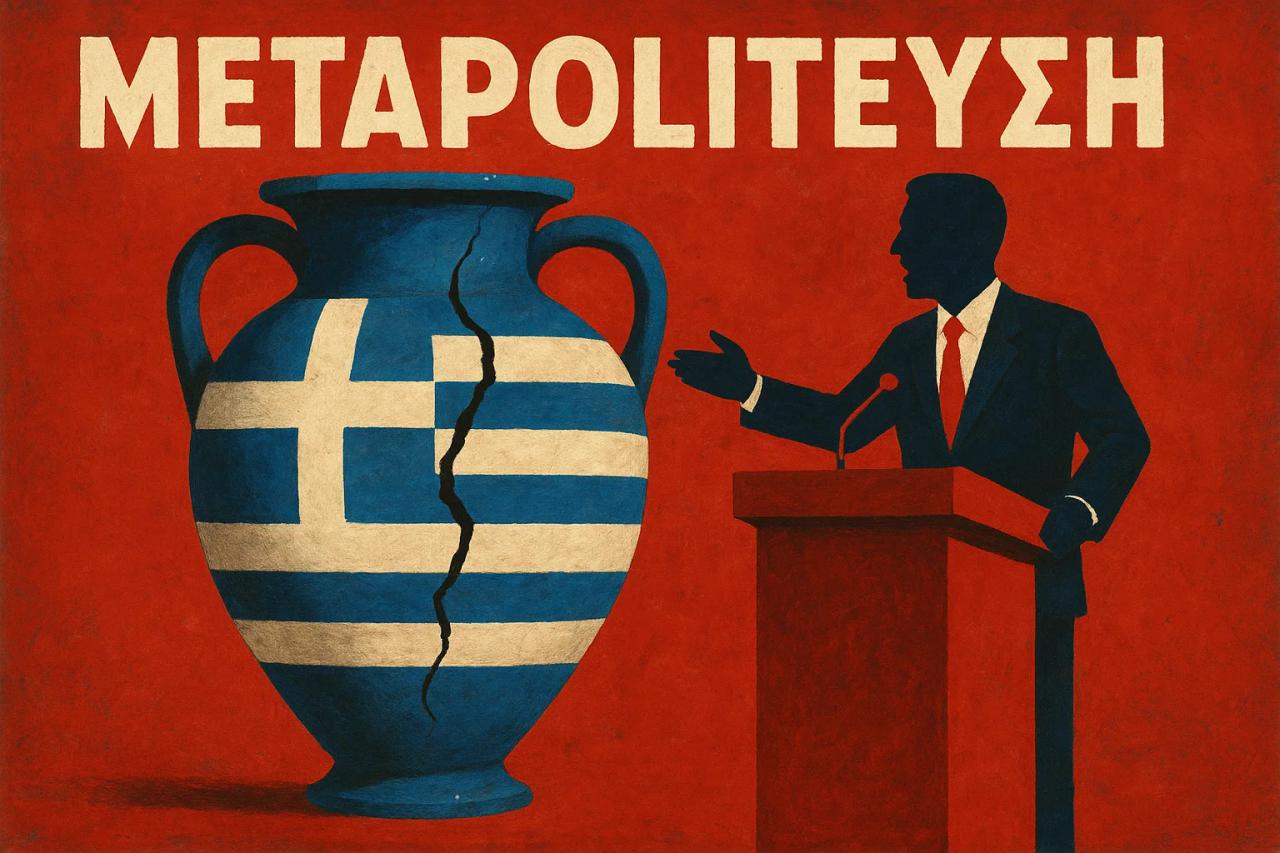
The Metapolitefsi Period, Signifying a Turning Point for Greece (Generated by Artificial Intelligence)
British historian Mark Mazower described this period as "the transition to calm after the bloodiest conflict and regime change in Europe in 1945." The Metapolitefsi era has since become a defining concept characterizing Greece’s political landscape over the last 50 years.【2】
In scholarly literature, the period extending from 1974 to the present is referred to as the Metapolitefsi or its synonym, Metapolitism. The beginning of this era is marked by Konstantinos Karamanlis’s return to Athens and the establishment of a provisional National Unity Government.
In the general elections held in November of the same year, the New Democracy Party under Karamanlis’s leadership won approximately 54 percent of the vote and came to power. A referendum held in December 1974 abolished the monarchy and officially inaugurated the Third Hellenic Republic.【3】 This process represented not merely a change in government but also a comprehensive transformation at the social, political and constitutional levels.
Political instability in Greece reached its peak in the mid-1960s. During this period, left-right conflicts and political polarization intensified. Citing this unstable environment, a group of military officers led by Colonel Georgios Papadopoulos seized power in a coup on 21 April 1967. This regime, known as the Colonels’ Junta, quickly suspended democracy, dissolved parliament, banned political parties, neutralized trade unions, shut down numerous newspapers and brought the press under strict control. Thousands of people were arrested and exiled on political grounds.【4】
Human rights violations became widespread under the junta, opposition was silenced, pressure on universities increased and student movements were violently suppressed. The bloody crackdown on student protests at the National Technical University of Athens in November 1973 severely damaged the junta’s credibility both domestically and internationally. The regime also suffered economic failures that further alienated the public.
One of the key events triggering the junta’s final collapse was the Cyprus Crisis of 1974. The junta-backed extremist nationalist organization EOKA-B, under the leadership of Nikos Sampson, launched a coup against President Makarios III on 15 July 1974. The aim of this action was the annexation of Cyprus to Greece (Enosis).
In response, Turkey invoked the London and Zurich Agreements and launched the Turkish Peace Operation in Cyprus on 20 July 1974. The Turkish military intervention in Cyprus proved a complete disaster for the Greek junta. Military failure undermined the junta’s credibility domestically and isolated Greece internationally.【5】
Following the defeat in Cyprus, disagreements among generals within the junta deepened and the military regime rapidly unraveled. The military failure triggered by the Cyprus crisis exhausted the junta’s capacity to govern and led to the complete loss of public support.
As the junta lost public support, widespread political disintegration emerged across the country. Greek political elites initiated efforts to restore a democratic system. At this critical juncture, a strong and charismatic leader was needed to guide the nation. That figure was former Prime Minister Konstantinos Karamanlis, who was in exile in France. Karamanlis had previously served as prime minister (1955–1963) and had steered the country toward European integration.
Under intense political pressure and widespread public demand, Karamanlis returned to Athens on 24 July 1974. He was greeted with enthusiastic demonstrations nationwide and viewed by many as the leader capable of restoring political stability. Upon his return, his first act was to form a broad-based government and initiate reforms aimed at reinstating political freedoms. Political prisoners were released, banned political parties resumed operations and the press gained partial freedom.
One of the most important steps in the transition to democracy was determining the form of government. The debate over whether Greece should remain a monarchy or become a republic reflected a fundamental dimension of the country’s historical political divide. In a referendum held on 8 December 1974, approximately 69 percent of voters supported abolishing the monarchy and adopting a republican system. Thus, the monarchy was formally abolished and a parliamentary republic was established.
The new constitution, adopted in June 1975, was drafted according to the principles of parliamentary democracy. It balanced and limited executive powers through checks and balances, strengthened the legislative branch and guaranteed judicial independence by law. With the new constitution, the powers of the president were curtailed and the principle of parliamentary supremacy was adopted.
Following the adoption of the new constitution, free elections rapidly democratized Greek political life. Two dominant center parties emerged in Greek politics: the center-right New Democracy Party led by Konstantinos Karamanlis and the center-left Panhellenic Socialist Movement (PASOK) led by Andreas Papandreou. The political competition between these two parties contributed significantly to the consolidation of a stable democratic system in Greece.
In the post-1974 period, the strengthening of democratic institutions, the revival of civil society and the process of European integration accelerated rapidly. Greece’s full membership in the European Economic Community in 1981 provided a crucial external mechanism for reinforcing democratic institutions.
The Metapolitefsi period represents a turning point in modern Greek political history. This process rendered military intervention unacceptable in Greek politics and laid the foundation for the entrenchment of a democratic culture in society. Moreover, the experiences of this period established democracy as the unquestioned form of governance in the Greek political system.
In conclusion, Metapolitefsi was not merely a period of regime change in Greek history but a comprehensive restructuring process in which the transition to democracy was recognized as a profound social, cultural and political transformation. The democratic gains achieved during this period have since become the fundamental reference point for all subsequent political developments in Greece.
The Metapolitefsi period brought significant shifts in Greece’s foreign policy. From this point onward, the country moved away from a foreign policy focused solely on national concerns and adopted a strategy centered on Europe and multilateral alliances. Within this framework, the core strategic objectives of Metapolitefsi-era foreign policy can be summarized as follows:
As a result of these developments, Greece’s foreign policy shifted toward a more institutional and Western alliance-oriented orientation. However, in subsequent years, traditional security concerns reemerged and foreign policy once again refocused on national security.
With the onset of Metapolitefsi, a shift occurred in Greece’s security doctrine. The Soviet Union-centered threat perception previously defined as the "Threat from the North" during the Cold War was replaced by a Turkey-centered threat perception. This change was articulated by then Foreign Minister Evangelos Averoff, and the concept of the "Threat from the East" entered official foreign policy discourse.
In this context, Turkey was positioned as the primary threat in Greek foreign policy documents and political rhetoric. Political parties such as PASOK adopted this approach and advanced the thesis that Turkey constituted a threat to national sovereignty and territorial integrity. This reorientation of security policy influenced Greece’s defense strategies and military doctrine.
Immediately following the 1974 Cyprus Peace Operation, the Metapolitefsi government made the Cyprus issue the central pillar of its foreign policy. Supporting the Greek Cypriot community was declared by Greece as its "primary and foremost national issue." However, over subsequent years, this rigid stance softened and a more pragmatic tone was adopted. Nevertheless, the policy of maintaining the unresolved status of the Cyprus issue has remained one of the enduring elements of Greek foreign policy.
During the Metapolitefsi period, Greece, by submitting its application for full membership in the European Economic Community (EEC), clearly realigned its foreign policy toward the West. This orientation aimed, on one hand, to reduce dependence on the United States and, on the other, to secure multilateral support against Turkey.
Greece’s policy sought to rebalance its relationship with the United States within the context of the Cold War and to foreground an independent foreign policy that enhanced national sovereignty. At the same time, in response to tensions with Turkey—particularly concerning Islands (Aegean) Sea and Cyprus—Greece sought international support through multilateral platforms, primarily the EEC and later the European Union. In this context, Greece turned to European institutions and norms as instruments of foreign policy to avoid isolation vis-à-vis Turkey.
From the 1990s onward, particularly amid rising tensions in the Aegean Sea and recurring diplomatic crises between the two countries, certain Greek academics and strategic experts have argued that a military conflict with Turkey is possible and have supported this thesis. Such approaches demonstrate how the post-Metapolitefsi perception of Turkey as a security threat has become institutionalized in both political discourse and academic circles and has influenced foreign policy formulation.
The Metapolitefsi period marked the beginning of Greece’s domestic democratization and signaled a fundamental shift in its foreign policy. The institutionalization of the perception of Turkey as a security threat triggered a structural transformation in foreign policy-making. European integration, the redefinition of relations with the United States, and the pursuit of international legitimacy vis-à-vis Turkey on issues concerning the Aegean Islands and Cyprus constitute the defining features of this period’s foreign policy.
Together, these developments position the Metapolitefsi period not only as a stage in Greece’s Westernization but also as the beginning of a new strategic era in its relations with Türkiye.
[1]
Can Kızılkan, Yunanistan'ın Bölgesel Stratejisi ve Ege'de Deniz Güvenliği: 1974'ten Günümüze (Ankara: Nobel Yayınları, 2025), 18.
[2]
Mark M. Mazover, After the War Was Over: Reconstructing the Family, Nation, and State in Greece, 1943-1960 (Princeton: Princeton University Press,2000), 7.
[3]
Chirstina Koulouri, The Cold War 1944-1990, (Selanik, CDRSEE Yayınları, 2016), 122.
[4]
Richard Clogg, “Obituary: General Phaedon Gizikis,” The Independent. Erişim 2 Ağustos 2025. https://www.independent.co.uk/arts-entertainment/obituary-general-phaedon-gizikis-1110723.html
[5]
George A. Kourvetaris ve Betty A. Dobratz, A Profile of Modern Greece: In Search of Identity (Oxford: Clarendon Press, 1987), 154.


Henüz Tartışma Girilmemiştir
"Metapolitefsi" maddesi için tartışma başlatın
Rise and Actions of the Military Junta
Foreign Policy Crisis and the Cyprus Issue
The End of the Junta and the Transition to Democracy: Metapolitefsi
New Constitution and the Proclamation of the Republic (1974–1975)
Institutional Democratization and the Rise of Political Parties
Historical and Political Significance of Metapolitefsi
Transformation in Foreign Policy Dynamics
Turkey-Centered Threat Perception
The Cyprus Issue and Deepening of Turkish-Greek Relations
Greece’s Strategic Orientation and Alliance Policy
Contemporary Threat Perception and Academic Interpretations