
Bu içerik Türkçe olarak yazılmış olup yapay zeka ile otomatik olarak İngilizceye çevrilmiştir.
Purpose(s) | Manned missions to the Moon and deep space operations | ||||||||
|---|---|---|---|---|---|---|---|---|---|
Developer(s) | National Aeronautics and Space Administration (NASA) | ||||||||
Capsule Height | Approximately 3.3 m | ||||||||
Capsule Diameter | Approximately 5 m | ||||||||
Crew Capacity | 4 astronauts | ||||||||
Launch System | Space Launch System (SLS) | ||||||||
Program | Artemis Program | ||||||||
International Partner | European Space Agency (ESA) – European Service Module (ESM) | ||||||||
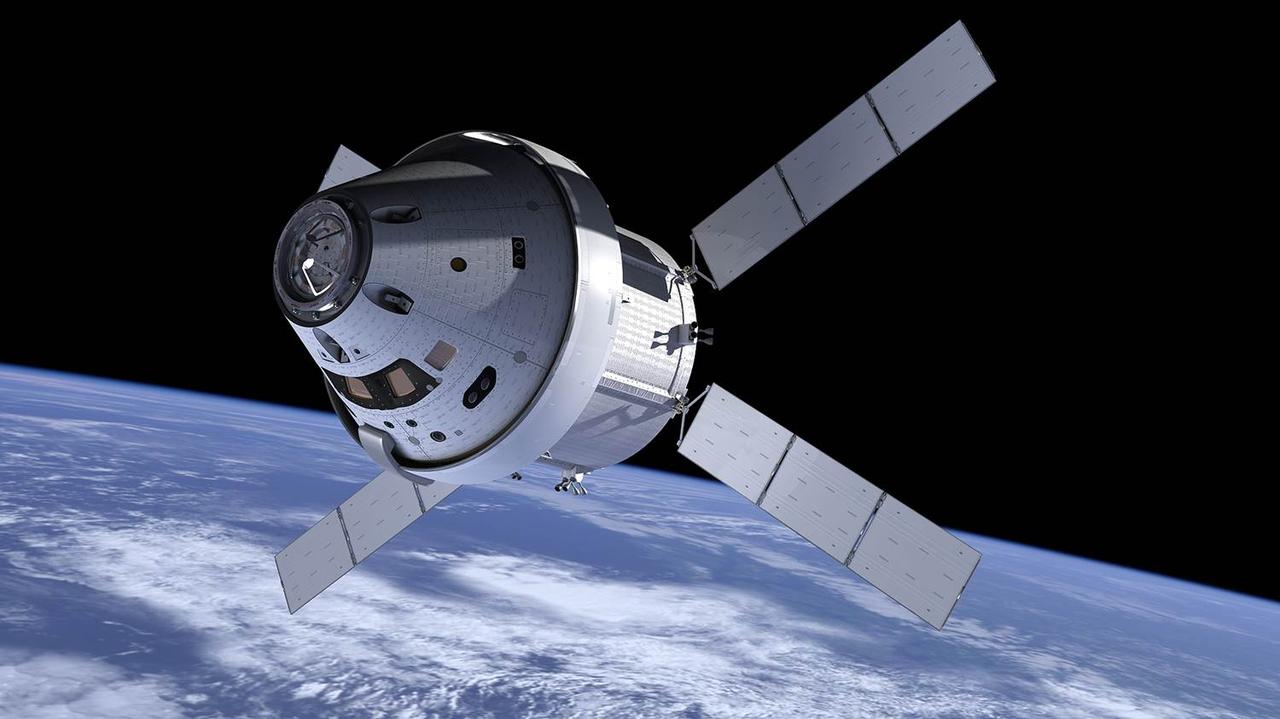
NASA Orion Spacecraft (Orion Multi-Purpose Crew Vehicle – MPCV) is a four-person crew capacity spacecraft developed by the United States National Aeronautics and Space Administration (NASA) for human exploration missions beyond low Earth orbit. Orion assumes the roles of transporting crew, sustaining life-support conditions in space, and ensuring safe return to Earth at the conclusion of missions within the Artemis Program’s lunar mission architecture. The system is designed as an integrated vehicle comprising the crew capsule and the service module that provides in-space mission support, along with a launch abort system that can rapidly separate the crew from the rocket in the event of an emergency during launch.
Orion’s operational concept for Artemis missions is structured to meet long-duration mission requirements after launch aboard the heavy-lift Space Launch System (SLS) rocket, during trans-lunar injection, lunar orbital operations, and return phases. In this framework, Orion’s service module performs critical functions including power generation, propulsion (maneuverability), thermal control, and carrying life-support consumables such as air and water. The European Service Module (ESM), developed with contributions from the European Space Agency (ESA), forms the spacecraft’s “power and support backbone.” In the early stages of the program, Orion’s deep space flight profile was tested during an uncrewed mission lasting approximately three weeks that extended beyond the Moon, thereby completing a foundational system validation step for Artemis’s crewed phases.
Orion’s origins trace back to NASA’s Constellation Program (2005), which sought to reestablish a human exploration architecture for returning to the Moon and reaching more distant destinations. Within this framework, Orion was initially conceived as part of the Crew Exploration Vehicle approach. After the program was terminated in 2010, it was redefined under a new direction from the U.S. Congress as the Multi-Purpose Crew Vehicle (MPCV) and assigned the primary role of crew transportation for missions beyond low Earth orbit. This period marked a transitional phase during which the capsule’s design matured, and programmatic requirements for safe launch/abort, deep space life support, and high-energy reentry were clearly defined.
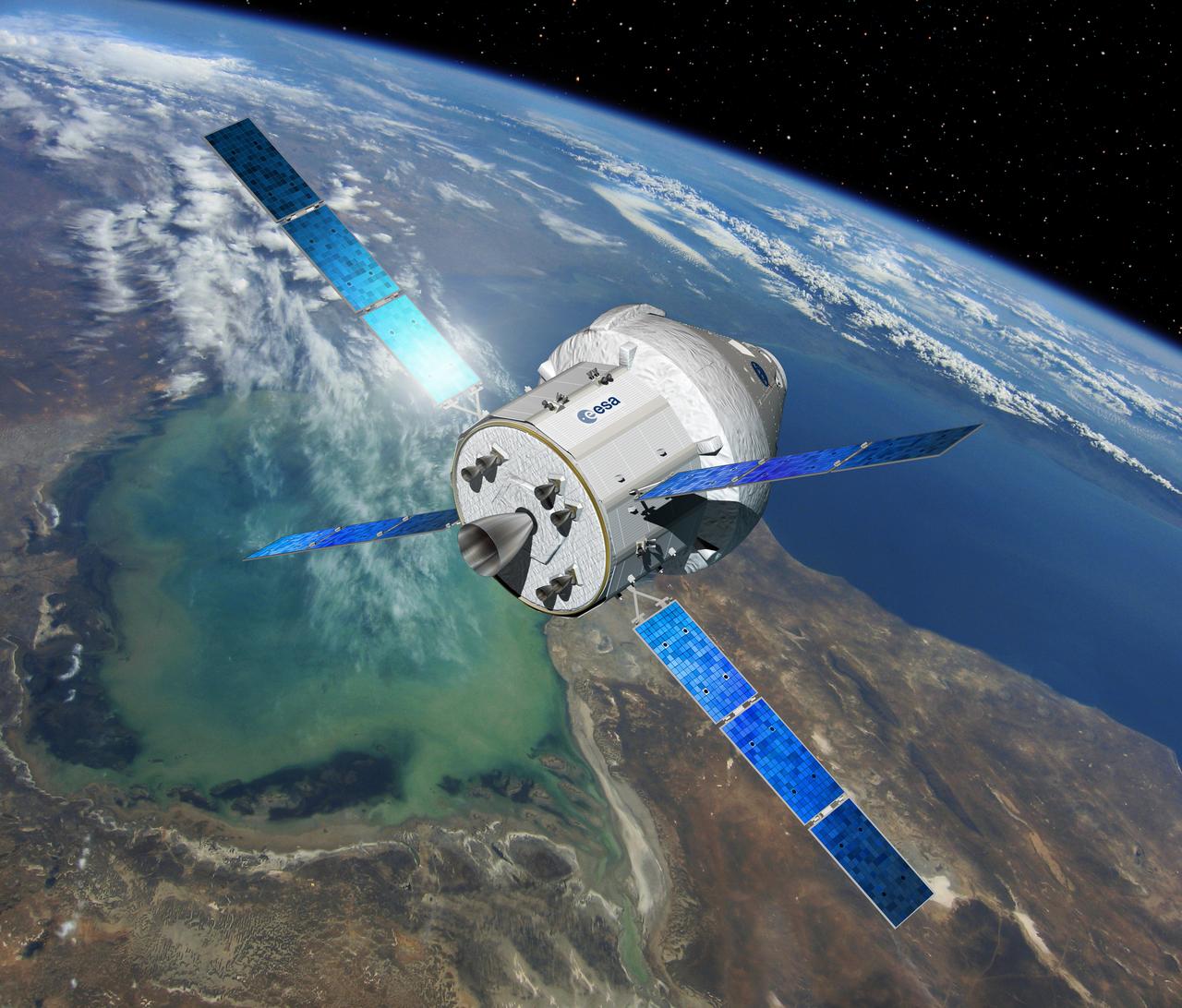
Orion Spacecraft (ESA)
Orion’s first flight test, designated Exploration Flight Test-1 (EFT-1), was conducted on 5 December 2014. This approximately 4.5-hour uncrewed mission, launched on a Delta IV Heavy rocket, was designed to demonstrate the capsule’s spaceworthiness, the behavior of its heat shield during reentry conditions, and recovery processes following splashdown. EFT-1’s flight profile focused specifically on testing critical components of reentry dynamics similar to those expected during a lunar return, particularly due to its high altitude and associated high-energy reentry conditions.
Orion’s first integrated deep space flight under the Artemis Program was accomplished during the Artemis I mission. Launched on 16 November 2022 aboard the SLS rocket, Orion completed a mission involving flybys of the Moon and lunar orbital operations before returning to Earth and splashing down in the ocean on 12 December 2022. Artemis I was positioned as a system test aimed at validating the integrated performance of Orion and the SLS, including flight software and ground systems, as well as high-speed reentry performance. The first crewed Orion mission, Artemis II, is planned to carry four astronauts on a lunar flyby and is currently targeted for launch no earlier than March 2026 according to NASA’s latest mission schedule.
The Orion spacecraft consists of two primary modules that operate in tandem within the mission architecture: the Crew Module (CM) and the European Service Module (ESM). During launch, the Launch Abort System (LAS), positioned atop the capsule for crew safety, functions as an integral part of the “full stack.”
The pressurized “capsule” section where astronauts reside and the only major component that returns to Earth at the end of the mission.

Orion Spacecraft (ESA)
Developed with contributions from ESA, the ESM serves as Orion’s “power and support backbone” in space, carrying and supporting the crew module throughout the mission before separating prior to Earth return.
According to NASA’s published technical summaries, Orion’s “full stack” configuration (crew module + service module + adapter + launch abort system) has a gross launch mass of 78,000 lb (35,380 kg). The vehicle, launched by the SLS rocket, operates with a system architecture in which its mass reduces to approximately 25–26 metric tons after trans-lunar injection (e.g., 26,536 kg at TLI; 25,854 kg post-TLI). Orion’s independent mission duration is defined as 21 days and it is equipped with a Launch Abort System (LAS) to rapidly separate the capsule from the rocket in the event of an emergency during launch. The spacecraft is designed to fly atop the SLS for Artemis missions. Additionally, Orion’s thermal protection system is engineered to withstand temperatures of approximately 5,000°F (about 2,760°C) on the heat shield during high-energy lunar return reentries.
Orion is the spacecraft forming the backbone of crew transportation and return for the Artemis Program. Within NASA’s approach, Orion is positioned to carry crew from Earth to lunar orbit after launch on the SLS, sustain critical functions such as life support and navigation during the mission, and safely return the crew to Earth at mission conclusion.

Orion Spacecraft (ESA)
This role expands progressively in accordance with Artemis’s “increasing complexity” principle: Artemis II will validate system operational maturity through a crewed lunar flyby; in subsequent Artemis phases, Orion will integrate with lunar infrastructure (particularly the Gateway station), becoming the essential link in the chain of crew rendezvous, docking, transfer to surface missions, and return. In the Gateway-centric architecture, Orion facilitates the operational handover between the station and the Human Landing System (HLS) used for lunar surface descent; after surface operations are completed, the crew returns to Orion for the journey back to Earth.
Beyond its function as a transportation vehicle, Orion also serves as a platform for regularly generating the deep space operational disciplines required for sustainable lunar presence. Repeated missions in lunar orbit and near-Moon space build institutional expertise in areas such as long-duration spacecraft health monitoring, high-speed reentry, deep space communications, risk management for human missions, and logistics planning.
This accumulated experience supports both the approach to permanent lunar infrastructure (Gateway-based orbital logistics, HLS-based surface access, and operational rhythm) and NASA’s broader strategy of treating Artemis as a stepping stone to Mars, advancing technological and operational maturity in areas such as life support, power and propulsion, thermal management, and mission architecture.
Orion’s overall capsule architecture is designed to evoke the truncated cone (frustum) shape of the Apollo Command Module, both aerodynamically and structurally; the primary reason is that this geometry has been historically proven to effectively manage thermal loads during high-speed reentries while maintaining controllable flight. However, Orion has been modernized beyond Apollo’s analog-based approach through the integration of digital flight computers, sensor fusion-based navigation, and screen-based (“glass cockpit”) human-machine interfaces. According to NASA’s defined operational concept, the crew will manage spacecraft systems primarily through electronic interfaces and digital procedures rather than physical control panels. Additionally, recognizing the multi-week duration of Artemis missions, more advanced solutions have been adopted for life support and cabin environmental control, with features such as limited-duration “closed-loop” life support capability in emergency scenarios like pressure loss or atmospheric contamination being emphasized.
The second dimension of Orion’s modernization lies in international collaboration. The European Service Module (ESM), which assumes critical functions such as propulsion, power generation, thermal control, and consumables supply in space, is positioned as the primary infrastructure component developed by ESA to support Orion throughout the mission. This architecture is based on the principle that only the crew module returns to Earth for splashdown and recovery, while the service module and launch abort system are jettisoned at appropriate stages of the mission profile. Thus, Orion is evaluated not as a fully reusable spacecraft but as a partially reusable system in which the returning crew capsule can be refurbished for reuse, while other components are produced anew for each mission.
European Space Agency (ESA). "Orion European Service Module." Accessed February 8, 2026. https://www.esa.int/Science_Exploration/Human_and_Robotic_Exploration/Orion/European_Service_Module.
European Space Agency (ESA). "Orion Spacecraft." Accessed February 8, 2026. https://www.esa.int/Science_Exploration/Human_and_Robotic_Exploration/Orion/What_is_Orion.
NASA Office of Inspector General. *NASA’s Management of the Artemis Missions*. Audit Report IG-23-015. Washington, DC: NASA Office of Inspector General, 2023. Accessed February 8, 2026. https://oig.nasa.gov/docs/IG-23-015.pdf.
National Aeronautics and Space Administration (NASA). "After 15 Years, 1,000 Tests, Orion’s Heat Shield Ready to Take the Heat." Accessed February 8, 2026. https://www.nasa.gov/humans-in-space/after-15-years-1000-tests-orions-heat-shield-ready-to-take-the-heat/.
National Aeronautics and Space Administration (NASA). "Artemis I." Accessed February 8, 2026. https://www.nasa.gov/mission/artemis-i/.
National Aeronautics and Space Administration (NASA). "Artemis." Accessed February 8, 2026. https://www.nasa.gov/humans-in-space/artemis/.
National Aeronautics and Space Administration (NASA). "Orion By the Numbers (Quick Facts)." Accessed February 8, 2026. https://www.nasa.gov/wp-content/uploads/2015/06/fs-2014-08-004-jsc-orion_quickfacts-web.pdf.
National Aeronautics and Space Administration (NASA). "Orion Overview." Accessed February 8, 2026. https://www.nasa.gov/orion-overview.
National Aeronautics and Space Administration (NASA). "Orion Spacecraft." Accessed February 8, 2026. https://www.nasa.gov/orion.
National Aeronautics and Space Administration (NASA). "Orion’s Parachute System." Accessed February 8, 2026. https://www.nasa.gov/wp-content/uploads/2017/12/orion_parachutes.pdf.
National Aeronautics and Space Administration (NASA). "Orion’s Service Module." Accessed February 8, 2026. https://www.nasa.gov/wp-content/uploads/2018/07/orion_smonline.pdf.
National Aeronautics and Space Administration (NASA). "Space Launch System (SLS)." Accessed February 8, 2026. https://www.nasa.gov/humans-in-space/space-launch-system/.
National Aeronautics and Space Administration (NASA). "Spacecraft Components." Accessed February 8, 2026. https://www.nasa.gov/reference/spacecraft-components/.
U.S. Government Accountability Office (GAO). "NASA Artemis Programs: Crewed Moon Landing Faces Multiple Challenges." GAO-24-106256. Washington, DC: GAO, 2024. Accessed February 8, 2026. https://www.gao.gov/products/gao-24-106256.


Purpose(s) | Manned missions to the Moon and deep space operations | ||||||||
|---|---|---|---|---|---|---|---|---|---|
Developer(s) | National Aeronautics and Space Administration (NASA) | ||||||||
Capsule Height | Approximately 3.3 m | ||||||||
Capsule Diameter | Approximately 5 m | ||||||||
Crew Capacity | 4 astronauts | ||||||||
Launch System | Space Launch System (SLS) | ||||||||
Program | Artemis Program | ||||||||
International Partner | European Space Agency (ESA) – European Service Module (ESM) | ||||||||
Henüz Tartışma Girilmemiştir
"NASA Orion Spacecraft (Orion Multi-Purpose Crew Vehicle – MPCV)" maddesi için tartışma başlatın
History
Structural Features
Crew Module (Crew Module – CM)
European Service Module (European Service Module – ESM)
Technical Specifications
Role in the Artemis Program
Design Context