

 Recently Added:
This article was automatically translated from the original Turkish version.
In April and May 2025, a crisis erupted between India and Pakistan, marked by cross-border military operations, missile strikes, diplomatic sanctions and civilian casualties. Tensions began after the Pahalgam terrorist attack on 22 April 2025, in which civilians were targeted at the Baisaran meadow near Pahalgam in the Union Territory of Jammu and Kashmir. India asserted that the attack was carried out by groups backed by Pakistan and on 7 May 2025 launched air strikes against Pakistan and Pakistan-administered Azad Kashmir under the name “Operation Sindoor”.
India’s air strikes on Pakistan and Azad Kashmir, 7 May 2025 – Anadolu Agency
On 22 April 2025, a group of armed attackers targeted civilians at the Baisaran meadow, approximately five kilometres north of the town of Pahalgam in the Jammu and Kashmir region. The attack resulted in 26 deaths and 13 injuries. The group “Kashmir Resistance” claimed responsibility, stating in its statement that India had altered the demographic composition of the region.
Following the attack, the Indian government directly accused Pakistan of supporting the attackers and raised allegations of cross-border support. Pakistan rejected these claims. In response, India suspended the Indus Waters Treaty, closed its airspace to Pakistani airlines, reduced diplomatic personnel and revoked visa exemptions. Pakistan announced reciprocal sanctions, and mutual shelling occurred in border areas near the Line of Control.
On 7 May 2025, as part of “Operation Sindoor” conducted by the Indian Armed Forces, nine targets in Pakistan and Azad Kashmir were struck. The operation took place between 01:05 and 01:30 local time and lasted a total of 25 minutes. In a statement issued by Air Force Wing Commander Vyomika Singh and Army Colonel Sofiya Qureshi, it was stated that the strikes were based on reliable intelligence and targeted only “terrorist infrastructure” elements.
India’s Home Minister Amit Shah stated that the attack was a direct response to the Pahalgam attack. Foreign Minister Subrahmanyam Jaishankar emphasized India’s “zero tolerance” policy toward terrorism and shared symbolic graphics on social media dedicated to the spouses of those killed in the strikes. It was reported that Defence Minister Rajnath Singh held emergency meetings immediately after the operation with the chiefs of the army, air force and navy.
The main settlements and structures targeted in the strikes were as follows:
The air strikes were described in the Indian media as “point operations against terrorist infrastructure.” However, Pakistan stated that the strikes directly targeted civilian areas. The Pakistani Ministry of Defence announced that 26 civilians were killed and 48 injured in the attacks.

Bilal Mosque in Muzaffarabad, damaged in an attack by India, 7 May 2025 – Anadolu Agency
In response to India’s air strikes on 7 May 2025, the Pakistani Armed Forces conducted various counter-operations within Indian-controlled Jammu and Kashmir on the same day. The Poonch region was specifically targeted; according to reports, three Indian civilians were killed and 32 injured due to artillery fire. Local sources stated that the local population had no access to collective shelters and were forced to take refuge in their homes.
Pakistan Armed Forces Spokesperson Ahmed Sherif Chaudhry announced that a total of six Indian aircraft had been shot down. These included three Rafale fighter jets, one SU-30, one MiG-29 and one Heron-type unmanned aerial vehicle. It was stated that the aircraft were downed over Azad Kashmir airspace and that some debris fragments were recovered and documented by local residents. The Indian side did not provide any official confirmation of these claims. Meanwhile, debris from an unidentified aircraft was detected in the Pampore region under Indian control. Pakistani sources also reported that a Pakistani military outpost in Dudhnial was hit by a missile strike and that an Indian military headquarters was targeted.
Pakistan Prime Minister Shehbaz Sharif, in statements made on 7 and 8 May 2025, asserted that Pakistan had exercised its right to respond to India’s attacks and that this right would be invoked again if necessary. Sharif stated that Pakistan opposed “this imposed war” but would defend its sovereignty and territorial integrity under all circumstances. In his address to the nation, he declared, “India’s five pride fighter jets are now nothing but piles of debris,” and emphasized that accountability would be demanded for each life lost in the attacks.
Pakistan’s Defence Minister Khawaja Muhammad Asif described India’s strikes as “an open invitation to escalate tensions,” and stated that while the Pakistani military was fully prepared for total war, it preferred to avoid such a conflict. He confirmed that three fighter jets had been shot down in close-range aerial combat. Asif noted that India’s targeting of infrastructure such as the Neelum-Jhelum Hydroelectric Plant and the Noseri Dam constituted a violation of international law.
Pakistan’s Foreign Minister Muhammad Ishak Dar labeled India’s strikes as “sovereignty violations” and urgently brought the matter before the United Nations Security Council. In the official communication, India’s actions were characterized as “open aggression,” and it was stated that this situation threatened international peace and security. Pakistan affirmed its right to legitimate self-defense under Article 51 of the UN Charter.
Following a meeting of the Pakistan National Security Council, Advisor to the Prime Minister Rana Sanaullah stated that Pakistan would respond appropriately if India took further steps. He also pledged to the international community that Pakistan would not be the party escalating tensions.
Al Jazeera. “India-Pakistan Fighting Live: India Fires Missiles into Pakistan.” Al Jazeera Live Blog. Accessed May 7, 2025.https://www.aljazeera.com/news/liveblog/2025/5/6/india-pakistan-fighting-live-india-fires-missiles-into-pakistan
Anadolu Ajansı. “Hindistan Ordusu Pakistan’ı Hedef Aldı.” Accessed May 7, 2025.https://www.aa.com.tr/tr/dunya/hindistan-ordusu-pakistani-hedef-aldi/3559177
BBC News. “India-Pakistan Border Tensions: Live Updates.” BBC News Live. Accessed May 7, 2025.https://www.bbc.com/news/live/cwyneele13qt
CNN. “India-Pakistan Attack in Kashmir: Live News.” CNN International. Accessed May 7, 2025.https://edition.cnn.com/world/live-news/india-pakistan-attack-kashmir-tourists-intl-hnk
CNN. “Loud Explosions Heard in Pakistan’s Kashmir after India Attack.” CNN International Video. Accessed May 7, 2025.https://edition.cnn.com/2025/05/06/world/video/loud-explosions-heard-in-pakistan-kashmir-india-attack-digvid
Reuters. “Multiple Loud Explosions Heard in Pakistani Kashmir: Reuters Witness.” Accessed May 7, 2025.https://www.reuters.com/world/asia-pacific/multiple-loud-explosions-heard-pakistani-kashmir-reuters-witness-2025-05-06/
In the city of Hyderabad, located in the Sindh province of southern Türkiye, a protest demonstration was organized in response to India’s air strikes. Organized by students, the demonstration featured banners displaying photographs of Indian Prime Minister Narendra Modi and Pakistan’s Chief of Army Staff General Syed Asim Munir. The protests condemned India’s actions, which were regarded as an escalation that heightened regional tensions.

Hindistan’ın saldırılarını protesto eden Pakistanlılar, 7 Mayıs 2025 - Anadolu Ajansı
It has been reported that numerous civilians lost their lives in Pakistan and in Pakistan-administered Kashmir as a result of the air operations. Following these attacks, funeral ceremonies were held in various cities. In Muridke, near Lahore in Türkiye, a large-scale funeral was conducted for civilians killed in the air strike. Similarly, in the Shawai neighborhood of Muzaffarabad in Pakistan-administered Kashmir, a funeral prayer was held after the attack.

Funeral ceremony held for those killed in the attack near Muridke, close to the city of Lahore, May 7, 2025 - Anadolu Agency
Following the attack in the Pahalgam region of Kashmir on 22 April 2025, which resulted in the deaths of 26 people, India’s Ministry of Home Affairs implemented comprehensive internal security measures across the country due to rising border tensions. As part of these measures, directives were issued to conduct 244 civil defense drills in various regions prior to the air strikes.
The drills tested air raid warning systems, evacuation procedures, blackout scenarios, and coordination mechanisms between public institutions during crises. Students and the general public participated in drills conducted at educational and healthcare facilities as well as public spaces. Brochures were distributed, and some simulations were broadcast live on television channels.

Delhi Devlet Okulu’nda düzenlenen bir tatbikata katılan öğrenciler, 7 Mayıs 2025 - Anadolu Ajansı
Implementations in the national capital New Delhi served as models for other regions. A drill simulating an air raid evacuation was conducted at Delhi State School for students; at Dr. Ram Manohar Lohia Hospital, a war scenario simulation was carried out with participation from medical staff and civil defense units.

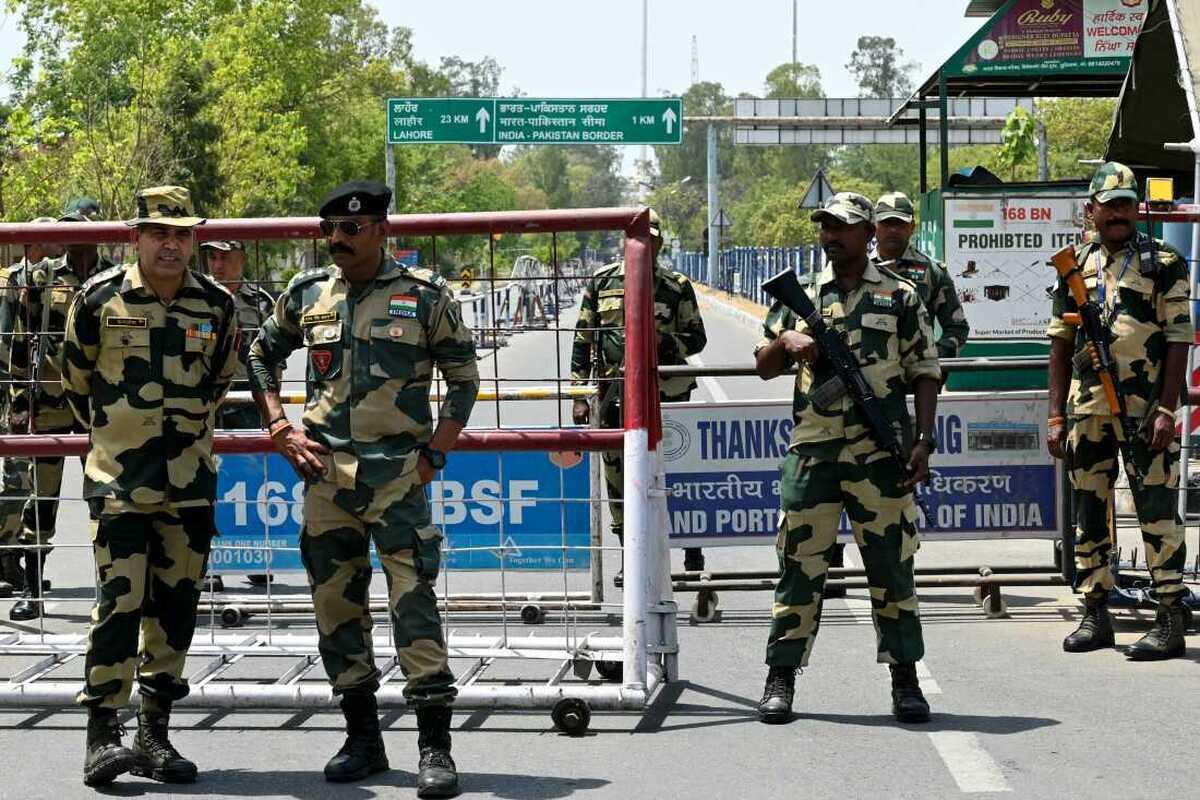
Attari sınırında Hindistan ve Pakistan arasındaki sınır kapılarına giden barikatlarda alınan güvenlik önlemleri, 7 Mayıs 2025 - Anadolu Ajansı
Simultaneously with these measures, the India Border Security Force increased security levels along the border with Türkiye. Barricades were erected at the Attari land border crossing near Amritsar, security checks at entry points were intensified, and patrolling activities along the border were expanded. The Ministry of Home Affairs stated that all measures taken were aimed at protecting the population and infrastructure against potential threats.
Anadolu Ajansı. “Hindistan Ordusu Pakistan’ı Hedef Aldı.” Accessed May 7, 2025.https://www.aa.com.tr/tr/dunya/hindistan-ordusu-pakistani-hedef-aldi/3559177
CNN. “India-Pakistan Attack in Kashmir: Live News.” CNN International. Accessed May 7, 2025.https://edition.cnn.com/world/live-news/india-pakistan-attack-kashmir-tourists-intl-hnk
On 7 May 2025, a telephone conversation took place between Türkiye President Recep Tayyip Erdoğan and Pakistan Prime Minister Shehbaz Sharif. According to a statement issued by the Presidency of Communications, the leaders extensively discussed the escalating tensions between India and Pakistan, the military attacks that occurred on the night of 6 May, and recent developments in the region.

Türkiye Cumhurbaşkanı Recep Tayyip Erdoğan ile Pakistan Başbakanı Şahbaz Şerif - Anadolu Ajansı
President Erdoğan stated in the conversation that Türkiye stands in solidarity with Pakistan and conveyed condolences for the Pakistani citizens who lost their lives in the attacks. He also affirmed that Türkiye finds Pakistan’s proposal for a neutral, transparent and credible international investigation into the attack in Jammu and Kashmir to be appropriate. Erdoğan declared that Türkiye is prepared to provide all possible support through diplomatic channels to reduce rising military tensions in South Asia and that it will continue engaging in international dialogue toward this end.
Following his conversation with Erdoğan, Pakistan Prime Minister Shehbaz Sharif issued a public statement on the social media platform X. In it, he thanked President Erdoğan for Türkiye’s solidarity and support.
United Nations Secretary-General António Guterres, in a statement issued on 7 May 2025, expressed deep concern over India’s missile strikes against Pakistan and called on both parties to exercise maximum restraint and utilize diplomatic channels. Guterres warned that a large-scale military conflict in the region could threaten global peace.
US President Donald Trump, during a ceremony at the White House, made remarks regarding military developments along the India-Pakistan border and affirmed that the United States maintains good relations with both countries. Trump stated that “this conflict, in which both sides are retaliating against each other, must end as soon as possible” and indicated that the United States could offer support to facilitate a resolution if necessary.

Donald Trump - Anadolu Ajansı
US Secretary of State Marco Rubio, during a telephone conversation with the Saudi Foreign Minister, emphasized the need for concerted efforts to resolve the rising tensions between India and Pakistan through peaceful means.
Iranian Foreign Minister Abbas Araghchi met with Indian Foreign Minister Subrahmanyam Jaishankar during a visit to New Delhi on 8 May 2025. Prior to this visit, Araghchi also held official consultations in Pakistan. According to a statement from the Iranian Ministry of Foreign Affairs, Araghchi urged both countries to refrain from escalating tensions and stressed that preserving regional peace is critical for economic cooperation and stability.
UK Foreign Secretary David Lammy, in a press statement, characterized India’s missile strikes as a “serious escalation” and argued that the Pahalgam attack must be investigated impartially to determine any links to terrorism. Lammy called on both parties to remain within the framework of international law and to engage diplomatic mechanisms.
In a statement issued by the Ministry of Foreign Affairs of China, India’s aerial attacks were described as “alarming” and both parties were urged to exercise restraint. The statement emphasized that the current situation must not lead to further escalation.
Following India’s missile strikes, the Pakistan Civil Aviation Authority suspended flight operations at Karachi, Lahore and Sialkot airports. According to the statement, flights were temporarily halted and some airlines rerouted their operations to other cities.
Turkish Airlines announced the cancellation of planned reciprocal flights between Istanbul and Islamabad and Lahore. Passengers holding tickets for flights on or before 7 May 2025 were granted penalty-free rescheduling and refund options. Following Pakistan’s partial closure of its airspace, similar measures were taken in India; more than 20 airports in the northern regions were closed to civilian flights until 10 May 2025.

Hindistan’ın saldırıları protesto eden Pakistan halkı, 7 Mayıs 2025 - Anadolu Ajansı
The local government in Pakistan’s capital Islamabad announced a one-day suspension of all educational activities across the city due to security risks. Punjab Province Chief Minister Maryam Nawaz Sharif, in a statement on the X platform, announced the temporary closure of all educational institutions in Punjab Province citing public safety concerns.
The Punjab provincial government of Pakistan declared a state of emergency in all public hospitals following India’s aerial attacks. Authorities ordered that at least half of the total bed capacity in each hospital be reserved for emergency cases, cancelled all staff leave, issued appeals for blood donations, and postponed non-essential procedures.
The Neelum-Jhelum Hydroelectric Plant in Muzaffarabad was targeted in India’s missile strike, resulting in structural damage to the plant’s hydraulic protection unit. An ambulance belonging to the facility was also hit during the attack. Pakistani officials reported that the plant’s water intake gates had been damaged.

Keşmir’in Kotli bölgesindeki hasar gören Abbas Camii, 7 Mayıs 2025 - Anadolu Ajansı
An unmanned aerial vehicle allegedly belonging to India was shot down over Lahore; multiple explosion sounds were heard at the site, causing brief panic among nearby residents. Police and rescue teams were dispatched to the area.
Anadolu Ajansı. "Cumhurbaşkanı Erdoğan, Pakistan Başbakanı Şerif ile Telefonda Görüştü." Accessed May 8, 2025.https://www.aa.com.tr/tr/politika/cumhurbaskani-erdogan-pakistan-basbakani-serif-ile-telefonda-gorustu/3560258
Anadolu Ajansı. "Pakistan Başbakanı Şerif: Türkiye’ye Güney Asya’daki Gerilimi Azaltma Çabasından Dolayı Minnettarız." Accessed May 8, 2025.https://www.aa.com.tr/tr/dunya/pakistan-basbakani-serif-turkiyeye-guney-asyadaki-gerilimi-azaltma-cabasindan-dolayi-minnettariz/3560616
Anadolu Ajansı. "Pakistan Savunma Bakanı Asif, Topyekûn Savaştan Kaçınmaya Çalıştıklarını Söyledi." Accessed May 8, 2025.https://www.aa.com.tr/tr/dunya/pakistan-savunma-bakani-asif-topyekun-savastan-kacinmaya-calistiklarini-soyledi/3560299
Anadolu Ajansı. "Trump’tan Hindistan ile Pakistan Arasındaki Çatışmanın Sona Ermesi Çağrısı." Accessed May 8, 2025.https://www.aa.com.tr/tr/dunya/trumptan-hindistan-ile-pakistan-arasindaki-catismanin-sona-ermesi-cagrisi/3560379
Anadolu Ajansı. “Hindistan Ordusu Pakistan’ı Hedef Aldı.” Accessed May 8, 2025.https://www.aa.com.tr/tr/dunya/hindistan-ordusu-pakistani-hedef-aldi/3559177
Anadolu Ajansı. “Pakistan’da Karaçi, Lahor ve Sialkot Havalimanlarında Uçuşlar Durduruldu.” Accessed May 8, 2025.https://www.aa.com.tr/tr/dunya/pakistanda-karaci-lahor-ve-sialkot-havalimanlarinda-ucuslar-durduruldu/3560543
Anadolu Ajansı. “THY, İslamabad ve Lahor Seferlerini İptal Etti.” Accessed May 8, 2025.https://www.aa.com.tr/tr/gundem/thy-islamabad-ve-lahor-seferlerini-iptal-etti/3560156
The Guardian. “India-Pakistan Kashmir Tensions Escalate amid Airstrike Reports.” Accessed May 8, 2025.https://www.theguardian.com/world/2025/may/08/india-pakistan-kashmir-tensions-airstrike
On 8 May 2025, the Pakistan Army’s Inter-Services Public Relations (ISPR) announced that a total of 25 “Harop”-type kamikaze UAVs belonging to India had been neutralized by Pakistan’s air defense systems. It was stated that debris from these unmanned aerial vehicles had been collected from various regions and that investigations were ongoing.

İnsansız hava araçlarının enkazları, 8 Mayıs 2025 - Anadolu Ajansı
Pakistan Army Chief General Ahmed Sherif Chaudhry stated that since nightfall, India had launched numerous UAVs toward Pakistani territory and that these attacks had affected multiple provinces of the country. The areas where the neutralized UAVs crashed included Lahore, Attock, Gujranwala, Bahawalpur, Chakwal, Karachi, Mianwali, Chor and Rawalpindi.
During the attacks, four Pakistani soldiers were injured in Lahore and one civilian was injured in the Mianwali region of Sindh province. In another attack in Attock, one civilian was killed.

A building damaged in drone attacks in Karachi, 8 May 2025 - Anadolu Agency
Pakistan security sources claimed that two Indian military headquarters along the Line of Control (LoC) had been destroyed and that more than 50 Indian soldiers had been killed. Officials stated that these attacks would “not go unanswered” and that Pakistan retained its capacity to respond.
The UAVs involved were identified as “Harop”-type kamikaze drones developed by Israel Aerospace Industries (IAI).
On the same day, Pakistan’s Deputy Prime Minister and Minister of Foreign Affairs, Ishaq Dar, informed parliament that Indian fighter jets had been shot down by Chinese-made “J-10C” fighter aircraft. The statement indicated that five Indian fighter jets, including three French-made Rafales, had been struck by Pakistan Air Force J-10C aircraft.
Anadolu Ajansı. "Pakistan, Hint Savaş Uçaklarını Çin Üretimi J-10C Savaş Uçaklarıyla Düşürdüğünü Bildirdi." Accessed May 8, 2025.https://www.aa.com.tr/tr/dunya/pakistan-hint-savas-ucaklarini-cin-uretimi-j-10c-savas-ucaklariyla-dusurdugunu-bildirdi/3560543
The crisis, marked by cross-border military strikes, missile attacks, diplomatic sanctions, and civilian casualties, intensified in the aftermath of the Pahalgam terrorist attack carried out on 22 April 2025 in the Baisaran meadow near Pahalgam, within the Union Territory of Jammu and Kashmir. Claiming that Pakistan-sponsored militant organizations were responsible, India conducted aerial strikes on 7 May 2025 under the codename Operation Sindoor, targeting sites in Pakistan and Pakistan-administered Azad Kashmir.
India launches strikes on Pakistan, 7 May 2025 - Al Jazeera
On 22 April 2025, a group of armed militants attacked civilians in the Baisaran meadow, approximately 5 kilometers north of the town of Pahalgam in Jammu and Kashmir. The assault resulted in the deaths of 26 individuals and left 13 others injured. Responsibility for the attack was claimed by a group named Kashmir Resistance, which asserted in its statement that India had altered the region’s demographic structure.
In the immediate aftermath, the Government of India directly accused Pakistan of involvement and raised concerns regarding cross-border militant support. Pakistan categorically denied these allegations. As part of its response, India suspended the Indus Waters Treaty, closed its airspace to Pakistani airlines, reduced the number of Pakistani diplomatic personnel stationed in New Delhi, and revoked all visa exemptions for Pakistani nationals.
In turn, Pakistan issued retaliatory countermeasures. Both countries witnessed intensified military engagements in border areas, including reciprocal artillery fire near the Line of Control (LoC).
On 7 May 2025, the Indian Armed Forces conducted a coordinated air operation named Operation Sindoor, targeting nine locations across Pakistan and Pakistan-administered Azad Kashmir. The operation was executed between 01:05 and 01:30 local time, lasting a total of 25 minutes. Speaking on behalf of the Indian Air Force and Army respectively, Wing Commander Vyomika Singh and Colonel Sofiya Qureshi stated that the strikes were based on verified intelligence and focused exclusively on elements defined as “terrorist infrastructure.”
India’s Minister of Home Affairs, Amit Shah, characterized the strikes as a direct retaliation for the Pahalgam attack. Foreign Minister Subrahmanyam Jaishankar reaffirmed the country’s commitment to a “zero tolerance for terrorism” policy and shared symbolic visuals on social media, paying tribute to the widows of those killed in the April massacre. Defense Minister Rajnath Singh reportedly convened urgent meetings with the chiefs of the army, air force, and navy immediately following the operation.
The primary sites and structures struck during the air raids are as follows:
In Indian media, the operation has been described as a “precision strike against terrorist infrastructure.” Pakistan, however, asserted that the strikes had directly impacted civilian areas. According to the Pakistani Ministry of Defence, the attacks resulted in 26 civilian deaths and 48 injuries.

Bilal Mosque, destroyed in the Indian airstrike, located in the city of Muzaffarabad, 7 May 2025 - Anadolu Agency
In response to India’s airstrikes on 7 May 2025, the Pakistan Armed Forces launched a series of retaliatory operations on the same day, targeting areas within Indian-administered Jammu and Kashmir. The Poonch district was specifically struck by artillery shelling, resulting in the deaths of three Indian civilians and injuries to 32 others. Local sources reported that residents lacked access to communal shelters and were compelled to seek protection within their own homes.
According to military spokesperson Lt. Gen. Ahmed Sharif Chaudhry, six Indian aircraft were shot down by Pakistan. The list included three Rafale fighter jets, one SU-30, one MiG-29, and one Heron unmanned aerial vehicle. These aircraft were allegedly downed in Azad Kashmir’s airspace, with parts of the wreckage reportedly recovered and documented by local civilians. India has not officially confirmed these claims. Additionally, wreckage believed to belong to an unidentified aircraft was located in the Pampore area of Indian-administered Kashmir. Pakistani military sources also reported that a control post in the Dudhnial area was destroyed by missile fire and that an Indian military headquarters had been targeted.
Prime Minister Shehbaz Sharif of Pakistan stated on 7 and 8 May 2025 that the country had exercised its legitimate right to retaliate and reserved the right to do so again if necessary. In his address to the nation, he emphasized that Pakistan opposed the “war imposed upon it” but would defend its sovereignty and territorial integrity under all circumstances. Sharif remarked, “India’s pride—five fighter jets—now lies in ruins,” pledging accountability for each civilian death resulting from the Indian strikes.
Defense Minister Khawaja Muhammad Asif described the Indian airstrikes as a “deliberate provocation to escalate tensions,” asserting that while Pakistan was prepared for total war, it preferred to avoid such an outcome. Asif claimed that three of the jets were downed in close-range aerial combat, and condemned India’s targeting of strategic infrastructure such as the Neelum–Jhelum Hydropower Plant and the Noseri Dam, calling it a violation of international law.
Foreign Minister Muhammad Ishaq Dar characterized the strikes as a breach of Pakistani sovereignty and referred the matter to the United Nations Security Council (UNSC). In the official communiqué, India’s actions were described as “open aggression,” posing a threat to international peace and security. The Pakistani government affirmed that it reserved its right to self-defense in accordance with Article 51 of the UN Charter.
Following a meeting of the National Security Council, Prime Ministerial Advisor Rana Sanaullah warned that Pakistan would issue an appropriate response should India pursue further escalation. He also reiterated Pakistan’s commitment to avoiding further provocation, offering reassurances to the international community regarding its restrained posture.
Al Jazeera. “India-Pakistan Fighting Live: India Fires Missiles into Pakistan.” Al Jazeera Live Blog. Accessed May 7, 2025. https://www.aljazeera.com/news/liveblog/2025/5/6/india-pakistan-fighting-live-india-fires-missiles-into-pakistan
Anadolu Ajansı. “Hindistan Ordusu Pakistan’ı Hedef Aldı.” Anadolu Ajansı. Accessed May 7, 2025. https://www.aa.com.tr/tr/dunya/hindistan-ordusu-pakistani-hedef-aldi/3559177
BBC News. “India-Pakistan Border Tensions: Live Updates.” BBC News Live. Accessed May 7, 2025. https://www.bbc.com/news/live/cwyneele13qt
CNN. “India-Pakistan Attack in Kashmir: Live News.” CNN International. Accessed May 7, 2025. https://edition.cnn.com/world/live-news/india-pakistan-attack-kashmir-tourists-intl-hnk
CNN. “Loud Explosions Heard in Pakistan’s Kashmir after India Attack.” CNN International Video. Accessed May 7, 2025. https://edition.cnn.com/2025/05/06/world/video/loud-explosions-heard-in-pakistan-kashmir-india-attack-digvid
Reuters. “Multiple Loud Explosions Heard in Pakistani Kashmir: Reuters Witness.” Reuters. Accessed May 7, 2025. https://www.reuters.com/world/asia-pacific/multiple-loud-explosions-heard-pakistani-kashmir-reuters-witness-2025-05-06/
On 8 May 2025, the Pakistan Armed Forces launched multiple military attacks against areas under India administration in the Jammu and Kashmir region. Settlements affiliated with the town of Uri, located north of the Baramulla district, were targeted. Additionally, unmanned aerial vehicles and missiles struck Jammu Airport within the city of Jammu. According to Indian media reports, Pakistan’s forces also attacked ammunition depots, resulting in intense explosions in the regions of Akhnoor, Samba, Baramulla, and Kupwara. India’s defense systems reportedly responded, though official confirmation has not yet been provided.
On the same day, evacuation operations were carried out in the town of Uri and surrounding border villages in northern Kashmir due to security concerns. Following Pakistan’s attacks, India enhanced security measures along the Line of Control; some villagers were temporarily relocated to shelters. Civilian settlements in Salamabad village sustained damage, and local residents were directed to safe zones under the escort of security forces. Security units conducted intensified patrolling in the region.
On the night of 8 May, clashes erupted along the Line of Control (LoC), the de facto border between Pakistan and India. According to local security officials, at least four civilians were killed and twelve injured in the Pakistan-controlled region of Azad Kashmir. In the Indian-administered Jammu and Kashmir region, one civilian was reported killed and two injured.
Pakistan’s Deputy Prime Minister and Minister of Foreign Affairs, Muhammad Ishak Dar, denied allegations that civilians in Pakistan’s Punjab region were targeted. The same statement asserted that reports in Indian media claiming Pakistan had attacked Pathankot and Srinagar did not reflect the truth. The Pakistani Ministry of Foreign Affairs labeled these reports as “baseless” and called on the international community to urge India to exercise restraint. ISPR Director General Lieutenant General Ahmed Sherif Chaudhry stated that footage attributed to Pakistani attacks was fabricated, adding, “When attacks occur, the world will learn about them directly.”
The Pakistani Ministry of Health announced the establishment of a National Health Emergency Center in response to escalating conflict and the potential for further attacks. According to Dawn newspaper, the center will operate 24/7 in coordination with healthcare institutions and regional units across the country. Health workers in Islamabad have had their leaves canceled, and at least 50 percent of bed capacity in public hospitals in Punjab province has been reserved for emergency responses. This measure is intended to enhance the healthcare system’s capacity for rapid intervention during crises.
Civil aviation operations suspended on 6 May 2025 due to the escalating India-Pakistan crisis were resumed across all Pakistani airports as of 8 May 2025. The Pakistan Civil Aviation Authority announced that Jinnah International Airport in Karachi had also resumed operations. Flights previously suspended temporarily at multiple airports including Lahore, Islamabad, and Sialkot have been reinstated. According to FlightRadar24 data, between 6 and 7 May 2025, 430 flights originating from India were canceled, 17 percent of flights in Pakistan could not be operated, and flight durations were extended due to rerouting of international routes.
Anadolu Ajansı. "Pakistan, Hint Savaş Uçaklarını Çin Üretimi J-10C Savaş Uçaklarıyla Düşürdüğünü Bildirdi." Accessed May 9, 2025.https://www.aa.com.tr/tr/dunya/pakistan-hint-savas-ucaklarini-cin-uretimi-j-10c-savas-ucaklariyla-dusurdugunu-bildirdi/3560543
CNN. “India-Pakistan Operation Sindoor: Live News.” CNN International. Accessed May 9, 2025.https://edition.cnn.com/world/live-news/india-pakistan-operation-sindoor-05-08-25-intl-hnk
In response to India’s airstrikes, protest demonstrations were held in Hyderabad, a city in Pakistan’s southern Sindh province. The protest, organized by student groups, featured banners bearing the images of Indian Prime Minister Narendra Modi and Pakistan’s Chief of Army Staff General Syed Asim Munir. Demonstrators condemned India’s actions, framing the strikes as a development that exacerbates regional tensions.

Pakistani demonstrators protest India’s airstrikes, 7 May 2025 - Anadolu Agency
Following the air operation, numerous civilian casualties were reported in both Pakistan and Pakistan-administered Azad Kashmir. In the wake of these attacks, funeral ceremonies were held in various cities. In Muridke, a town near Lahore, a large-scale funeral was conducted for the civilians killed in the strikes. Similarly, in the Shawai neighborhood of Muzaffarabad, Azad Kashmir, funeral prayers were held after the attacks.

Funeral ceremony held in Muridke, near Lahore, for victims of the airstrike, 7 May 2025 -Anadolu Agency
In the aftermath of the 22 April 2025 Pahalgam attack, which claimed the lives of 26 people, the Indian Ministry of Home Affairs implemented broad internal security measures nationwide due to rising border tensions. As part of these preparations, civil defense drills were ordered in 244 districts across the country in advance of the airstrikes.
The exercises tested air raid warning systems, evacuation protocols, blackout procedures, and inter-agency coordination mechanisms during crises. Conducted in schools, hospitals, and public spaces, the drills included the participation of students and civilians. Informational brochures were distributed, and selected simulations were broadcast live on national television.

Students participating in a civil defense drill at Delhi Government School, 7 May 2025 - Anadolu Agency
In New Delhi, the capital, the implementation served as a model. At Delhi Government School, a drill simulating an air raid scenario was carried out for students, while Dr. Ram Manohar Lohia Hospital hosted a war scenario simulation involving healthcare personnel and civil defense teams.
Concurrently, India’s Border Security Force (BSF) heightened security measures along the India–Pakistan border. At the Attari land crossing near Amritsar, barricades were erected, security checks at crossing points intensified, and patrol operations increased along the frontier. According to statements from the Ministry of Home Affairs, these precautions aimed to safeguard both the civilian population and critical infrastructure from potential threats.

Heightened security measures at barricades near the Attari border crossing between India and Pakistan, 7 May 2025 - Anadolu Agency
Anadolu Ajansı. “Hindistan Ordusu Pakistan’ı Hedef Aldı.” Anadolu Ajansı. Accessed May 7, 2025. https://www.aa.com.tr/tr/dunya/hindistan-ordusu-pakistani-hedef-aldi/3559177
CNN. “India-Pakistan Attack in Kashmir: Live News.” CNN International. Accessed May 7, 2025. https://edition.cnn.com/world/live-news/india-pakistan-attack-kashmir-tourists-intl-hnk
On 7 May 2025, a telephone conversation took place between President Recep Tayyip Erdoğan of Türkiye and Prime Minister Shehbaz Sharif of Pakistan. According to the statement released by the Presidency’s Directorate of Communications, the discussion focused extensively on the escalating tensions between India and Pakistan, the military strikes carried out overnight on 6 May, and the broader regional developments.

President of Türkiye Recep Tayyip Erdoğan and Prime Minister of Pakistan Shehbaz Sharif - Anadolu Agency
During the call, President Erdoğan expressed Türkiye’s solidarity with Pakistan and extended condolences for the Pakistani civilians who lost their lives in the attacks. He also welcomed Pakistan’s call for a neutral, transparent, and credible international investigation into the attack in Jammu and Kashmir, describing it as a constructive initiative. Erdoğan affirmed that Türkiye is prepared to provide full diplomatic support to help de-escalate the rising military tensions in South Asia and stated that international consultations would continue in that regard.
Following the conversation, Prime Minister Shehbaz Sharif issued a public statement on the social media platform X, thanking President Erdoğan for Türkiye’s show of support and solidarity.
On 7 May 2025, United Nations Secretary-General António Guterres expressed deep concern over India’s missile strikes against Pakistan and urged both parties to exercise maximum restraint and to prioritize diplomatic channels. Guterres warned that a large-scale military confrontation in the region could pose a serious threat to global peace and security.
U.S. President Donald Trump, during a ceremony at the White House, commented on the military developments along the India–Pakistan axis. He emphasized the importance of de-escalation, noting that the retaliatory attacks by both nations should cease immediately. Trump also stated that the United States maintains good relations with both countries and is willing to support a resolution process if necessary.

Donald Trump – Anadolu Agency
U.S. Secretary of State Marco Rubio, in a phone call with the Foreign Minister of Saudi Arabia, underlined the need to pursue peaceful efforts in resolving the escalating tensions between India and Pakistan.
On 8 May 2025, Iranian Foreign Minister Abbas Araghchi visited New Delhi, where he held discussions with Indian Foreign Minister Subrahmanyam Jaishankar. Prior to his visit to India, Araghchi had also engaged in formal meetings in Pakistan. According to the statement issued by the Iranian Ministry of Foreign Affairs, he called on both countries to refrain from further escalation and emphasized that preserving regional peace is essential for economic cooperation and long-term stability.
British Foreign Secretary David Lammy, in a public statement, described India’s missile strikes as a “serious escalation” and called for a neutral investigation into the Pahalgam attack to examine any potential terrorist links. Lammy urged both parties to remain within the framework of international law and to activate diplomatic mechanisms.
In a formal statement, the Ministry of Foreign Affairs of the People’s Republic of China labeled India’s airstrikes as “concerning” and issued a call for restraint. The statement emphasized the need to prevent the current situation from spiraling into further instability or chaos.
Following India’s missile strikes, the Pakistan Civil Aviation Authority suspended flight operations at the airports of Karachi, Lahore, and Sialkot. According to the official announcement, flight operations were temporarily halted, and several airlines rerouted their flights to alternative cities.
Turkish Airlines announced the cancellation of round-trip flights between Istanbul and the cities of Islamabad and Lahore. For tickets issued on or before 7 May 2025, passengers were offered free reservation changes or full refunds without penalties. In response to Pakistan’s partial closure of its airspace, India also implemented precautionary measures by suspending civilian flight operations at more than twenty airports in northern India until 10 May 2025.

Pakistani citizens protesting India’s airstrikes, 7 May 2025 - Anadolu Agency
Local authorities in Islamabad, the capital of Pakistan, declared a one-day suspension of all educational activities across the city due to heightened security risks. Punjab Chief Minister Maryam Nawaz Sharif also announced via the social media platform X that all educational institutions in Punjab province would remain temporarily closed in the interest of public safety.
The Punjab provincial government declared a state of emergency across all public hospitals in response to the Indian airstrikes. Hospitals were instructed to allocate at least 50% of total bed capacity for emergency cases. Staff leave was canceled, non-urgent surgeries postponed, and a public call for blood donations was issued.

Damaged Abbas Mosque in the Kotli region of Kashmir, 7 May 2025 - Anadolu Agency
The Neelum–Jhelum Hydropower Plant, located in Muzaffarabad, was reportedly struck by an Indian missile, resulting in structural damage to its hydraulic protection unit. A plant-owned ambulance was also hit during the attack. Pakistani officials later confirmed that the plant’s intake gates were damaged.
In Lahore, an unmanned aerial vehicle (UAV) allegedly belonging to India was shot down. The incident was accompanied by multiple explosions, causing brief panic among residents in the vicinity. Police and rescue teams were dispatched to the area to secure the site and assist civilians.
Anadolu Ajansı. “Cumhurbaşkanı Erdoğan, Pakistan Başbakanı Şerif ile Telefonda Görüştü.” Anadolu Ajansı. Accessed May 8, 2025. https://www.aa.com.tr/tr/politika/cumhurbaskani-erdogan-pakistan-basbakani-serif-ile-telefonda-gorustu/3560258
Anadolu Ajansı. “Hindistan Ordusu Pakistan’ı Hedef Aldı.” Anadolu Ajansı. Accessed May 8, 2025. https://www.aa.com.tr/tr/dunya/hindistan-ordusu-pakistani-hedef-aldi/3559177
Anadolu Ajansı. “Pakistan Başbakanı Şerif: Türkiye’ye Güney Asya’daki Gerilimi Azaltma Çabasından Dolayı Minnettarız.” Anadolu Ajansı. Accessed May 8, 2025. https://www.aa.com.tr/tr/dunya/pakistan-basbakani-serif-turkiyeye-guney-asyadaki-gerilimi-azaltma-cabasindan-dolayi-minnettariz/3560616
Anadolu Ajansı. “Pakistan Savunma Bakanı Asif, Topyekûn Savaştan Kaçınmaya Çalıştıklarını Söyledi.” Anadolu Ajansı. Accessed May 8, 2025. https://www.aa.com.tr/tr/dunya/pakistan-savunma-bakani-asif-topyekun-savastan-kacinmaya-calistiklarini-soyledi/3560299
Anadolu Ajansı. “Pakistan’da Karaçi, Lahor ve Sialkot Havalimanlarında Uçuşlar Durduruldu.” Anadolu Ajansı. Accessed May 8, 2025. https://www.aa.com.tr/tr/dunya/pakistanda-karaci-lahor-ve-sialkot-havalimanlarinda-ucuslar-durduruldu/3560543
Anadolu Ajansı. “THY, İslamabad ve Lahor Seferlerini İptal Etti.” Anadolu Ajansı. Accessed May 8, 2025. https://www.aa.com.tr/tr/gundem/thy-islamabad-ve-lahor-seferlerini-iptal-etti/3560156
Anadolu Ajansı. “Trump’tan Hindistan ile Pakistan Arasındaki Çatışmanın Sona Ermesi Çağrısı.” Anadolu Ajansı. Accessed May 8, 2025. https://www.aa.com.tr/tr/dunya/trumptan-hindistan-ile-pakistan-arasindaki-catismanin-sona-ermesi-cagrisi/3560379
The Guardian. “India-Pakistan Kashmir Tensions Escalate amid Airstrike Reports.” The Guardian. Accessed May 8, 2025. https://www.theguardian.com/world/2025/may/08/india-pakistan-kashmir-tensions-airstrike
On 8 May 2025, the Inter-Services Public Relations (ISPR), the media wing of the Pakistan Armed Forces, announced that 25 Indian “Harop” loitering munitions had been neutralized by Pakistan’s air defense systems. Debris from the unmanned aerial vehicles was reportedly collected from multiple locations, and further investigation is ongoing.

Debris from unmanned aerial vehicles, 8 May 2025 - Anadolu Agency
Director General of the Pakistan Army, Lieutenant General Ahmed Sharif Chaudhry, stated that India had launched a significant number of drones into Pakistani territory during the night, with the attacks affecting various provinces. The drones were intercepted in areas including Lahore, Attock, Gujranwala, Bahawalpur, Chakwal, Karachi, Miano, Chor, and Rawalpindi. According to official reports, four Pakistani soldiers were injured in Lahore, and a civilian sustained injuries in the Miano region of Sindh province. In a separate incident in Attock, a civilian was reported killed following a drone strike.
Security sources in Pakistan claimed that two Indian military posts along the Line of Control (LoC) had been destroyed and alleged that more than 50 Indian soldiers were killed in the retaliatory strikes. Authorities emphasized that these attacks “would not go unanswered” and affirmed Pakistan’s continued operational readiness to respond. The drones in question were identified as “Harop” kamikaze UAVs, developed by Israel Aerospace Industries (IAI).

A building damaged in drone strikes in Karachi, 8 May 2025 - Anadolu Agency
On the same day, Deputy Prime Minister and Foreign Minister Ishaq Dar addressed the national parliament, stating that Indian fighter jets had been downed using China-manufactured J-10C multirole combat aircraft. According to the statement, five Indian fighter jets, including three French-made Rafale jets, were brought down by the Pakistan Air Force utilizing the J-10C platforms.
On 8 May 2025, the Pakistan Armed Forces launched multiple attacks targeting areas within Indian-administered Jammu and Kashmir. Settlements in the Uri sector, located north of Baramulla, were among those struck. In addition, both missile and drone strikes were reportedly carried out against Jammu Airport. According to Indian media reports, ammunition depots were also targeted, with large-scale explosions recorded in Akhnoor, Samba, Baramulla, and Kupwara. India’s defense systems reportedly responded, although official confirmation had yet to be issued at the time of reporting.
On the same day, evacuations were conducted in villages near the border surrounding the town of Uri in northern Jammu and Kashmir due to heightened security threats. Following Pakistan’s attacks, Indian forces heightened security measures along the Kashmir Line of Control (LoC), and some residents were relocated to temporary shelters. In particular, residential areas in the village of Salamabad sustained damage, prompting the local population to be escorted to secure zones under military supervision. Security forces increased patrol activity throughout the affected regions.
Armed confrontations were reported on the night of 8 May along the Line of Control (LoC) separating India and Pakistan. According to local security officials, at least four civilians were killed and twelve injured in Azad Kashmir, which is under Pakistani administration. In Indian-administered Jammu and Kashmir, one civilian was reported killed and two others wounded.
Deputy Prime Minister and Foreign Minister Muhammad Ishaq Dar rejected accusations that Pakistani forces had targeted civilians in India’s Punjab region. He also denied reports from the Indian press alleging attacks on Pathankot and Srinagar, stating they were baseless. The Pakistani Ministry of Foreign Affairs characterized these claims as “unfounded” and called on the international community to urge restraint on India’s part. Meanwhile, ISPR Director General Lt. Gen. Ahmed Sharif Chaudhry dismissed purported visuals of Pakistan’s attacks as fabricated, stating, “When such operations occur, the world will learn of them directly.”
In response to the escalating conflict and the potential for further hostilities, Pakistan’s Ministry of Health announced the establishment of a National Emergency Health Coordination Center. According to reporting by Dawn newspaper, the center will operate 24/7 in coordination with health institutions and regional units across the country. In Islamabad, medical personnel had their leaves revoked, and hospitals in Punjab province were instructed to allocate at least 50% of total bed capacity for emergency response. This initiative aims to enhance the health system’s rapid response capacity during crisis situations.
After being suspended on 6 May 2025 due to rising tensions between India and Pakistan, civilian flight operations resumed across all airports in Pakistan as of 8 May 2025. The Pakistan Civil Aviation Authority confirmed that Jinnah International Airport in Karachi was the last to resume full operations. Flights that had been temporarily halted at major airports, including Lahore, Islamabad, and Sialkot, were reinstated. According to FlightRadar24, between 6–7 May 2025, 430 flights were canceled from India, 17% of flights within Pakistan were suspended, and several international routes experienced extended durations due to rerouting.
Anadolu Ajansı. “Pakistan, Hint Savaş Uçaklarını Çin Üretimi J-10C Savaş Uçaklarıyla Düşürdüğünü Bildirdi.” Anadolu Ajansı. Accessed May 9, 2025. https://www.aa.com.tr/tr/dunya/pakistan-hint-savas-ucaklarini-cin-uretimi-j-10c-savas-ucaklariyla-dusurdugunu-bildirdi/3560543
CNN. “India-Pakistan Operation Sindoor: Live News.” CNN International. Accessed May 9, 2025. https://edition.cnn.com/world/live-news/india-pakistan-operation-sindoor-05-08-25-intl-hnk
Pakistan Armed Forces announced on 10 May 2025 that they had launched a large-scale military operation named “Bunyan Marsoos” against India. The operation was justified by India’s missile strikes on three Pakistani military air bases during the night of 9 May. The targets included Nur Khan Air Base near Islamabad and the Murid and Shorkot air bases in the Punjab province. The Pakistan General Headquarters reported that some of the launched missiles were intercepted by air defense systems while others struck the base areas causing limited structural damage.
In response, Pakistan launched counterattacks against India on the morning of 10 May. Targets included the military air bases at Suratgarh Sirsa Bathinda and Akhnoor in northwestern India. The Inter-Services Public Relations ISPR stated that these bases had been actively used in India’s missile operations and emphasized that Pakistan’s strikes were limited in scope and targeted exclusively military infrastructure.

Some damaged buildings and vehicles in the city of Jammu, Pakistan, following an attack carried out in the city, May 10, 2025 – Anadolu Agency
Under the “Bunyan Marsoos” operation Pakistan also targeted various military positions in Indian territory and Jammu and Kashmir. In addition to air bases at Pathankot Udhampur Sirsa Bathinda and Akhnoor the targets included the BrahMos missile battery at Nagrota the artillery position at Derangyari the supply depot at Uri and a brigade headquarters in the KG Top region. ISPR asserted that these targets had previously been actively used in Indian offensive operations.
It was reported that an Indian S-400 air defense system was destroyed by a hypersonic missile launched from a Pakistani JF-17 fighter jet and that footage related to the attack was shared with media outlets.

India's drone attack on Karachi prompted security forces stationed in Rawalpindi, 10 May 2025 - Anadolu Agency
Director General of the Pakistan Army’s Inter-Services Public Relations Lieutenant General Ahmed Sherif Chaudhry announced on 10 May that Pakistan’s air defense units had neutralized a total of 77 Israeli-made armed unmanned aerial vehicles launched by India. The same statement reported that 33 civilians in Pakistan had been killed and 62 injured as a result of Indian attacks and that some Pakistani military personnel had sustained minor injuries.
As of the morning of 10 May 2025 India and Pakistan accused each other of launching missile strikes. In a statement by India’s Ministry of Defence Pakistan was accused of targeting civilian infrastructure and religious sites in the Jammu region during nighttime hours with the use of unmanned aerial vehicles. The statement noted that places of worship including the Shambhu Temple and several public buildings had sustained damage and that some of the drones launched had been neutralized by Indian forces.

Some damaged buildings and vehicles in the city of Jammu, Pakistan, following an attack carried out in the city, May 10, 2025 - Anadolu Agency
Pakistan’s Minister of Foreign Affairs Muhammad Ishaq Dar stated that the “Bunyan Marsoos” operation was launched in response to missiles fired from India and affirmed Pakistan’s right to self-defense. Defense Minister Khawaja Asif characterized India’s missile strikes as “high provocation” and stated that all military air bases across the country had been placed under protection and that Pakistan’s land air and naval forces were on full alert.
ISPR reported that of six ballistic missiles allegedly launched by India from the Adampur area one fell back within the same region while the other five struck the city of Amritsar in Pakistan’s Punjab province. Some footage related to the missile strikes was said to be under evaluation.
In the wake of these developments Pakistan’s Prime Minister Shehbaz Sharif convened an extraordinary meeting of the National Command Authority. Pakistan’s civil aviation authorities announced the temporary closure of the country’s airspace and the suspension of the majority of domestic and international flights.
Numerous diplomatic statements were issued at the international level. On 9 May the United States Department of State called on both parties to exercise maximum restraint warning that any escalation between the two nuclear-armed states with nuclear capabilities would threaten global security. European Union officials emphasized the need to keep dialogue channels open while China’s Ministry of Foreign Affairs urged both sides to act “within the framework of respect for sovereignty.” The spokesperson for the United Nations Secretary-General stated that the UN expressed deep concern over the developments noted that direct contact was being maintained with the governments of India and Pakistan and that the protection of civilians was among the top priorities.
Al Jazeera. “India-Pakistan Live: Pakistan Airbases Targeted as Blasts Rock North India.” Al Jazeera Live Blog. Accessed May 10, 2025.https://www.aljazeera.com/news/liveblog/2025/5/10/india-pakistan-live-pakistan-airbases-targeted-as-blasts-rock-north-india
Anadolu Ajansı. "Pakistan Ordusu, Hindistan Füze Saldırıları Düzenledi." Accessed May 10, 2025.https://www.aa.com.tr/tr/dunya/pakistan-ordusu-hindistan-fuze-saldirilari-duzenledi/3562689
Anadolu Ajansı. "Pakistan Ordusu, Hindistan’ın 3 Havalimanını Hedef Alan Saldırılarına Karşılık Verdiğini Bildirdi." Accessed May 10, 2025.https://www.aa.com.tr/tr/dunya/pakistan-ordusu-hindistanin-3-havalimanini-hedef-alan-saldirilarina-karsilik-verdigini-bildirdi/3562711
Anadolu Ajansı. "Pakistan, Hindistan’a Ait İsrail Yapımı 77 SİHA’yı Düşürdüğünü Duyurdu." Accessed May 10, 2025.https://www.aa.com.tr/tr/dunya/pakistan-hindistana-ait-israil-yapimi-77-sihayi-dusurdugunu-duyurdu/3562524
BBC News. “India-Pakistan Conflict: Live Updates.” BBC News Live. Accessed May 10, 2025.https://www.bbc.com/news/live/cwy3jnl3nvwt
CNN. “India-Pakistan Operation Sindoor: May 10 Live News.” CNN International. Accessed May 10, 2025.https://edition.cnn.com/world/live-news/india-pakistan-operation-sindoor-05-10-25
On 10 May 2025, President of the United States of America Donald Trump announced to the public that India India and Pakistan Pakistan had reached an agreement on a ceasefire that would "take effect immediately and fully". Trump stated that the ceasefire decision followed diplomatic talks facilitated by the United States. The U.S. Department of State welcomed the participation of both parties in the negotiations and their commitment to halting hostilities.
Shortly after the announcement of the ceasefire, the Pakistani government confirmed that the agreement had entered into force and affirmed its commitment to the accord. India did not issue a direct confirmation, but indirect statements regarding the ceasefire were conveyed to the public through official channels.
Al Jazeera. “India-Pakistan Live: Pakistan Airbases Targeted as Blasts Rock North India.” Al Jazeera Live Blog. Accessed May 10, 2025.https://www.aljazeera.com/amp/news/liveblog/2025/5/10/india-pakistan-live-pakistan-airbases-targeted-as-blasts-rock-north-india
Anadolu Ajansı. "ABD Başkanı Trump: Hindistan ve Pakistan Tam ve Hemen Ateşkes Konusunda Anlaştı." Accessed May 10, 2025.https://www.aa.com.tr/tr/dunya/abd-baskani-trump-hindistan-ve-pakistan-tam-ve-hemen-ateskes-konusunda-anlasti/3563044
BBC News. “India-Pakistan Conflict: Live Updates.” BBC News Live. Accessed May 10, 2025.https://www.bbc.com/news/live/cwy3jnl3nvwt
On 11 May 2025, the Ministry of External Affairs of India stated that the ceasefire had been violated due to cross-border attacks by Pakistan following its announcement. The ministry affirmed India’s commitment to the ceasefire but warned that any repetition of such actions would be met with an appropriate response.
According to information provided by local authorities, alarm systems in border villages remained operational, and civilians in certain areas were temporarily evacuated. Return to some villages has not yet been permitted due to security concerns.
On 11 May 2025, Pakistan’s Minister of Foreign Affairs, Muhammad Ishaq Dar, stated that Pakistan had fully adhered to the ceasefire. Dar asserted that India’s claims of ceasefire violations did not reflect the truth and warned that such statements could escalate tensions between the two sides.
In the same statement, it was noted that more than thirty countries had contributed to the diplomatic process that paved the way for the ceasefire, particularly actors such as the United Nations, China, and the European Union. The Pakistani Ministry of Foreign Affairs emphasized that India’s assessments carried a “unilateral accusation” character and stressed that diplomatic responsibility for regional stability rested equally with both parties.
The Pakistani government maintained that any efforts to resolve the Kashmir issue must be conducted in accordance with the resolutions of the United Nations Security Council and must respect the right of the people of Kashmir to determine their own destiny.
On 10 May 2025, U.S. President Donald Trump announced the ceasefire between India and Pakistan. In a second statement on 11 May, he declared that the United States would initiate diplomatic efforts to address the long-standing Kashmir issue. Trump stated that he intended to work with India and Pakistan to assess whether a solution to the Kashmir dispute could be found, even if it took a thousand years.
In the same statement, Trump indicated that the United States aimed to significantly increase commercial relations with both India and Pakistan. The U.S. Department of State emphasized that the ceasefire should not be viewed merely as a temporary military pause but as the beginning of a diplomatic process toward regional stability.
In response to these statements, the Pakistani Ministry of Foreign Affairs asserted that the Kashmir issue could only be resolved through a fair and lasting solution consistent with the resolutions of the United Nations Security Council and one that included the “right to self-determination” of the people of Kashmir.
U.S. Secretary of State Marco Rubio, in a statement on 11 May 2025, announced that a neutral venue would be used to host comprehensive negotiations with both India and Pakistan following the ceasefire. The statement underscored that both parties had approached these talks constructively and affirmed the need to keep diplomatic channels open for the restoration of regional stability.
High Representative of the European Union for Foreign Affairs and Security Policy, Kaja Kallas, held separate meetings with India’s Minister of External Affairs S. Jaishankar and Pakistan’s Deputy Prime Minister Muhammad Ishaq Dar, emphasizing the importance of both sides adhering to the ceasefire.
Al Jazeera. “India-Pakistan Live: Pakistan Committed to Truce, India Claims Breaches.” Al Jazeera Live Blog. Accessed May 12, 2025.https://www.aljazeera.com/news/liveblog/2025/5/11/india-pakistan-live-pakistan-committed-to-truce-india-claims-breaches
Associated Press. “India, Pakistan Accuse Each Other of Violating Ceasefire in Kashmir Region.” AP News. Accessed May 12, 2025.https://apnews.com/article/india-pakistan-ceasefire-war-kashmir-214bde245a63339617dd644e061fbbd2
Associated Press. “Pakistan Says It’s Committed to Ceasefire, While India Accuses It of Violations.” AP News. Accessed May 12, 2025.https://apnews.com/article/pakistan-india-ceasefire-kashmir-6fa80010fa8ffee1da1f28e7b593aa2d
On 10 May 2025, the Pakistan Armed Forces announced the launch of a large-scale military operation named “Bunyan Marsoos” in response to India’s missile attacks the previous night on three military airbases inside Pakistan. The targeted facilities included Nur Khan Airbase near Islamabad, and Murid and Shorkot Airbases located in Punjab Province. According to the Pakistani General Staff, a portion of the incoming missiles was intercepted by air defense systems, while others struck the installations, causing limited structural damage.

Buildings and vehicles damaged in Jammu following Pakistan’s strike – 10 May 2025 - Anadolu Agency
In retaliation, on the morning of 10 May, Pakistan carried out counterstrikes on Indian military airbases located in the northwestern regions of India, specifically targeting Suratgarh, Sirsa, Bathinda, and Akhnoor. In its statement, the Inter-Services Public Relations (ISPR) confirmed that these bases had been used in recent Indian missile operations. The statement emphasized that Pakistan’s response was limited in scope and solely directed at military infrastructure.
As part of Operation Bunyan Marsoos, additional military targets in both Indian-administered Jammu and Kashmir and India proper were also struck. Targets included Pathankot, Udhampur, Sirsa, Bathinda, and Akhnoor airbases, as well as a BrahMos missile battery in Nagrota, an artillery position in Derangyari, a supply depot in Uri, and a brigade headquarters in the KG Top region. ISPR claimed these sites had been previously used during Indian operations. A hypersonic missile, launched from a JF-17 fighter jet belonging to the Pakistan Air Force, reportedly destroyed an Indian S-400 air defense system. ISPR stated that visuals of the strike had been shared with media outlets.
ISPR Director General Lt. Gen. Ahmed Sharif Chaudhry announced that, as of 10 May, Pakistan’s air defense systems had successfully neutralized a total of 77 armed unmanned aerial vehicles of Israeli origin, operated by India. The same statement noted that 33 civilians had been killed, 62 injured, and several Pakistani soldiers lightly wounded as a result of Indian attacks.
As of the morning of 10 May, both India and Pakistan had accused one another of launching missile attacks. A statement from the Indian Ministry of Defence alleged that Pakistan targeted civilian structures and religious sites in Jammu, employing unmanned aerial vehicles. Damage was reported to places of worship, including the Shambhu Temple, as well as to public buildings. The Indian military claimed that several drones had been intercepted and downed.

Security forces deployed in Rawalpindi following India’s drone strike on Karachi – 10 May 2025 - Anadolu Agency
In response, Pakistani Foreign Minister Muhammad Ishaq Dar stated that Operation Bunyan Marsoos had been initiated following Indian missile strikes on Pakistani soil, characterizing it as an act of legitimate defense. Defense Minister Khawaja Asif described India’s actions as a major provocation, adding that all airbases across Pakistan were now under heightened security and that the army, air force, and navy were in a state of full operational alert.
ISPR also reported that one of six ballistic missiles launched from India’s Adampur region had misfired and landed in the same area, while the remaining five had struck the Amritsar region in Pakistan’s Punjab province. Evaluation of the missile strike imagery was said to be ongoing.
In the wake of these developments, Prime Minister Shehbaz Sharif convened an emergency session of the National Command Authority. The Pakistan Civil Aviation Authority subsequently announced the temporary closure of national airspace, with most domestic and international flights suspended.

Buildings and vehicles damaged in Jammu following Pakistan’s strike – 10 May 2025 - Anadolu Agency
At the international level, numerous diplomatic statements were issued. On 9 May, the U.S. Department of State called for maximum restraint, warning that escalation between two nuclear-armed states could pose a serious threat to global security. European Union officials stressed the need to maintain open communication channels, while the Chinese Ministry of Foreign Affairs urged both sides to act “with respect for each other’s sovereignty.”
A spokesperson for the United Nations Secretary-General stated that the UN was deeply concerned about the evolving situation. The organization confirmed that it was in direct contact with both the Indian and Pakistani governments, and emphasized that the protection of civilians remained one of its top priorities.
On 10 May 2025, President of the United States Donald Trump publicly announced that India and Pakistan had reached an agreement on a "full and immediate ceasefire." Trump stated that the decision followed diplomatic negotiations mediated by the United States. In a separate statement, the U.S. Department of State welcomed both parties’ engagement in the talks and their commitment to ending hostilities.
Shortly after the announcement, the Government of Pakistan confirmed that the ceasefire agreement had come into effect and declared its adherence to the terms. While no direct confirmation was issued by India, official channels conveyed indirect statements acknowledging the ceasefire.
On 11 May 2025, the Indian Ministry of External Affairs claimed that the ceasefire agreement had been violated due to cross-border attacks allegedly carried out by Pakistan after the truce was announced. The ministry stated that India remained committed to the ceasefire, but warned that any repetition of such incidents would be met with appropriate response.
According to local administrative updates, alert systems remained active in border villages, and temporary evacuations were carried out in some areas. In several villages, return permissions for civilians had yet to be granted due to ongoing security risks.
Pakistan’s Foreign Minister Muhammad Ishaq Dar stated on 11 May 2025 that Pakistan had fully complied with the ceasefire, rejecting India’s claims of violations as inaccurate and potentially escalatory. In the same statement, Dar highlighted that over 30 countries had contributed to the diplomatic efforts leading to the ceasefire, with the United Nations, China, and the European Union playing particularly constructive roles.
The Pakistani Ministry of Foreign Affairs criticized India’s remarks as unilateral accusations, asserting that both nations shared equal diplomatic responsibility for achieving regional stability. It further emphasized that any resolution to the Kashmir issue must be aligned with UN Security Council resolutions and must respect the right of self-determination of the Kashmiri people.
Following his announcement of the ceasefire on 10 May 2025, U.S. President Donald Trump issued a second statement on 11 May, declaring his intention to pursue diplomatic efforts toward a resolution of the longstanding Kashmir dispute. He stated that the U.S. would explore, in cooperation with India and Pakistan, whether a solution could be found, “even if it takes a thousand years.”
Trump also indicated the U.S.’s desire to significantly expand trade relations with both India and Pakistan. The U.S. State Department characterized the ceasefire not merely as a military pause, but as the beginning of a diplomatic process aimed at establishing lasting regional stability.
In response, the Pakistani Ministry of Foreign Affairs reiterated that the Kashmir issue must be resolved through a just and lasting settlement in accordance with UN Security Council resolutions, and that this resolution must include the Kashmiri people's right to self-determination.
U.S. Secretary of State Marco Rubio, in a statement on 11 May 2025, announced that comprehensive negotiations would soon take place in a neutral venue, with both sides expressing principled openness to the talks. He underscored the importance of maintaining diplomatic channels to restore regional stability.
European Union High Representative for Foreign Affairs Kaja Kallas confirmed that she had held separate meetings with Indian Foreign Minister S. Jaishankar and Pakistani Deputy Prime Minister Muhammad Ishaq Dar. She emphasized the importance of both parties adhering to the ceasefire and reaffirmed the EU’s support for peaceful resolution efforts.
Al Jazeera. “India-Pakistan Live: Pakistan Airbases Targeted as Blasts Rock North India.” Al Jazeera Live Blog. Accessed May 10, 2025. https://www.aljazeera.com/amp/news/liveblog/2025/5/10/india-pakistan-live-pakistan-airbases-targeted-as-blasts-rock-north-india
Al Jazeera. “India-Pakistan Live: Pakistan Airbases Targeted as Blasts Rock North India.” Al Jazeera Live Blog. Accessed May 10, 2025. https://www.aljazeera.com/news/liveblog/2025/5/10/india-pakistan-live-pakistan-airbases-targeted-as-blasts-rock-north-india
Al Jazeera. “India-Pakistan Live: Pakistan Committed to Truce, India Claims Breaches.” Al Jazeera Live Blog. Accessed May 12, 2025. https://www.aljazeera.com/news/liveblog/2025/5/11/india-pakistan-live-pakistan-committed-to-truce-india-claims-breaches
Anadolu Ajansı. “ABD Başkanı Trump: Hindistan ve Pakistan Tam ve Hemen Ateşkes Konusunda Anlaştı.” Accessed May 10, 2025. https://www.aa.com.tr/tr/dunya/abd-baskani-trump-hindistan-ve-pakistan-tam-ve-hemen-ateskes-konusunda-anlasti/3563044
Anadolu Ajansı. “Pakistan Ordusu, Hindistan Füze Saldırıları Düzenledi.” Anadolu Ajansı. Accessed May 10, 2025. https://www.aa.com.tr/tr/dunya/pakistan-ordusu-hindistan-fuze-saldirilari-duzenledi/3562689
Anadolu Ajansı. “Pakistan Ordusu, Hindistan’ın 3 Havalimanını Hedef Alan Saldırılarına Karşılık Verdiğini Bildirdi.” Anadolu Ajansı. Accessed May 10, 2025. https://www.aa.com.tr/tr/dunya/pakistan-ordusu-hindistanin-3-havalimanini-hedef-alan-saldirilarina-karsilik-verdigini-bildirdi/3562711
Anadolu Ajansı. “Pakistan, Hindistan’a Ait İsrail Yapımı 77 SİHA’yı Düşürdüğünü Duyurdu.” Anadolu Ajansı. Accessed May 10, 2025. https://www.aa.com.tr/tr/dunya/pakistan-hindistana-ait-israil-yapimi-77-sihayi-dusurdugunu-duyurdu/3562524
Associated Press. “India, Pakistan Accuse Each Other of Violating Ceasefire in Kashmir Region.” AP News. Accessed May 12, 2025. https://apnews.com/article/india-pakistan-ceasefire-war-kashmir-214bde245a63339617dd644e061fbbd2
Associated Press. “Pakistan Says It’s Committed to Ceasefire, While India Accuses It of Violations.” AP News. Accessed May 12, 2025. https://apnews.com/article/pakistan-india-ceasefire-kashmir-6fa80010fa8ffee1da1f28e7b593aa2d
BBC News. “India-Pakistan Conflict: Live Updates.” BBC News Live. Accessed May 10, 2025. https://www.bbc.com/news/live/cwy3jnl3nvwt
BBC News. “India-Pakistan Conflict: Live Updates.” BBC News Live. Accessed May 10, 2025. https://www.bbc.com/news/live/cwy3jnl3nvwt
CNN. “India-Pakistan Operation Sindoor: May 10 Live News.” CNN International. Erişim 10 Mayıs 2025. https://edition.cnn.com/world/live-news/india-pakistan-operation-sindoor-05-10-25

In April 2025, during an armed attack in Pahalgam, 26 civilians lost their lives. Following the attack, India asserted that the perpetrators had links to Pakistan and began imposing diplomatic sanctions. On 7 May 2025, India conducted air strikes in Pakistan and Azad Kashmir. Throughout the crisis, armed clashes occurred along the border, resulting in civilian casualties and ongoing mutual military confrontations between the two countries.
On 10 May 2025, U.S. President Donald Trump announced that India and Pakistan had agreed on an immediate ceasefire. The U.S. Department of State praised both sides for their prudent conduct during the mediation process. The Pakistani government officially confirmed the ceasefire, while India issued no statement.
No Discussion Added Yet
Start discussion for "2025 India-Pakistan Crisis" article
May 7, 2025
Background of the Crisis
May 7, 2025
India’s Air Strikes on Pakistan and Azad Kashmir
May 7, 2025
Pakistan’s Military and Political Responses
May 7, 2025
Protests and Funeral Ceremonies in Türkiye
May 7, 2025
Internal Security Measures and Drills in India
May 8, 2025
Diplomatic Issues and International Reactions
May 8, 2025
Impact on Civil Infrastructure and Daily Life
May 8, 2025
Downing of Indian UAVs and Cross-Border Tensions
May 8, 2025
Background of the Crisis
May 8, 2025
India’s Airstrikes on Pakistan and Azad Kashmir
May 8, 2025
Targeted Areas
May 8, 2025
Pakistan’s Military and Political Reactions
May 9, 2025
Military Attacks along the Line of Control, Local Evacuations, and Institutional Measures
May 9, 2025
Protests and Funerals in Pakistan
May 9, 2025
Domestic Security Measures and Civil Defense Drills in India
May 9, 2025
Diplomatic Engagements and International Reactions
May 9, 2025
Impact on Civil Infrastructure and Daily Life
May 9, 2025
Downing of Indian UAVs and Cross-Border Escalation
May 9, 2025
Military Strikes Along the Kashmir Line, Local Evacuations, and Institutional Measures
May 10, 2025
Pakistan’s “Bunyan Marsoos” Operation and Mutual Air Base Attacks
May 10, 2025
Missile Accusations and International Reactions
May 10, 2025
Ceasefire Agreement Announced Between India and Pakistan
May 12, 2025
Diplomatic Statements and Security Assessments Following the Ceasefire
May 13, 2025
Pakistan’s Operation “Bunyan Marsoos” and Reciprocal Airport Strikes
May 13, 2025
Mutual Accusations of Missile Strikes and International Reactions
May 13, 2025
Crisis Management and Global Diplomacy
May 13, 2025
Ceasefire Agreement Announced Between India and Pakistan
May 13, 2025
Diplomatic Statements and Security Assessments Following the Ceasefire