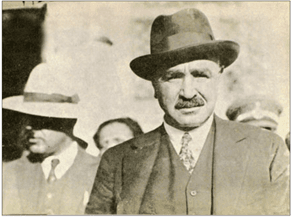

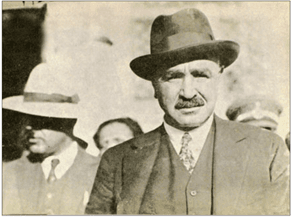

Ali Çetinkaya, born in 1878 in Afyonkarahisar, was an officer and politician who held military and political positions during the Ottoman and Republican periods. After serving on various fronts in the Ottoman Army, he played an active role during the National Struggle; following the opening of the Grand National Assembly of Türkiye, he became a member of parliament as a deputy. Çetinkaya was one of the first Ministers of Public Works and Transportation of the Republic of Türkiye and died in 1949.
Ali Çetinkaya was the son of Ahmet Efendi, a blacksmith master from the prominent Şerifoğulları family of Afyonkarahisar, and Fatma Hanım. He lost his father at an early age and received his education at the Bursa Military Preparatory School and the Military Academy under his mother’s guidance. He joined the Ottoman Army in 1898 with the rank of second lieutenant.
Çetinkaya began his military career by combating committees in the Balkans and served in various units in Albania, Bulgaria, and Macedonia. In 1907, he joined the Committee of Union and Progress in Manastır and participated in the Action Army during the 31 March Incident.
He served alongside Mustafa Kemal and Enver Paşa on the Tripolitania Front and commanded units on various fronts during the Balkan Wars and World War I. His contributions, particularly on the Iraq Front and during the victory at Kut al-Amara, attracted significant attention.
After the Armistice of Mudros, Çetinkaya was active in Istanbul within the Karakol Society and the Mim Mim Group, which continued the functions of the Special Organization. Following the Greek occupation of İzmir on 15 May 1919, he initiated hostilities on 29 May against Greek forces landing in Ayvalık without waiting for orders.
Çetinkaya, whose resistance played a decisive role in the effective beginning of the National Struggle, was elected as a deputy for Afyonkarahisar in the elections held that same year and entered the Chamber of Deputies. After the closure of the Chamber, he was exiled to Malta and was released in 1921, returning to Ankara where he assumed duties in the Grand National Assembly.
In the First Assembly, he served within the First Group and worked on various committees. After the proclamation of the Republic, he participated in the founding process of the Republican People’s Party and contributed to the drafting of its program and bylaws. He held the position of Deputy Speaker of the CHP Parliamentary Group for many years.
Following the enactment of the Law on the Maintenance of Order in 1925, he served as President of the Ankara Independence Tribunal and presided over trials involving military deserters, members of the opposition press, and various other cases.
On 16 February 1934, he was appointed to the Ministry of Public Works (Ministry of Public Works and Transportation), where he implemented nationalization and infrastructure investments in road, railway, bridge, tunnel, port, and quay projects. He became the first Minister of Transportation upon the establishment of the Ministry of Transportation in 1939. During his tenure, he contributed to railway construction, the founding process of Turkish Airlines, and the development of coastal shipping and postal services.
Ali Çetinkaya served as a deputy until 1946 but did not continue in parliament after the transition to a multi-party system. He died in Istanbul on 21 February 1949; his body was taken to Afyonkarahisar and buried in the mausoleum at the Asri Cemetery.

Life and Military Career
National Struggle Period
Political Roles
Ministerial Positions
Final Years and Death