

This article was automatically translated from the original Turkish version.
+2 More
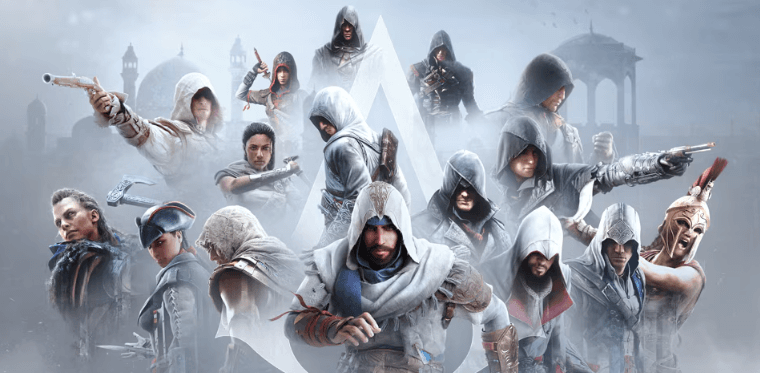
Assassin's Creed Series
Developer(s) | Ubisoft Montreal | ||||||||
|---|---|---|---|---|---|---|---|---|---|
Publisher(s) | Ubisoft | ||||||||
Chronological (By Release Year) | Assassin’s Creed: Shadows (2025) Assassin’s Creed: Mirage (2023) Assassin’s Creed: Valhalla (2020) Assassin’s Creed: Odyssey (2018) Assassin’s Creed: Origins (2017) Assassin’s Creed: Syndicate (2015) Assassin’s Creed: Unity (2014) Assassin’s Creed: Rogue (2014) Assassin’s Creed IV: Black Flag (2013) Assassin’s Creed: Liberation (2012) Assassin’s Creed III (2012) Assassin’s Creed: Revelations (2011) Assassin’s Creed: Brotherhood (2010) Assassin’s Creed II (2009) Assassin’s Creed (2007) | ||||||||
Video game series Assassin’s Creed, launched by publisher Ubisoft in 2007, has become an important landmark in the gaming world, demonstrating how deeply and compellingly historical fiction can be woven into interactive experiences. Each game does not merely immerse the player in a specific historical era but centers its narrative on the ancient conflict between Assassins and Templars, their philosophical themes, and the decisions that shaped human history. Modern characters access the genetic memories of their ancestors through a technology called the Animus, while the primary focus remains on the Assassins of the past. This epic journey spans from the Crusades to Ancient Egypt, from Renaissance Italy to feudal Japan, and is woven not only with battles and conflicts but also with culture, science, ideology, and personal struggles.
Desmond Miles, an ordinary man, is kidnapped by the mega-corporation Abstergo Industries. Forced to relive the memories of his ancestor Altaïr Ibn-La’Ahad through the Animus, a device that unlocks genetic memory, Desmond experiences Altaïr’s life in the 12th century. A member of the Hashashin Order, Altaïr is demoted after a fatal act of arrogance during a mission. To atone for his sins, he is assigned a series of assassinations targeting key Templar leaders. Over time, it becomes clear that these targets are part of a larger conspiracy and that the Templars are pursuing a hidden order. Altaïr begins to question not only his enemies but also his own beliefs.
The events of the game unfold in cities such as Jerusalem, Acre, and Damascus during the Third Crusade. The complex balance of power between the Templars, Crusaders, Muslim emirates, and the people is explored throughout the game. The Assassin Order, inspired by the historical figure Hasan Sabbah, is portrayed not through direct interaction with Saladin or Crusade commanders but through the political figures surrounding them, effectively capturing the era’s atmosphere.
Desmond Miles, while working as a bartender, is connected to the Animus to access the memories of his Assassin ancestor. Abstergo Industries seeks to locate the Pieces of Eden through these memories. This mysterious Isu technology possesses the power to control human minds. Over time, Desmond’s body begins to acquire Altaïr’s abilities through the “bleeding effect.” By the end of the game, after leaving the Animus, Desmond begins seeing symbols drawn in blood on walls and realizes he is part of a greater prophecy.
Ezio Auditore da Firenze, raised as the son of a noble and wealthy family, witnesses the execution of his father and brothers following a political conspiracy in Florence. In the aftermath, Ezio embarks on a path of assassination, seeking both revenge for his family and the exposure of the hidden order behind the Templars. Initially driven by personal vengeance, Ezio gradually transforms into an ideological leader and becomes one of the most prominent members of the Assassin Brotherhood.
This game fundamentally evolves the series’ formula by introducing numerous new features:
Renaissance Italy forms the most powerful atmospheric element of the game. The Medici-Borgia power struggle, the influence of the Catholic Church, and the rise of art and science are directly reflected in the narrative. Leonardo da Vinci aids Ezio not only with inventions but also in deciphering secrets, exemplifying the game’s seamless fusion of historical fiction and creativity.
Desmond Miles, now reliving Ezio’s memories, gains further insight into the modern Templars. Simultaneously, he acquires Ezio’s abilities through the “bleeding effect.” By the end of the game, the secrets surrounding the Pieces of Eden that Abstergo seeks begin to unravel.
Assassin’s Creed II begins immediately after its predecessor. Following his confrontation with Rodrigo Borgia, Ezio travels to Rome, which lies under the tyranny of the Borgia family. The city is consumed by poverty, corruption, and fear. Ezio’s primary target is Cesare Borgia. No longer a lone Assassin, Ezio rebuilds the Assassin Brotherhood in Rome, recruits new members, and trains them. The Brotherhood is no longer defined by a single individual but by a structured system.
The structure of early 16th-century Rome is rendered with both historical accuracy and creative interpretation. The struggle between the Papacy and the aristocracy, the oppression of the people, and the influence of political thinkers like Machiavelli are deeply embedded in the narrative. Cesare Borgia’s brutality is drawn from historical reality and presented as Ezio’s primary adversary.
While Desmond and his team decode Ezio’s memories to uncover Templar secrets, they discover the location of a temple near Rome. In the climax, Desmond experiences a major crisis in the modern era: he unintentionally kills Lucy under the influence of the Apple of Eden. This event marks a pivotal turning point in the modern storyline.
Ezio is now an aged and experienced master. Before retiring from assassination, he seeks to uncover the secrets left by his predecessor Altaïr and reach the library hidden within Masyaf Castle. To this end, he travels to Constantinople, the jewel of the Ottoman Empire. There, he collaborates with Ottoman Assassins to combat Templar activities in the city. Ezio must collect five keys, each revealing a fragment of Altaïr’s life.
The religious, cultural, and political structure of early 16th-century Ottoman Constantinople is successfully portrayed. The city blends Ottoman, Byzantine, and Venetian influences. The meeting between Şehzade Süleyman and Ezio reveals how strategically minded the future “Lawgiver” would become. The structure of Ottoman Assassins is also detailed.
Desmond Miles, having fallen into a coma after the events of the previous game due to the Apple of Eden’s influence, continues the modern narrative through sequences set in the “Black Room” within his mind. In this environment, as Desmond recalls his past, he encounters Subject 16, the artificial intelligence of Animus 1.0. The final scene, where Ezio discovers Altaïr’s message, opens the door for Desmond to embrace his destiny.
Assassin’s Creed III marks a major shift in the series’ narrative and gameplay. At the start, players control Haytham Kenway, a British gentleman, who is revealed to be a Templar. His son, Ratonhnhaké:ton, known as Connor, becomes an Assassin after his village is destroyed by the British, driven by a quest for both revenge and justice. During the American Revolutionary War, Connor struggles against the Templars while also confronting his own identity.
The chronology and details of the American Revolution are fully integrated into the game. Key events such as the Boston Tea Party, the Battle of Lexington, and the Valley Forge encampment become playable. George Washington, Benjamin Franklin, and other leaders’ neutrality in the Assassin-Templar conflict highlights how gray the power struggles of human history truly are. Connor’s Mohawk identity is powerfully explored through the oppression and identity conflicts faced by Indigenous peoples.
Desmond Miles, alongside his father William and his team Shaun and Rebecca, continues searching for the Pieces of Eden in competition with the Templars. The energy source within an ancient temple holds the key to preventing an impending catastrophe. The final scene, in which Desmond sacrifices himself to save the world, creates a dramatic climax in the modern narrative.
Assassin’s Creed: Liberation centers on Aveline de Grandpré, the series’ first female protagonist. Of French-Caribbean descent, Aveline enjoys privileged status in society as the daughter of a noble family, while simultaneously fighting against the slave trade as an Assassin. The game explores Aveline’s struggle against Templars arriving from France and her questioning of her own identity. Her mixed racial heritage offers a rich narrative on identity politics.
The transition of New Orleans from French to Spanish rule in the late 18th century is depicted. Anti-slavery messages, class disparities of the era, and critiques of colonial systems lie at the heart of the game. While Templars feed off this order, characters like Aveline strive to dismantle it. The social position of women, particularly mixed-race women, is portrayed with historical accuracy.
Unlike Desmond’s story, Liberation is framed as a fictionalized historical narrative repurposed by Abstergo Industries as a consumer product called “Animus Entertainment.” Players are guided by an anonymous Assassin who hacks into Aveline’s true memories. This metanarrative delivers a powerful critique of how Templars manipulate historical interpretation.
Black Flag focuses on Edward Kenway, the grandfather of Connor Kenway. Initially, Edward is neither an Assassin nor an idealist, but a pirate driven solely by money and fame. However, fate leads him to steal the identity of an Assassin and find himself at the heart of the war between Assassins and Templars. Over time, the losses he suffers and the truths he witnesses transform Edward’s thought world, drawing him closer to Assassin ideology.
The early 18th-century Caribbean during the Golden Age of Piracy is meticulously portrayed. Historical figures are presented not superficially but with their political views, contradictions, and personal dramas. The anarchist solidarity among pirates, their rebellion against authority, and utopian approaches stand out. Edward’s character development lies at the heart of this historical narrative: he transforms from a reckless rogue into a thoughtful leader.
After Desmond’s death, Abstergo uses genetic data to turn history into a commercial “entertainment” product. The player assumes the role of an Abstergo employee examining Edward’s memories. However, the company’s goal is not merely entertainment but tracking the Pieces of Eden. A mysterious technician named John (in fact, an Isu avatar serving Juno) guides the player. This structure critiques information production under corporate control and reveals Juno’s plans for return.
Rogue features the series’ most radical narrative: the transformation of an Assassin into a Templar. Shay Cormac is a member of the Assassin Brotherhood in America. However, after a mission involving an excavation related to a Piece of Eden results in a massive destruction in Lisbon, Shay undergoes an ideological breakdown. Opposed to the Brotherhood’s willingness to endanger civilians, Shay abandons his Assassin comrades and joins the Templars. Much of the game follows Shay hunting down his former friends.
Set during the Seven Years’ War, this period coincides with the height of colonial tensions before American independence. Figures like Benjamin Franklin are presented as Templars, challenging the player’s perception of history. The Templars’ pursuit of peace and order contrasts sharply with the Assassins’ ideal of freedom, creating a clear philosophical debate.
As an unnamed character working in Abstergo’s Montreal studio, we access Shay’s memories through hacking missions. During this process, the brainwashing systems and security protocols imposed by Abstergo on its employees are criticized. Shay Cormac’s dark history is presented as justified from the Templar perspective, forcing the player to question the entire system.
Arno Victor Dorian is a young man raised by a Templar, though his father was an Assassin. Living a life of aristocracy in Versailles, he finds himself thrust into revolutionary Paris after his stepfather is murdered. Driven by a quest for truth, Arno joins the Assassin Order to uncover the secrets of the past and free Paris from darkness. The game intertwines Arno’s personal revenge story with the broader revolutionary chaos.
The turbulent atmosphere of the French Revolution is presented in detail: the Storming of the Bastille, the Reign of Terror, the Jacobins, guillotine scenes... The chasm between social classes, the collapse of the aristocracy, popular uprisings, and anarchy are rendered powerfully. Moreover, Paris is meticulously rebuilt to scale, allowing real-time exploration. Historical textures from Versailles Palace to impoverished neighborhoods are faithfully recreated.
This game largely sidelines the traditional modern time narrative. The player observes the “Unity” scenario through Abstergo’s commercialized Helix Animus program. However, at one point, a character named Bishop directly contacts the player, urging them to solve the memories in the correct order and remain vigilant against Templar propaganda narratives involving characters like Shay Patrick Cormac. Unity presents the modern story as a metaphor for the player’s awakening.
Jacob and Evie Frye, siblings, arrive in London to break Templar control and liberate the people. Jacob unites street gangs to form the “Rooks,” a resistance organization, while Evie uses a strategic and scientific approach to track down the Pieces of Eden and fight the Templars. Though the siblings occasionally experience ideological disagreements, their goal remains the same: reclaim London.
Mid-19th-century London is a time of sharp class divisions, child labor, colonialism, and the rise of labor movements. The Templars sustain this system, while the Frye siblings strive to dismantle it. Street gangs, unions, and political movements are detailed. Historical areas such as Westminster, the River Thames, and Buckingham Palace are explorable within the game.
Abstergo seeks a new lead to the Pieces of Eden by investigating a data remnant in London. Modern Assassins investigate the past to find it before Abstergo. Juno’s influence persists as Rebecca and Shaun reappear. Guided by Bishop, the player deciphers the Frye siblings’ memories. This structure continues the Helix narrative begun in Unity.
Bayek is the last Medjay of the Siwa temple. After his son is murdered by the “Order of the Ancients,” the precursor to the Templars, he embarks on a quest for vengeance. This journey takes him across every corner of Egypt, where he gradually realizes that the corrupt power structure threatens not only his family but all of society. Together with his wife Aya, they launch a secret movement to dismantle the system and protect the people: The Hidden Ones. This organization will evolve into the Assassin Order centuries later.
The game focuses on the final era of Ancient Egypt under Greco-Roman influence. Cleopatra’s power struggle, her alliance with Caesar, and Rome’s rise are directly woven into the narrative. Bayek, respectful of Egypt’s ancient pantheon and folk beliefs, becomes a bridge between the changing world order. Pyramids, temples, and tombs are modeled with detailed architecture.
Layla Hassan, a former Abstergo employee, independently develops an Animus and dives into Bayek’s memories to locate the Pieces of Eden. During this process, Layla meets modern Assassins and joins them, becoming the new protagonist of the post-Desmond modern narrative. Additionally, near the end of the game, the Isu civilization and prophecies about the future are revealed with unprecedented clarity.
Odyssey stands out as the game with the furthest historical setting in the series. The player assumes the role of a mercenary (misthios), a grandchild of Spartan king Leonidas. Their family was torn apart in childhood; the player character was thrown from a cliff and survived, falling into fate’s hands. As the hero seeks to uncover their past, they pursue the trail of a shadowy organization called the “Kosmos Order.” The journey is not only personal vengeance but also entwined with events that shaped the entire Greek world.
The Peloponnesian War, the great political and military conflict between Athens and Sparta, is central. The player can undertake missions on both sides. Athens’ ideal of democracy is contrasted with Sparta’s disciplined autocracy. Socrates’ dialogues, Pericles’ position in Athens, and Herodotus’ accounts are presented as both educational and atmospheric. Additionally, the influence of the Olympian gods on the populace is conveyed through mystical narratives.
Layla Hassan, using Leonidas’ spear, accesses the genetic memories of the character descended from him. Through the Animus, she uncovers secrets of both Alexios/Kassandra and the Isu civilization. Odyssey lays the foundation for the “Atlantis” story that deepens Isu mythology. DLCs introduce the city of Atlantis, where the player encounters Isu gods (Poseidon, Hades, Persephone). Layla is no longer merely an observer but a part of the universal cycle.
Eivor is a Viking leader determined to relocate her clan to England. She arrives in England with her brother Sigurd to establish a new settlement. However, Sigurd believes he is the chosen one of the gods and turns toward the teachings of the Assassins (The Hidden Ones). Eivor, more pragmatic, focuses on her people’s future. Over time, Eivor’s past, her connection to the Isu race, and the intertwined reality of the gods begin to shape her destiny.
In 9th-century England, political tensions among the four major kingdoms (Mercia, Wessex, East Anglia, Northumbria) are portrayed. Alfred the Great’s rise, Viking invasions, and the Danelaw are integrated into the narrative. The Templars operate under the name “The Order of the Ancients.” The Assassins are still called “The Hidden Ones.” The legend of Ragnar Lodbrok is conveyed alongside Viking mythological elements.
Layla Hassan, seeking to prevent a global catastrophe, investigates ancient civilization relics. Using Eivor’s genetic memories, she tracks the Pieces of Eden. Valhalla delves into the depths of Isu mythology: Odin is revealed to be Eivor’s reincarnation. Loki and the Isu’s plan for rebirth force Layla to make a monumental decision. At the end of the game, Layla, to save humanity, traps herself as a digital consciousness within “The Grey,” an Isu system.
Mirage focuses on the youth of Basim, previously seen in Valhalla. Basim, a pickpocket living in Baghdad, is taken to Alamut Castle to be trained by The Hidden Ones. There, under his master Roshan, he begins his path as an Assassin. However, Basim’s past is not merely that of an ordinary thief. Voices in his mind and visions he sees gradually reveal secrets of his Isu heritage. Basim must confront not only his enemies but also his own identity.
9th-century Baghdad represents the Abbasid Caliphate’s “House of Wisdom” and cultural zenith. The city hosts Arab, Persian, Turk, Jewish, and Christian communities. Scholars, engineers, scribes, and spies appear as environmental details in Basim’s story. The city’s design, including alleyways, markets, mosques, and water canals, is highly detailed. The first three-dimensional depiction of Alamut Castle provides a visual foundation for the Order’s origins.
Mirage nearly sidelines the modern storyline. While Layla’s digital consciousness continues to exist within the Isu system, the focus shifts to Basim’s past and his Isu identity (Loki). It is suggested that Basim, following Valhalla, is poised to replace Desmond. Themes of mental fragmentation, reincarnation, and consciousness transfer are explained through Isu technology. This game prefers to deepen historical mythology rather than directly continue the modern narrative.
Shadows is set in Japan during the Sengoku period, when the country was divided by civil war. The game is told from the perspective of two playable characters:
Yasuke’s life, governed by honor and loyalty as a samurai, intersects with Naoe’s path as a stealthy shinobi driven by free will. In the chaos of Japan, players can choose to progress through missions using either character and select either combat or stealth approaches. The game presents the Assassin-Templar conflict in Japan while centering on cultural clashes and internal reckonings.
The Sengoku period was Japan’s bloodiest and most chaotic era. As daimyos (feudal lords) fought each other, Oda Nobunaga sought to establish centralized authority. In the game, Nobunaga’s reformist yet brutal rule is linked to the Templars. Yasuke’s real-life arrival in Japan supports Ubisoft’s historical foundation. Additionally, Japanese martial arts, tea ceremonies, Zen philosophy, and Shinto-Buddhist temple structures are richly integrated.
As yet, details of the modern storyline are limited due to the game’s recent release. However, clues suggest the continuation of the post- Mirage and Valhalla consciousness transfer system, with Isu technology leaving a piece in Japan and Naoe’s family connected to ancient Assassins. Shadows is structured to provide a new foundation for the modern narrative, both historically and mythologically.
"Assassin's Creed oyunlarının kronolojik sıralaması." Accessed March 21, 2025. https://www.gamespot.com
Bonthuys, Darryn. “The Assassin's Creed Timeline – How To Play The Games In Chronological Order.” GameSpot. Accessed March 21, 2025. https://www.gamespot.com
Broadwell, Josh. “Every ‘Assassin’s Creed’ Game, Ranked From Worst to Best.” Rolling Stone. Accessed March 21, 2025. https://www.rollingstone.com/culture/rs-gaming/
“Assassin’s Creed Games in Order: A Brief History.” History Hit. Accessed March 21, 2025. https://www.historyhit.com
“Assassin’s Creed Games in Order: Chronological and Release.” TrueAchievements. Accessed March 21, 2025. https://www.trueachievements.com
“Five Things to Know About 'Assassin’s Creed’.” History Hit. Accessed March 21, 2025. https://www.historyhit.com

Assassin's Creed Series
Developer(s) | Ubisoft Montreal | ||||||||
|---|---|---|---|---|---|---|---|---|---|
Publisher(s) | Ubisoft | ||||||||
Chronological (By Release Year) | Assassin’s Creed: Shadows (2025) Assassin’s Creed: Mirage (2023) Assassin’s Creed: Valhalla (2020) Assassin’s Creed: Odyssey (2018) Assassin’s Creed: Origins (2017) Assassin’s Creed: Syndicate (2015) Assassin’s Creed: Unity (2014) Assassin’s Creed: Rogue (2014) Assassin’s Creed IV: Black Flag (2013) Assassin’s Creed: Liberation (2012) Assassin’s Creed III (2012) Assassin’s Creed: Revelations (2011) Assassin’s Creed: Brotherhood (2010) Assassin’s Creed II (2009) Assassin’s Creed (2007) | ||||||||
No Discussion Added Yet
Start discussion for "Assassin's Creed Series (Video Game)" article
1. Assassin’s Creed (2007)
Key Information
Story Summary
Gameplay and Innovations
Historical Context
Modern Story
2. Assassin's Creed II (2009)
Key Information
Story Summary
Gameplay and Innovations
Historical Context
Modern Story
3. Assassin’s Creed: Brotherhood (2010)
Key Information
Story Summary
Gameplay and Innovations
Historical Context
Modern Story
4. Assassin’s Creed: Revelations (2011)
Key Information
Story Summary
Gameplay and Innovations
Historical Context
Modern Story
5. Assassin’s Creed III (2012)
Key Information
Story Summary
Gameplay and Innovations
Historical Context
Modern Story
6. Assassin’s Creed: Liberation (2012)
Key Information
Story Summary
Gameplay and Innovations
Historical Context
Modern Story
7. Assassin’s Creed IV: Black Flag (2013)
Key Information
Story Summary
Gameplay and Innovations
Historical Context
Modern Story
8. Assassin’s Creed: Rogue (2014)
Key Information
Story Summary
Gameplay and Innovations
Historical Context
Modern Story
9. Assassin’s Creed: Unity (2014)
Key Information
Story Summary
Gameplay and Innovations
Historical Context
Modern Story
10. Assassin’s Creed: Syndicate (2015)
Key Information
Story Summary
Gameplay and Innovations
Historical Context
Modern Story
11. Assassin’s Creed: Origins (2017)
Key Information
Story Summary
Gameplay and Innovations
Historical Context
Modern Story
12. Assassin’s Creed: Odyssey (2018)
Key Information
Story Summary
Gameplay and Innovations
Historical Context
Modern Story
13. Assassin’s Creed: Valhalla (2020)
Key Information
Story Summary
Gameplay and Innovations
Historical Context
Modern Story
14. Assassin’s Creed: Mirage (2023)
Key Information
Story Summary
Gameplay and Innovations
Historical Context
Modern Story
15. Assassin’s Creed: Shadows (2025)
Key Information
Story Summary
Gameplay and Innovations
Historical Context
Modern Story


